
South Korea’s Top Two Memory Chip Players: Outlook Under Leverage Rules & Central Bank Tightening

Five-Minute Market Update | Korea’s 'Friday Fright': Memory Chip Giants Plunged, 2x Leveraged ETFs Suffer Sharp Pullbacks! What Should You Do Now?
On June 5, Korean equities delivered a masterclass in high volatility to global investors. 。Korean stocks plunged sharply during today’s session, sending the KOSPI Composite Index into a steep decline and triggering a circuit breaker on KOSPI 200 futures, which halted algorithmic trading for five minutes.The main drivers behind the sell-off were South Korea’s two memory chip giants.: $Samsung Electronics (005930.KR)$ fell nearly 7%, $SK Hynix (000660.KR)$ dropped close to 10%; meanwhile, two popular leveraged ETFs—which had surged more than 600% year-to-date— $CSOP Samsung Electronics Daily (2x) Leveraged Product (07747.HK)$ 、 $CSOP SK Hynix Daily (2x) Leveraged Product (07709.HK)$ saw deep drawdowns today as their leverage mechanisms amplified market volatility.
。Korean stocks plunged sharply during today’s session, sending the KOSPI Composite Index into a steep decline and triggering a circuit breaker on KOSPI 200 futures, which halted algorithmic trading for five minutes.The main drivers behind the sell-off were South Korea’s two memory chip giants.: $Samsung Electronics (005930.KR)$ fell nearly 7%, $SK Hynix (000660.KR)$ dropped close to 10%; meanwhile, two popular leveraged ETFs—which had surged more than 600% year-to-date— $CSOP Samsung Electronics Daily (2x) Leveraged Product (07747.HK)$ 、 $CSOP SK Hynix Daily (2x) Leveraged Product (07709.HK)$ saw deep drawdowns today as their leverage mechanisms amplified market volatility.At this point, many fellow investors may find themselves caught inpolarized mindsets: either panicking and selling at a loss, convinced the AI memory chip rally is over, or rushing to buy the dip, believing this sharp drop is a golden buying opportunity.But in fact, there’s no need to panic over this 'Friday fright' in South Korean equities—stock market ups and downs are routine, and a single-day plunge doesn’t mean the fundamentals of the sector have fundamentally deteriorated. Today’s drop appears more likean emotional release triggered by a confluence of factors: crowded positioning, overheated valuations, concentrated leverage, and multiple news catalysts—rather than weakening demand for memory chips or vanishing AI-driven storage demand.
Root Cause Analysis: Why Did South Korea’s Memory Giants Suddenly Reverse Course?
Today’s drop in Korean stocks may seem sudden, but the underlying risks had likely been quietly building up all along.。
。Reason 1: U.S. semiconductor stocks turned downward first, acting as the catalyst for the Korean market selloff.
Global AI semiconductors form an interconnected investment theme, with strong cross-market correlation in price movements. Previously, Broadcom released its earnings report, and its revenue guidance for AI-related businesses fell short of the market’s earlier optimistic expectations, causing its stock to plunge by more than 12%. Memory-focused peers like Micron followed suit with similar declines.As leading U.S. memory and semiconductor stocks weakened, global investors began reassessing the speculative fervor around AI chips. Korean memory stocks, which had previously doubled in value, were already trading at elevated valuations and thus became prime targets for profit-taking. The negative sentiment flowed from U.S. markets through global capital channels straight into Korea.
Reason 2: Overreliance on just two stocks backfired—the market rose sharply because of them, and now falls sharply because of them too.
Imagine a class of 100 students, where more than half of the total final exam scores depend on just two of the smartest 'top performers.' If these two top students fall ill and perform poorly, the class average would collapse. South Korea's stock market is currently in a similar situation. Fueled by the AI boom, Samsung Electronics and SK Hynix have attracted massive global capital inflows, and data shows these two companies now account for approximately 54% of the KOSPI index’s market weight.This year, nearly three-quarters of the index’s gains have been driven solely by these two firms. Such 'two-stock dependency' leaves the broader Korean equity market relatively vulnerable. Even a slight weakening in AI-sector momentum could easily trigger a market backlash.
Reason 3: Korean retail investors are running out of cash while leveraged positions pile up, creating hidden margin-call risks
According to data from the Korea Financial Investment Association, the margin balance in retail investors’ securities accounts dropped from KRW 137 trillion on May 12 to KRW 121 trillion on May 22 (indicating less readily available cash), while total market margin debt rose to a record-high KRW 38 trillion (showing a surge in borrowed funds used for stock purchases). In simple terms:Investors have less spare cash on hand, yet they’re borrowing more to buy stocks. If share prices decline, some investors will be forced to sell assets to repay loans, potentially triggering a cascade of forced selling and accelerating the market downturn.
Reason 4: Liquidity tightening is expected in the Korean market
The market widely anticipates that the Bank of Korea will begin raising interest rates next month. Higher rates would directly increase borrowing costs. Over the past year, the memory-chip-driven bull market in Korean equities has relied heavily on low-cost leveraged capital to support valuations.As funding costs rise, the valuation appeal of high-priced semiconductor stocks quickly diminishes. Short-term speculative capital, seeking to avoid risk, is opting to exit early, further intensifying selling pressure on the market.
Don’t panic over short-term declines! Stay clear-headed with these three steps and seize opportunities ahead
After a sharp single-day drop, short-term traders may look to bet on a bounce-back. However, for new fellow investors, it’s wise to ask yourself three key questions before attempting any so-called 'bottom-fishing' or adding to positions.:
:First, is your entry rationale based on a long-term bullish outlook on the AI memory cycle and the fundamental supply-demand dynamics of chips, or simply because the stock price has dropped sharply and appears cheap?If your decision relies solely on the idea that 'it’s fallen enough, so I’ll buy,' it may not be suitable to enter positions directly.
Second, can you withstand further declines in your holdings?In particular, leveraged ETFs can experience losses far exceeding those of the underlying stocks due to leverage effects. In the event of consecutive drawdowns, you would face significantly greater pressure and risk. Therefore, we must strictly set stop-loss levels and maintain trading discipline.
Third, is your current position overly concentrated?Avoid placing all your capital on a single stock, sector, or market. Staggered entries and diversified allocation are the cornerstones of sound investing.
For many beginners, attempting to catch a bottom with short-term trades during the early stages of a sharp decline carries extremely high risk. When market panic hasn’t fully subsided and circuit breakers are triggered, it’s very difficult to identify the true 'bottom.' Jumping in prematurely could easily leave you trapped by subsequent volatility.A more prudent approach is to observe more and act less, patiently waiting for market sentiment to stabilize. Maintaining patience when signals are unclear is itself a strategy.
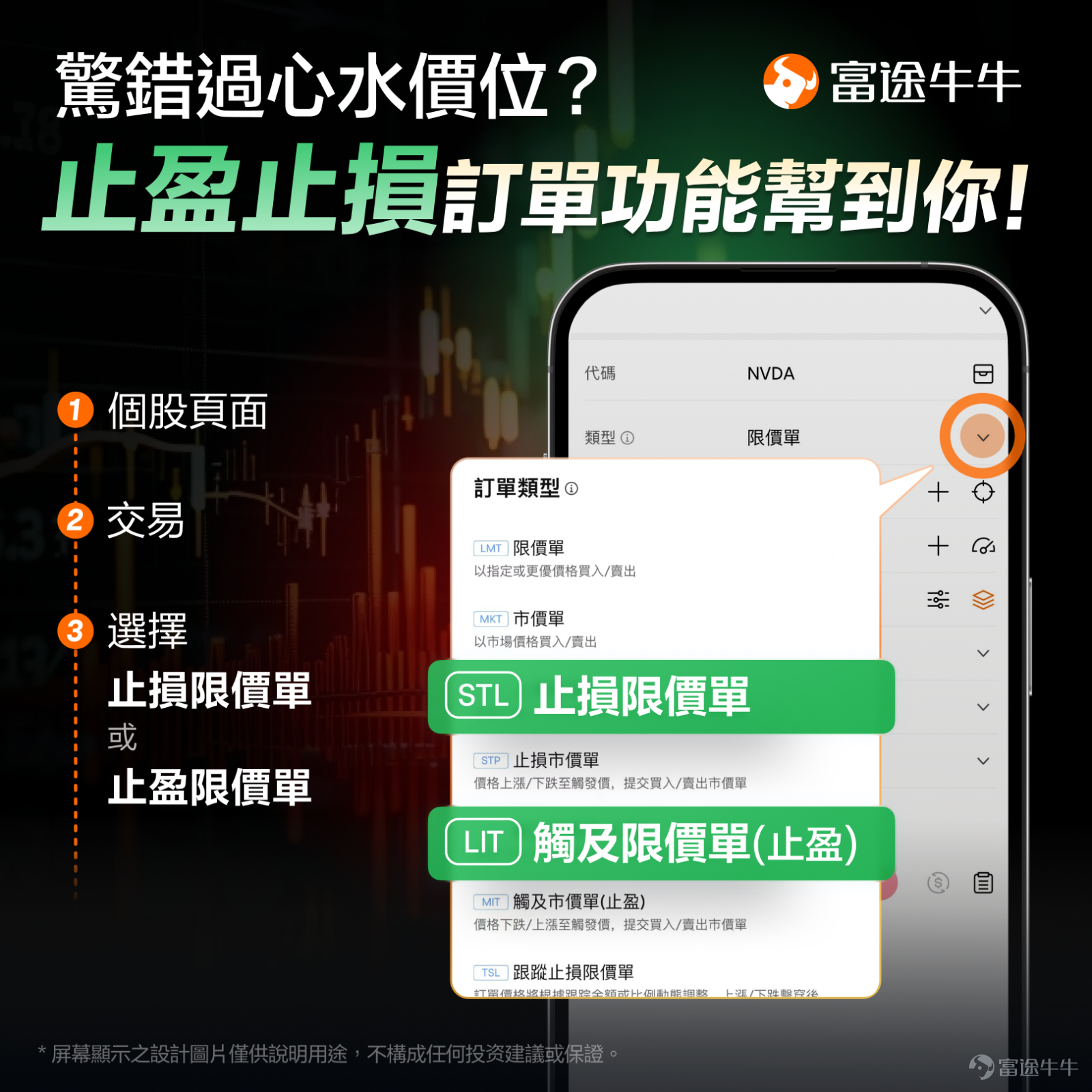
Of course, there’s no need to panic amid heightened market volatility—take advantage of Futubull“Advanced Orders”Functionality that allows you to preset a stop-loss price, helping you lock in risk and avoid missing the 'escape route.'
![On June 5, Korean equities delivered a masterclass in high volatility to global investors.[Sob]。Korean stocks plunged sharply during today’s session, sending the KOSPI Composite Index into a steep decline and triggering a circuit breaker on KOSPI 200 futures, which halted algorithmic trading for five minutes.The main drivers behind the sell-off were South Korea’s two memory chip giants.: $Samsung Electronics (005930.KR)$ fell nearly 7%, $SK Hynix (000660.KR)$ dropped close to 10%; meanwhile, two popular leveraged ETFs—which had surged more than 600% year-to-date— $CSOP Samsung Electronics Daily (2x) Leveraged Product (07747.HK)$ 、 $CSOP SK Hynix Daily (2x) Leveraged Product (07709.HK)$ saw deep drawdowns today as their leverage mechanisms amplified market volatility. At this point, many fellow investors may find themselves caught inpolarized mindsets: either panicking and selling at a loss, convinced the AI memory chip rally is over, or rushing to buy the dip, believing this sharp drop is a golden buying opportunity.But in fact, there’s no need to panic over this 'Friday fright' in South Korean equities—stock market ups and downs are routine, and a single-day plunge doesn’t mean the fundamentals of the sector have fundamentally deteriorated. Today’s drop appears more likean emotional release triggered by a confluence of factors: crowded positioning, overheated valuations, concentrated leverage, and multiple news catalysts—rather than weakening demand for memory chips or vanishing AI-driven storage demand. Root Cause Analysis: Why Did South Korea’s Memory Giants Suddenly Reverse Course? Today’s decline in Korean stocks may seem sudden and unexplained—but in reality...](https://nnqimage.futunn.com/sns_client_feed/999960/20260605/web-1780654084161-zUUkMDBSql.png/big?area=2&is_public=true&imageMogr2/ignore-error/1/format/webp)
Always remember: when the market is falling, what matters most is not courage, but staying clear-headed!Today's decline in South Korean stocks is essentially the result of multiple factors converging—overheated AI chip trading, crowded positioning, leverage pressure, and a pullback in overseas semiconductor stocks. The long-term fundamentals of the memory industry may remain intact, but short-term market risks have clearly escalated.When investing, don’t let the phrase 'buying the dip' cloud your judgment, nor should you be so frightened by the word 'circuit breaker' that you lose all perspective. What matters more is understanding exactly what you’re buying, what risks you’re taking on, and whether you have sufficient position sizing and mental preparedness.Markets never lack opportunities—the real scarcity is investors who can maintain discipline amid volatility.。
。This article provides an objective analysis of current market conditions only and does not constitute any investment advice regarding buying, selling, or holding positions. Leveraged ETFs carry high volatility risk. Investing involves risk; please exercise caution and make independent decisions based on your own risk tolerance.
Risk Disclaimer: The above content only represents the author's view. It does not represent any position or investment advice of Futu. Futu makes no representation or warranty.Read more


Comments (8)
to post a comment
56
52