
Corning shares hit a new all-time high! Is a new king emerging in optical communications?

Quick Options Recap: AI Panic Spreads Ahead of NFP Release! Broadcom Plunges on Earnings vs. Nokia Quietly Rises
Happy Friday, fellow investors!
Today is the day the non-farm payrolls data is released (at 8:30 p.m. ET), and market sentiment was already somewhat uneasy.On the other hand, concerns about 'overconcentration in AI investments' are resurfacing, likely leaving many heavily invested in tech stocks feeling nervous right now.
This week, the market gave us a tale of two extremes: on one side, AI chip leader Broadcom suffered a sharp sell-off; on the other, legacy telecom giant Nokia continued its quiet rally. The options activity on these two stocks perfectly illustrated the 'leverage magic' of put and call options under contrasting market conditions—though, of course, the risks behind that magic shouldn't be underestimated.
$Broadcom (AVGO.US)$ : Disappointing guidance triggers put options
Custom chip leader Broadcom reported earnings after U.S. market close on June 3. Although second-quarter revenue came in at $14.9 billion and adjusted earnings per share reached $1.60—both exceeding market expectations,the issue lay in its forward guidance: third-quarter revenue is projected at approximately $15.3 billion. While this represents strong year-over-year growth, it fell short of the market’s previously over-optimistic expectations.
Adding to market concerns is the pace of growth in its AI business: although Broadcom’s AI chip-related revenue grew 44% year-over-year, investors are now questioning whether the company can sustain such high growth rates, given that major clients like Google and Amazon are increasingly developing their own custom chips and facing mounting competitive pressure from NVIDIA.Compounded by the fact that the stock had already seen significant gains, profit-taking surged, even briefly dragging down the entire red-hot semiconductor sector.

(The design images displayed on the screen are for demonstration purposes only and do not constitute any investment advice or guarantee; market movements are frequent, and the option prices shown do not represent actual conditions. The filtering criterion is options with an initial price below $3 per unit.)
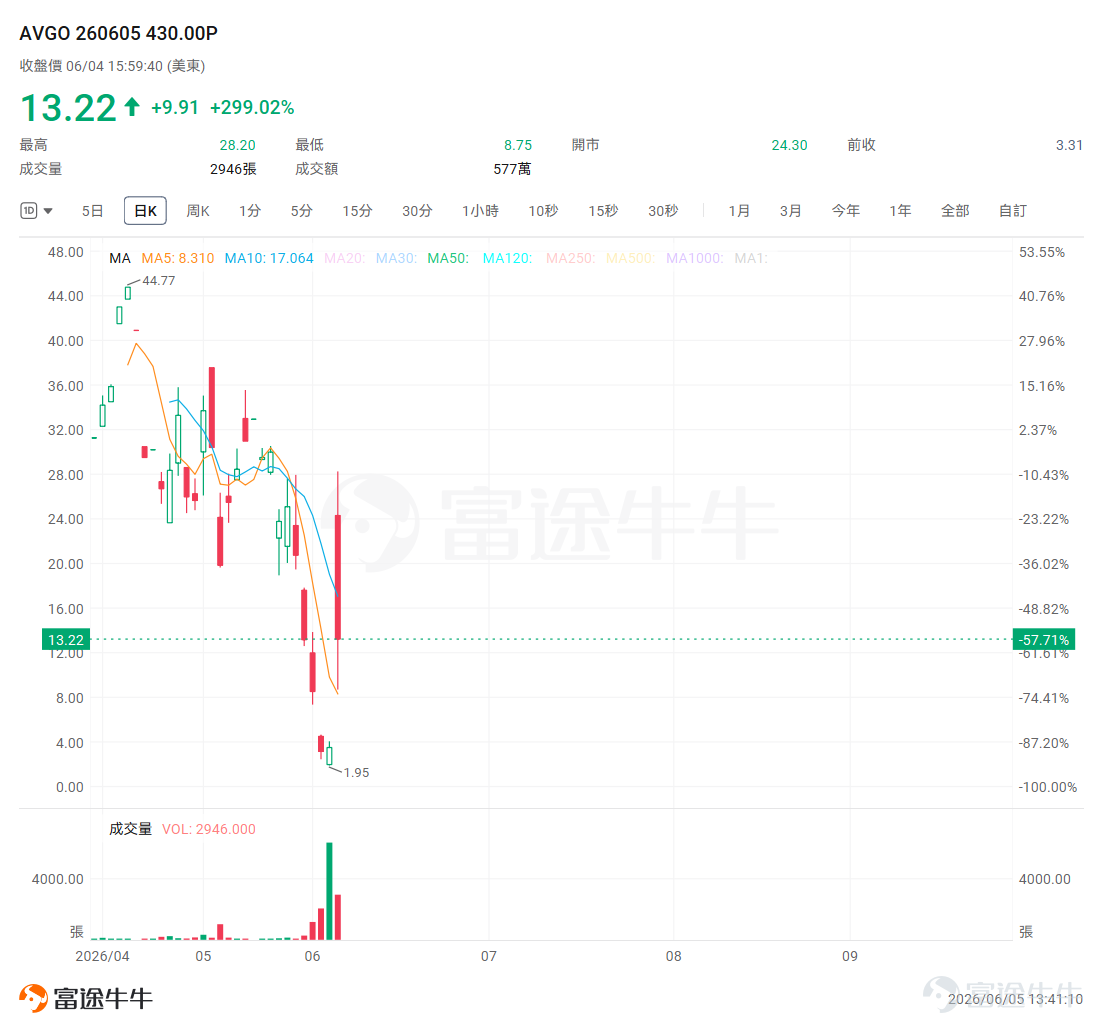
Let’s look at the option shown in this chart—AVGO 260605 430.00P, a put option with a $430 strike price expiring today.
As of the market close on June 4, this option was quoted at $13.22, surging +299.02% in a single day—tripling in value! It briefly spiked to $28.20, with a volume of 2,946 contracts and a notional value of $5.77 million, indicating significant activity.
Why such a sharp rally? Two key factors converged:
First, the underlying stock moved in the anticipated direction.This is a put option, meaning the holder bet on Broadcom’s share price falling. When the stock indeed plunged, the option’s "intrinsic value" soared—the further below the $430 strike price the stock dropped, the higher the put’s value became.
Second, the 'expiration-week' effect for short-dated options.This option expired on June 5, meaning buyers had virtually no time value left when purchasing it. Normally, out-of-the-money options nearing expiration become very cheap due to rapid time decay. However, if the underlying stock experiences sharp moves in the correct direction, these options can exhibit extraordinary percentage gains.
Here’s a key takeaway for fellow investors: This is precisely the allure of so-called 'expiring options'—because their base price is low (the options themselves are very cheap), if the direction is right, the returns can be extremely exaggerated. Conversely, if the direction is wrong or the stock price doesn't move, the option could easily expire worthless. As shown in the chart, this option once dropped to around $1.95, nearing the $100 mark.
Knowledge extension: What is 'time value decay'?
An option’s price consists of two components: intrinsic value (the difference between the stock price and strike price) and time value (a premium reflecting the potential for movement due to remaining time). The closer it gets to expiration, the faster the time value erodes—especially in the final week, when decay accelerates. Thus, 'expiring options' are cheap because their time value has nearly vanished, leaving only speculative 'gambling value' on a sharp move in the underlying stock price.The recent surge in Broadcom puts was fundamentally driven by a sharp drop in the underlying stock, which significantly increased intrinsic value and more than offset the loss from time value decay.
$Nokia Oyj (NOK.US)$ : Veteran telecom stock continues its rally
In stark contrast to Broadcom's dismal performance, Nokia has posted another steady upward move this week (as of now). Since its March lows, the stock has climbed more than 100%.

As a long-established player in 5G infrastructure and telecommunications equipment, Nokia is drawing market attention during this AI wave for its growth potential in enterprise networking and private wireless networks.
Let’s take a look atNOK 260612 14.00C—that is, the call option expiring on June 12 with a $14 strike price.

(The design images displayed on the screen are for demonstration purposes only and do not constitute any investment advice or guarantee; market movements are frequent, and the option prices shown do not represent actual conditions. The filtering criterion is options with an initial price below $3 per unit.)
As of the close on June 4, the quote stood at $2.70. Although it dipped slightly by 3.66% on the day, its weekly gain since May 29 has approached60%。
Compared to Broadcom's put option with its 'one-day surge,' Nokia's call option resembles more of a 'boiling frog slowly in warm water':
From May 29 to June 1, the option started around $1.35 and gradually climbed alongside the underlying stock;
On June 2–3, the underlying stock broke through a key level, driving the option to accelerate upward and peak at $3.72, with intraweek gains briefly exceeding 120%;
On June 4, it pulled back slightly to $2.70
Why wasn’t the gain as dramatic as Broadcom’s put option?
Two reasons:
First, there’s still over a week until expiration. This option expires on June 12. Its time value hasn’t yet been fully 'squeezed out,' so the option’s base price remains relatively high, naturally resulting in a less spectacular percentage gain compared to 'last-day options.'
Second, the underlying stock’s volatility differs. Nokia’s rise has been gradual, lacking the kind of 'single-day plunge' seen in Broadcom that triggers sharp swings, so the option price reacted more smoothly in response.
Key Concept Extension: The 'Sensitivity' of Option Prices to the Underlying Stock
Many beginners wonder: Why does a 10% rise in the stock price sometimes lead to only a 20% gain in the option, while other times it can surge by 200%?
The answer lies in the option's 'sensitivity' to the underlying stock—simply put, how much the option price moves for every $1 change in the stock price. This sensitivity isn't fixed; it varies based on three factors:
Whether the option is 'in-the-money':For call options, the further the stock price is above the strike price, the closer the sensitivity gets to 1—meaning a $1 increase in the stock price translates to roughly a $1 increase in the option price.
Time remaining until expiration:The shorter the time to expiration, the lower the sensitivity of out-of-the-money options (as their chance of becoming profitable dwindles). However, once they move in-the-money, sensitivity can rise sharply.
Expected market volatility:If the market anticipates significant stock price swings, option prices generally rise, and their sensitivity adjusts accordingly. This Nokia call option, with time still left until expiration, retains substantial time value, resulting in relatively stable price sensitivity to the underlying stock.
Weekly Recap: Even when both 'double,' the underlying logic is entirely different
Looking back at these two tickers, we can distill several key takeaways worth remembering for fellow investors:
Getting the direction right comes first. The massive surge in Broadcom puts was fundamentally predicated on 'correctly betting on a decline'; similarly, the profit from Nokia calls relied on 'accurately anticipating an uptick.' Options’ leverage is a double-edged sword—get the direction wrong, and losses are magnified just as sharply.
Your choice of expiration date defines the 'rules of the game.' Weekly (or 'pin-risk') options are cheap but extremely risky, suitable only for investors with a clear, short-term view on an imminent event; longer-dated options cost more but offer greater room for error, making them better suited for trend-following strategies.
Don’t be blinded by headline returns.While Broadcom puts jumping 299% looks enticing, remember they had previously plunged 87%, nearly going to zero. The most important rule in options trading is this:Only risk money you can afford to lose.。
Not comfortable with options basics? Study up before jumping in.
If, while reading this recap, you're still unclear about concepts like 'What is a Long Call?' or 'How to interpret strike prices,' don't rush to place orders—take some time first to solidify your foundational knowledge.Here’s a curated list of practical beginner resources—recommended for bookmarking:
Finally, here's a small perk for fellow Futubull investors, welcome to claim it.Options Beginner Pack
*This event is only open to invited HK users, click to learn more.Detailed event rules>>

Disclaimer
This content does not constitute any offer, solicitation, recommendation, opinion, or any guarantee of any securities, financial products, or tools. The risk of loss in trading options can be substantial. In some cases, losses may exceed the initial margin deposited. Even if stop-loss or limit orders such as "stop-loss" or "limit" are set, they may not prevent losses. Market conditions may cause these instructions to be unexecuted. You may be required to deposit additional margin within a short period. If you fail to provide the required amount within the specified time, your open positions may be liquidated. However, you will still be responsible for any shortfall in your account. Therefore, before trading, you should study and understand options and carefully consider whether such trading is suitable for you based on your financial situation and investment objectives. If you trade options, you should be familiar with the procedures for exercising options and the rights and obligations upon expiration, as well as your rights and responsibilities when exercising options and at expiration.
Risk Disclaimer: The above content only represents the author's view. It does not represent any position or investment advice of Futu. Futu makes no representation or warranty.Read more


Comments
to post a comment
32
8