
Corning shares hit a new all-time high! Is a new king emerging in optical communications?

Broadcom stock plunges 11%, but smart money is buying the dip | Smart Money Options
Thursday was a rollercoaster day for the AI infrastructure sector.
In$Broadcom (AVGO.US)$ After its earnings release, the stock plunged more than 11%, weighing on semiconductor and AI hardware shares in early trading and sparking market concerns that weakness from this key AI infrastructure leader could signal a cooling of the broader AI trade frenzy.
However, as trading progressed, market sentiment quickly improved. Several AI infrastructure companies recouped their early losses, $Marvell Technology (MRVL.US)$ and $Credo Technology (CRDO.US)$ even turning positive, indicating investors haven’t entirely abandoned the AI infrastructure theme but are instead reassessing the impact of Broadcom’s earnings.
Yet just as investors were selling off Broadcom and questioning whether the AI infrastructure trade can sustain itself, AVGO’s options market revealed a significant institutional bullish bet.
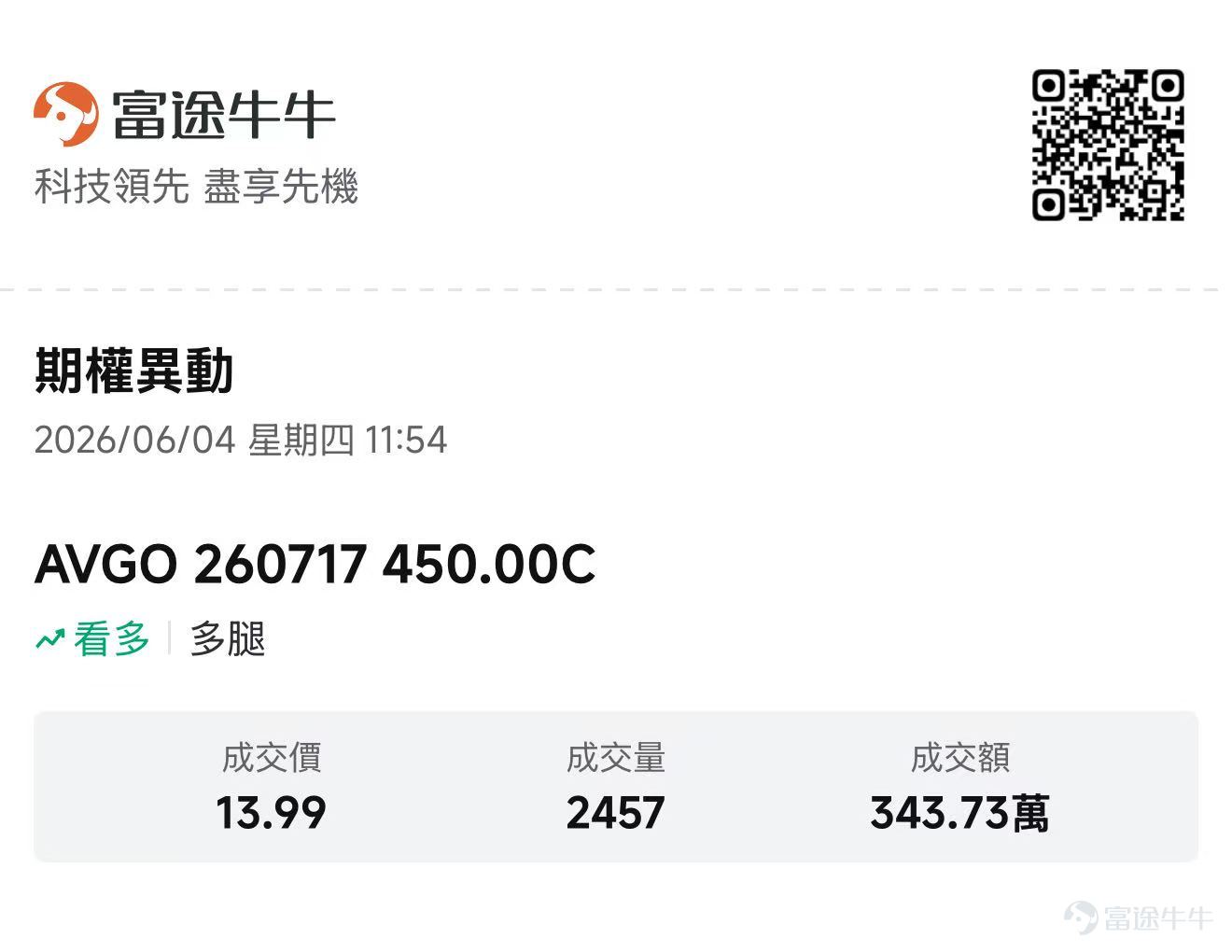
Data shows that on Thursday morning, a trader executed two large bullish options purchases, buying 2,460 and 3,150 call contracts respectively, both expiring on July 17, 2026, with a $450 strike price, at prices ranging from $13.97 to $13.99 per contract.
More importantly, both trades were executed after Broadcom released its earnings and the subsequent stock decline. In other words, this was not speculative positioning ahead of earnings, but rather a contrarian position established amid post-earnings market panic.
Structurally, this trade represents a clear directional bullish bet.
At the time, Broadcom’s stock was trading around $409, meaning the $450-strike calls implied roughly a 10% upside over the next six weeks. This suggests some investors viewed the post-earnings sell-off as an overreaction and have already begun positioning for a rebound.


In fact, Broadcom's results were far from disappointing.
The company reported record-breaking second-quarter revenue of $22.2 billion, with AI-related revenue reaching $10.8 billion—an increase of over 140% year-over-year. More importantly, management expects AI-related revenue in the third quarter to reach approximately $16 billion, signaling continued strong demand for AI infrastructure.
From a fundamentals perspective, AI demand has not slowed down.
What disappointed investors was overly high expectations.
Over the past few months, Broadcom’s stock price repeatedly hit new highs, driven by robust demand for ASICs, AI networking equipment, and custom AI accelerators. As market enthusiasm for AI infrastructure continued to build, investor expectations for the company’s future growth kept rising.
Therefore, when the earnings report failed to deliver a new catalyst exceeding the most optimistic market expectations, some investors chose to lock in profits, causing the stock to pull back sharply.
From this perspective, the sell-off appears more like a recalibration of market expectations rather than a fundamental deterioration in the AI investment thesis.
Large purchases of bullish options in Broadcom’s options market indicate that at least some institutional investors share this view.
If investors truly feared that AI demand had peaked, capital would likely shift toward more defensive allocations. However, these bullish options trades emerged immediately after the post-earnings sell-off, suggesting that some investors believe the market overreacted and are positioning for a sentiment recovery.
For the AI infrastructure sector, demand for application-specific integrated circuits (ASICs), high-speed networking, and data center interconnect solutions remains one of the most important long-term growth drivers. Broadcom continues to be one of the key beneficiaries of the current AI capital expenditure cycle.
From this perspective, the signal behind this options trade is very clear: At least some smart-money investors view Broadcom’s post-earnings plunge as a reset of market expectations rather than the end of the AI investment cycle.
Options Risk Disclosure
An option is a contract that grants the holder the right—but not the obligation—to buy or sell an underlying asset at a predetermined price on or before a specified date. Option prices are influenced by multiple factors, including the current price of the underlying asset, the strike price, time to expiration, and implied volatility. Implied volatility reflects the market’s expectation of future price fluctuations over the life of the option; it is derived by reverse-engineering the Black-Scholes pricing model and is commonly viewed as an indicator of market sentiment. When investors anticipate higher volatility, they may be willing to pay more for options to hedge their risk, resulting in higher implied volatility. Traders and investors use implied volatility to assess the attractiveness of option prices, identify potential mispricings, and manage their risk exposure.
Disclaimer
This content does not constitute an offer, solicitation, recommendation, advice, opinion, or any guarantee regarding any securities, financial products, or instruments. The risk of loss in trading options can be substantial. In certain circumstances, your losses may exceed the initial margin deposit you made. Even if you place contingent orders such as 'stop-loss' or 'limit' orders, these may not necessarily prevent losses. Market conditions may render such orders unexecutable. You may be required to deposit additional margin on short notice. If you fail to meet such margin calls within the specified timeframe, your open positions may be liquidated. Nevertheless, you remain liable for any resulting deficit in your account. Therefore, prior to trading options, you should thoroughly study and understand options and carefully consider whether such trading is suitable for you based on your financial condition and investment objectives. If you trade options, you should become familiar with the procedures for exercising options and at expiration, as well as your rights and obligations upon exercise or expiration. Options trading involves significant risk and is not suitable for all investors. Investors should carefully read Characteristics and Risks of Standardized Options before engaging in any options trading strategy.
Risk Disclaimer: The above content only represents the author's view. It does not represent any position or investment advice of Futu. Futu makes no representation or warranty.Read more


Comments
to post a comment
2
6