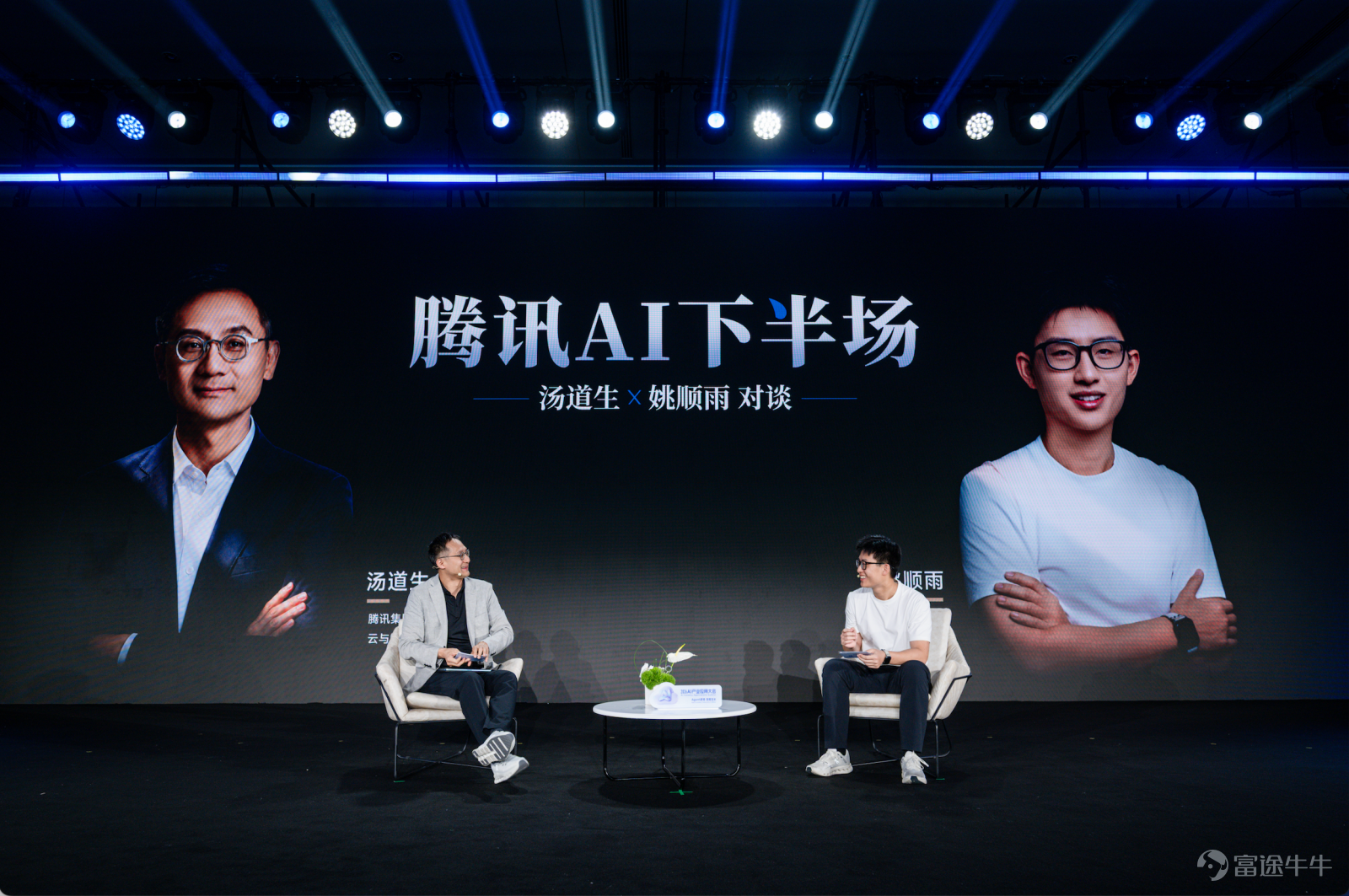

Tang Daosheng in Conversation with Yao Shunyu: Tencent's AI Second Half
Earlier today, Tang Daosheng, Senior Executive Vice President of Tencent and CEO of the Cloud and Smart Industries Group, held a dialogue with Yao Shunyu, Tencent’s Chief AI Scientist, at the China National Convention Center in Beijing, discussing Tencent's thinking and progress on large models and AI products.
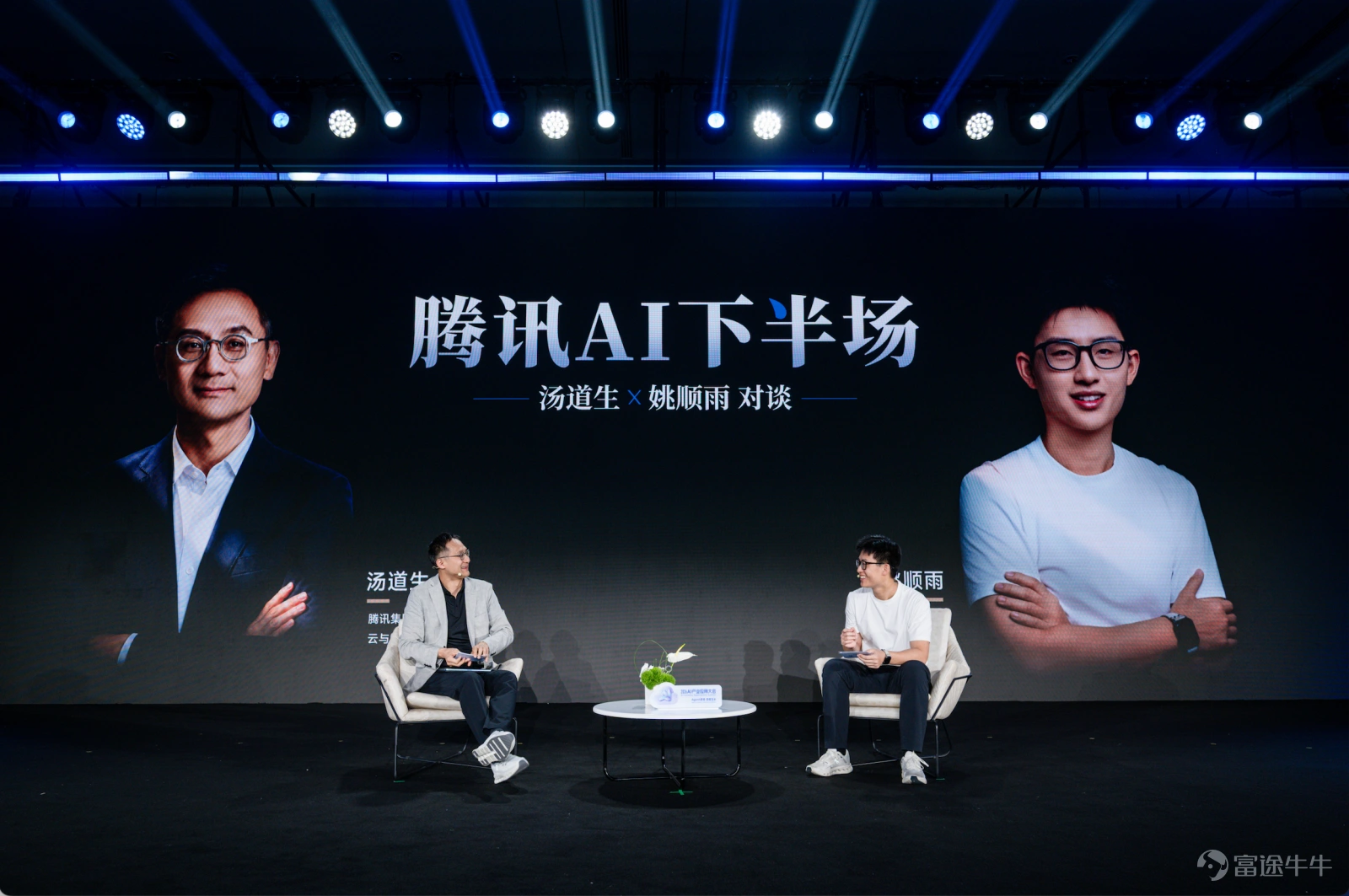
Below is the full transcript of their conversation:
What is the 'first-principles' approach to building models versus building products?
Tang Daosheng: Welcome, Shunyu.
Yao Shunyu: Hello everyone. I’m usually based in Haidian District and rarely come to Chaoyang District, so I’m very happy to be here.
Tang Daosheng: Our conversation today may take a rather novel form, and if anything unexpected happens, I hope it will be a pleasant surprise for everyone.
Shunyu, before you joined Tencent, I remember asking you some questions—why did you choose Tencent for the second half of your career? And what do you believe is most important in the next phase of AI development?
Yao Shunyu: First, let me clarify what I mean by 'the second half.' I’ve recently felt this term is being overused. I originally introduced this concept in a blog post last year. What does it mean? Essentially, I think that prior to last year, AI had already been developing for decades, with a stronger focus on solving problems and finding good methodologies. Recently, however, it’s become clear that the methodology has matured significantly, while identifying the right problems has become increasingly difficult.
For example, in the past we developed methods like AlphaGo to play Go, but such methods were only suitable for Go or other board games. You might build a specialized model for translation, but it could only perform translation and nothing else.
But after we developed pre-training and post-training, we realized we now have a universal hammer that can hit any nail—it’s a general methodology capable of solving all kinds of problems. Paradoxically, the harder part has become identifying good problems worth solving.
Actually, I think one of the most important reasons for joining Tencent is that there are so many great problems here and so many products. I believe this will become increasingly important going forward. On one hand, good products address the first question: after we’ve done pre-training and post-training, where exactly should we apply them to create value? Second, environment is critical—if you don’t have the right environment, agents can’t accomplish various tasks. For instance, without a food-delivery tool, you simply can’t order food; many things just won’t be possible. I think context is what matters most—whether for enterprises or individuals. As I mentioned at AGI-Next last time, context is becoming ever more crucial because models are increasingly adept at transforming highly complex inputs into outputs. Often, your competitive moat lies in whether you possess the most original input data—whether you truly understand what a person is actually doing or know all kinds of information about a company. In this regard, I believe Tencent holds a very strong advantage. But honestly, I think this is only the second-biggest reason. The most important reason is culture. I remember during my first conversation with you—and also with other members of the executive leadership team—my immediate impression was that everyone was extremely honest, straightforwardly acknowledging what was working well and what wasn’t, without any attempt to conceal anything. That candor made a strong first impression on me.
The second point is that Tencent as a whole operates based on trust rather than metrics, which I believe is critically important for AI development. Moreover, I feel our culture embodies very low ego and great solidity—qualities essential for building a long-term AI organization. This includes our commitment to long-termism. So, what matters most in the next phase of AI? Personally, I believe we should establish a long-term AGI-oriented organization in China. Today’s AI landscape consists primarily of three components:
First is the foundation—how we make the core elements of pre-training and post-training extremely solid.
The second component is product—how we ensure this technology genuinely creates value for people and society.
The third is the frontier—how we explore new research paradigms and uncover new opportunities.
I believe the key is to build a highly balanced, triangle-like organization.
Regarding foundation work:
First and foremost, sufficient resources are essential.
Second, we need the right approach to execution—which aligns with the cultural values I mentioned earlier. For products, having strong product intuition and people who truly understand how to build great products is absolutely critical.
Third, we aren’t doing enough frontier exploration in China today, so I hope we can inject more of the spirit of frontier exploration into our organization.
Tang Daosheng: The sincerity or pragmatic atmosphere you mentioned feeling during conversations is also feedback I frequently receive from clients. I believe our approach to work and product philosophy are quite grounded in reality. After all, the AI race is a marathon, and mindset matters greatly. We must honestly acknowledge both what we do well and where we fall short. But ultimately, it’s a multidimensional competition. We’ve seen significant progress in models recently, and our products are taking on increasingly diverse forms—different scenarios demand different solutions. I remain very optimistic about the future.
Co-Design: How can models and products empower each other?
Tang Daosheng: You just mentioned models and products. Products, in a sense, provide an environment that supplies contextual information to models. I’d like to ask a question: In our meetings, we often use the term 'Co-Design.' How can we more tightly integrate products and models, especially now that we have such a rich portfolio of products? These include Yuanbao, a chatbot with which we collaborate very closely, as well as AI-powered search, enterprise-deployed intelligent customer service and smart marketing solutions, and recently popular lobster-like tools such as CodeBuddy and Workbuddy—all of which rely heavily on models. How do you think about this Co-Design approach?
Yao Shunyu: There are three points:
First, the prerequisite for Co-Design is that the model itself must be solid, with strong foundational work. I believe pre-training is relatively product-agnostic—if done robustly, it provides a powerful foundation. Its greatest strength lies in being a generalizable learning process; improvements here continuously enhance performance across a wide range of downstream tasks. For post-training, the most critical aspect is establishing the right evaluation framework. In China, there’s an unfortunate tendency to chase leaderboard rankings. However, I believe it’s far more important to construct evaluations that are grounded in real products and genuine applications—evaluations that reflect reality.
Second, we must recognize that practical utility outweighs leaderboard performance. We’ve invested substantial effort in deep Co-Design collaborations with various products. A key element of Co-Design is building mutual trust. We’ve done extensive work to establish this trust—figuring out how to effectively leverage product data, manage data feedback loops, and design meaningful evaluations. There are many details involved, which I won’t elaborate on here.
Third, the fundamental difference between the LLM era and previous AI approaches is generalization. Before LLMs, if you were building a translation product, you only needed high-quality translation data. If you were creating a Go-playing program, you only required excellent Go-specific data. But today, even if your goal is solely to build a coding agent, you’ll find you need far more than just coding data—you also require strong conversational ability, powerful search capabilities, robust instruction-following skills, and advanced reasoning capacity. It’s actually a highly composite data taxonomy, and I believe one needs good judgment—or 'taste'—about this reality.
This leads to an important implication: product ecosystems with systemic advantages will gain significant leverage. For example, our Co-Design collaboration with Yuanbao has endowed our model with strong chat and search capabilities, which can then be transferred to other products like IMA and Workbuddy. These products generate diverse data streams, yet the data can generalize across them, forming a network-like system. I believe this interconnected value is becoming increasingly critical.
Tang Daosheng: Right—external leaderboards are also a form of evaluation. So, what’s the difference between our internal evaluations and these external benchmarks?
Yao Shunyu: First, benchmarks still have their value—they’re not entirely without merit. The issue is that these leaderboards are very prone to overfitting. Real-world data can greatly assist model development: for one, it helps uncover fundamental issues with models. In fact, one of our primary reasons for releasing a Preview model is precisely to gather real-world feedback so we can fix various problems that weren’t detected in benchmark evaluations, which will lead to significant improvements in the official release.
Second, you gain a deeper understanding of the actual prompt distribution. Let me give an example: benchmark questions are often highly precise, with very detailed and concrete descriptions, and usually pose a single, isolated question. But we know that in real-world scenarios, users often ask vague questions—sometimes just one or two sentences—and then follow up iteratively. These kinds of interactions can inspire us on how to better design our training approaches.
Third, I think we can even draw inspiration from these products to advance new benchmarks or domains that currently don’t exist. For instance, we’ve recently done a lot of work on context learning, and user feedback on Yuanbao has provided us with tremendous inspiration and help. So I believe the mutual reinforcement between products and models is becoming an increasingly important topic in AI.
Tang Daosheng: I remember that when we first developed Yuanbao, we encountered issues with multi-turn instruction following. It seemed that the way users iteratively refine their prompts during actual product usage differs significantly from benchmark settings. The capabilities truly needed in real products appear quite different from those evaluated in benchmarks.
Yao Shunyu: You’ve asked me so many questions—I’d like to ask you one as well.
Tang Daosheng: Go ahead.
Yao Shunyu: I actually remember the first time we spoke—you told me a lot about your past experiences, from the era of QQ Zone and QQ Show all the way to my favorite product back in elementary school.
From QQ Music to cloud services and now to Yuanbao, chatting with you is always fascinating because you’ve worked on all kinds of products—consumer-facing (to C) and enterprise-facing (to B), from ancient times to today’s AI era. I’m curious: what do you consider the first principles of product development? What experiences and values remain constant, and what has changed?
Tang Daosheng: Ultimately, I believe product development always comes down to understanding what users truly need—how to solve their pain points and create real value for them. Across different eras and even industries, a product must deliver value; otherwise, users won’t adopt it or pay for it. So whether it was building QQ Zone in the PC internet era, developing various mobile-era content products, or working on cloud services in the industrial internet phase, we always invested significant time and effort listening to customers and trying to address their challenges. At its core, this logic hasn’t changed much.
That said, I do think there are quite a few differences between building products in the PC/mobile internet eras and doing so in today’s AI era. From a paradigm perspective, prior to the AI era, we typically designed products around specific features to meet user needs. As a product or service provider, you’d define a set of capabilities upfront—users would then select from predefined options, almost like ordering from a menu of 'pre-made meals.'
But building products in the AI era comes with very different requirements and challenges due to the open-ended nature of service delivery. The interaction could be as simple as natural language or voice, and as a product team, you genuinely don’t know what users might ask. Therefore, you must fully leverage the model’s capabilities to understand user intent and then, for example, use the large model’s logical reasoning ability to invoke tools. The product needs to provide the model with a wide array of usable tools to handle these open-ended demands—that’s what I see as fundamentally different from how we used to build products.
This even includes Eval, which you just mentioned. In the past, when building products, we had very clear and specific descriptions of detailed features—how to design, develop, and test them—and the waterfall-style process was fairly straightforward. However, with AI products, I’ve found the biggest change is that we likely need to redesign our entire workflow. Especially this year, most code is generated by AI, so our engineers may spend more time on design—particularly architectural design—and delegate coding tasks to AI, periodically guiding and correcting it. Testing also needs to shift left, becoming more proactive: we must clarify upfront how to evaluate various scenarios, define our requirements for open-ended responses, and even determine how to align outputs with the style our users expect. Overall, I feel that building products today demands far more comprehensive capabilities.
Yao Shunyu: It’s become harder.
Tang Daosheng: It’s become harder. Let me ask you about HunYuan 3—everyone’s calling the Hy3 preview your debut at Tencent. What specific changes has HunYuan 3 introduced? Could you walk us through it?
Yao Shunyu: Honestly, I don’t think there’s any secret here. To some extent, building large models today is relatively trivial—we should focus on getting infrastructure right and data right; the algorithm part is actually simpler. I’d highlight a few key points.
First, we completely rebuilt our infrastructure, both for pre-training and reinforcement learning. Second, we made significant changes to our data and evaluation processes—how to define more realistic problems, how to enrich data taxonomies, and how to improve data quality. This is an endless pursuit.
Third, many critical decisions—like hiring strategies, setting the model development cadence, and making daily trade-offs—don’t follow a clear formula. I believe it’s largely driven by taste. That leads me to a question I’m quite curious about: earlier, you mentioned the concept of co-design. How do you view co-design? Specifically, what responsibilities do you think belong to the model versus the product?
Tang Daosheng: I think co-design has continuously evolved over the past two years, largely driven by advancements in model capabilities. Of course, shifting industry dynamics, market conditions, and user needs also push both the model and product sides to better meet evolving demands. One deep impression I’ve had is around alignment. When we jointly develop a product and hold alignment sessions, we face many divergent decisions: the product team might target a specific problem to solve, but how should the model adapt to fulfill that need? Yet ultimately, the model requires data—so how should that data be annotated? At what granularity? What constitutes good versus poor annotation? After all, some behaviors need rewarding while others require penalizing.
Then there’s evaluation and benchmarking. If the product team believes a certain experience is good, but evaluations disagree, the resulting product will be inconsistent. Thus, to me, co-design means involving multiple roles within the project team in product design—establishing shared product goals and ensuring diverse stakeholders can align effectively on open-ended questions. Without such alignment, product behavior becomes unpredictable, sometimes even random, because the model training process itself may get muddled. That’s been my key takeaway from co-designing with product and model teams over the past two years. What’s your take?
Yao Shunyu: As I mentioned earlier, the hardest part is establishing trust. Empathy is crucial because, at the end of the day, while there’s significant overlap between model-building and product-building objectives, there are also misalignments. Model developers naturally want maximum capability, whereas product teams prioritize fulfilling user needs as effectively as possible. These inherent tensions mean it’s vital to cultivate the ability to see things from each other’s perspective.
Actually, when you just asked me how we co-designed Yuanbao step by step, an important detail was that we dispatched our strongest post-training team to help Yuanbao get its post-training right. At the time, our own pre-training wasn’t ready yet, but we knew that supporting a product like Yuanbao—and maintaining its DAU—would be extremely important for our future model development and crucial for innovative collaboration.
Back then, many algorithm engineers didn’t understand this decision, so I had to work hard to explain it. In hindsight, however, those efforts were all about making trade-offs. I believe this move helped the product team realize that the model team was genuinely thinking about what was best for the product. This proved critically important for our subsequent collaboration, including the successful launch of Hy3 preview on Yuanbao. Of course, there are many technical aspects worth discussing, but the hardest part was actually building trust and practicing empathy.
Tang Daosheng: Yes, I completely agree.
Where is agent technology headed? How will it land in industry?
Tang Daosheng: Let me switch topics. You’re the creator of the ReAct framework, and your doctoral research also focused on language agents. Have any of the views you expressed several years ago come true today? If so, which ones?
Yao Shunyu: The other day, I felt quite nostalgic—I reread my dissertation and felt like I’d traveled back to a very ancient era. My dissertation title was 'Language Agent: From Next Token Prediction to Digital Automation,' completed in 2019.
Tang Daosheng: Seven years ago.
Yao Shunyu: Back then, literally, we only had GPT-2, which could only perform next-token prediction. Its generated text wasn’t very coherent and often contained glitches, so it was hard for people to imagine it would one day become a world-changing force. At the time, even modestly imaginative research—like asking, 'What’s China’s capital?' and having the model respond 'Beijing' through next-token prediction—was seen as knowledge-intensive, and researchers were thrilled that the technology could achieve this; they found it truly fascinating.
My imagination ran a bit wilder—I thought GPT was an incredibly elegant system. Predicting the next token was such a minimalistic yet universal mechanism. I believed its potential went far beyond merely generating the next token; I envisioned it eventually automating everything in the world. Back then, my vision wasn’t even big enough—I only thought of digital automation, but now it seems it could encompass both digital and physical automation.
I think during my PhD, I mainly focused on two areas. The first was establishing an agent methodology—figuring out how to transform a next-token prediction machine into an agent, into an automated system. My most significant contribution in this area was probably the ReAct framework you mentioned.
I remember one evening in July 2022, when I first connected the PaLM 2 API with a Wikipedia API I had written myself. For the first time, it could answer questions based on web content and support multi-turn interactions. At that moment, I felt like a dim lightbulb had suddenly lit up. As far as I knew, this was the first time humans had connected a large language model (LLM) to the internet and enabled multi-turn interaction. I sensed that this development might transform things in five or ten years—but perhaps even faster than I imagined.
I recall when we first proposed SWE-bench, I thought, 'Okay, if this can be achieved, it will clearly deliver enormous value.' Back then, the potential impact might have been tens or hundreds of billions—but now it’s likely in the trillions. The figure is literally in the trillions, and I probably still underestimated it.
Another part of my work has been defining digital automation tasks. For example, WebShop was the first internet-based Web Agent task, and InterCode and SWE-bench were among the earliest Coding Agent tasks. Today, it’s clear that the two most critical components of agent technology are indeed Web Agents and Coding Agents.
The other day, while chatting with everyone in the group, I looked back at the conclusion of my PhD thesis—specifically, the future work section I wrote in 2024. The first item was training models for agents; the second was safe and robust deployment; the third was scientific discovery; and the fourth was how to help humans. I was deeply moved—I’m now fortunate enough to actually be working on the very future directions I listed back then.
Tang Daosheng: That’s incredible—you’ve witnessed the entire industry advancing precisely along these directions.
Yao Shunyu: I probably still didn’t think big enough. I felt I was already thinking ambitiously, but maybe it still wasn’t ambitious enough.
Tang Daosheng: Technological progress often exceeds our expectations. Today, everyone says agents require massive token consumption—token calls. Regarding HunYuan’s next-generation model development, what do you consider your key priorities, and which aspects are most important?
Yao Shunyu: Undoubtedly, today’s agents—or Coding Agents specifically—are becoming as essential as pre-training itself; they’re a foundational capability. Personally, I believe Coding Agents are fundamentally important for many reasons. Another critical reason is that they resemble something Turing-complete: once an agent can control its own file system and operate within a container, it essentially becomes a complete system. Today, agents are unquestionably a focal point for every model developer. Our approach may differ in a few key ways:
First, even though coding is already the most important task today, we still emphasize building a comprehensive system. I’ve always believed that to excel at coding, you need far more than just coding data—you also need dialogue, reasoning, and various other capabilities, because the core strength of large models lies in their generalization ability.
Second, the role of products is clearly growing in importance. How to effectively leverage online feedback loops is a challenge every model developer is grappling with and reflecting on. In this context, the substantial co-design experience we’ve recently accumulated has become critically important.
Third, I think we need more imagination—whether in technological evolution, product evolution, or even the next paradigm shift. We need to engage in exploratory and even uncertain work.
Tang Daosheng: From the product side, as more and more people express anxiety about token usage, with token costs growing explosively, I’ve also heard many customers—and even colleagues around me—closely monitoring their token or credit consumption. How can we improve our model’s token efficiency when solving a specific problem or completing a task? Previously, I worked on some tasks that clearly headed in unviable directions, yet the model would still attempt them, only to abandon them later and try another path. Are there opportunities to optimize this process to enhance overall token efficiency?
Yao Shunyu: In China, discussions about cost-effectiveness often focus on model architecture, but it’s actually a very complex system. I believe performance is the most critical factor. Many people have told me they ultimately found that using a model like OPUS saved them more money than using an inferior model, because it got things right faster and spared human effort. Performance is paramount—if your performance is strong, cost-effectiveness naturally follows. Especially this year, I think robustness on simpler tasks will become even more important. Getting relatively simple tasks right the first time may be the key to better cost-effectiveness—not just model architecture.
The second aspect is cost itself. First and foremost for cost-effectiveness is performance—if performance is poor, cost-effectiveness is irrelevant. The second point is cost. China leads globally here—we’ve done extensive work optimizing costs. The most crucial aspect of cost optimization may be how to use a smaller model to effectively handle higher-value tasks. On this foundation, architectural innovations—including long-context management and scaffolding—have plenty of room for improvement.
If we can build a relatively smaller model that matches the performance of larger models and demonstrates strong robustness across most tasks—even achieving just a one or two percentage point improvement in long-horizon scenarios—it could be especially valuable in today’s Chinese context.
I’m curious—when did you first realize that Agents represented a new product opportunity, and how has your understanding evolved since then? In your view, what is currently the biggest bottleneck preventing us from building truly useful Agents?
Tang Daosheng: Our Agents take different forms depending on the scenario. In designing Agents, our main goal is to fully leverage the model’s capabilities. As models iteratively improve and become more capable, Agents require less intervention. Over the past period, we’ve observed that as model capabilities strengthened, we were able to simplify several of our Agent-based products. We’re now providing models with more diverse tools and creating additional skills to help them complete tasks more efficiently. We also supply what we call 'memory'—context derived from users’ past behaviors and extracted preference information. For instance, in coding environments, relevant context is provided to the model; in Workbuddy for office collaboration, such as creating a PowerPoint presentation, the type of context given to the model differs accordingly.
Therefore, when building different Agents, I believe it’s essential to understand which content and information are most relevant in each specific scenario, so the model receives precisely what it needs while maximizing its capabilities.
Yao Shunyu: We’ve recently launched products like Workbuddy, which have received positive user feedback. Behind these successes are many small teams rapidly iterating on products. I’m genuinely curious—compared to traditional product development, how do you think product team structures and organizational management have changed in this new Agent era? What are your reflections on this shift?
Tang Daosheng: Recently, I helped draft an internal announcement for Workbuddy and noticed their highly flat organizational structure, which differs significantly from our previous product teams. They operate with many small squads of three to five people, each focusing on a specific domain to tackle challenges head-on. These teams conduct numerous experiments and also rely on infrastructure support to run trials. Different squads explore various approaches and validate outcomes. Since most experiments don’t yield positive feedback, we must foster a culture that tolerates trial and error. This approach—using extensive experimentation to distill insights that positively impact user workflows and desired outcomes—is, in my view, essential for building native AI products like Agents, and the organizational structure must effectively support this methodology.
Moreover, many engineers used to spend a lot of time writing code, but today, without a doubt, much of that work can be delegated to AI. As a result, we’ll see greater role convergence—everyone becomes a product manager who deeply understands user needs and designs the desired product form. Every engineer will act more like an idea-driven leader, orchestrating multiple coding agents to develop products aligned with our requirements. They’ll also participate earlier in evaluation and testing, leveraging AI capabilities to bring quality assurance and alignment efforts forward in the development cycle.
In the second half of the AI era, where are the new opportunities?
Tang Daosheng: I’d also like to ask a question that’s been widely discussed—many people say Tencent has been slow, claiming we missed timely opportunities in AI. Do you really think we’ve been slow? What exactly is this ‘second half’? Could you elaborate further?
Yao Shunyu: That sounds more like a question I should be asking you.
Tang Daosheng: Haha.
Yao Shunyu: I believe there are two critical judgments about AI today. First, do we view AI as a short-term game or a long-term one? In Silicon Valley, there’s widespread sentiment like, ‘Oh no—in two years, everyone will lose their jobs; AI will replace all human work, so we’d better make money quickly and retire.’ But clearly, our view is that AI is a long-term game. In fact, I think AI is just getting started—the second half has only just begun. I don’t believe ChatGPT and Claude Code will be the only super apps; that would be a very bleak world. Instead, I’m confident a steady stream of new opportunities will continue to emerge.
Today might be akin to the 1970s, when personal computers had just emerged—I believe there’s still a tremendous amount of work left to do.
The second judgment concerns whether AI will evolve along a linear path or become more diversified. Over the past few years, we’ve clearly seen a dominant trajectory: pre-training, post-training, then agents—especially coding agents—as if everyone is following the same clear roadmap, essentially copying one another. That, too, would be a very bleak scenario.
But will the future become more homogeneous or more diverse? Personally, I believe it will become far more diverse. Undoubtedly, coding agent productivity will grow increasingly important—it’s still in its infancy. There remains vast uncharted territory in this world: multimodality, embodied intelligence, and countless other innovations are either already emerging or have only just begun. So from this perspective, if we accept that the second half has only just started, then clearly it’s far from over.
In the past, models and products have undergone extensive exploration and taken many detours—I think that’s perfectly normal. When you attempt something for the first time, twists and turns are inevitable. But what matters more is whether we can honestly confront ourselves—whether we can stay real, observe feedback, adapt accordingly, and maintain patience. That’s the most crucial thing for succeeding in the second half.
Tang Daosheng: People often like to criticize Tencent by focusing on a single point. Of course, I think we also welcome higher expectations and constructive feedback from everyone.
We are a company with a highly diverse range of businesses. Our products span many sectors, and numerous teams are driving different projects and initiatives. Undoubtedly, within such a complex organization, there are areas where we move too fast, others where we’re slower, and some where we may fail as we explore new paths. So I believe all these reminders are very valuable. Indeed, there are areas where we can do better—but as you mentioned, this is a long race, a marathon, and Tencent still has an abundance of real-world scenarios.
As you noted at the beginning—choosing Tencent makes sense because AI needs context, and models require rich contextual information. Tencent’s years of accumulation across various products and sectors actually provide valuable context for each specific scenario, enabling our models to deliver meaningful value.
In this long-term race, I believe models will continuously evolve, user needs will keep changing, and new product forms will emerge. For example, earlier this year, we responded quite quickly to the surge of interest in agents. We also have intelligent agent products like WorkBuddy, which actually originated several years ago from our Coding and CodeBuddy initiatives. Over time, we recognized strong demand beyond just programmers and were able to respond swiftly. Today, we’re hearing high expectations from many customers about how our different products can be integrated effectively.
So we’re in this marathon, and we sincerely ask everyone to keep giving us reminders, suggestions, and—most importantly—positive feedback by using our products.
I notice we’ve actually run over time already. First, I’d like to thank Shunyu for today’s sharing. We’ve just discussed building models and products, covering topics like co-design, the evolution of agents, organizational transformation, and industry opportunities. Over the past year, we’ve seen many enterprises facing similar challenges or shared uncertainties—such as when products aren’t used effectively, companies can’t sustain investment, or ROI falls short. All of this affects the pace of AI adoption in enterprises. To address this, we’re launching today a suite of efficiency-focused intelligent agent tools to help businesses deploy agent applications more securely and efficiently.
This initiative is backed by three core capabilities from Tencent:
First is our ability to connect scenarios. Through high-frequency touchpoints like WeChat, WeCom, and Yuanbao, we embed large models directly into real business workflows, enabling deep integration with users, data, and ecosystems.
Second is our engineering execution capability. Through a comprehensive Harness system, we ensure agents operate stably, reliably, and sustainably. This includes robust AI infrastructure—such as high-speed networking, high-throughput storage, and a high-performance Agent Runtime—to maximize GPU utilization.
Third is model-driven innovation, leveraging the HunYuan large model and co-designed model products to balance practicality, cost-effectiveness, and return on investment (ROI).
Meanwhile, we have also launched the Tencent AI Co-Creation Program (Phase II), partnering with ISVs and MSPs to jointly develop industry-specific solutions and create more benchmark cases.
In the next segment, my colleague will share more details on these topics. This afternoon, we will host multiple parallel forums focused on productivity enhancements for individuals and enterprises, covering product technology, industry use cases, and ecosystem co-creation, as well as a dedicated AI product launch session to introduce over 20 new products and capabilities.
That concludes our conversation today. Thank you, Shunyu, and thank you all!
Risk Disclaimer: The above content only represents the author's view. It does not represent any position or investment advice of Futu. Futu makes no representation or warranty.Read more


Comments (2)
to post a comment
22
8