
With market-stabilizing measures intensifying, will Hong Kong tech stocks continue their rebound?

Niu Niu Views Futures | From 'AI Applications Taking the Baton' to 'Southbound Fund Rebalancing': How to Navigate the 5,000-Level Battle for Hang Seng Tech Index Futures?
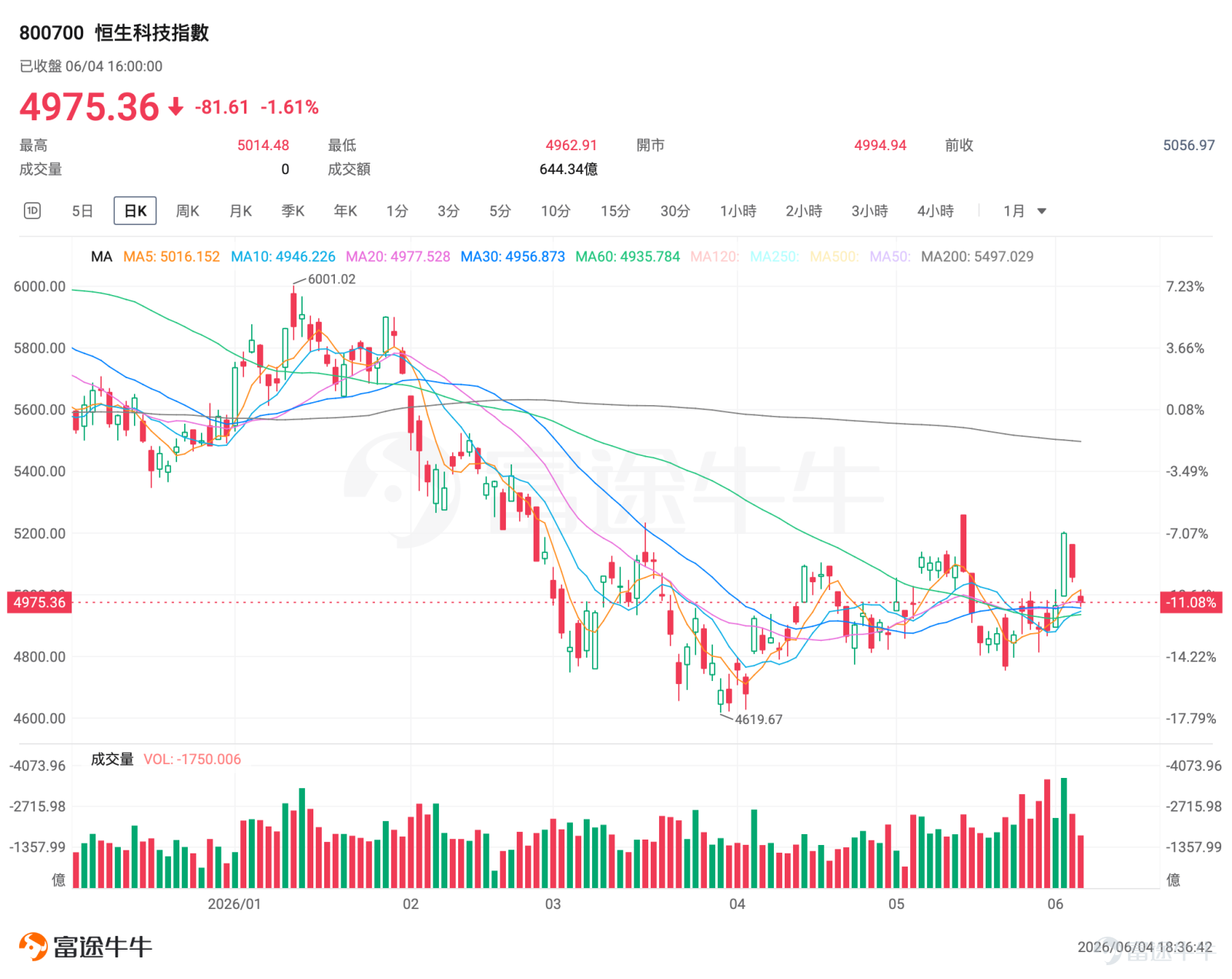
Since June 2026, $Hang Seng TECH Index (800700.HK)$ it has oscillated repeatedly around the key psychological level of 5,000. On June 2, the index surged 4.72% to close at 5,199 points; on June 3, it pulled back to 5,056 points; and on June 4, it briefly fell below the 5,000 mark again during intraday trading, $HTI Futures (JUL6) (HTImain.HK)$ with intense positioning activity centered around the 5,000 level.
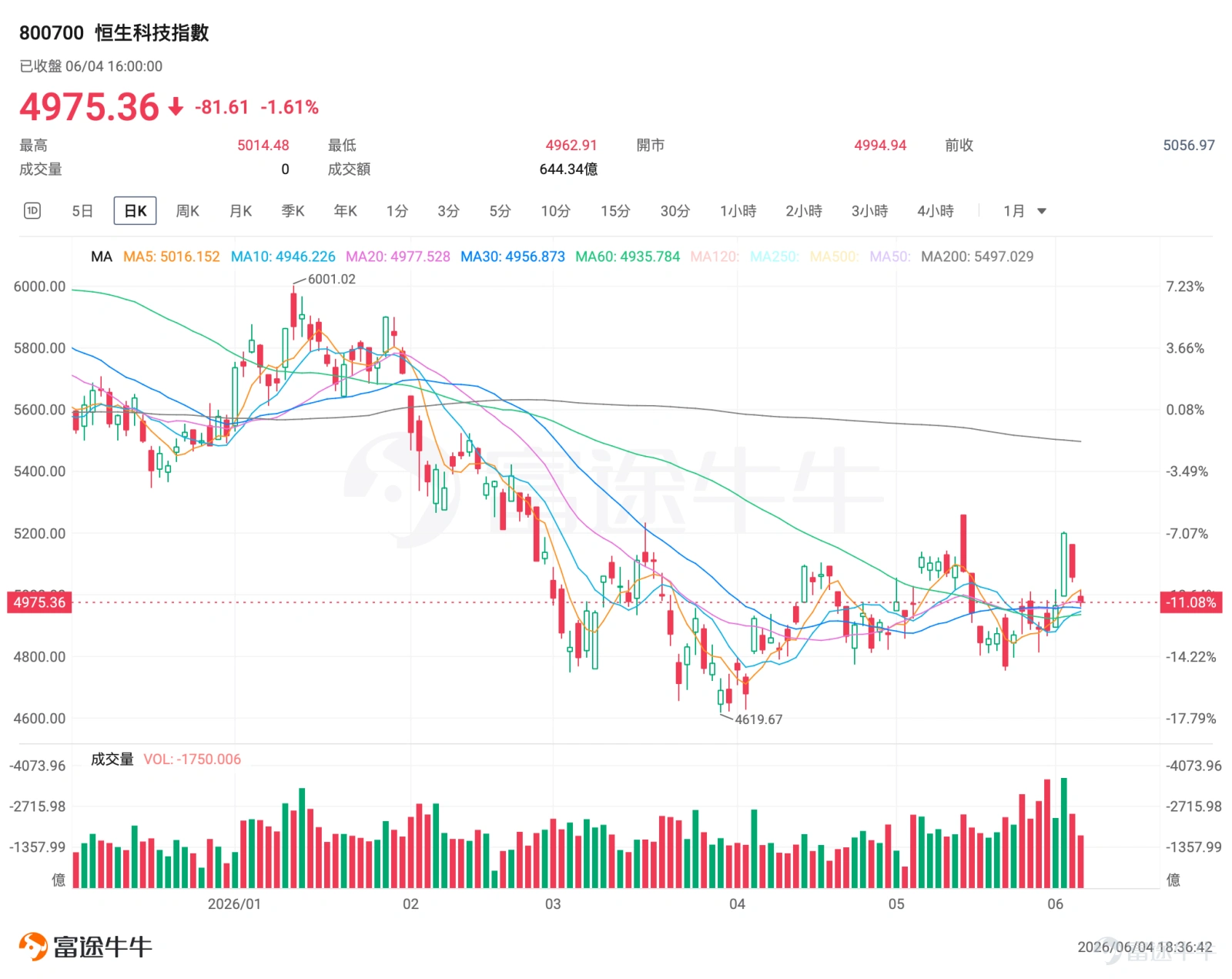
1. Hong Kong equity indices rebounded across the board on June 2, with the Hang Seng Tech Index rising nearly 5%. What drove this sharp, pulse-like rally?
June 2 $Hang Seng TECH Index (800700.HK)$ All major stocks surged, with heavyweight leaders rallying collectively, including $TENCENT (00700.HK)$ surged 10.46%, $MEITUAN-W (03690.HK)$ up 9.27%. This short-term surge was driven by a confluence of four key factors:
Meituan's earnings release: $MEITUAN-W (03690.HK)$ On June 1, after U.S. market hours, it released its Q1 earnings report, reporting revenue of RMB 91 billion, up 5.6% year-over-year, and a significant narrowing of operating losses to RMB 6.5 billion—substantially better than consensus market expectations. Citi and several other foreign institutions simultaneously raised their target prices. Coupled with market rumors that Tencent is about to launch its WeChat AI agent product, expectations around AI implementation have ignited sentiment in the sector.
Valuation is at a historical low: As of June 2, $Hang Seng TECH Index (800700.HK)$ its PE-TTM stands at just 21.55x, sitting at the 22nd percentile of its historical range over the past decade. The index has declined nearly 10% year-to-date, suggesting potential catch-up demand following an oversold correction, with its low valuation providing a cushion.
Short-covering was the key driver behind the recent short-term rally: After a prolonged six-month decline, Hang Seng Tech Index valuations had already reached historic lows. Coupled with positive fundamental news materializing, short sellers rushed to close positions and lock in profits, creating concentrated buying pressure that directly propelled the index into a sharp, pulse-like surge;however, rallies driven by short-covering typically exhibit strong initial momentum but limited sustainability.
Second, the Hang Seng Tech Index plunged sharply on June 3 as AI reshapes HK equity valuations—any underperformance versus AI implementation expectations immediately triggered valuation corrections
The euphoria lasted only one trading session before markets swiftly reversed on June 3, $Hang Seng TECH Index (800700.HK)$ falling 2.74%, with previously leading gainers retreating across the board $MEITUAN-W (03690.HK)$ plunged nearly 6%, $TENCENT (00700.HK)$ fell nearly 3%, but locally listed Hong Kong semiconductor stocks bucked the trend and rose.
According to Wind's latest sector weight data, $Hang Seng TECH Index (800700.HK)$ among its constituent stocks, internet platforms (media, e-commerce, food delivery, and software) account for a combined weight of 53%, consumer manufacturing 25%, and hard-tech sectors such as semiconductors only 22%, $TENCENT (00700.HK)$ 、 $BABA-W (09988.HK)$ 、 $MEITUAN-W (03690.HK)$ 、 $BIDU-SW (09888.HK)$ the four leading AI application companies together hold over 25% weight in the Hang Seng Tech Index, and the pace at which they monetize AI will directly determine the index’s direction.
The market action on June 3 may be worth noting: prior to that day, expectations that Tencent’s WeChat AI agent would launch in June drove a sharp single-day rally in Tencent; however, after the company stated it could not confirm a launch date, Tencent’s stock tumbled sharply, with Meituan and Alibaba also weakening in tandem, $HTI Futures (JUL6) (HTImain.HK)$ quickly pulling back to test the 5,000-point level.
In the medium to long term, if major internet firms successfully commercialize AI, they could potentially lead $HTI Futures (JUL6) (HTImain.HK)$ a breakout above the 5,000-point level; conversely, if AI investments continue to exceed expectations while monetization lags, $HTI Futures (JUL6) (HTImain.HK)$ the index may instead oscillate and consolidate around the 5,000-point mark.
III. Southbound capital shifts from soft tech to hard tech, with structural reallocation influencing the Hang Seng Tech Index's medium-term trajectory around the 5,000-point level
Since 2026, southbound capital has exhibited a dual allocation pattern of 'exiting soft tech in favor of hard tech + embracing high-dividend stocks,' and this divergence in fund flows could become a key variable constraining $Hang Seng TECH Index (800700.HK)$ a breakout above the 5,000-point mark.
As of the close on June 3, cumulative net southbound purchases in the Hong Kong equity market reached HK$299.49 billion,with May marking the first monthly net outflow of HK$3.55 billion year-to-date for southbound funds,the previous monthly outflow having occurred as far back as June 2023.
There has been a clear shift in capital allocation structure:Funds have staged a temporary exit from internet platforms, continuously flowed into semiconductor and AI computing infrastructure—so-called hard-tech names—and simultaneously increased positions in high-dividend defensive sectors such as banks and utilities.
Reasons behind the southbound net outflow in May include:
First, amid strengthening profit momentum in A-share technology stocks, capital rotated from Hong Kong equities—previously favored under a low-valuation rationale—to A-shares where sectoral upturns are being realized.
Second, some market participants anticipate a peak in share lock-up expirations in the second half of 2026, prompting early exits to avoid potential liquidity pressure;
Third, in May, external macro disruptions caused repeated shifts in Fed rate-cut expectations, pushing the 10-year U.S. Treasury yield close to 5% at one point. As an offshore asset priced in U.S. dollars, Hong Kong equities faced more direct valuation pressure. Meanwhile, as AI investment logic tilted toward hardware sectors, capital rotated out of internet giants into hard-tech names.
Therefore, if southbound capital flows can reverse May’s outflows and return to sustained net inflows—and if funds rotate back from hard tech into internet applications, $Hang Seng TECH Index (800700.HK)$ the index could stabilize above the 5,000 level and launch a rebound; however, if the trend of 'abandoning software for hardware' persists, the index is likely to oscillate repeatedly around the 5,000 mark.
Fourth, four key signals in June may determine the bottom and potential turning point for the Hang Seng Tech Index.
1. Inclusion of major AI model companies into the index
On June 8, the quarterly review results of the Hang Seng Index series will take effect, $Z.AI (02513.HK)$ and $MINIMAX-W (00100.HK)$ with new additions simultaneously entering the Hang Seng Tech Index—marking the first time pure-play AI large-model companies are included in a Hong Kong index. The market views this as a landmark move to enhance the index’s 'AI purity,' which is expected to bring in approximately USD 300–400 million in passive fund inflows.
2. Overseas liquidity conditions
Investors should closely monitor U.S. inflation and employment data released in June, along with Fed rate-cut expectations and U.S. Treasury yields, as improvements in overseas liquidity could determine the scope for foreign capital to flow back into Hong Kong equities.
3. Realization of AI Commercialization
$TENCENT (00700.HK)$ 、 $BABA-W (09988.HK)$ 、 $BIDU-SW (09888.HK)$ The pace of AI commercialization determines market valuation. Investors may consider monitoring the rollout progress of Tencent's AI agents.
4. Industry Competition Peaks & Domestic Consumption Recovers
Meituan’s losses are now in a rapid narrowing phase, suggesting the industry’s 'bleeding period' is likely nearing its end. Investors should watch for data confirming this trend. Additionally, sustained improvements in key indicators—such as June 18 shopping festival sales, monthly CPI, and social financing data—could validate the valuation thesis around domestic demand recovery and represent potential conditions for valuation repair.
5. Investment Strategies for the Hang Seng Tech Index Futures at the 5,000-Point Threshold
(Hang Seng Tech Index futures are highly volatile due to exchange rate fluctuations, foreign capital flows, and geopolitical policies. Investors should trade cautiously based on their own risk tolerance. The following does not constitute investment advice.)
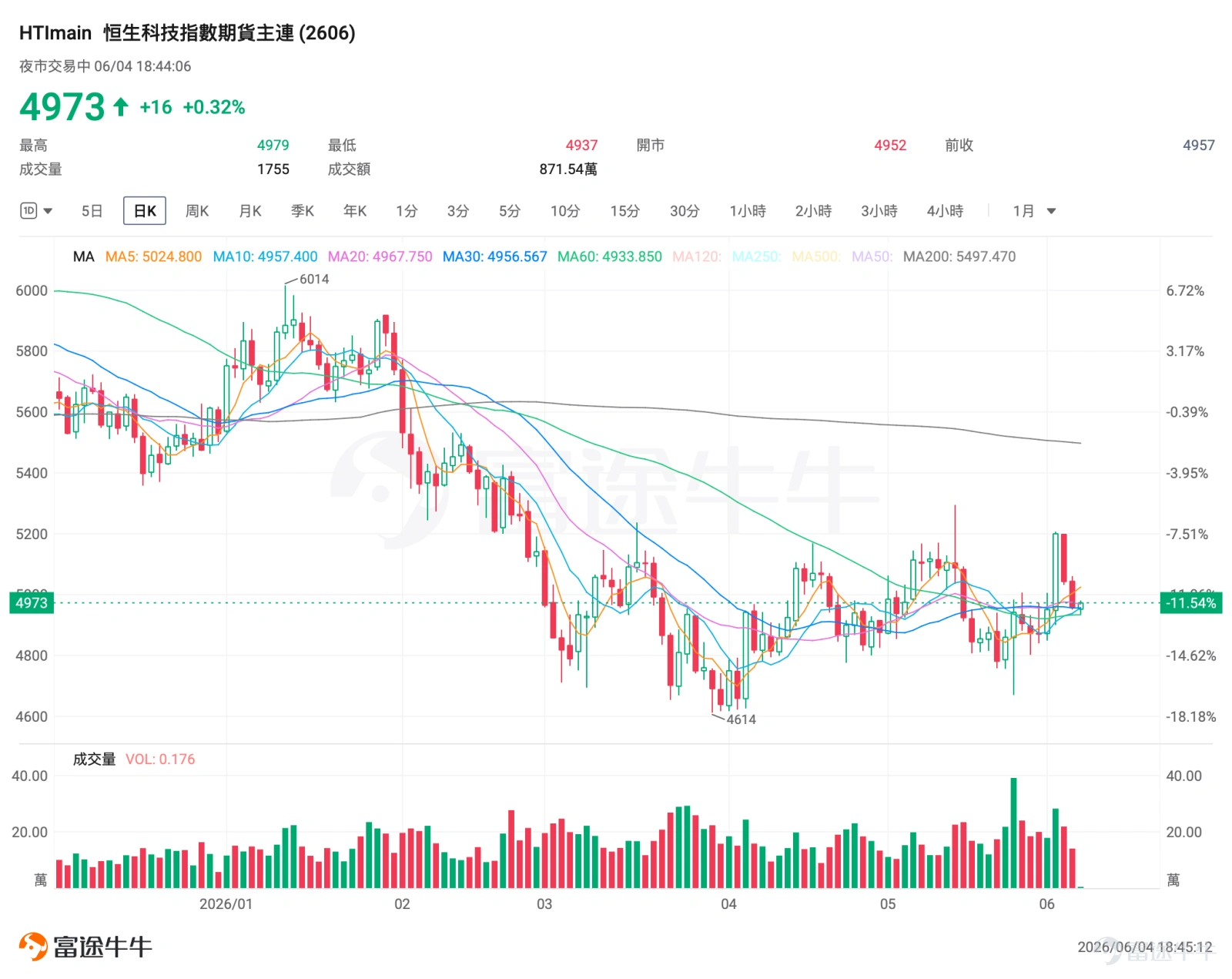
Current$HTI Futures (JUL6) (HTImain.HK)$ We are currently in a window characterized by 'high volatility, intense positioning, and structural divergence.' The following investment strategies are presented from multiple perspectives for investor reference.
1. Short-Term Strategy
Investors who expect the Hang Seng Tech Index to continue experiencing wide intraday swings—driven by short-covering, unusual northbound flows, or overnight U.S. market moves—may consider primarily trading range-bound, buying low and selling high.
Range-bound trading (buying low and selling high within the range):If the Hang Seng Tech Index futures are near the upper resistance zone without supporting trading volume, consider a small short position. If the index futures pull back to the lower support level and southbound capital outflows slow down, a short-term long position may be appropriate. However, note that this strategy demands high execution discipline—timely profit-taking and stop-losses are essential.
2. Event-driven trading strategy (centered on the index rebalancing event on June 8)
Index quarterly review takes effect on June 8: $MINIMAX-W (00100.HK)$ 、 $Z.AI (02513.HK)$ Inclusion in the index could trigger passive inflows of approximately USD 300–400 million, potentially causing a short-lived price spike one to two trading days before and after the effective date.However, beware of the 'buy the rumor, sell the news' phenomenon.。
If investors believe that Zhipu AI and MiniMax’s inclusion in the index will drive a short-term rally in the Hang Seng Tech Index, they may establish long positions ahead of June 8—but should manage position sizing carefully. If the positive catalyst materializes, profits should be taken in stages, and stop-losses should be triggered promptly if the index breaks below key support levels. $HTI Futures (JUL6) (HTImain.HK)$ If investors anticipate that the Hang Seng Tech Index will lack follow-through buying after the positive news is priced in and may resume its downward trend, they could consider initiating a small short position after the rally peaks—specifically when the index fails to break above its prior high, closes lower on the daily chart, and shows signs of stalling. The short position could be closed upon retesting previous support levels. Importantly, if the index surges on high volume and decisively breaks above the prior high, the short position must be stopped out immediately.
3. Medium- to long-term staged allocation strategy
The Hang Seng Tech Index currently trades at a historically low price-to-earnings (PE) ratio. For investors bullish on the index’s medium- to long-term shift toward a dual structure of 'Internet + AI hard tech,' but concerned about the absence of a near-term liquidity turnaround, a staged long strategy may be suitable. Establish an initial long-term base position when index futures retreat into support zones, add to positions during subsequent pullbacks, and partially reduce holdings during rallies to average down the cost basis. In the event of a sharp market selloff—or when any of the four key monitoring signals become clearly evident—consider adding to positions.
Hang Seng Tech Index is currently trading at a historically low P/E ratio. For investors bullish on the medium- to long-term shift toward a dual-structure investment theme of 'Internet + AI hard tech' within the index, but facing short-term liquidity constraints, a stepped, phased long strategy could be considered. Establish a core long position via index futures when they pull back into the support range, add positions during interim corrections, and trim holdings during rallies to smooth out the average cost basis. Consider adding further exposure if the index experiences an extreme sharp decline or when the aforementioned four key observation signals become clear.
4. Position Hedging Strategy (Equity Long Hedge)
Investors holding Hong Kong-listed tech stocks who are concerned about further pullbacks in their positions may consideropening a small short position in Hang Seng Tech Index futures to hedge against systemic market-wide downside risk, thereby managing portfolio drawdowns.
VI. Summary
In the near term, affected by IPO-related capital diversion, sector rotation from high- to low-valuation stocks, and external liquidity headwinds, the Hang Seng Tech Index may remain range-bound with continued volatility. Passive inflows triggered by the index rebalancing on June 8 could spark short-term rallies. Over the medium to long term, the index has limited room for significant further declines; its current low valuation provides a margin of safety, though a sustained trend reversal will require the simultaneous emergence of turning points in corporate earnings, liquidity conditions, and industry competition dynamics.
Disclaimer
The above information does not represent Futu's views in any way and is provided for reference only; it does not constitute any investment advice. Futures trading involves substantial risk of loss, which can be very significant—in certain circumstances, losses may exceed the initial margin deposited. Market conditions may prevent stop-loss, limit orders, or other contingency instructions from being executed. Investors should thoroughly research and understand futures contracts before trading and carefully consider whether such transactions are suitable given their financial situation and investment objectives. Futures trading entails high risk and may not be appropriate for all investors. Before engaging in any futures trading strategy, investors should fully understand the associated risks and assess their own risk tolerance.
Want to pick stocks or diagnose holdings? Want to know the opportunities and risks in your portfolio? For all investment-related questions,Just ask Futubull AI!

Editor/Doris
Risk Disclaimer: The above content only represents the author's view. It does not represent any position or investment advice of Futu. Futu makes no representation or warranty.Read more

Comment (1)
to post a comment
5
2