
SpaceX sets IPO price at $135! How will its trillion-dollar space infrastructure empire ignite the supply chain?
In 2026, the global tech capital market is reaching a historic inflection point. As artificial intelligence and commercial spaceflight converge deeply, Elon Musk’s highly anticipated company SpaceX is gradually lifting the veil on its entry into the capital markets.
Latest IPO update: Price locked in advance, racing toward the largest IPO in history
According to the latest filing submitted to the U.S. Securities and Exchange Commission (SEC), Musk has made a rare move on Wall Street—officially launching its initial public offering roadshow at an issue price of $135 per share.
Typically, IPO pricing is dynamically determined during the roadshow based on institutional investors’ subscription interest. SpaceX’s unconventional approach—bypassing this norm and directly locking in a single target price for the roadshow—demonstrates management’s absolute confidence in strong market demand.Notably, as a prelude to this capital frenzy, a 2x leveraged ETF tracking SpaceX (ticker: SPCH) is expected to debut on the market either on SpaceX’s listing day or shortly thereafter.
According to the current offering schedule, shares are expected to be listed onJune 12, 2026Officially listed for trading, with the Nasdaq ticker symbol set as"SPCX"。
Valuation and scale:SpaceX's total market capitalization will reach an astonishing$1.77 trillion(exceeding $1.8 trillion on a fully diluted basis). This scale already surpasses Tesla—also owned by Musk—with its approximate $1.6 trillion valuation, making SpaceX the seventh-largest publicly traded company in the U.S. by market cap.
Fundraising Size:The company plans to issue 555.6 million shares in its base offering, raising capital directlyUSD 75 billion, a scale triple that of the largest IPO in U.S. history to date (Alibaba). This offering represents only 4.2% of its total outstanding shares, with the remaining 95.8% still held by Elon Musk and other insiders.Elon Musk himself will be subject to a 366-day lock-up period following this IPO, and his net worth is expected to surpass the $1 trillion mark this month.
Use of Proceeds:SpaceX plans to allocate the proceeds from the offering toward expanding AI computing infrastructure, upgrading launch facilities and launch vehicles, scaling up the size and capacity of its satellite constellation, and using any remaining funds for general corporate purposes.
Latest Business Breakdown: Three Core Pillars Target a $28.5 Trillion Addressable Market
In its several-hundred-page prospectus, SpaceX anchors its total addressable market (TAM) at an unprecedented$28.5 trillion. Such an ambitious target is underpinned by its already-established three business pillars: aerospace launch services, Starlink satellite internet, and space-based computing & AI.
Space Infrastructure: Heavy-lift launch vehicle 'Starship'
The Starship program has cumulatively invested over $15 billion to date. On May 22, 2026, the Starship V3 successfully completed its 12th test flight, marking the first use of the upgraded Raptor 3 engines and achieving flawless hot-staging separation. With the successful maiden flight of the V3 version, the company expects Starship to begin commercial orbital payload deliveries in the second half of 2026, potentially breaking through humanity's current bottleneck in space access capacity.
'Cash Cow' Business: Global broadband network 'Starlink'
As of March 2026, Starlink had nearly 10,000 satellites in orbit and over 10.3 million global subscribers. Financial data shows that Starlink generated $11.4 billion in revenue in 2025 (accounting for 61% of total revenue), with an EBITDA margin of 63%.
Starlink is not only the company’s only segment currently generating positive cash flow but has also secured contracts with major airlines such as Emirates and United Airlines. Going forward, Starlink will leverage Starship launches to deploy high-capacity V3 satellites, each offering 1 Tbps of throughput, further widening its technological lead.
AI and Space-based Computing (xAI/Grok)
This represents the biggest variable in the upcoming IPO. In February 2026, SpaceX merged with xAI (valued at approximately $250 billion) via an all-stock transaction, integrating the Grok model and the X platform to fully advance its 'Orbital AI Compute Center.'
This division is currently burning approximately $1 billion per month, resulting in a full-year net loss of $4.94 billion for SpaceX. However, signs of commercialization are emerging: SpaceX has signed a massive agreement with AI giant Anthropic, under which Anthropic will pay $1.25 billion monthly to purchase SpaceX’s AI computing capacity. According to the prospectus, AI accounts for 93% of the company’s quantified total addressable market (approximately $26.5 trillion).
Supply Chain Opportunities: Amid the 'IPO of the Century,' Who Will Get a Piece of the Pie?
The emergence of SpaceX’s $1.77 trillion empire means the valuation framework for the 'AI × Space' sector in public markets will be fundamentally reshaped. Investors should closely monitor the following related investment opportunities:
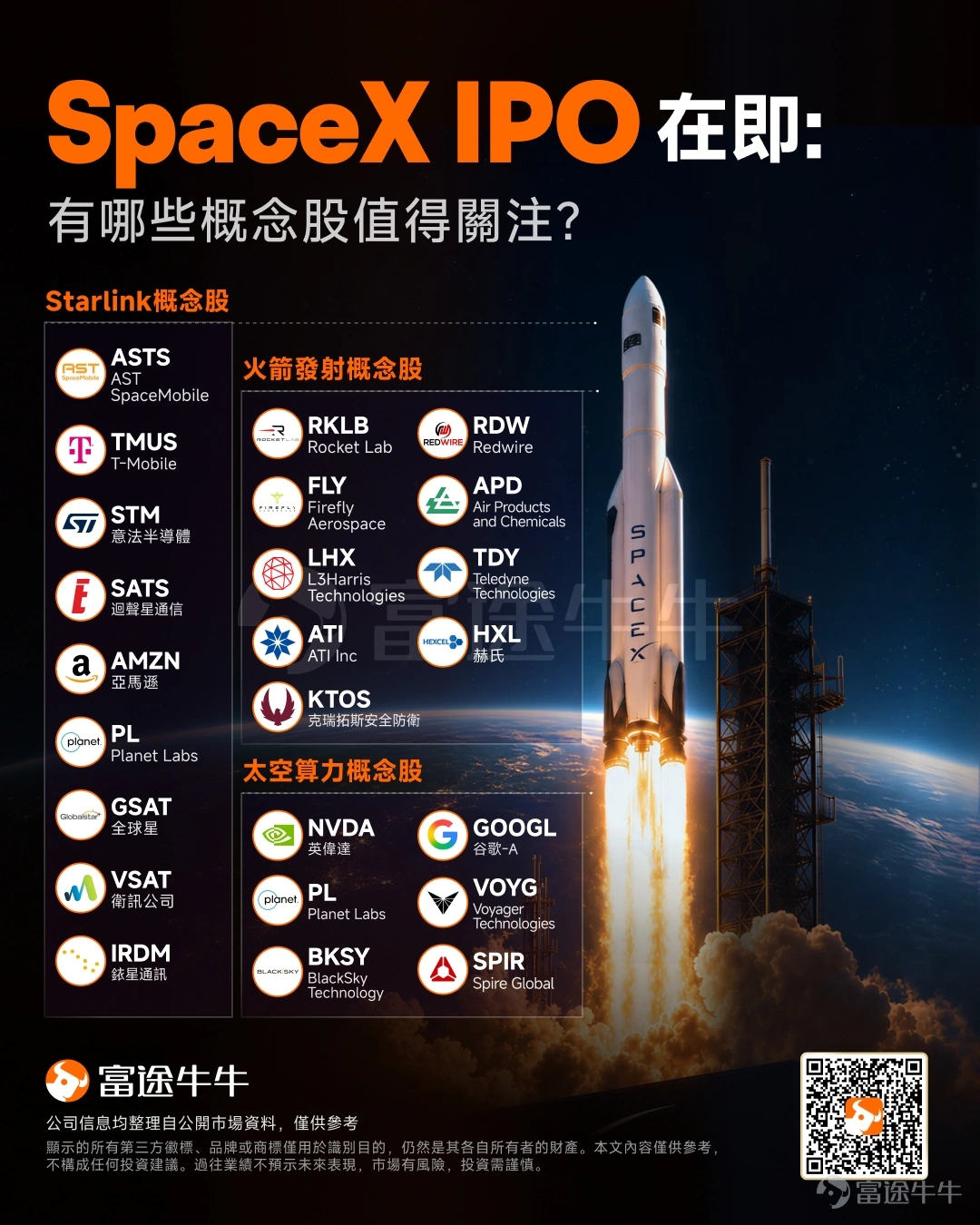
Starlink-related stocks: Direct beneficiaries of space-ground connectivity
As SpaceX's biggest 'cash cow,' Starlink's commercialization will drive prosperity across the entire space-based communications supply chain:
Communications services and competitors: $AST SpaceMobile (ASTS.US)$ 、 $Globalstar (GSAT.US)$ 、 $Iridium Communications (IRDM.US)$ 、 $Viasat (VSAT.US)$ . As direct participants in the satellite-to-smartphone and satellite broadband segments, these companies will directly benefit from the 'sector-wide valuation uplift' driven by Starlink.
Key partners and customers: $T-Mobile US (TMUS.US)$ serves as Starlink’s leading telecom ally in bringing the service to the mass consumer market; $Amazon (AMZN.US)$ And, $Planet Labs PBC (PL.US)$ is a major commercial customer heavily reliant on SpaceX’s launch capacity.
Hardware and spectrum suppliers: $STMicroelectronics (STM.US)$ provides critical underlying chip support; $EchoStar (ECHO.US)$ has deeply tied itself to SpaceX through equity ownership by selling spectrum rights.
Rocket Launch Concept Stocks: Scarce Launch Capacity and Infrastructure 'Shovel Suppliers'
Under SpaceX's halo effect, suppliers of space launch infrastructure and advanced materials are also entering a historic period of industry tailwinds:
The Two Leaders in Rocket Launch: $Rocket Lab (RKLB.US)$ And, $Firefly Aerospace (FLY.US)$ . As among the few private rocket companies currently possessing routine launch capabilities, they represent the most scarce 'alternative assets' to SpaceX.
Specialty Materials and Propellants: $Air Products & Chemicals (APD.US)$ as a major player in core industrial gases and propellants; $ATI Inc (ATI.US)$ And, $Hexcel (HXL.US)$ monopolizes advanced specialty alloys and composite materials required for aerospace applications.
Space Infrastructure and Defense: $Redwire (RDW.US)$ 、 $L3Harris Technologies (LHX.US)$ 、 $Teledyne Technologies (TDY.US)$as well as$Kratos Defense & Security Solutions (KTOS.US)$ covers the core supply chain ranging from microgravity manufacturing in space and precision instruments to national defense and space security.
Space Computing Concept Stocks: The Testing Ground for Next-Generation Silicon-Based Intelligence
With SpaceX acquiring xAI and positioning the 'Orbital AI Computing Center' as its core narrative, the space-based computing network has become the largest incremental market:
Computing Power & Cloud Infrastructure: $NVIDIA (NVDA.US)$ And, $Alphabet-A (GOOGL.US)$ . The former is the indispensable dominant player in foundational AI chips, while the latter was an early strategic shareholder of SpaceX and is deeply integrated with its cloud services.
Space-Based Data & Observation: $Planet Labs PBC (PL.US)$ 、 $BlackSky Technology (BKSY.US)$ And, $Spire Global (SPIR.US)$ . These companies operate extensive low-Earth orbit satellite constellations and represent the most direct application layer for space-based computing in high-frequency Earth observation and meteorological data analysis.
Space Technology Infrastructure: $Voyager Technologies (VOYG.US)$ and other emerging firms involved in deploying next-generation space stations and computing hardware.
Conclusion: A landmark year for tech IPOs
Although the staggering $1.77 trillion valuation implies that the market has already priced in a significant portion of SpaceX’s future growth—and Starship V3’s commercialization still faces trial-and-error risks in high-altitude testing—no one can deny that SpaceX’s IPO marks a watershed moment, transitioning commercial spaceflight from 'science fiction storytelling' to 'hard profit realization.'
Coupled with OpenAI and Anthropic, both also queued for IPOs by the end of 2026, the year 2026 is destined to be remembered as the inaugural year of 'orbital computing power converging with silicon-based intelligence,' permanently etched into the annals of global capital markets.
Risk Disclaimer: The above content only represents the author's view. It does not represent any position or investment advice of Futu. Futu makes no representation or warranty.Read more


Comments (25)
to post a comment
115
318