Optical communication stocks lead the rebound; will the AI optical cycle continue?

Jensen Huang Sets the Tone with 'Copper-and-Optics Roadmap': Will AI's Next Phase Shift from Scrambling for Compute Power to Scrambling for 'Connectivity'?
As AI models evolve toward the era of massive 'agents,' data centers' computational bottlenecks are gradually shifting toward 'connectivity.'A foundational infrastructure revolution—transitioning from copper cables to optical fiber—is now fully igniting.
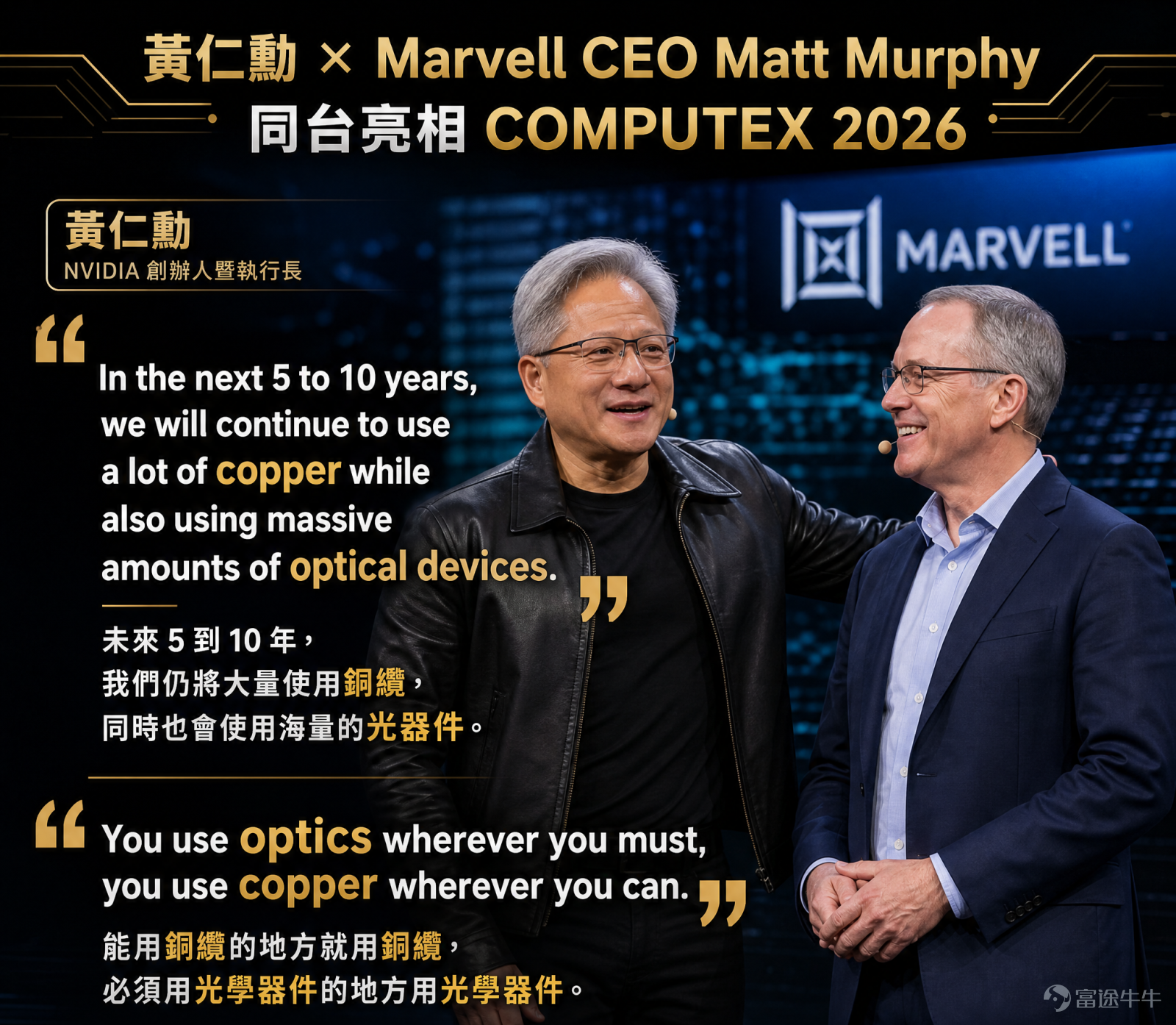
On June 2, 2026, on the stage of COMPUTEX TAIPEI (COMPUTEX 2026), $NVIDIA (NVDA.US)$ NVIDIA CEO Jensen Huang joined Marvell Technology CEO Matt Murphy onstage to discuss a seemingly 'understated' yet pivotal term capable of reshaping trillion-dollar AI infrastructure—connectivity.
Huang offered a clear judgment: 'Use copper wherever you can, and optics wherever you must(You use optics wherever you must, you use copper wherever you can).He further explained that copper cables face physical limits in bandwidth and transmission distance. Until those boundaries are surpassed, copper remains a simple, low-cost, and practical choice; once past that threshold, optical fiber takes over to meet expansion needs between racks, across data centers, and even between geographically dispersed data centers.
「Over the next 5 to 10 years, we will still heavily rely on copper cables while also deploying massive volumes of optical components.。」This statement by Jensen Huang has set the tone for the next decade of AI infrastructure.

2026–2028: Critical Inflection Point for Copper-to-Optical Transition
Bottlenecks in AI infrastructure are emerging sequentially: computing power (led by NVIDIA, which has become the world’s first company to reach a $5 trillion market cap) → memory (three new companies in the memory space have recently joined the trillion-dollar market cap club) → connectivity (currently unfolding).
At GTC 2026, Jensen Huang explicitly laid out a roadmap: copper cables and optical interconnects will coexist from 2026 to 2027; by 2028, with the Feynman architecture, CPO (co-packaged optics) will be widely adopted for scale-up connections within server racks.
2026 (Current Era – Rubin):Copper cables still dominate intra-rack connections, with per-rack usage hitting new highs.NVIDIA has officially confirmed that its Rubin architecture, scheduled for mass production in the second half of 2026, along with the accompanying Vera Rubin platform rack, will continue to use high-speed active copper cables as the core solution for GPU-to-GPU NVLink interconnects.
2027 (Critical Juncture – Rubin Ultra):As single-GPU bandwidth exceeds 20 TB/s, connections across compute units (Canisters) within racks will adopt CPO (co-packaged optics) or NPO (near-packaged optics),marking a structural inflection point for fiber demand. NVIDIA’s official roadmap shows that while the Rubin Ultra platform and its accompanying Kyber rack—slated for mass production in the second half of 2027—will still rely primarily on copper cables,they will simultaneously integrate CPO to enable high-density scaling.。
2028 and beyond (CPO becomes mainstream):Copper cables retreat to chip-level ultra-short-reach interconnects (<5mm), while optical interconnects take over longer intra-rack and external expansion links.NVIDIA's next-generation Feynman platform will, for the first time, adopt a hybrid 'copper cable + CPO' architecture in scale-up scenarios, further expanding the application scope of optical interconnects.

High-speed copper cables: the preferred choice for short-reach transmission
Amid the explosive growth in AI computing demand and the rise of high-density rack architectures as the mainstream solution, copper cables have not been replaced by optical technologies such as optical modules and CPO. Instead, they have become the foundational interconnect solution within AI data centers,thanks to their core advantages of exceptional cost-performance, low power consumption, and high reliability in short-reach transmission scenarios.The core investment thesis lies in the certain incremental demand driven by
the ramp-up of AI racks,”Industry data shows that the global high-speed copper cable market will exceed RMB 20 billion in 2026 and is expected to reach RMB 35.22 billion by 2032, representing a compound annual growth rate (CAGR) of 15.2% during this period. The direct driver of this demand is the dramatic increase in per-rack usage. For example, NVIDIA’s GB200 NVL72 architecture requires 5,184 high-speed copper cables within a single rack to achieve GPU-to-GPU communication bandwidth of up to 1.8 TB/s—over 200 times more than the 16–24 copper cables needed in a traditional 8-GPU server.Industry data shows that the global high-speed copper cable market is projected to exceed RMB 20 billion in 2026 and reach RMB 35.22 billion by 2032, representing a compound annual growth rate (CAGR) of 15.2% during this period. This surge in demand is directly driven by the sharp increase in per-rack cable usage. For instance, NVIDIA's GB200 NVL72 architecture requires 5,184 high-speed copper cables within a single rack to achieve GPU-to-GPU communication bandwidth of up to 1.8 TB/s—more than 200 times the 16–24 cables typically needed in conventional 8-GPU servers.

The current high-speed copper cable market is primarily composed of three major product categories:
1) Active Electrical Cables (AECs), as mid-to-high-end products with the highest technical barriers, already account for 35%–40% of the market. Equipped with integrated chips such as Retimers, they actively amplify and reshape signals, making them suitable for longer distances and higher data rates. AECs are the core driver behind market growth and average selling price increases.
2) Active Copper Cables (ACCs): holding a relatively limited market share (approximately 5%–10%), they are primarily used in specific short-reach, high-density scenarios;
3) Passive Direct Attach Copper Cables (DACs): benefiting from highly mature technology and the lowest cost structure, they still dominate 50%–60% of the market share and form the market’s foundational base.
In the long term, as AI clusters continue to demand higher bandwidth and greater stability,AECs, leveraging their performance advantages, are expected to become the fastest-growing segment.。
The high-speed copper cable industry chain encompasses upstream raw materials and chips, midstream cables and connectors, and downstream assembly and end applications. The overall landscape is characterized by overseas giants dominating the high-end market, while domestic Chinese suppliers are gradually breaking through—from serving as supporting vendors toward achieving independent substitution.
Upstream raw materials and chips: primarily include high-purity copper, silver-plated copper wire, and core Retimer/AEC chips.The chip segment is currently still dominated by $Credo Technology (CRDO.US)$、 $Broadcom (AVGO.US)$、 $Marvell Technology (MRVL.US)$dominated by overseas vendors such as, representing a critical bottleneck in the domestic industrial chain. Domestic $MONTAGE TECH (06809.HK)$ vendors are accelerating R&D efforts, making them key watchpoints for domestic substitution.
$Credo Technology (CRDO.US)$ : a global leader in high-speed interconnect solutions,particularly commanding approximately 73% of the global market share in active electrical cables (AEC), with deep integration into major clients,Microsoft, Meta, Google, AWS, and OpenAI—the five cloud giants—account for over 90% of the company's revenue. The company not only monopolizes the AEC market but is also actively expanding into optical interconnects through acquisitions of DustPhotonics (silicon photonics technology) and Hyperlume (MicroLED optical interconnects), building end-to-end 'electrical-to-optical' capabilities. Needham reaffirmed its 'Buy' rating and raised the price target from $220 to $275.
$Marvell Technology (MRVL.US)$ : Although renowned for optical interconnects and networking chips, Marvell Technology also holds a significant position in high-speed SerDes IP and companion connector chips,Jensen Huang publicly stated at COMPUTEX 2026 that 'Marvell could become the next trillion-dollar company.', highlighting its core value in the AI connectivity ecosystem.
$ZIJIN MINING (02899.HK)$ : Benefiting from copper's 'super cycle,' it is China's largest copper mining company. Company executives explicitly stated during the earnings call that they are optimistic about new applications such as AI data centers becoming a 'super engine' for copper demand.
Midstream cable and connector manufacturing: This is currently the core area where domestic manufacturers seek breakthroughs. In copper cable manufacturing,Overseas $Amphenol (APH.US)$giants such as Molex and TE Connectivity have captured the majority of the high-end market share thanks to their first-mover advantage and technological expertise.Domestic manufacturers are starting from supplying supporting components and gradually penetrating into high-end products.
$Amphenol (APH.US)$ : An NVIDIA supplier and global leader in high-speed connectors, it announced a second price increase this year—raising prices by 5%–8% for standard communication/industrial products, and by 10%–15% for AI server 224G high-speed connectors and 800V high-voltage customized products.
$TE Connectivity (TEL.US)$ : Provides comprehensive high-speed connectivity solutions, including 224G backplane connectors, CPO-integrated high-speed connectors, and near-package high-speed cable modules. Its products have already passed NVIDIA’s GB3 certification.
$FIT HON TENG (06088.HK)$ : A Hong Kong-listed connector industry leader, andCore supplier in NVIDIA's AI server connector segmentIts stock price has surged over 85% year-to-date.
Downstream assembly and end applications: Includes finished copper cable assembly, ultimately deployed in AI data centers of major players such as NVIDIA, AMD, Google, and Microsoft.
Optical fiber takes the baton, breaking through transmission limits
When transmission distance and bandwidth exceed physical limits, a vast array of optical components—especially next-generation CPO (Co-Packaged Optics) technology—will become an essential necessity.Optical fiber will take over to meet inter-rack, intra-data-center, and cross-data-center scalability demands.。
AI data center construction drives explosive demand for optical fiber. As NVIDIA advances its Rubin, Spectrum-X, and CPO architectures, 800G/1.6T optical modules are rapidly penetrating the market, significantly increasing optical interconnect density within GPU clusters. This has accelerated demand for high-end optical fiber in AI data centers. According to a CCTV Finance report on June 3, driven by AI computing infrastructure buildout, domestic optical fiber and cable manufacturers already have orders booked through 2027, keeping the sector highly robust. By 2027, fiber demand from AI-driven intra-data-center and data center interconnect (DCI) applications is expected to surge to 30% of total demand, sharply boosting requirements for premium specialty fibers such as G.654.E and hollow-core fiber.
Supply-demand imbalance drives 'volume and price gains': The upstream core material—optical fiber preform—has a capacity expansion cycle lasting 18 to 24 months. Overseas giants are operating at full capacity, severely constraining global supply in the short term. This supply-demand imbalance has triggered explosive price surges—several-fold increases—for both standard and high-end optical fiber products, propelling the industry into a highly prosperous cycle.
Strategic positioning in advanced technologies:Such as multi-core fiber, hollow-core fiber, and specialty fibers, enabling industry leaders to benefit not only from the global fiber price surge in terms of volume but also to dominate high-value segments of the industrial chain.

During this industry upswing characterized by rising volumes and prices, leading companies with advanced technological capabilities are capturing additional alpha returns. They not only enjoy sector-wide pricing tailwinds but have also built moats around the highest-value segments of the supply chain.
$Corning (GLW.US)$ :A global leader in optical fiber and a primary beneficiary of the AI-driven surge in fiber demand, following the signing of a multi-year agreement worth up to $6 billion with Meta, the company added two more hyperscale customers in Q1. In Q1 2026, its optical communications business reported sales of $1.846 billion, up 36% year-over-year, with net profit reaching $387 million. According to Shenwan Hongyuan, Corning’s new orders—combined with unchanged 2026 capital expenditure guidance—suggest clear near-term overseas capacity constraints, indicating a widening supply-demand gap for high-end optical fiber. These capacity bottlenecks imply substantial spillover demand, which will continue to support the company’s earnings.
$YOFC (06869.HK)$ :It is one of the few global companies that independently masters and has commercialized all three mainstream optical fiber preform fabrication technologies—PCVD, OVD, and VAD—and possesses fully integrated vertical capabilities spanning from 'preform' to 'fiber' to 'cable.'Its hollow-core fiber technology leads globally, achieving a world-record-low attenuation of 0.04 dB/km, and has been deployed in over 10 commercial and pilot projects worldwide. In Q1 2026, the company reported revenue of RMB 3.695 billion, up 27.7% year-over-year; attributable net profit surged 226.4% year-over-year to RMB 495 million. Its gross margin reached a record-high 41.51% and net margin hit 15.84%—both all-time highs since listing. Goldman Sachs raised its target price from HK$255 to HK$290.
$Fujikura (5803.JP)$ : A Japanese optical fiber giant with deep technical expertise in specialty fibers and optical fiber preforms, holding a 15–20% share of the global high-end preform market.
No matter how powerful a GPU is, if data can’t get out, can’t move fast enough, or can’t travel far enough, it remains an isolated island. Optical interconnects are the bridges connecting these islands.
Jensen Huang has already cast his vote with $6 billion—since the start of 2026, NVIDIA's moves in the optical space have been nothing short of a buying spree: investments of $Lumentum (LITE.US)$ $2 billion, $Coherent (COHR.US)$ $2 billion, $Marvell Technology (MRVL.US)$ $2 billion, $Corning (GLW.US)$ $500 million, and participation in Ayar Labs' $500 million Series E funding round.
It is this strategic choice that reveals the true nature of the AI infrastructure race:In the first half, everyone competed for computing power; in the second half, everyone is racing for connectivity.
Risk Disclaimer: The above content only represents the author's view. It does not represent any position or investment advice of Futu. Futu makes no representation or warranty.Read more


Comments (12)
to post a comment
87
324