
Broadcom partners with OpenAI! Will self-developed chips ignite the market?
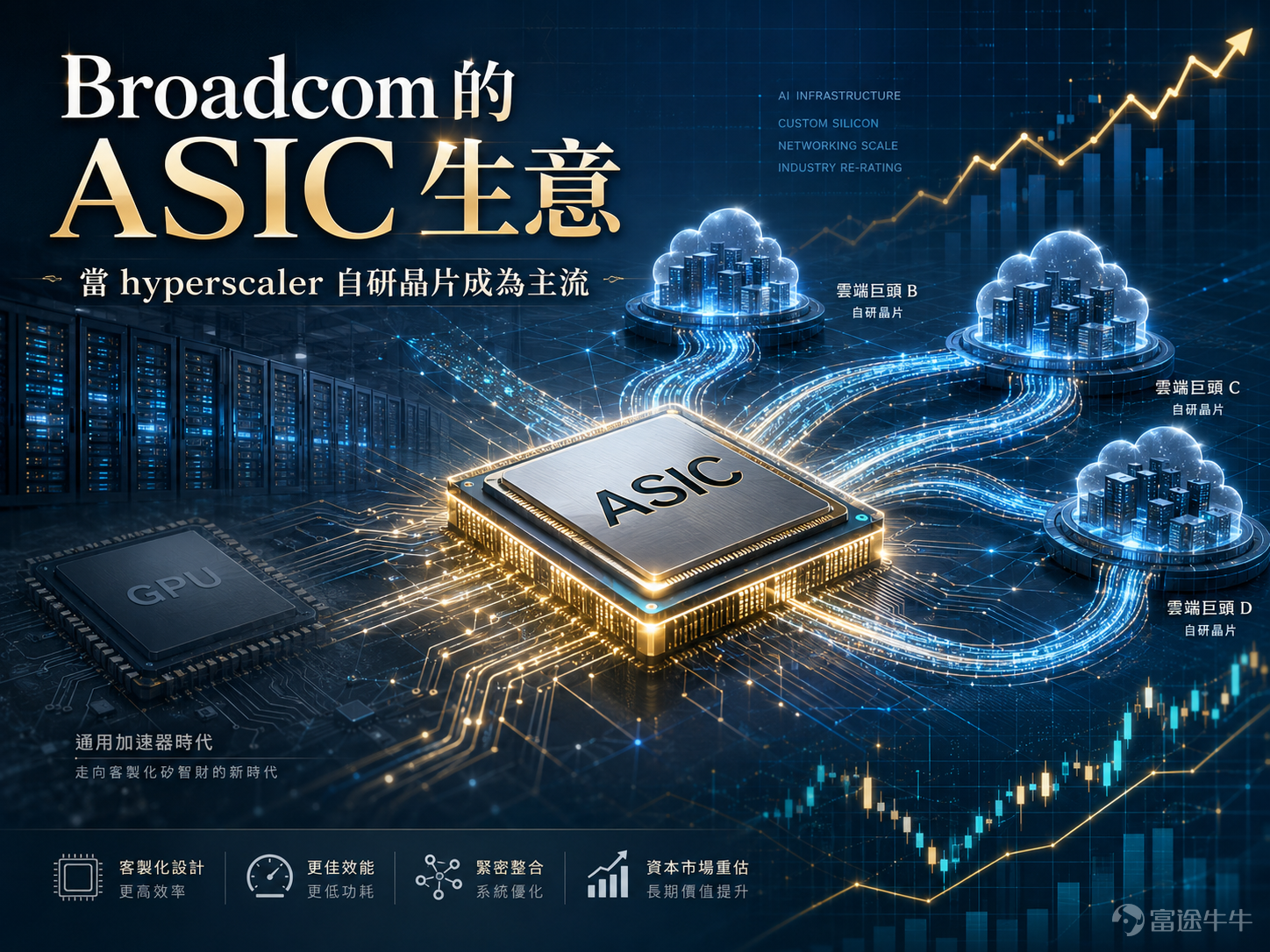
Broadcom's ASIC business

Over the past two years, the AI semiconductor market has been dominated by a simple narrative: computing power equals GPUs, and GPUs equal Nvidia. This view wasn't wrong in the early stages of large model training, as general-purpose GPUs offered a mature software ecosystem, a vast developer community, complete server solutions, and the fastest delivery cadence. For cloud giants aiming to rapidly scale computing capacity and gain an edge in model iteration speed, purchasing Nvidia systems was often the most straightforward choice.
However, as AI infrastructure enters its second phase, the nature of the challenge is shifting. When hyperscalers are spending tens of billions of dollars annually on capital expenditures, chips are no longer just about performance—they become a complex equation involving cost, power consumption, supply chain resilience, security, and workload alignment. Companies like Google, Amazon, Microsoft, Meta, and OpenAI are accelerating their in-house AI chip development not merely to 'de-Nvidia' but to directly embed their specific models, data center architectures, network topologies, and inference requirements into hardware design. This is precisely why Broadcom’s ASIC business has suddenly become a focal point in capital markets.
ASICs, or application-specific integrated circuits, differ fundamentally from general-purpose GPUs in that they aren’t designed to handle all tasks but are instead optimized for specific workloads. For most companies, developing ASICs is costly, time-consuming, and risky—and therefore not economical; however, for hyperscalers, as long as deployment scale is sufficiently large, improvements in performance per watt, compute per dollar, and cost per inference can more than offset upfront R&D expenses. As AI inference demand surges, this economic advantage becomes even more pronounced. Training prioritizes peak performance and flexibility, whereas inference places greater emphasis on cost, latency, power efficiency, and consistent throughput. The more standardized and scaled the workload, the better suited it is for custom silicon.
Broadcom sits precisely at this inflection point. Unlike Nvidia, which sells a complete AI platform, or cloud companies that design chips for their own use, Broadcom plays a dual role as both a 'custom chip engineering partner' and a 'data center networking supplier.' Hyperscalers define the requirements, architecture, and target workloads, and Broadcom translates them into mass-producible, packageable ASICs that integrate seamlessly into large-scale clusters. While this model isn’t as visible to the market as GPUs, it could emerge as the second most critical semiconductor theme as AI capital expenditures deepen.
Beyond Nvidia, the AI chip battleground is stratifying
More importantly, Broadcom’s advantage lies not just in the chips themselves. The bottleneck in AI data centers has long ceased to be solely about the performance of individual accelerators—it’s now about how accelerators interconnect, how data is moved, and how clusters scale. Broadcom’s longstanding expertise in Ethernet switch chips, optical communications, network control, and high-speed interconnects gives it a natural edge in the 'AI accelerator + networking' combination. If future AI clusters shift away from relying exclusively on Nvidia’s InfiniBand and increasingly adopt Ethernet-based architectures, Broadcom’s role could evolve from being merely an ASIC supplier to becoming a core beneficiary of the entire AI networking infrastructure.
This is also why the market is re-evaluating Broadcom. Historically, investors viewed Broadcom primarily as a semiconductor giant with strong cash flow, robust M&A capabilities, and a stable product portfolio. After its acquisition of VMware, the market began incorporating infrastructure software valuation logic as well. However, the surge in demand for AI ASICs has suddenly opened up greater growth potential for Broadcom. It combines the scale, gross margins, and customer stickiness of a traditional semiconductor company with the growth elasticity driven by the AI cycle. Unlike pure-play GPU companies that are fully exposed to a single competitive narrative, or cloud providers burdened by massive data center investment and ROI pressures, Broadcom occupies a more balanced position.
However, Broadcom’s ASIC business also carries certain risks. First, customer concentration is high. Custom chips are typically driven by a small number of hyperscalers; if any major client shifts its technology roadmap or outsources more design work to Marvell or internal teams, revenue visibility could suffer. Second, ASIC development cycles are long, and success depends not only on chip design but also on access to advanced process nodes, HBM supply, advanced packaging, yield rates, and system integration. Delays in any of these areas could disrupt delivery timelines. Third, ASICs do not fully replace GPUs. Cutting-edge training still requires highly flexible general-purpose platforms, and Nvidia’s software moat remains deep. Custom chips mainly offload specific workloads rather than instantly reshaping the entire market.
Therefore, Broadcom’s investment thesis should not be oversimplified as 'the next Nvidia.' It is better understood as an 'engineering winner' emerging as AI infrastructure matures. In the first phase, the market focused on who could deliver compute power fastest; in the second phase, the emphasis shifts to who can support sustained AI application operations at lower cost, higher efficiency, and greater reliability. Broadcom may not lead in AI model development or boast the flashiest consumer-facing brand, but it directly addresses hyperscalers’ most pressing practical challenge: how to transform AI from lab experiments and viral applications into a sustainable, operational infrastructure.
(Chip & Compute Power Series #63)
Risk Disclaimer: The above content only represents the author's view. It does not represent any position or investment advice of Futu. Futu makes no representation or warranty.Read more

Comments
to post a comment
1
1