
AI infrastructure is heating up! Hardware stocks rally across the board

Should AI companies be valued based on revenue, EBITDA, or compute output?

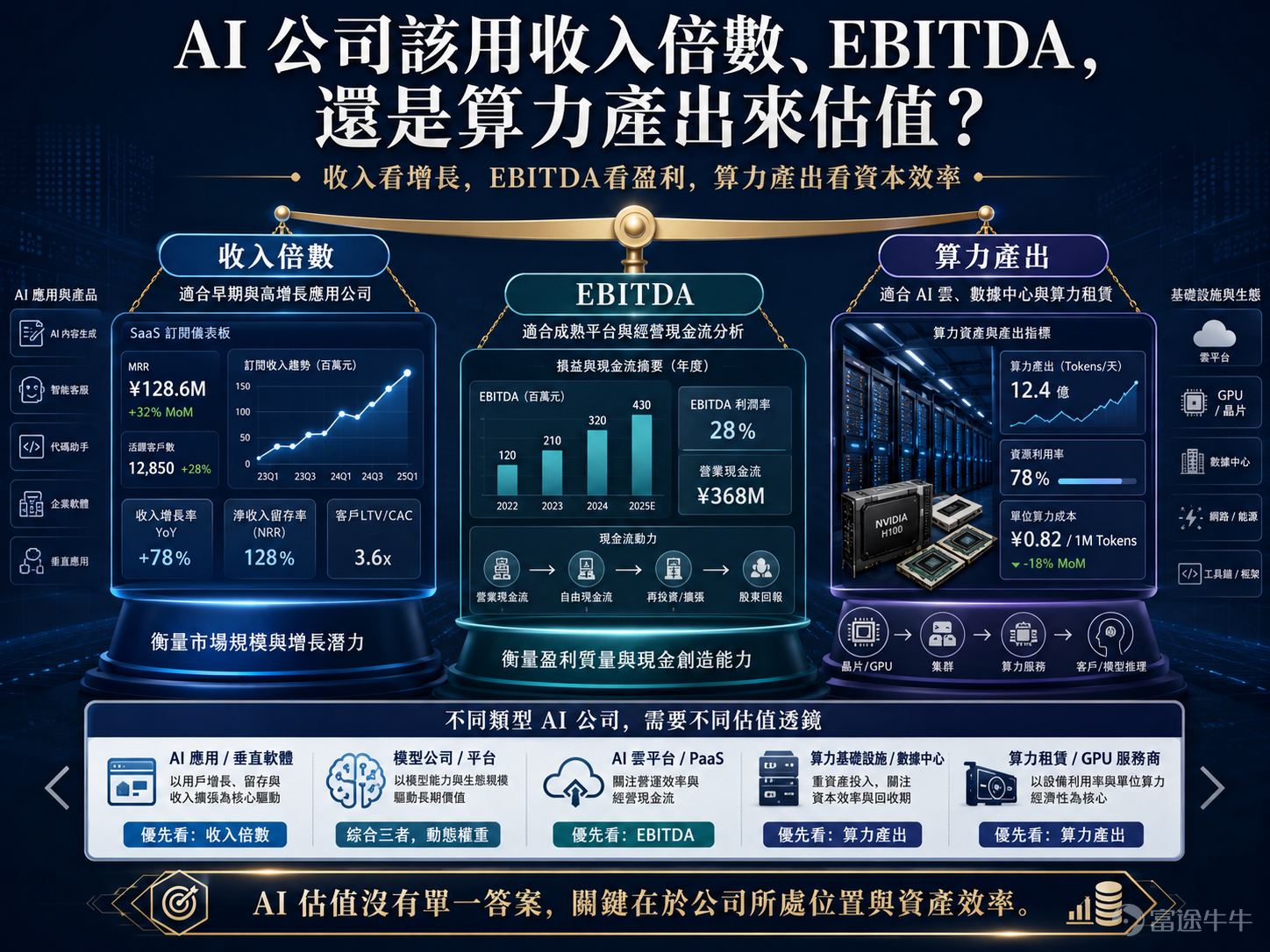
How to value AI companies is one of the most difficult questions in today’s capital markets. Historically, SaaS companies were most commonly valued using revenue multiples because, once software was developed, marginal costs were low, and metrics like renewal rates, gross margins, and customer retention sufficiently explained value. Early-stage AI companies initially adopted this same framework—especially generative AI application firms—where rapid revenue growth alone justified high valuation multiples from the market. However, the issue is that AI revenue carries a cost far heavier than in the SaaS era: inference costs. Every user query, image generation, or enterprise API call consumes GPUs, electricity, bandwidth, and model-serving capacity. If revenue multiples aren’t scrutinized alongside gross margins, it’s easy to mistake 'burning compute for revenue' as 'high-quality growth.'
Therefore, revenue multiples are suitable for early-stage or rapidly scaling AI companies—but only under several key conditions: Is the revenue recurring? Are gross margins improving? Are customers willing to pay long-term? Is the unit cost of inference declining? And does the model offer differentiation? If an AI application company’s revenue primarily stems from short-lived hype, has low customer switching costs, and requires substantial compute consumption for every additional dollar of revenue, then a high revenue multiple essentially just capitalizes future losses upfront. Conversely, if a company can embed its model capabilities deeply into enterprise workflows—achieving high retention, high average contract value, and low marginal costs—then revenue multiples remain reasonable.
EBITDA represents another valuation lens. For mature businesses—such as AI cloud providers, data centers, chip distributors, and enterprise software platforms—EBITDA reflects operating cash flow generation and helps investors avoid focusing solely on growth while ignoring cost discipline. However, using EBITDA for AI companies also carries pitfalls. Many firms classify massive investments in GPUs, servers, and data centers as depreciation expenses, making EBITDA appear healthy while free cash flow may remain under prolonged pressure. AI infrastructure isn’t a light-asset platform; equipment turns over quickly, chips depreciate rapidly, power costs are high, and lease and debt obligations are significant. Relying solely on EBITDA without examining capital expenditures and depreciation cycles can lead to overestimating a company’s truly distributable cash.
Thus, for AI infrastructure companies, EBITDA must always be evaluated alongside capital expenditure intensity. Investors shouldn’t ask merely 'Is EBITDA positive?' but rather: 'How much GPU and power investment is required per dollar of EBITDA?', 'Can contract durations cover equipment depreciation?', 'Are customer commitments sufficient to support financing costs?', and 'Will demand persist for older compute capacity when next-generation chips arrive?' The greatest fear for AI cloud providers isn’t lack of revenue—it’s revenue failing to keep pace with depreciation. It isn’t lack of customers—it’s short-term customer contracts paired with long equipment lifecycles, ultimately turning technological progress into asset impairments.
Three valuation lenses, measuring AI companies at different stages
As for computational output, it is the most intriguing—and also the riskiest—valuation method in the AI era. Traditional manufacturers look at output per production line, energy companies at revenue per barrel of oil or per kilowatt-hour, and telecom firms at revenue per gigabyte of data traffic. AI companies, meanwhile, can assess how many tokens, inference requests, enterprise revenues, and gross profits are generated per GPU, per megawatt of power, or per dollar spent on compute capacity. The advantage of this approach is that it grounds AI valuations in tangible productivity rather than abstract narratives. Compute isn’t a matter of faith—it’s a form of productive capital. Model quality, scheduling efficiency, compression techniques, inference optimization, and customer pricing all determine whether the same batch of GPUs can generate more revenue.
However, computational output alone shouldn’t be used in isolation. The value of AI output isn’t measured by token count but by its problem-solving capability. Generating vast quantities of tokens at low cost yields only data noise if it doesn’t translate into improved enterprise efficiency, user payments, or workflow displacement. Truly effective compute-based valuation should focus on 'effective compute revenue': how much sustainable revenue each GPU-hour generates, how much gross profit each million tokens deliver, how many enterprise contracts each megawatt of capacity supports, and whether compute utilization remains stable between peak and off-peak periods. This is far more meaningful than merely comparing model parameters, GPU counts, or data center scale.
Therefore, AI valuations shouldn’t force a choice among revenue multiples, EBITDA, and computational output—they should layer these metrics according to a company’s position in the value chain. For model and application companies, revenue multiples may be appropriate early on, but gross margins and customer retention must be scrutinized. Mature software and platform businesses should gradually shift toward EBITDA and free cash flow. Meanwhile, AI cloud providers, data centers, and compute-leasing firms must incorporate computational output, utilization rates, contract backlogs, depreciation, and power costs. The closer a business is to infrastructure, the more it should emphasize asset efficiency; the closer to applications, the more it should focus on customer value; and the closer to foundational models, the more it should prioritize R&D efficiency and ecosystem stickiness.
(Chip & Compute Series #62)
Risk Disclaimer: The above content only represents the author's view. It does not represent any position or investment advice of Futu. Futu makes no representation or warranty.Read more

Comments
to post a comment
2
2