
Broadcom dipped after earnings—could the pullback in optical communications present a buying opportu

Options Sir Breaks Down the Hot Topic | Marvell Surged 32% in a Single Day—Should You Still Chase It? Understand Its Business and Rally Drivers in One Read
I. Why the sharp rally yesterday: Jensen Huang’s endorsement was the trigger, but the core driver was the re-pricing of AI interconnects
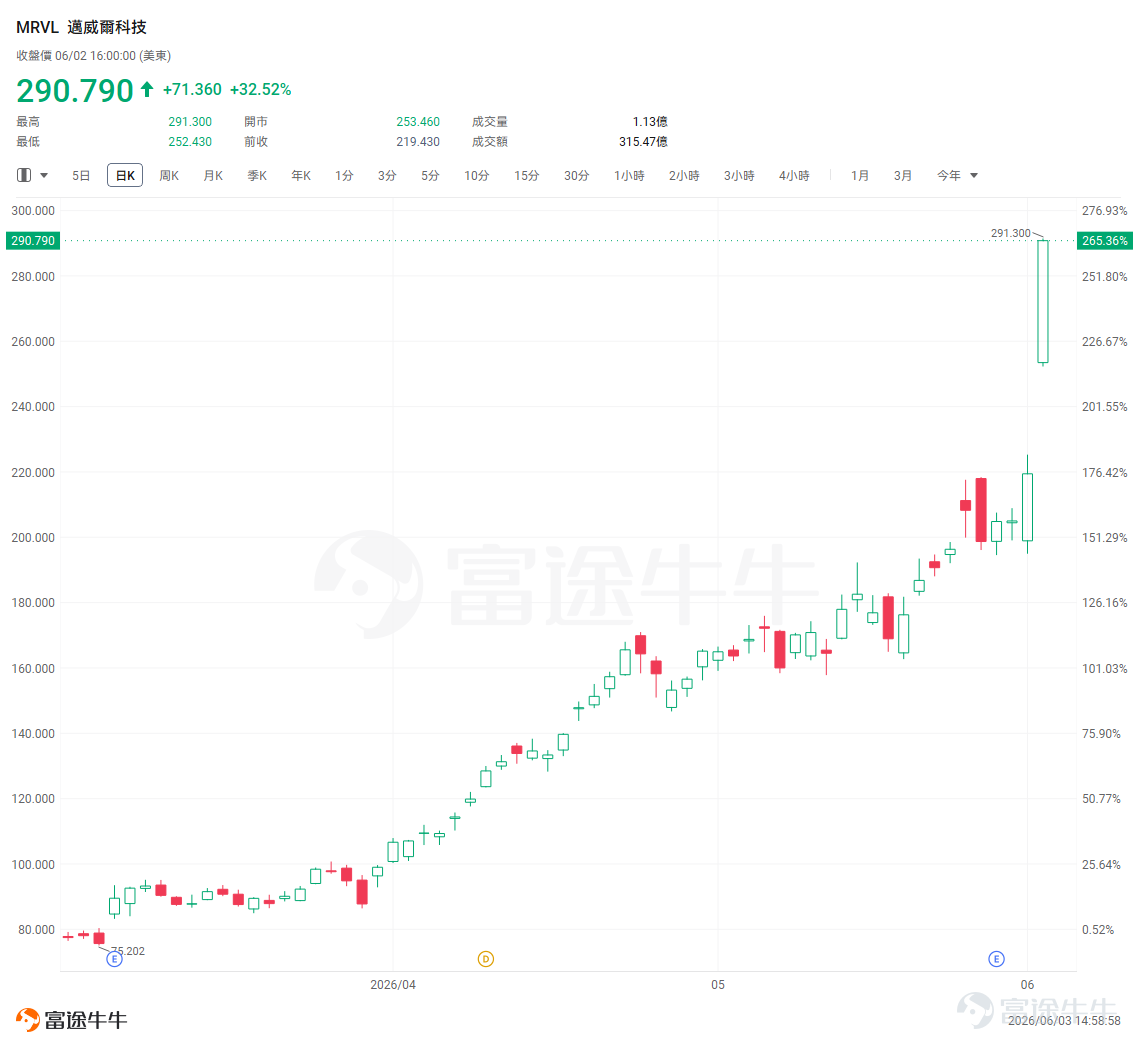
$Marvell Technology (MRVL.US)$ Marvell became one of the standout names in the US AI hardware segment yesterday. On June 2, MRVL shares surged 32.5%, directly catalyzed by NVIDIA CEO Jensen Huang’s public comments during Computex, where he stated Marvell could become 'the next trillion-dollar company.'
and lifted the entire 'optical' sector, $Lumentum (LITE.US)$ up 13.72%, $Coherent (COHR.US)$ up 17.63%, $Corning (GLW.US)$ up 13.4%.

From the market reaction, Marvell’s sharp rally this time stems from three key factors.
First, Jensen Huang’s public endorsement significantly boosted market attention.NVIDIA is currently the central pricing anchor in the AI computing supply chain, and Jensen Huang’s comments on companies in this ecosystem are often viewed by the market as validation of industry direction. After Marvell was specifically named, capital quickly repriced it from an 'AI hardware beneficiary' to a 'core AI infrastructure supplier.'
Second, bottlenecks in AI data centers are shifting from individual chips to the system level.In the past, the market focused most on GPUs, HBM, and full server systems—components that are highly visible and easiest to validate through earnings.However, as AI clusters grow ever larger, raw compute power alone is no longer sufficient; the efficiency of data transfer between chips, servers, and racks is becoming equally critical.If data movement can’t keep pace, even the most powerful GPUs may suffer from lower utilization rates.
Third, Marvell’s recent earnings and guidance have given the market further reason for optimism.The company reported revenue of $2.418 billion for its latest fiscal quarter, up 28% year-over-year—a record high—and non-GAAP earnings per share of $0.80. More importantly, it provided a midpoint revenue guidance of $2.7 billion for the next fiscal quarter, implying 35% year-over-year growth.Management also explicitly stated that AI-related orders remain strong and raised its revenue outlook for fiscal years 2027 and 2028.
This indicates that its AI-related demand is already reflected in orders, revenue, and medium-term targets.
Second, what exactly does Marvell do? It is the 'high-speed data highway company' within AI data centers.
For average investors, Marvell’s business is indeed less straightforward to understand than NVIDIA’s or AMD’s. $NVIDIA (NVDA.US)$ selling GPUs, $Advanced Micro Devices (AMD.US)$ selling CPUs and GPUs—products that clearly carry the 'computing chip' label.Marvell is more like a company that builds roads, bridges, and transportation hubs inside AI data centers.
This can be understood through the lens of the industrial supply chain.
At the heart of an AI data center are computing chips—such as GPUs, XPUs, and CPUs—which handle computations. However, large model training and inference aren’t accomplished by a single chip alone; instead, they require thousands of chips working in concert. These chips must transfer data among themselves, servers need to exchange data, and racks must be connected at high speeds. In this process, networking, switching, optical interconnects, and customized chips become critically important.
Marvell primarily offers several product categories. Breaking it down, the data center business is the core engine.
Data center revenue in the first quarter was approximately $1.83 billion, up 27% year-over-year, accounting for more than 75% of total revenue. This indicates that Marvell’s revenue mix has clearly shifted toward AI and cloud data centers.
1、The first category is custom chips, also known as ASICs.
Cloud providers want to design chips better suited to their own AI workloads to reduce power consumption, improve efficiency, and decrease reliance on a single general-purpose GPU supplier.Marvell can offer these customers customized chip design capabilities, including XPUs and supporting chips surrounding the XPU.
Cloud providers continue to expand their AI-related capital expenditures. Hyperscale cloud vendors such as Microsoft, Amazon, Google, and Meta are still building AI data centers.As long as this capital spending continues, demand for Marvell’s data center chips will have solid underlying support.The company also stated that its current growth is primarily driven by its data center business, and AI-related orders remain strong.
Cloud providers developing their own chips is already a major trend. $Amazon (AMZN.US)$ Amazon has Trainium, $Alphabet-C (GOOG.US)$ Google has TPU, $Microsoft (MSFT.US)$ 、 $Meta Platforms (META.US)$ Other companies are also advancing their own AI chip roadmaps. Marvell does not need to directly challenge NVIDIA GPU's dominance; its opportunity lies in helping cloud providers design custom chips and generating revenue through complementary components such as XPUs, CXL, NICs, and optical interconnects. The company has previously stated a target of over $10 billion in custom chip revenue by fiscal year 2029, offering the market a clear long-term vision.
2. The second category is optical interconnect chips, particularly optical DSPs.AI data centers handle enormous volumes of data, and traditional copper cables face limitations in terms of distance, power consumption, and bandwidth.Marvell’s optical DSP can be understood as the 'signal processing brain' inside optical modules,responsible for converting and correcting high-speed electrical signals and enabling fiber-optic transmission. As data centers upgrade from 400G and 800G toward 1.6T, the value contribution of optical DSPs will continue to increase.
3. The third category is data center switch chips.The growing number of AI servers and accelerator cards is making network architectures increasingly complex.Switch chips act as traffic hubs within data centers, determining whether data can flow with low latency and high throughput.Marvell’s Teralynx series of switch chips targets cloud and AI data centers, with the latest Teralynx T100 delivering 102.4 Tbps, emphasizing low power consumption, low latency, and high bandwidth.
4. The fourth category includes Ethernet controllers, PHYs, storage, and CXL-related products.These products may not seem exciting in isolation, but they serve as critical infrastructure within large-scale AI clusters. The larger the AI data center, the greater the complexity of data movement, memory expansion, network connectivity, and storage access—driving up demand for foundational chips like those from Marvell.
Put simply, NVIDIA primarily addresses the 'compute speed' challenge, while Marvell focuses more on 'fast connectivity, reliable data transmission, and low power consumption.' As AI clusters grow larger, the market is increasingly likely to reprice the importance of the latter.
3. Is it still worth buying at current prices? The long-term thesis is compelling, but short-term entry carries significant risk.
From a medium- to long-term perspective, Marvell deserves a spot in the core watchlist for AI hardware.Its business is well-positioned, sitting precisely at the critical juncture where AI data centers shift from 'piling on compute power' to 'optimizing system efficiency.'All three product lines—optical interconnects, switching chips, and custom chips—are backed by strong industry trends, and the company has a solid customer base and robust product portfolio.
After a single-day surge of over 30%, the stock price has already fully priced in the sentiment boost from Jensen Huang’s endorsement and the market’s revaluation of AI interconnects. While Marvell’s investment case is clear, risks remain elevated: first, such a sharp short-term rally increases the likelihood of profit-taking; second, the market’s tolerance for any growth shortfall over the next few years has diminished. Its forward P/E ratio has already reached 118x, reflecting expectations that it will be a core AI infrastructure player—pricing in high growth for many years ahead. Any deceleration in growth momentum would likely trigger an immediate market reaction.
Second is competitive risk. $Broadcom (AVGO.US)$ Other players are also strong in custom AI chips and networking chips. Although Marvell holds an advantageous position, it is not the only participant in this space.
Third is customer concentration and project-cycle risk. Custom chip projects are large in scale but have long development cycles, which can lead to uneven revenue recognition. Changes in cloud providers’ capital expenditure plans, shifts in chip architecture strategies, or project delays could all impact the company’s revenue.
Technically, the stock is extremely strong,All moving averages are aligned in a bullish formation, MACD momentum continues to expand, and the breakout to a new all-time high was accompanied by massive volume and net inflows from institutional capital. However,The current share price (USD 331.2 in after-hours trading) has significantly surpassed the 5-day moving average (MA5) of USD 223.75, resulting in a positive deviation rate of approximately 48%. The medium- to long-term trend remains exceptionally bullish, butin the short term, price exhibits gravitational pull toward the moving averages.
In the options market, implied volatility (IV) for June 2 options has surged to 89.99%, placing it at the 95th percentile of its historical IV range; the Put/Call ratio stands at just 0.62, reflecting extremely bullish market sentiment;During the session, an unusually large order emerged: selling June 26-expiry call options with a USD 235 strike price, collecting USD 8.82 million in premiums—a clear sign of institutional players collecting premium at elevated levels. After-hours trading has already pushed the price above USD 332. Upside moves may accelerate quickly due to sparse existing options positions above this level, meaning there’s no clear near-term 'ceiling.' Should the rally fail, however, the pullback could be swift, with profit-taking potentially driving prices directly back to USD 320, USD 300, or even around USD 290.
Short-term traders who choose to participate should strictly manage position size and monitor: first, whether the stock can sustain a high-level consolidation after its sharp rally rather than rapidly falling back into the breakout zone; second, whether the broader AI hardware ecosystem—including NVIDIA, Broadcom, optical modules, and memory—can continue to show synchronized strength. If only Marvell surges while the sector begins to cool off, the risk of chasing the rally in the short term will rise significantly.
A more prudent approach is to adopt a scenario-based strategy. Regarding options strategies:
(1) For investors already holding positions: if you currently own the underlying stock and do not wish to sell in the short term but are concerned about a potential pullback following a gap-up open
Covered calls can be used to enhance returns. If the stock continues to rise after the market opens, you can sell short-term out-of-the-money calls to collect premium from elevated implied volatility (IV), while retaining some upside exposure. This strategy suits investors who are comfortable holding the underlying stock but want to generate additional cash flow in a high-volatility environment.
As long as the stock price doesn't rise above this strike price, the shares won’t be called away, and you’ll keep the premium. However, if the stock price breaks above this level, you forgo the additional gains your underlying position could have otherwise captured.
(2) For investors without an existing position who wish to buy on dips
This approach is suitable for investors who are bullish on MRVL’s medium-term fundamentals but don’t want to chase the current high price, preferring instead to wait for a pullback or use option premium to create a cushion. A better entry strategy would be to wait for the stock to retest key support levels following its recent surge, while monitoring whether trading volume contracts and sector sentiment remains intact. If the AI semiconductor theme remains strong and buying interest emerges on any pullback, consider entering via a sell-put strategy.
However, it’s important to note that selling puts requires sufficient margin collateral. This strategy is best suited for investors who are already willing to take delivery of the shares, as MRVL is currently highly volatile—should the stock gap up and then reverse sharply, the risk exposure from being assigned shares increases significantly.
(The figure below illustrates the simulated profit and loss scenario of this strategy on the expiration date. The design image displayed on the screen is for demonstration purposes only and does not constitute any investment advice or guarantee; market conditions fluctuate frequently, and the prices shown do not represent actual values.)

Finally, Option Sir brings a small perk for fellow investors, welcome to claim it.Options Beginner Pack
*This event is exclusive to invited HK users. Click to learn more.Detailed event rules>>
Market conditions are complex and volatile,Options StrategyOverwhelmed by choices? Futubull helps you build a portfolio in three steps.Options Strategymaking investing simple and efficient!

Option Risk Warning:An option is a contract that grants the holder the right, but not the obligation, to buy or sell an asset at a fixed price on a specific date or at any time before that date. The price of an option is influenced by various factors, including the current price of the underlying asset, the strike price, time to expiration, and implied volatility. Implied volatility reflects the market’s expectations for the level of volatility in the option over a future period. It is a data point derived inversely from the Black-Scholes option pricing model and is generally regarded as an indicator of market sentiment. When investors anticipate greater volatility, they may be more willing to pay a higher price for options to hedge risks, resulting in higher implied volatility. Traders and investors use implied volatility to assess the attractiveness of option prices, identify potential mispricings, and manage risk exposure.
Disclaimer:This content does not constitute any offer, solicitation, recommendation, opinion, or guarantee of any securities, financial products, or tools. The risk of loss in trading options can be substantial. In some cases, losses may exceed the initial margin deposited. Even if you set contingent orders such as 'stop-loss' or 'limit' orders, these may not prevent losses. Market conditions may make such orders unexecutable. You may be required to deposit additional margin within a short period. If you fail to provide the required amount within the specified time, your open positions may be liquidated. However, you will still be responsible for any shortfall in your account. Therefore, before trading, you should study and understand options and carefully consider whether such trading is suitable for you based on your financial situation and investment objectives. If you trade options, you should be familiar with the procedures for exercising options and the rights and obligations upon exercise and expiration. Options trading carries extremely high risks and is not suitable for all investors. Investors should carefully readCharacteristics and Risks of Standardized Options。
Risk Disclaimer: The above content only represents the author's view. It does not represent any position or investment advice of Futu. Futu makes no representation or warranty.Read more


Comments (5)
to post a comment
41
191