
Hong Kong Market Barometer: CPO, PCB, and memory stocks rally in rotation! Are you on the right trai

Long time no see! Hong Kong-listed 'legacy tech' stocks are staging a collective comeback! Which names are quietly gaining momentum?
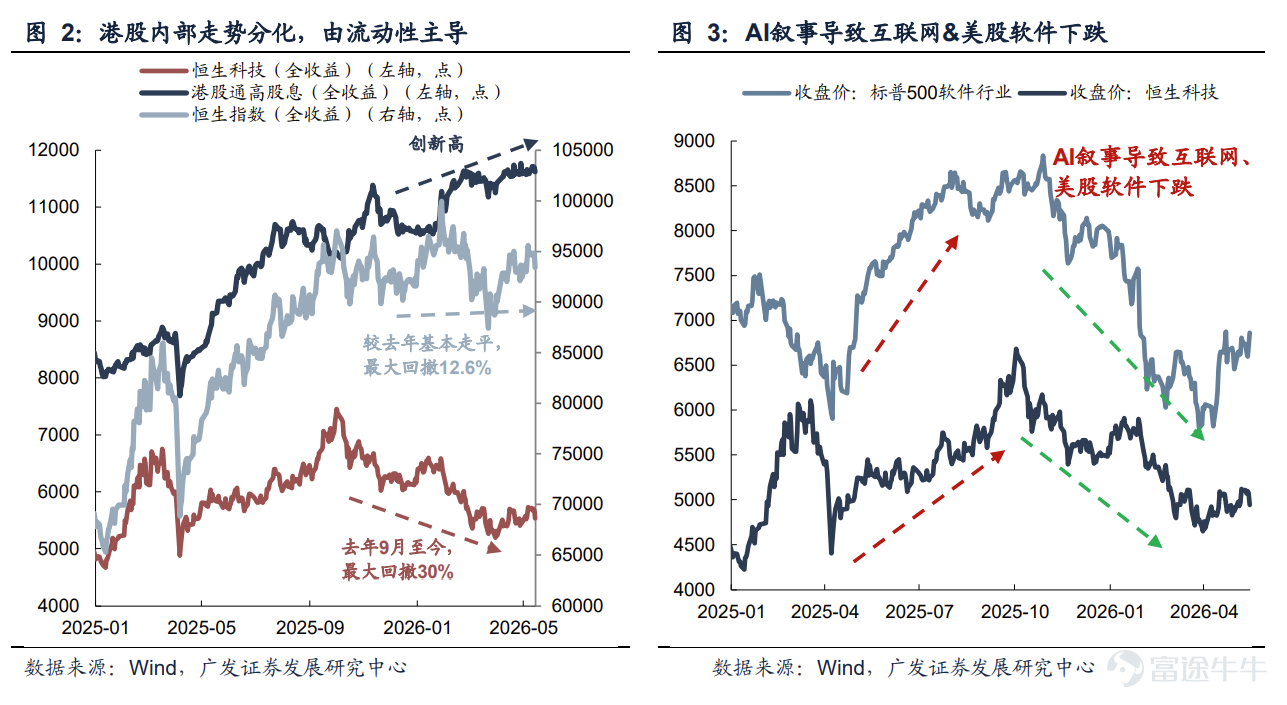
Entering 2026, the Hong Kong stock market has shown clear divergence, with capital no longer blindly chasing all tech-related concepts,On one hand, investors are focusing on 'hardcore assets' with tangible orders, clear business models, and valuation advantages—sectors like memory storage and optical communications have taken off; on the other hand, established tech names such as Tencent, Alibaba, Meituan, and Kuaishou are struggling, dragging the Hang Seng Tech Index to repeated new lows.Southbound capital is simultaneously increasing positions in hardware stocks benefiting from the AI supply chain and allocating to stable, high-dividend sectors amid the dividend-spreading rally.
In its mid-year outlook, CITIC Securities noted that the valuation floor for Hong Kong equities has stabilized, with incremental capital expected in the second half of the year. It recommended focusing on five key themes: high-growth tech segments; stable, high-dividend sectors serving as 'bond proxies' in the context of the dividend-spreading rally; innovative drug developers during a period of dense data catalysts; and CXO companies building high barriers through positive feedback loops.

Recently, market leadership in Hong Kong has shifted significantly,Previously favored 'hardcore tech' segments have undergone corrections, while traditional sectors—such as consumer discretionary, real estate, and utilities—and some re-evaluated 'legacy tech names' have risen against the trend, becoming the main destination for market capital flows.
On June 2, Hong Kong stocks staged a long-awaited rebound, $Hang Seng Index (800000.HK)$ rising more than 2%, $Hang Seng TECH Index (800700.HK)$ Increased over 4%, $TENCENT (00700.HK)$ Intraday gains briefly exceeded 10%, $MEITUAN-W (03690.HK)$ Up nearly 9%, with the five tech giants rallying collectively, fueling market sentiment.

This phenomenon, colloquially dubbed by the market as 'old money rotation,' is not merely a simple sector rotation but a value reassessment driven by the convergence of multiple macroeconomic, industrial, and capital flow factors. Which specific stocks are quietly gaining momentum? This article will delve into the underlying logic behind this market style shift and uncover investment opportunities across various sub-sectors.
Established Tech Names: Rotation from High to Low Valuations and Value Reassessment
Pessimism toward large-cap Chinese internet stocks listed in Hong Kong has neared its peak, $TENCENT (00700.HK)$ trading at a P/E ratio in the lowest 5% range over the past year, $KUAISHOU-W (01024.HK)$ with a P/E ratio of just 10.43. Dongwu Securities believesthat the spillover effect from overseas tech rallies could resonate with Hong Kong-listed tech stocks. Currently, the overseas tech rally is spreading from AI hardware upstream to application software and downstream segments.
Large-cap Internet Stocks: $MEITUAN-W (03690.HK)$ Q1 2026 earnings came in better than expected, with operating losses narrowing significantly. The stock saw a long-awaited surge post-earnings. Tencent reported Q1 free cash flow of RMB 56.7 billion, and its Non-IFRS operating profit margin remained stable. With earnings disclosed and market expectations stabilizing, a rebound wave appears likely.
Near-term catalysts: 1)Accelerated commercialization of AI applications. According to multiple financial media reports, WeChat’s AI assistant, operated by Tencent, has officially launched a subscription-based pricing model using a tiered 'membership' structure. In Q1 this year, Tencent’s capital expenditures totaled approximately RMB 31.2 billion, with a significant portion allocated to AI infrastructure. Investors had previously worried about 'burning cash without returns,' but now that WeChat AI is directly charging users, the 'cash-burning' narrative finally has a monetization loop.Hong Kong-listed 'ATM' stocks resonate, collectively igniting sector sentiment, as the Hong Kong-listed 'ATM' trio— $BABA-W (09988.HK)$ , Tencent, and Meituan rally together, offering struggling tech stocks potential catch-up gains.

Additionally, market funds recentlyhave shifted toward established tech giants that have already achieved commercialization in the AI wave and are seeing strong order backlogs.As the global leader in computing power and a core supplier of AI servers, $LENOVO GROUP (00992.HK)$ reported record-high revenue for Q4 of fiscal years 2025/26, with total revenue up 27% year-over-year and AI-related revenue surging 84% YoY. Its order backlog exceeds RMB 140 billion (approximately USD 21 billion), reflecting tangible order fulfillment and continued investor favor. Lenovo’s shares have risen over 100% since its earnings announcement, triggering a systemic re-rating of its valuation.
Veteran players in the software and SaaS sectors are also welcoming a springtime. $KINGDEE INT'L (00268.HK)$ On June 1, 2026, the stock surged nearly 19% in a single day, directly catalyzed by the acceleration of its AI commercialization. The company’s Q1 AI suite contract value has already reached RMB 230 million, equivalent to 65% of its full-year 2025 total. The market now expects its AI suite revenue in 2026 to exceed RMB 1 billion, overturning prior skepticism about the difficulty of monetizing AI features in SaaS businesses.
Power Sector: Dual Drivers of Pro-cyclical Demand and AI Computing Power
Extreme high temperatures driven by El Niño have pushed electricity demand beyond expectations, while massive green energy requirements from AI infrastructure such as data centers have led to robust supply and demand for domestic power generators.The Hong Kong-listed power sector has gained over 12% year-to-date, with $DATANG POWER (00991.HK)$ 、 $HUANENG POWER (00902.HK)$ 、 $CHINA RES POWER (00836.HK)$ 、 $HARBIN ELECTRIC (01133.HK)$ 、 $CHINA POWER (02380.HK)$ multiple stocks delivering impressive gains.
Huaneng Power International: From 'Thermal Power Giant' to Leader in 'Power-Compute Synergy.' The company maintains a solid core business, reporting RMB 14.41 billion in attributable net profit for 2025, up 42.17% year-over-year. Its current share price implies a forward P/E ratio of approximately 9.05x for 2026 and a dividend yield of 3.9% (H-shares), offering a strong margin of safety. Unlike most power companies that merely supply electricity to data centers,Huaneng Power International has opted for a 'hands-on' approach by building and operating its own intelligent computing centers,with plans to invest RMB 30–50 billion between 2026 and 2028to construct a nationwide 'Power-Compute Hub Network' featuring 'Eastern inference + Western training.', with a long-term aggregate computing power target of 70,000–100,000 PFLOPS. If revenue from computing power services continues to rise as a share of total revenue, its valuation framework could shift toward that of the technology infrastructure sector (15–20x P/E).
China Power International Development:Key beneficiary of green electricity transition and 'computing-power synergy'. As of the end of 2025, the company’s controlled installed capacity will reach 54.75 GW, of which clean energy (hydropower, wind, and solar) accounts for as much as 82%—a leading position among major power generation groups. According to Huayuan Securities forecasts, the company’s attributable net profit (after deducting perpetual bond interest) for 2026–2028 will be approximately RMB 2.5 billion, RMB 3.0 billion, and RMB 3.3 billion, respectively, implying current P/E multiples of 16x, 13x, and 12x. The stock price has recently continued to rise, hitting a new year-to-date high of HK$3.85.

Consumer Staples and Healthcare: Defensive Allocation
As capital had previously been overly concentrated in hard-tech sectors, some undervalued, high-dividend consumer staples and innovative drug segments are now attracting capital rotation from high- to low-valuation areas and defensive positioning.
$POP MART (09992.HK)$ : The market has overly worried about its slowing overseas growth while underestimating two key facts:Its domestic core business has demonstrated exceptional resilience, with Q1 revenue surging 100%–105% year-over-year and online segment growth exceeding 150%, reflecting significant success in core IP iteration and operational optimization.Its overseas strategy is undergoing critical adjustments, shifting from reliance on traffic driven by the LABUBU single IP to deepening store quality and brand operations. The company's stock price has retraced more than 40% from its peak, and with the ongoing strategic adjustments, its future growth potential warrants attention.
Innovative drugs: The sector has delivered relatively muted performance so far this year. Last year, BD-driven sentiment in innovative drugs led to significant excess returns for the subsector, but 2024 marks a period of realization, during which companies with weaker execution have weighed down index performance. Founder Securities notes,The innovative drug sector has officially entered a profitability cycle, with recurring BD-related revenue driving rapid net profit growth, and multiple companies now entering a commercial breakout phase.Future opportunities will concentrate on: 1) benchmark companies that have successfully executed BD deals and are about to receive sales royalties; and 2) industry leaders whose core products are entering commercial-scale ramp-up. $WUXI APPTEC (02359.HK)$ 、 $BEONE MEDICINES (06160.HK)$

Market rallies are often born in despair—the long-awaited surge in Hong Kong stocks is truly uplifting! However, investors are also reminded to invest rationally and identify high-quality names backed by solid fundamentals and valuation recovery potential.The essence of value investing is buying the future of exceptional companies at reasonable prices.
Key risks to closely monitor in the Hong Kong equity market include:
Overseas policy and liquidity risks: Uncertainty remains around the Federal Reserve’s monetary policy trajectory and geopolitical factors, which could trigger foreign capital outflows and increase overall volatility in the Hong Kong stock market.
Economic recovery falling short of expectationsIf domestic consumer spending recovers weakly and downward pressure persists, it will directly impact the earnings of large consumer companies and their related supply chains, dragging down overall market sentiment.
Geopolitical conflict riskThe current U.S.-Iran conflict remains unresolved; a major geopolitical clash would worsen global risk appetite, prompting capital outflows from emerging markets—including Hong Kong-listed stocks—and exacerbating market liquidity dry-ups.
Risk Disclaimer: The above content only represents the author's view. It does not represent any position or investment advice of Futu. Futu makes no representation or warranty.Read more


Comments (10)
to post a comment
34
73