Tengsi · IPO Subscription Strategy | Which money market fund is most profitable? Can you use money market funds for IPO subscriptions?! Backtested returns of RMB 10,000 over 232 trading days!


What Is a Money Market Fund?
A money market fund, formally known as a Money Market Fund (MMF), is a low-risk investment product primarily investing in short-term money market instruments. Its underlying assets typically include government treasury bills, bank certificates of deposit, commercial paper, and repurchase agreements—financial instruments characterized by extremely high liquidity and low credit risk.
Within Futu's platform ecosystem, Hong Kong dollar-denominated money market funds are typically offered to investors under the name"Cash Plus"Its core purpose is not as a high-return investment vehicle, but rather as a cash management tool for idle HKD funds in securities accounts—designed to generate returns significantly higher than traditional bank demand deposits while enabling rapid liquidity to seize stock market investment opportunities when needed.
Post-Purchase Return Mechanism and Core Features
After purchasing a Hong Kong dollar money market fund, the most immediate benefit investors receive is earning stable returns on idle HKD cash held in their securities accounts.
Unlike non-interest-bearing cash sitting idle in a securities account, money market funds continuously generate interest income from their underlying assets, thereby delivering steady daily returns to investors.
It is particularly worth noting thateven on non-fund trading days such as weekends and public holidays, as long as investors continue to hold fund units, the underlying assets invested in by money market funds are stillcontinuously generating interest income, so the calculation of returns is continuous and uninterrupted.
The only difference is that earnings accrued on non-trading days will only be reflected in the holding’s market value after the fund company updates the net asset value (NAV) on the next trading day evening.be reflected all at once, this is not a loss of earnings, but merely a delay in data presentation.
However, the value of investing in money market funds goes far beyond just earning returns. After activating"Cash Plus Auto Subscription/Redemption"and"Margin Account"features, investors can have their money market fund holdings counted toward stock trading purchasing power at a 95% conversion rate, thereby maximizing capital efficiency.
For example, if an investor holds HK$10,000worth of HKD Cash Plus, they can obtain approximatelyHK$9,500of additional cash buying power; when trading US stocks, the system will convert this into equivalent USD margin buying power.
It is important to emphasize that this feature is only available for margin accounts (commonly known as"Margin Account"), and cash accounts, even if they have enabled automatic subscription/redemption functionality, cannot access this buying power.
Strategy of using money market funds for IPO subscriptions ("IPO flipping")
For investors looking to participate in Hong Kong IPO subscriptions, HKD-denominated money market funds can serve as a highly efficient cash management tool.
To use held HKD money market fund shares for IPO subscriptions, the key prerequisite is that the investor must have a"Margin Account"and enable"Cash Plus Auto Subscription/Redemption"feature allows Cash Treasure holdings to automatically provide 95% of their value as purchasing power for new stock subscriptions once eligibility criteria are met, without requiring manual redemption—meaning investors can participate in new share offerings using the asset value of their money market fund shares without actually selling them.
A particularly commendable design aspect is that during the period when investors use their Cash Treasure quota for new stock subscriptions, the corresponding money market fund sharesare not actually redeemed, and therefore continue to generate daily returns according to the money market fund's rules,including weekends and holidays—this fundamentally differs from the alternative approach of manually redeeming Cash Treasure first and then using cash to subscribe, as the latter ceases to accrue returns once the fund shares are confirmed as sold, whereas the former achieves"having your cake and eating it too"effect.
Interpretation and proper evaluation methods for yield metrics
When evaluating money market fund returns, investors often encounter a common confusion: why does the 7-day annualized yield shown on the app differ from the actual annualized return they receive after holding the fund for seven days?
To understand this issue, it's essential first to clarify two key return metrics of money market funds and their fundamental differences.
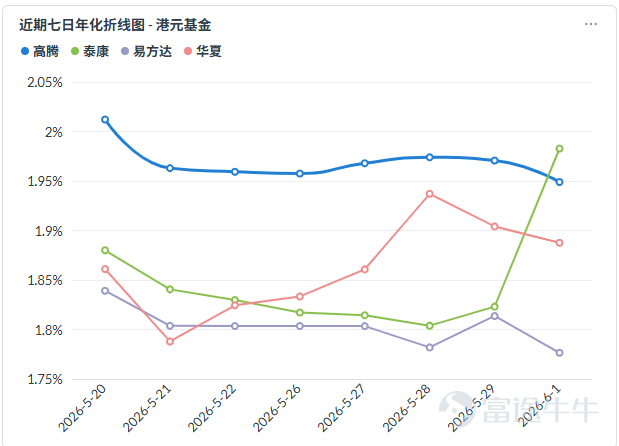
The first metric isthe 7-day annualized yield, which represents the annualized average of the fund’s net returns over the past seven days, including the current day.
By nature, it is a historical, backward-looking indicator, primarily used to smooth out daily fluctuations and facilitate comparisons of recent performance across different money market funds.
However, its key limitation is that it does not represent an investor’s actual future returns—the 7-day annualized yield seen at the time of purchase reflects the fund’s performance over the prior seven days. Once market interest rates change, the fund’s holdings mature, or the fund manager makes portfolio adjustments, the fund’s future returns may already differ significantly.
The second metric isthe daily yield per 10,000 units, which indicates the actual earnings generated on a given day from holding 10,000 units (equivalent to RMB 10,000) of the fund. Unlike the 7-day annualized yield, this is a realized, same-day metric that directly reflects the fund’s actual daily earning power.
The total return an investor earns over a seven-day holding period is the sum of the daily returns per 10,000 units during those seven days. Annualizing this total return yields the investor’s actual annualized return for the holding period.
Since the 7-day annualized yield is based on historical data, while the holding-period return depends on the fund's actual future performance, the two metrics are calculated over entirely different timeframes—making any discrepancy between them perfectly normal.
So, how should investors choose the most accurate evaluation metric?
The most reliable evaluation method is not to focus on the 7-day annualized yield at a single point in time, but rather to observe the long-term stability of the daily return per 10,000 units, especiallythe daily return per 10,000 units during holidays.
During holidays, the fund cannot trade, so its returns come solely from interest income on its holdings, with no interference from capital gains strategies. Therefore, multiplying the holiday daily return per 10,000 units by 365 provides a close approximation of the money market fund’s true static yield level.
By using this approach, investors can look beyond surface-level metrics and assess the fund’s core ability to generate stable interest income, enabling more informed investment decisions.
Optimal Timing Strategy for Subscription and Redemption
For this HKD money market fund on the Futu platform that supports T+0 interest accrual, the timing of subscription and redemption directly impacts an investor’s actual returns. Therefore, mastering the optimal execution timing is crucial.
* Regarding subscriptions, the core principle can be summarized in one sentence:The earlier you subscribe, the better the deal.。
This fund uses T+0 interest accrual—meaning that subscriptions submitted on a given day start earning returns immediately, which is a rare and investor-friendly feature—but only if the subscription request is submitted before 9:00 a.m. Hong Kong time on a trading day.
If submitted after 9:00 a.m., interest accrual will be deferred to the next trading day, meaning investors will lose an entire day of returns.
For example, if an investor submits a subscription at 8:50 a.m. on Monday, interest starts accruing that same day (Monday), the first returns will appear on Tuesday, and returns will accrue for all five trading days that week. However, if the subscription is submitted at 9:10 a.m. on Monday instead, interest won’t begin until Tuesday, with the first returns appearing on Wednesday—resulting in the complete loss of Monday’s returns.
Particular attention should be paid to subscriptions made on Fridays and the last trading day before extended holidays.
If a subscription is submitted before 9:00 a.m. on Friday, interest begins accruing that day. Although Saturday and Sunday are non-trading days, money market funds continue generating returns over the weekend, allowing investors to fully capture three days of returns from Friday through Sunday.
Similarly, completing a subscription before 9:00 a.m. on the last trading day before a long holiday (such as Chinese New Year, Qingming Festival, or Labor Day) enables investors to earn continuous returns throughout the entire holiday period—a classic strategy for maximizing yield.

*Regarding redemptions, the optimal strategy is exactly the opposite:Redeem as late as possible—ideally at the very last moment before you actually need the funds.。
HighTeng Money Market FundsSupports both standard redemption and instant redemption. For standard redemption, if submitted before 9:00 AM on a trading day, funds will be availableby 8:00 PM the same dayand earnings are still accrued for that day. With instant redemption, although funds can be used immediately for stock trading or new share subscriptions, you forfeit that day's earnings and incura 0.06% service fee.。
Therefore, unless funds are urgently needed, investors should prioritize standard redemption and complete the transaction before 9:00 AM to ensure same-day availability without sacrificing that day’s earnings.
It’s especially important to avoid redeeming on Fridays or before holidays—for example, redeeming at 8:50 AM on Friday ensures funds arrive by 8:00 PM that evening, but you’ll lose earnings for Friday and the entire weekend;
if the funds aren’t needed until the following Monday, you could instead wait until 8:50 AM on Monday to redeem, allowing your money to fully accrue three days of weekend earnings in the money market fund.

Backtested daily earnings per 10,000 RMB over the past 232 trading days for GaoTeng series money market funds

Earnings in July–August 2025 were relatively low, averaging about 0.46–0.48 per day, possibly due to lighter summer market activity;
December 2025 was the highest-earning month of the year, with total earnings of 20.84 and a daily average of 0.99.
The return distribution is right-skewed, with most returns concentrated in the HK$0.5–0.7 range. Returns exceeding HK$1.5 occur on the first trading day after Mondays or holidays, representing aggregated returns from weekends or holidays.
Investor perspective: If daily returns per HK$10,000 frequently fall within HK$0.55–0.7 over the past seven trading days, investors should decisively increase their positions.

Annualized return is approximately 2.88%. Returns clearly stepped up after September 2025, rising from an annualized 1.5% to over 3% annualized.
Aside from Mondays, daily returns are stably within the HK$0.5–0.6 range with minimal volatility, and the return distribution remains right-skewed.
Investor perspective: If daily returns per HK$10,000 frequently fall within HK$0.55–0.7 over the past seven trading days, investors should decisively increase their positions.
In conclusion
Generally speaking, the returns of HKD/USD money market funds exhibit the strongest correlation with short-term U.S. Treasury yields. $U.S. 1-Year Treasury Bills Yield (US12M.BD)$ Given current market pricing—where interest rates remain unchanged or may even rise—HKD/USD money market fund returns will likely stay stably at historically high levels.
Investors should closely follow our weekly Monday noon (2:00 PM) updatesGaozhan Weekly Rate Analysis | Iran Claims Permanent Control of the Strait! Is the Ghost of Rate Hikes Returning?series to monitor FOMC meeting minutes and interest rate decisions, Middle East developments over the past week, and global central bank activity.
Beyond IPO subscriptions, we have consistently been $GaoTeng WeInvest Money Market Fund (HK0000478930.MF)$ Waiting for you here.

Risk Disclaimer: The above content only represents the author's view. It does not represent any position or investment advice of Futu. Futu makes no representation or warranty.Read more


Comments
to post a comment
6
3