
South Korea’s Top Two Memory Chip Players: Outlook Under Leverage Rules & Central Bank Tightening

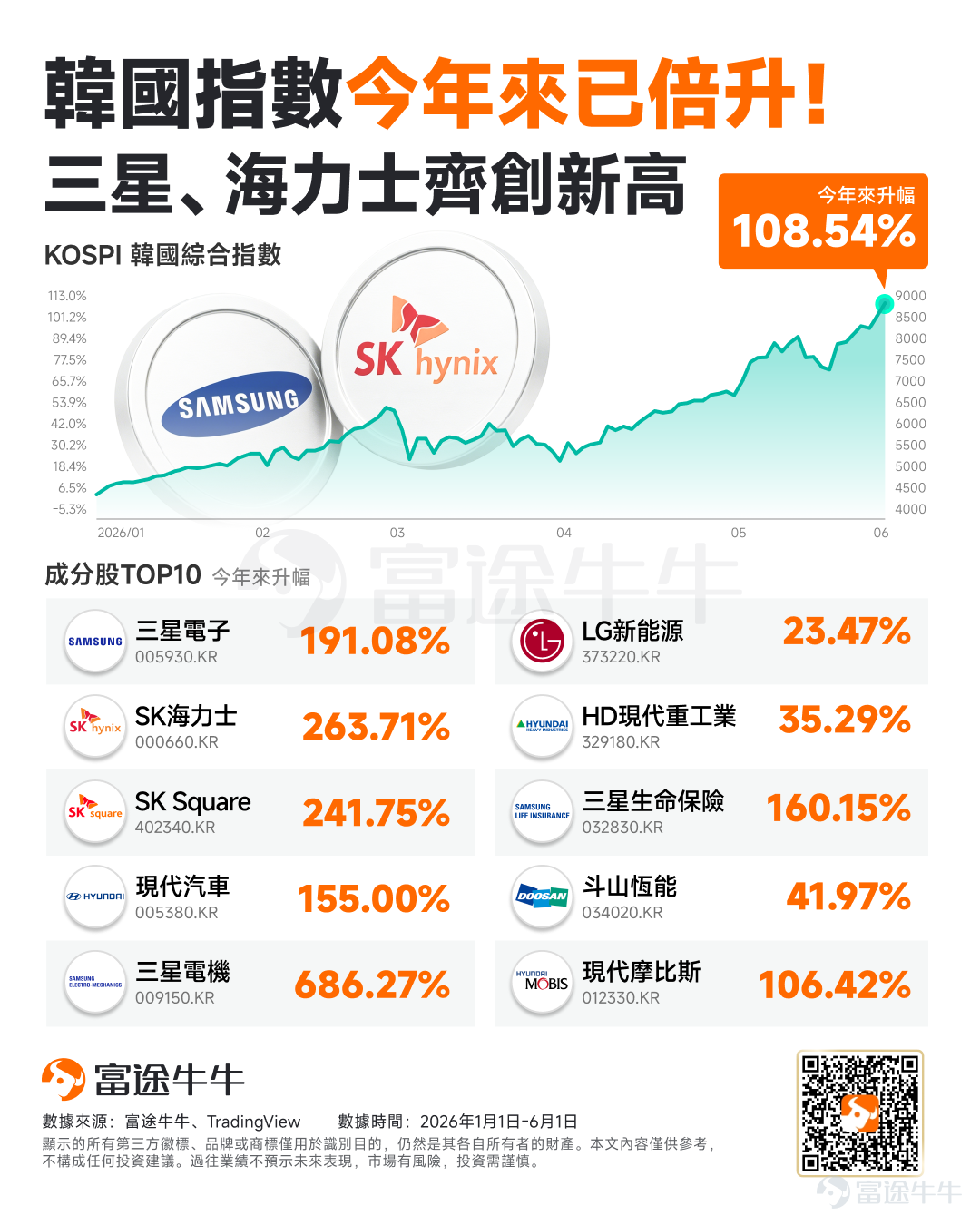
Korea’s benchmark index has doubled year-to-date! Samsung and SK Hynix have surged to record highs—what’s next for this epic rally?
It’s hard to imagine that a benchmark stock index of a major economy could double in less than six months—but South Korea’s stock market has done exactly that.
Since the beginning of this year, South Korea’s stock market has surged by 100%, surpassing the historic rallies seen just before the dot-com bubble burst and during South Korea’s late-1980s industrial boom.
Looking at a longer timeline, one year ago, the index $Korea Composite Index (.KOSPI.KR)$ was still hovering around the 2,600 level. Now, driven powerfully by core assets— $SK Hynix (000660.KR)$ And, $Samsung Electronics (005930.KR)$ the twin AI semiconductor leaders—the broader market has skyrocketed from the 5,000 mark to nearly 8,800 points within just a few months. This more-than-double cumulative gain is continuously reshaping global capital allocation patterns.

Faced with this epic rally, the market’s central concern is: what is the fundamental catalyst behind this surge? Is it earnings realization driven by the AI wave, or short-term sentiment-driven capital flows? More importantly, as the KOSPI index pushes into new highs near 8,800, will South Korea’s stock market top out at these elevated levels—or is this the beginning of a sustained bull market?
What is the underlying catalyst behind this explosive rally?
To understand why the Korean index has been hitting new highs, we cannot simply attribute it to short-term sentiment-driven capital flows. This is a reaction catalyzed byrobust industrial fundamentalsandand foundational institutional breakthroughstogether creating a chemical reaction that has triggered the classic 'Davis double play' in the capital markets.
1. Solid support from the industry cycle: Tangible 'earnings realization' by AI giants
Unlike the dot-com bubble era—where there were concepts but no profits—this surge in South Korea’s stock market is backed by exceptionally strong fundamentals.
As a core global supplier of AI computing infrastructure, $SK Hynix (000660.KR)$ its monopolistic advantage in HBM (High Bandwidth Memory), along with $Samsung Electronics (005930.KR)$ The dual tailwinds from advanced packaging and the recovery in memory chips have enabled these two giants to fully capitalize on the global AI arms race.
This is not an unfounded expectation, but rather a tangible geometric surge clearly reflected in their financial reports. The explosive earnings performance of these AI titans (driving EPS growth) has provided the core impetus behind the market’s dramatic rally.
2. The Ultimate Key to Valuation Re-rating: Easing Inheritance Taxes Shatter the 'Korea Discount'
If AI-driven earnings represent the visible catalyst,then expectations around inheritance tax reform constitute the hidden trigger behind this epic market rally.
For years, South Korea’s effective top inheritance tax rate—ranging from 50% to 60%—has been the invisible culprit behind the 'Korea discount.' Under such an extreme tax regime, chaebol families facing generational transitions have had strong incentives to deliberately suppress share prices, conceal profits, and avoid generous dividends—all to sidestep astronomical cash tax bills during succession. This severe misalignment between controlling shareholders and minority investors has led foreign capital to consistently apply a valuation discount to high-quality Korean assets.
To address this, the ruling party has proposed legislation that, for listed companies trading at excessively low price-to-book (P/B) ratios, would shift the basis for calculating inheritance tax on shares from 'market value' to 'asset value and earnings-based valuation.' This reform aims to eliminate corporate incentives to depress stock prices and thereby revitalize the Korean equity market.
3. Top-Down Policy Support: Resonance from the 'Corporate Value-Up' Initiative
Building upon foundational tax reforms, strong macro-level policy backing has created perfect synergy. President Lee Jae-myung, who assumed office in June 2025, previously pledged to drive the KOSPI index to 5,000 pointsand launched the 'Corporate Value-Up Program 2.0,'Establish a dedicated committee, introduce preferential dividend taxation, require listed companies to cancel treasury shares, and create domestic market re-entry accounts to encourage capital repatriation, attracting both foreign and retail investors to accelerate their market entry.
Reshaping the global capital allocation landscape
The KOSPI index’s cumulative gain—reaching as high as double its previous level—reflects a massive reallocation of global liquidity. In this rally, both capital flows and sentiment have acted as powerful 'accelerators.'
Dual demand for risk mitigation and growth: Against a backdrop of rising global macroeconomic uncertainty, the AI hardware supply chain—with its high-certainty growth prospects—has become a scarce asset. Combined with governance improvements, international capital now views South Korea as the optimal 'proxy' for participating in the global AI supercycle.
Passive buying driven by FOMO: As the index surged from 5,000 to 8,800 points within just a few months, fear of missing out (FOMO) began spreading among both institutional and retail investors. A large volume of passive ETFs and quant funds were forced to increase positions as index weights rose, further inflating valuations of heavyweight stocks and creating a self-reinforcing 'buy-the-rally' spiral.
Is the party coming to an end?
With the benchmark index standing at a historic peak of 8,800 points, investors’ foremost concern is: Is the party coming to an end?
In fact, declaring that the Korean stock market has already 'peaked' may be overly pessimistic. When viewed through a longer-term lens, this rally is more likely an early explosive phase of a sustained bull market.
JPMorgan raised its base-case target for the KOSPI from 7,000 to 9,000 points,At the same time,The firm also raised its bull-case target from 8,500 to 10,000 points.
JPMorgan stated that while the market’s recent rally appears somewhat excessive from a short-term technical perspective, key fundamentals remain strong. Over the next two years, the memory chip market could enter a sustained upcycle driven by rising average selling prices and shipment volumes. Therefore, investors should maintain their positions to capture further upside and avoid prematurely calling the end of the cycle.

Source: JPMorgan
In a newly released research report, Goldman Sachs said South Korean equities are its top pick among Asian stock markets and assigned an 'overweight' rating.The bank’s analysts raised their 12-month target for the Korea Composite Stock Price Index (KOSPI) from 8,000 to 9,000 points.Goldman Sachs analysts wrote in the report, adding that despite the recent surge, South Korean equities still do not appear expensive on a valuation basis and remain attractive for allocation.
In its latest in-depth global semiconductor memory industry report, Goldman Sachs noted that the current memory chip upcycle differs from previous ones: AI-driven demand sustainability, constrained supply growth, and structural shifts from long-term agreements (LTAs) are transforming the memory sector from a highly cyclical commodity business into an AI infrastructure play with more predictable earnings.The report highlighted four disruptive shifts underway in industry fundamentals and valuation logic:
First, the supply-demand gap has been comprehensively revised upward, with supply tightness in the DRAM, NAND, and HBM markets expected to exceed 2026 levels by 2027, and shortages projected to persist into 2028;
Second, a historic shift has occurred in the valuation framework, with the industry benchmark officially transitioning from price-to-book (P/B) to price-to-earnings (P/E), driving significant upward revisions to target prices across the 'Big Three' (SK Hynix implies approximately 53% upside, Samsung about 60%).
Third, the pricing logic for HBM is being re-evaluated, with the average HBM price projected to experience a catch-up rally of up to 44% relative to standard DRAM by 2027, leading to a 54% upward revision in its total addressable market (TAM) to $116 billion in 2027.
Finally, medium- to long-term operating profit forecasts for the Big Three have been comprehensively raised, with high profit margins expected to persist throughout the forecast period.
However, overall,future upside hinges on whether the market can achieve broad-based style rotation and接力 (succession).If the narrative driving Korean equities can evolve successfully—from a narrow 'AI semiconductor solo act' into a 'grand chorus' encompassing comprehensive valuation recoveries across sectors such as precision manufacturing, new energy vehicles, and traditional financials, fueled by governance dividends from inheritance tax reform—then the KOSPI index will not only stabilize above the 8,800 level but also break through unprecedented ceilings.
However,In the near term, elevated volatility and divergence warrant caution.Any market that doubles in value over an extremely short period inevitably accumulates substantial profit-taking pressure.Korean equities’ current strength remains heavily concentrated in just a few mega-cap names,which means the broader market is highly sensitive to earnings guidance from these tech giants and volatility in the U.S. Nasdaq index. Should global AI-related capital expenditure growth decelerate, near-term profit-taking could trigger severe market turbulence.
Therefore, for investors who are bullish on Korean equities—or even on Samsung and SK Hynix—but prefer not to place concentrated bets, ETFs/funds are the most efficient tool:
$Roundhill Memory ETF (DRAM.US)$ :The world’s first 'pure storage' ETF, which strictly screens companies whose core business revenue derives more than 50% from HBM, DRAM, or NAND. Its top three holdings are SK Hynix, Micron Technology, and Samsung Electronics, with a combined weight of nearly 60%.
$iShares MSCI South Korea ETF (EWY.US)$ :Indirectly holding heavy positions in South Korea’s leading storage giants, Samsung Electronics and SK Hynix dominate the MSCI Korea 25/50 Index, together accounting for over 50% of EWY's weight consistently. Beyond these two memory giants, EWY’s top ten holdings also include Hyundai Motor, SK Square, Hanwha Aerospace, and others, offering exposure to the growth of Korea’s other pillar industries.
$Direxion Daily MSCI South Korea Bull 3X ETF (KORU.US)$ :Triple-leveraged bet on 'South Korea = Storage', when a clear and strong short-term uptrend emerges in the Korean market—primarily driven by Samsung and SK Hynix—KORU can deliver exceptionally high returns, but investors must watch out for volatility decay, which can rapidly erode capital in choppy markets.
$GFI Global Select Equity Fund (HK0000914660.MF)$$GFI Global Select Equity Fund (HK0000914686.MF)$ : This fund’s historical portfolio has been highly concentrated in global tech giants, and South Korea’s memory and AI chip duopoly—SK Hynix and Samsung Electronics—has been one of the key drivers behind the strong performance of such global tech funds in recent years.
A quick heads-up: Futu will soon launch Korean equity trading—fellow investors, stay tuned!
Summary
The surge in South Korea’s stock market is the loudest signal yet of the convergence between real-economy transformation in the AI era and capital market institutional reforms. At this critical juncture, the next phase of the KOSPI will no longer be a blind, broad-based rally.
For investors, rather than trying to guess where the top lies, it’s far more important to closely monitor two key indicators:First, the pace of capital expenditure across the global AI supply chain; second, the actual progress of South Korea’s National Assembly in implementing the inheritance tax bill. These are the true compasses that will determine whether this capital-market rally can continue.
Risk Disclaimer: The above content only represents the author's view. It does not represent any position or investment advice of Futu. Futu makes no representation or warranty.Read more


Comments (11)
to post a comment
96
170