
Software stocks continue to strengthen—has concern over AI disruption dissipated?

Options Sir Breaks Down the Hot Topic | Microsoft Build Conference Arrives Tomorrow—Can It Ignite the Next Leg of Rally in Software Stocks?
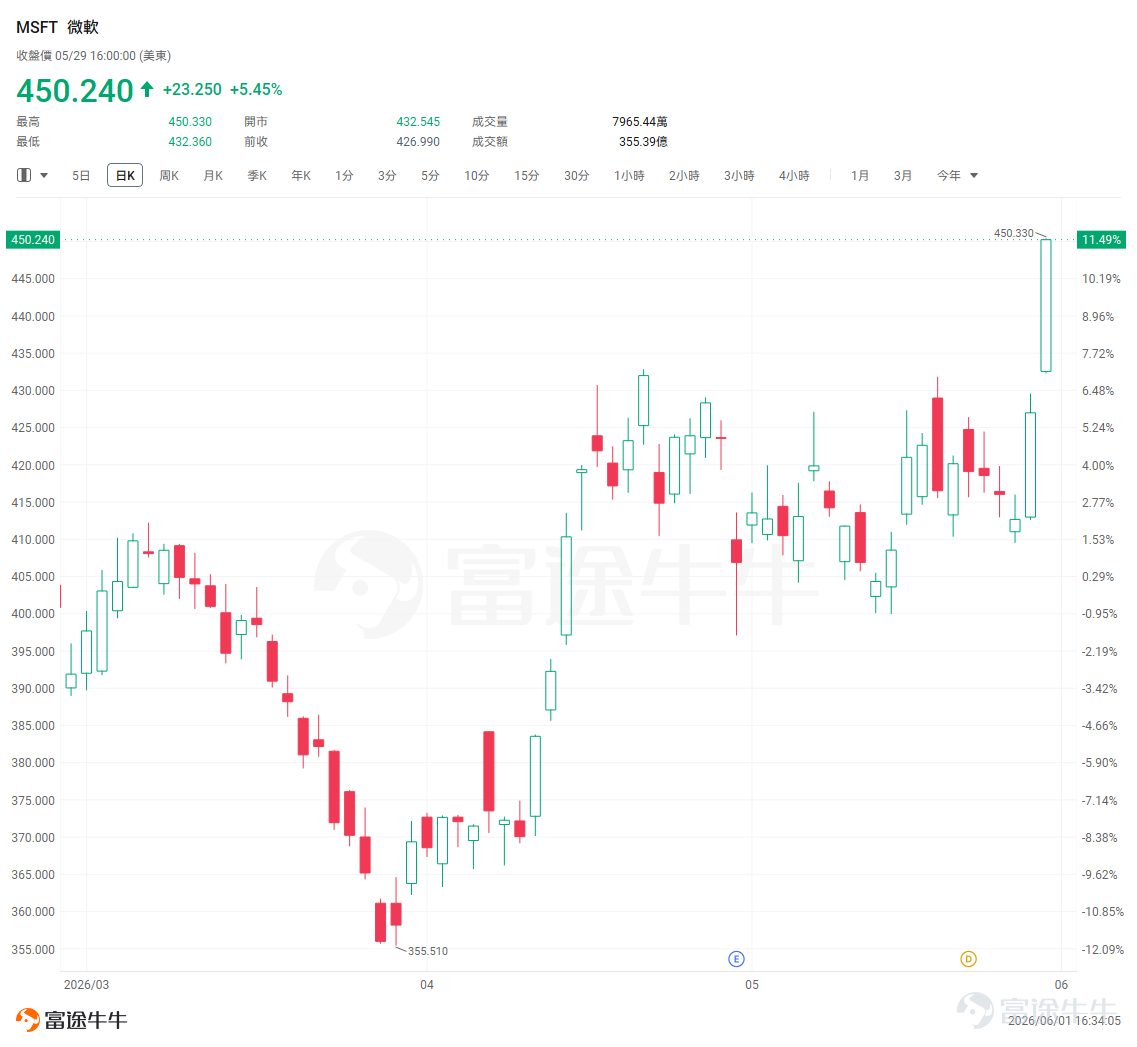
Software stocks have recently regained strength, and judging from individual stock performance, this is no longer just isolated movements. Last week, $Microsoft (MSFT.US)$ rose 7.5%, $Snowflake (SNOW.US)$ gained approximately 48%, $Okta (OKTA.US)$ climbed roughly 34%, $ServiceNow (NOW.US)$ increased by about 22%, $iShares Expanded Tech-Software Sector ETF (IGV.US)$ rose 8% last week, $Oracle (ORCL.US)$ 、 $Palantir (PLTR.US)$ well-known software companies also recorded double-digit gains.
Microsoft's Build developer conference is set to take place on June 2–3 this week, potentially serving as a key catalyst for the market to observe progress on AI application frontiers.

Behind the software sector’s rebound: From valuation recovery to narrative reassessment
The recent rebound in software stocks was initially driven by valuation recovery.
Over the past few quarters, U.S. software stocks faced multiple headwinds. First, capital continued flowing into the AI hardware supply chain, significantly marginalizing software stocks in terms of relative returns. Second, the rapid advancement of AI agents raised market concerns that traditional SaaS business models could face repricing—especially for companies reliant on subscription counts, user interface interactions, and workflow entry points.
With stable earnings reports from several industry leaders and strengthening signals of AI commercialization, the sector naturally has a solid foundation for a rebound. Specific catalysts include: on May 21, former U.S. President Trump announced he would sign a new executive order as early as this Thursday, primarily aimed at protecting critical U.S. infrastructure from AI-driven cyberattacks.
The White House, banks, and Anthropic have all emphasized the link between AI and cybersecurity. The market increasingly believes that AI cannot yet replace existing cybersecurity expertise; instead, it will generate even more security challenges, thereby elevating the value of cybersecurity solutions.

Another thing is that as…$Atlassian (TEAM.US)$ 、 $Datadog (DDOG.US)$ ,Also, recently$Snowflake (SNOW.US)$ with the release of recent earnings reports, the market realized that AI has not negatively impacted these SaaS companies—they not only stabilized their performance through usage-based pricing but also achieved steady user growth.
$Snowflake (SNOW.US)$ Its earnings performance is a typical signal.As a cloud data platform company, Snowflake’s core value lies in organizing, managing, and enabling access to enterprise data. For AI models to truly penetrate enterprise environments, they require a high-quality, governable, and accessible data foundation. The improvement in its earnings and guidance reinforces the narrative that 'enterprise AI applications need data platforms as their backbone,' prompting the market to reassess the valuation of data infrastructure and the software application stack.
Coupled with the significant valuation compression earlier, SaaS software stocks have become more attractively priced, and the market has realized it may have overestimated AI’s disruptive potential for software.It also underestimated the value of customers continuing to adopt existing software or SaaS services, as well as companies leveraging AI tools to enhance their offerings.
The significance of Microsoft Build: Observing AI platform capabilities, not just point-feature announcements
Microsoft will host its Build 2026 developer conference on June 2–3 at Fort Mason in San Francisco, themed around practical applications of cutting-edge AI technologies. The event is expected to unveil a series of new artificial intelligence models, including a code-specialized model aimed at strengthening the competitiveness of its GitHub Copilot coding assistant—a tool that once held a first-mover advantage in AI-assisted coding but has seen its market share steadily eroded by Cursor and Claude Code.
Based on market reactions to past Build conferences, Build typically does not act as a strong, earnings-like catalyst for Microsoft’s stock itself, but it does provide indirect momentum for the broader software sector and AI application narratives.
Microsoft is one of the strongest bellwethers for AI software. If it continues to demonstrate the commercial viability of Copilot, GitHub, Azure AI, and enterprise agents, the market will likely be more willing to reprice the entire software sector.

This year’s Build could carry more weight than in typical years, due to the current market backdrop.
First, software stocks have just undergone a notable rebound, and the market is searching for evidence on whether AI-driven applications warrant a revaluation.
If Microsoft emphasizes directions such as AI Agents, GitHub Copilot, in-house programming models, Copilot Studio, and Agent governance at its conference, it would directly support the core thesis behind the current software stock rally.
Second, the market has already shifted from 'buying compute infrastructure' to 'focusing on applications.'
Over the past two years, AI-related trades have mainly centered on hardware segments like NVIDIA, HBM, servers, optical modules, and power. Now that hardware-related stocks have seen significant gains, investors are increasingly asking: once AI infrastructure is built, who will convert this computing power into enterprise productivity? Microsoft’s Build conference happens to be a key event for validating this question.
Third, this year’s conference carries stronger expectations around AI programming and Agents.
According to The Information, Microsoft may unveil in-house AI models at the Build conference, including code-focused models designed to enhance GitHub Copilot. This direction directly aligns with the core themes of AI programming, developer tools, and enterprise software efficiency improvements.
The investment thesis for software stocks is being rebuilt, but stock selection has become more challenging.
From a trading perspective, software stocks still have room for further upside. The sector experienced significant pullbacks earlier, while hardware-linked names are now crowded at elevated levels. Earnings reports from companies like Snowflake have provided fundamental support, and Microsoft’s Build conference creates a clear catalyst window. If the event reinforces directions such as AI programming, enterprise Agents, and security governance, market sentiment could continue to broaden.
However, this is not an environment where software stocks can be bought indiscriminately. AI will amplify the advantages of strong platform companies while eroding the value of low-barrier software firms. Future gains in software stocks are likely to be structural, hinging on identifying companies that truly control data, workflows, developer ecosystems, and security governance gateways.
Therefore, investment decisions on software stocks should currently be tiered:
– $Microsoft (MSFT.US)$ is the core anchor, representing the highest degree of certainty in AI software platformization, though with relatively limited short-term upside.
– $Snowflake (SNOW.US)$ 、 $MongoDB (MDB.US)$ 、 $Datadog (DDOG.US)$ 、 $Cloudflare (NET.US)$WaitLeans toward AI application infrastructure, benefiting from growth in data, development, deployment, monitoring, and network traffic.
– $ServiceNow (NOW.US)$ 、 $Salesforce (CRM.US)$ 、 $Workday (WDAY.US)$Leans toward enterprise workflow entry points; the key lies in whether AI Agents can enhance customer stickiness and product pricing power.
– $CrowdStrike (CRWD.US)$ 、 $Okta (OKTA.US)$ 、 $Palo Alto Networks (PANW.US)$WaitLeans toward security and governance—a relatively more certain segment as enterprises scale AI deployments.
Risks are concentrated in three areas: first, valuation pressure following a rapid rebound; second, AI inference costs eroding profit margins; third, intensified competition from platform giants like Microsoft, compressing pricing power for certain independent software vendors.
Options Strategy
Technically, Microsoft shows a bullish moving average alignment, an upward MACD golden cross, and strong breakout volume, confirming a clear medium-term uptrend. On the major rally day of May 29, institutional funds (ultra-large + large orders) recorded a net inflow of USD 187 million, driving the surge through aggressive buying.
Speculative sentiment in the options market is running high,with the put/call ratio dropping as low as 0.24. Meanwhile, implied volatility (IV) has risen to 32.23%, sitting at a historically high percentile (85%), reflecting heightened market expectations of future price swings and strong speculative interest.
Additionally, a series of unusually large institutional options trades last week drew significant market attention.The most notable among them was a large-scale long-dated call spread involving 7,870 contracts.Buy the December 2027 $610-strike call option and simultaneously sell the December 2027 $720-strike call option. These two trades were executed nearly simultaneously, with a notional exposure exceeding $300 million and a net premium outlay of nearly $10 million.
This is a very typical institutional long-term AI positioning trade. Rather than aggressively purchasing naked call options outright, the trader reduced premium costs by selling the higher-strike $720 call option. This indicates that the real bet is not on a short-term speculative surge in Microsoft's share price, but rather on its significant potential for long-term valuation repricing over the next two years driven by its AI business, accompanied by a more sustainable upward trend.
(1)If confident the breakout is valid and seeking upside gains—use a bull call spread strategy.
Suitable for investors with moderate risk tolerance who wish to participate in the trend with limited risk.Cost is significantly lower than directly buying a call option, as premium income from the sold option offsets part of the purchase cost.Both risk and reward are capped, with maximum loss limited to the net premium paid.
(The figure below illustrates the simulated profit and loss scenario of this strategy on the expiration date. The design image displayed on the screen is for demonstration purposes only and does not constitute any investment advice or guarantee; market conditions fluctuate frequently, and the prices shown do not represent actual values.)

(2)If bullish long-term but prefer to wait for a pullback to enter—sell put options.
Bullish on Microsoft in the long term, but expect a short-term pullback or consolidation, and willing to buy at lower levels. Suitable for investors with cash reserves who seek enhanced returns or are looking for an entry opportunity.When the stock price trades sideways or rises, the full premium can be earned, with certain returns. If assigned, the stock can be purchased at the predetermined target price (strike price), effectively 'buying at a discount.'
(The figure below illustrates the simulated profit and loss scenario of this strategy on the expiration date. The design image displayed on the screen is for demonstration purposes only and does not constitute any investment advice or guarantee; market conditions fluctuate frequently, and the prices shown do not represent actual values.)

Finally, Option Sir brings a small perk for fellow investors, welcome to claim it.Options Beginner Pack
*This event is exclusive to invited HK users. Click to learn more.Detailed event rules>>
Market conditions are complex and volatile,Options StrategyOverwhelmed by choices? Futubull helps you build a portfolio in three steps.Options Strategymaking investing simple and efficient!

Option Risk Warning:An option is a contract that grants the holder the right, but not the obligation, to buy or sell an asset at a fixed price on a specific date or at any time before that date. The price of an option is influenced by various factors, including the current price of the underlying asset, the strike price, time to expiration, and implied volatility. Implied volatility reflects the market’s expectations for the level of volatility in the option over a future period. It is a data point derived inversely from the Black-Scholes option pricing model and is generally regarded as an indicator of market sentiment. When investors anticipate greater volatility, they may be more willing to pay a higher price for options to hedge risks, resulting in higher implied volatility. Traders and investors use implied volatility to assess the attractiveness of option prices, identify potential mispricings, and manage risk exposure.
Disclaimer:This content does not constitute any offer, solicitation, recommendation, opinion, or guarantee of any securities, financial products, or tools. The risk of loss in trading options can be substantial. In some cases, losses may exceed the initial margin deposited. Even if you set contingent orders such as 'stop-loss' or 'limit' orders, these may not prevent losses. Market conditions may make such orders unexecutable. You may be required to deposit additional margin within a short period. If you fail to provide the required amount within the specified time, your open positions may be liquidated. However, you will still be responsible for any shortfall in your account. Therefore, before trading, you should study and understand options and carefully consider whether such trading is suitable for you based on your financial situation and investment objectives. If you trade options, you should be familiar with the procedures for exercising options and the rights and obligations upon exercise and expiration. Options trading carries extremely high risks and is not suitable for all investors. Investors should carefully readCharacteristics and Risks of Standardized Options。
Risk Disclaimer: The above content only represents the author's view. It does not represent any position or investment advice of Futu. Futu makes no representation or warranty.Read more


Comments (3)
to post a comment
37
89