
【產品推薦官】邊個牛牛功能最幫到你賺錢?

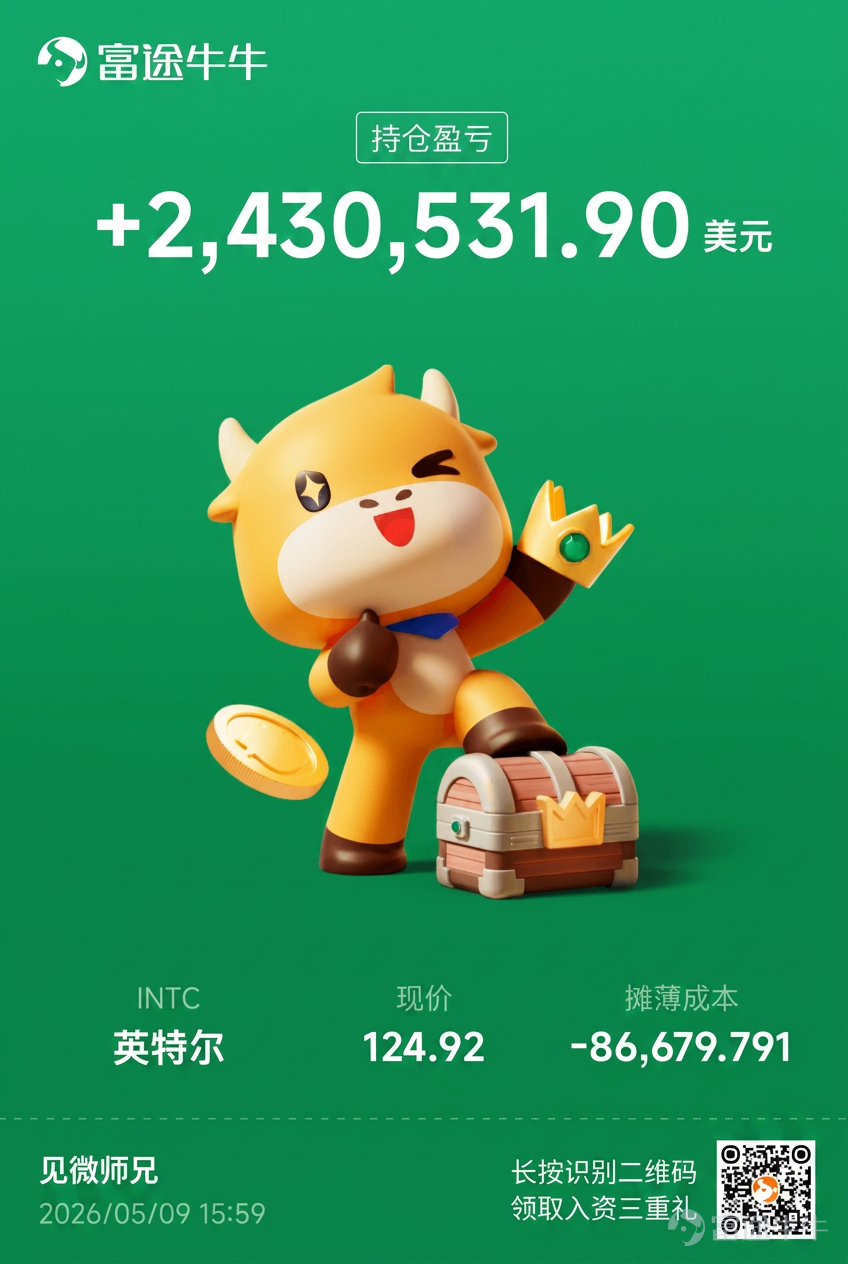
【Investor Story】Made over $10 million in one trade on Intel! How does the 'Positioning Investment Method' capture both liquidity and sector growth profits?
From a veteran in the semiconductor industry to a multi-million-dollar winner in Hong Kong and U.S. stocks—he doesn’t gamble on options or chase hot trends, relying solely on a‘Positioning Investment Method’—macro cycles + fundamentals + industry inflection points, he took a contrarian position on Intel and secured a 3x return! In his words:‘Investing isn’t about who makes money fastest—it’s about who survives steadily and profits sustainably.. Moreover,The more the sector develops, the more bearish it becomes for NVIDIA.’This article breaks down@见微师兄Its stock selection principles and entry/exit timing methods, along with practical tools such as earnings calendars and price-alert notifications.

1. 🧠 In investing, I only aim to earn these three types of returns: liquidity-driven gains, sector growth, and stock-specific alpha.

I started investing in A-shares in 2016 and didn’t shift to Hong Kong and U.S. stocks until 2021—I’ve been investing for over a decade overall. My trading logic is very simple: I only aim to earn money from these three sources.
(1)Money from liquidity expansion (highest priority): Seize opportunities aligned with the Federal Reserve’s monetary cycle (asset prices broadly rise during rate-cut cycles). We’re currently in the mid-phase of a rate-cut cycle—pace has slowed, but further cuts remain certain; the core thesis is that AI-driven disruption in IT employment will worsen labor market conditions, forcing the Fed to cut rates. Popular sectors currently offer low win rates and poor risk-reward ratios—chasing rallies requires caution.
(2)Money from sector growth (structural themes): Allocate to counter-cyclical, high-growth industries, such as electric vehicles and AI semiconductors in prior cycles.
(3)Alpha from individual stocks (company-specific competitive advantage): Select industry leaders or companies with solid, defensible positions in their ecosystems.
💎 Here, I lean toward capturingthe gains from liquidity expansion and sector growth—these two offer the highest certainty.。Moreover, after experiencing multiple market swings and managing larger capital, one should stillfocus on high-certainty opportunities.Because sometimes, if I had to do it all over again, I might not succeed—the outcome often depends on timing and luck.
II. 💰 Made $16.5 million in profit! Intel tactical trade: Counter-trend position-building logic and exit criteria
🔍 Why choose Intel? Three pillars of certainty
What I see is not a declining giant, but a severely undervalued strategic positioning play.」。Master Jianwei started building his position in August 2024, $Intel (INTC.US)$ kept buying consistently, and continued adding to his position in 2025(including during the April tariff crisis). He invested approximately RMB 5.5 million and ultimately realized profits exceeding RMB 16.5 million.
Logic beats luck! Three key rationales for entering a positioning investment:
(1)Stable CPU core business: At the time, Intel held over 70% market share in desktop CPUs and more than 60% in data center CPUs. Globally, only two companies produce x86 CPUs—and Intel dominates the vast majority of that market.
(2)Extremely strong foundry business positioning (strategic moat): Only $Taiwan Semiconductor (TSM.US)$$Samsung Electronics (005930.KR)$ Intel is one of only three such companies. Intel is the only advanced-process foundry based in the U.S., equivalent to China's SMIC. Amid geopolitical risks, Apple and NVIDIA would both prefer to have a second supplier whenever possible.Intel’s only competitor is itself—if it can improve its yield rates, orders will naturally follow.As expected, $Apple (AAPL.US)$ recently signed a cooperation agreement with Intel, validating this logic.
(3)Severely undervalued: At the time, Intel’s market cap was only $80–10 billion, yet I valued its CPU business alone at over $150–200 billion. Its price-to-sales ratio was below 1, and its valuation was even below book value—clearly deeply undervalued overall.
(4) Additionally, muststrictly adhere to this rule: set clear observation points and exit if expectations aren’t met
①Can the 18A process (Arrow Lake CPU) be launched on schedule?(by December 2025); if not launched on time—exit immediately
② Improved foundry yield, progress on 14A, data center CPU ramp-up, and major customer ordersetc. If the foundry business fails to deliver the 18A process—exit immediately.
✅ Result: 18A launched on schedule with excellent performance; nearly all milestones achieved—continue holding.I'm not betting everything blindly; rather, I see high certainty, a clear stop-loss point, and enormous potential profit.At the time, I invested RMB 5.5 million based on this conviction, which wasn't an overly heavy position for me.
Core of bottleneck-positioning investment strategy: the logic of targeting societal bottlenecks
This is the most central concept in my senior fellow investor's framework—Identify the critical bottlenecks hindering societal progress and bet that they will inevitably be overcome.。
Like bottom-fishing in semiconductors in October 2022: 'I didn’t know which sector would lead the market recovery, butI knew societal advancement must rely on improved productivity efficiency, productivity gains must come from technology, and the key bottleneck in technology was semiconductors.'So I said, regardless of what happens next in the market, semiconductors will definitely take off.” The result? The AI boom has validated this judgment.
Take Intel’s foundry breakthrough later on: 'The entire U.S. lacks advanced process capabilities, and Intel is the only viable candidate. Whether driven by national strategy or corporate demand, it will be pushed forward.'I don’t need to guess how they’ll solve it—I just know it will be solved.
Holding onto shares often tests one’s patience the most—how can someone hold with such conviction?
Because I don’t have as much confidence in other stocks, I can hold on tightly.Don’t get distracted by other skyrocketing stocks; firmly believe in your deeply researched strategic positioning logic, and wait for the wind to come.Although I’ve already reduced my Intel position, I still see room for its market cap to reach $1 trillion in the long term. Given the recent sharp short-term rally, a pullback is likely—waiting for that dip would be better.
Three: Reveal the Four Ironclad Stock Selection Rules
🏭Four Key Stock Selection Secrets
✅(1)Avoid companies with high dividends and aggressive share buybacks.Because a company's value lies in the efficient use of capital, if capital utilization is low, it’s better to just buy an index yourself.
✅ (2) Priority focusIndustries/companies that enhance productivity/business efficiency,are the only ones with a long-term thesis.
✅(3)When the price is sufficiently cheap + after a prolonged period of sideways trading,, there must be enough upside potential; we don’t participate if expected upside is less than 1x—we must assess therisk-reward ratio.
✅(4)Identify trustworthy CEOs: Focus on management teams that make no empty promises, consistently deliver results, and demonstrate strong execution.For example, Intel CEO Lip-Bu Tan—① immediately implemented aggressive layoffs upon taking office, leading to an instant improvement in cash flow; ② moved up the target timeline for yield improvements from ‘year-end’ to ‘mid-year’; ③ adopts a no-promises, only-delivery approach and consistently exceeds expectations. Regardless of how he achieves it, his execution has yielded excellent results. Also, avoid companies that love making grand promises and suffer from internal factionalism.
IV. ⚡ Contrarian Take: The more the industry advances, the more bearish it is for NVIDIA.
NVIDIA: Best to avoid it for now in the short term. It’s atits peak dominance, peak profitability, and peak market share. As long as the semiconductor industry continues to grow, it’s bearish for NVIDIA.Because industry growth means more competitors and more alternatives. NVIDIA’s peak is its ceiling.“But paradoxically, whether or not the industry grows depends on NVIDIA’s performance, so NVIDIA remains the market’s bellwether for now.”
Also, when it comes to earnings, my favorite feature isFutu’s Earnings Calendar and Earnings Live Coveragefunctionality. No more manually searching for earnings dates—now just openthe Earnings Calendar to see when each company reports; live coverage even includes real-time translation and breakdowns, with AI distilling key highlights from earnings calls,making it easy to stay up to speed.

Semiconductor supply chain: The further upstream, the safer
Certainty ranking: $ASML Holding (ASML.US)$ (lithography machines) → Taiwan Semiconductor / Intel (manufacturing) → GPUs/CPUs → cloud providers → large AI models → AI applications
A sober reminder on hot investment themes
– the memory sector: In the memory sector, from over 20 companies in the 1990s, each cycle eliminated players until only Samsung, SK Hynix, and Micron remain today.Low technological barriers, easy capacity expansion, and slow iteration—historically leading to repeated cycles of overcapacity and industry shakeouts. I remain skeptical of research reports claiming 'cyclical demand has become secular.'Given high uncertainty, I’m staying away for now.
– Software segment: AI is shifting from an enabler to a replacement—fundamental logic has reversed; be cautious about抄底 (buying the dip).
– Circle (blockchain settlement):I’m optimistic about its cross-border settlement efficiency (fast + low-cost) and its potential use in everyday transactions, offering commercial efficiency gains. It represents a small strategic 'beachhead' asset, though that doesn’t guarantee success.This can be considered a small, observable venture-capital-style position allocation; currently, it's better to wait for a prolonged consolidation period followed by moving average convergence before considering entry.
5. Practical Entry and Exit Tips: Simple Yet Extremely Effective
Long-Term Entry
Moving Average Convergence:After a prolonged consolidation, multiple moving averages (5-day, 10-day, and 120-day) converge.,Significant price movements often occur once this dynamic equilibrium is broken.
Short-Term Confirmation
RSI: Below 20 indicates oversold conditions; above 80 indicates overbought conditions.
Additionally, there are two other useful Futu features:① Price Alert: HereNot only can you set price alerts, but you also get monitoring for price changes, trading volume, and multiple technical indicators.No need to constantly watch the market,Your phone automatically notifies you when the target price is hit, so you won't miss the perfect time to buy or sell.

②Custom Indicators + AI-Powered Indicators: Everyone has different chart analysis habits. With custom indicators, you can build your own unique analytical system.AI-powered indicators are even better—just give natural language instructions, and AI quickly generates effective indicators for you, with one-click backtesting to clearly visualize returns.

Position Sizing and DCA Insights
– Position Rule: The higher your confidence level, the larger your position size.Typically, this is based on your depth of research and conviction—if you haven’t thought it through clearly, don’t act.
– Also, in factDollar-cost averaging shows you haven’t thought things through clearly—you haven’t figured out whether it’s worth buying now, you’re afraid of missing out, and you lack certainty.。
– Black swan response: Keep dry powder ready and be bold enough to act when the market crashes.
6. 🎯 Three ironclad rules for beginners
(1)Don’t blindly follow others’ stock recommendations.You must develop your own understanding to hold positions confidently. Otherwise, it’s like driving in the dark without knowing your destination.
(2)Don’t trade lightly if there’s no clear opportunity.The market never lacks opportunities—only patience. Stay in cash if you can’t find a compelling rationale.
(3)Every trade must be backed by your own logic, and only act once that logic is either validated or disproven—never trade emotionally or stubbornly hold losing positions.
Investing is not gambling—logic is king.Identify a sound rationale, choose the right niche, set your exit point, and then patiently wait for the wind to pick up.This applies not only to Intel but also to the entire investment journey,and it is also key for ordinary investors to achieve excess returns.
[Interactive Giveaway]
Share your reflections on this article in the comments section. The first 150 fellow investors whose comments exceed 30 words and offer thoughtful insights will receive 66 points.
If you found this article insightful for your investing, feel free to @ your friends to read it together~
Event deadline: From now until June 29, 2026
If you have more suggestions for our column, feel free to leave a comment! Follow@Investor StoryStay tuned for the next [Investor Story]!
Disclaimer:The content of this article is provided by@见微师兄Accept@Investor Story. Images in the article were provided and authorized for use by @见微师兄 Provided and authorized for use. The examples in this article are for reference only and do not constitute any investment advice. Information herein does not imply any recommendation regarding specific industries or indicators. Any mentioned stocks and related descriptions reflect personal opinions only, do not constitute stock recommendations, and do not represent Futu's views or professional advice. Past stock performance does not guarantee future results. The stock market involves risks; invest with caution.
Risk Disclaimer: The above content only represents the author's view. It does not represent any position or investment advice of Futu. Futu makes no representation or warranty.Read more


Comments (268)
to post a comment
457
243