
Why those who are bearish on Chagee today resemble the investors who missed out on it years ago
In June 2024, an article titled 'I’m a Consumer Investor—Dare Not Speculate About Chagee' went viral on social media.
At that time, it had been less than a month since Chagee disclosed its latest figures at the '2024 International Tea Day · Modern Oriental Tea Innovation Forum,' revealing a GMV of RMB 10.8 billion in 2023. Upon seeing Chagee’s revenue numbers, the article’s author—a consumer-sector investor—remarked, 'I can’t even bear to look; all I feel is envy.'
During those years, large-scale consumer financings with high valuations were rare in the private markets. Coupled with intense competition in the tea beverage segment and the consolidation of industry giants, Chagee’s sudden emergence surprised many—and left even more people baffled.
No one can precisely explain how Chagee achieved an annual GMV of RMB 10.8 billion in just seven years.
Interestingly, a year later, market sentiment shifted dramatically in the opposite direction.
In the second half of 2025, as Chagee deliberately slowed its expansion pace and same-store GMV faced temporary pressure, narratives like 'growth deceleration,' 'fad fading,' and 'midlife crisis' began circulating—even prompting unfounded claims that Chagee’s franchisees might be the most distressed players in the entire tea beverage industry.
However, these comments do not align with Chagee’s actual performance.
According to Caixin’s review of Chagee’s latest quarterly financial report, to some extent, those who are now bearish on Chagee are making nearly the same mistake as the investors who missed out on it earlier.
01 Behind the Financials: Chagee’s True Essence—Long-Termism Built on Steady Profitability
Market sentiment reversed in the autumn of 2025.
After a data point showing a 25% year-over-year decline in same-store GMV was released, narratives about 'growth stalling' and 'franchisee exits' quickly gained traction.
Although Chagee has publicly disclosed that its store closure rate remained at just 0.3% for three consecutive quarters—significantly lower than the industry-wide closure rate of approximately 12%–15% for China’s new tea beverage sector in 2025 (according to the '2026 China Ready-to-Drink Beverage Market Blue Book,' April 2026)—indicating overall stability in its store network and franchise system, commentary about the 'fad fading' continues unabated.
So, what is really going on with Chagee?
Chagee’s latest quarterly financial report may offer insight into the true fundamentals of this young brand amid controversy.
Let’s first examine a few hard metrics from Chagee’s Q1 2026 financial results.
The company has reported profits for 13 consecutive quarters. Since it began disclosing quarterly financials, Chagee has been profitable every quarter. Even during the most challenging period—Q4 2025—it still posted an adjusted net profit of RMB 1 billion. In Q1 2026, adjusted net profit improved to RMB 5.1 billion, representing a more than fourfold sequential increase.
Operating profit reached RMB 5.5 billion in the first quarter, yielding an operating margin of 15.4%, turning from a loss in the prior quarter to profitability. Excluding share-based compensation expenses, adjusted operating profit amounted to RMB 6.1 billion, pushing the adjusted operating margin up to 17.1%—a substantial improvement from 1.0% in the previous quarter.
Cash flow remains extremely healthy. As of the end of Q1 2026, the company held approximately RMB 7.15 billion in cash and cash equivalents, with zero interest-bearing debt. Its net cash position equals roughly 54% of its market capitalization. The board has approved a share repurchase program authorizing the buyback of up to USD 150 million worth of American Depositary Shares (ADS) over the next 12 months.
These figures all point to one conclusion: Chagee is not a fad-driven brand. Fad brands rely on traffic—if the buzz fades, so do they, often after extracting short-term gains. But Chagee did something counterintuitive in the eyes of outsiders: at the peak of its appeal—when it would have been easiest to aggressively recruit franchisees and expand rapidly—it deliberately slowed down and entered a phase of internal adjustment.
The reason lies in one key metric: same-store GMV.
Previously, Chagee was criticized externally for 'losing momentum' precisely because its same-store GMV growth rate had declined for multiple consecutive quarters. However, Chagee’s Q1 financial report shows that same-store GMV growth in China has improved for two consecutive quarters, with a significant sequential improvement of nearly 10 percentage points in Q1.
This indicates:
1. Judging from the trend in same-store GMV, Chagee is not in a downward 'decline phase' but has proactively entered a corporate 'adjustment phase.' Based on current financial performance, this adjustment phase is already yielding results.
2. Same-store GMV is not the sole indicator of a company's operational health. In fact, the direct drivers behind same-store GMV include a company’s store mix between new and existing outlets, changes in store density during rapid expansion, and deliberate shifts in operating strategy—rather than the oversimplified external perception of 'waning brand appeal' or 'consumers no longer paying.'
This is especially true for brands in a high-growth expansion cycle: when a large number of new stores enter the market, temporary fluctuations in per-store metrics are an industry norm. Rather than chasing short-term, aesthetically pleasing same-store GMV figures, Chagee prioritizes long-term store profitability, franchisee operational quality, and enduring brand value.
In both 2023 and 2024, Chagee doubled its store count year-over-year—particularly in 2024, when it expanded from approximately 3,000 stores to over 6,000. However, new stores naturally require time to reach breakeven. At the height of its popularity, Chagee demonstrated discipline by proactively slowing its pace to solidify operational fundamentals and strengthen profitability—a responsible move not only for its own brand but also for its franchisees and every individual store.
Only making money is real skill.
This is precisely the same mistake made today by those bearish on Chagee and by investors who missed out on it years ago: they are judging a long-term, profit-focused enterprise using the traffic-driven standards typically applied to 'internet-famous' brands.
This also proves one thing unequivocally: Chagee does not aim to be just another internet-famous brand, but a truly sustainable global consumer company built to last. As Chagee executives stated on their Q1 earnings call: 'The company is experiencing steady growth and is entering a mature, stable, and sustainable phase of high-quality expansion.'
02 Bold Moves—Not Just Waiting for the Wind
Sometimes, Chagee appears to be a somewhat 'clumsy' company.
After its founding in Yunnan in 2017, Chagee spent four to five years verifying the profitability of each store. It avoided large-scale expansion, opting instead for steady, methodical store openings and operations. From the very beginning, Chagee’s core strength has always been its consistent ability to generate stable profits.
Of course, this period also coincided with the typical hardships faced by startups.
Chagee’s approach to entering new markets follows a '1+9+N' model. When entering any new market, Chagee first rents an office locally and assembles a small team. It then opens its first store in a prime location to test brand viability in that market. Once feasibility is confirmed, it opens several more company-operated stores. Only after all these stores have validated the profitability model does Chagee begin onboarding local franchisees. This strategy rapidly concentrates and amplifies brand momentum in the short term, unlocking greater brand influence.
Such a store-opening strategy appeared 'unexciting' in the eyes of Tier-1 investors. At first glance, this expansion method seems 'slow and clumsy.' At the time, many nationwide tea beverage brands did not establish subsidiaries in different provinces or cities—some didn’t even maintain independent local offices. Oversight was typically handled by regional supervisors, let alone having regional subsidiaries deeply involved in local store operations, including those of franchisees.
Accustomed to evaluating companies through a traffic-driven lens and flashy—but risky—financial metrics, Tier-1 investors thus missed out on Chagee.
Today, despite facing market controversy, Chagee continues steadfastly down its familiar 'clumsy' path.
For example, Chagee was criticized last year for not launching any new products in six months. However, according to publicly available data, Chagee actually introduced over 20 new products in 2025.
At the end of last year, Chagee launched its 'Back to Yunnan' series, which impressed many consumers. During its Q1 earnings call, Chagee executives revealed that the 'Yun Jiao Carmelo' from the 'Back to Yunnan' series shows strong potential to become a long-term bestseller. Meanwhile, the newly launched Da Hong Pao Tea Special series outperformed historical new product averages across key metrics—including first-week GMV, cup sales contribution, first-week repurchase rate, and number of new customers acquired directly.
During this adjustment period, Chagee wasn’t simply waiting—it was quietly putting in the 'clumsy effort.' The days without new product launches were not idle; they were a period of recalibration and preparation.
Now, new products are being rolled out in quick succession, with an average of one new product launched each week, gradually forming a product matrix that includes whole-leaf fresh milk tea, tea lattes, specialty tea blends, and low-caffeine offerings.
In May, Chagee's gelato (Tea Latte) ice cream launched across 12 stores in eight cities, transforming 'drinking tea' into 'eating tea.' The Wukang Road store in Shanghai at one point saw queues stretching over 100 meters. Thirteen specialty tea blends have been introduced to date, exploring diverse expressions of whole-leaf tea.
On the consumption-scenario front, its morning and evening series cover all-day demand, and it is also expanding into occasions such as weddings, workplace settings, and birthdays. When a cup of tea appears in these contexts, it ceases to be just a beverage—it becomes part of a lifestyle.
On the organizational front, the restructuring initiated in the second half of 2025 has been largely completed, integrating mid- and back-office functions and reallocating resources toward frontline operations. At the company’s annual earnings call at the end of March 2025, Chagee executives clearly stated, 'Internal adjustments have been largely finalized, and our operational rhythm and order have returned to stability.'
Regarding its franchise model, starting January 2026, Chagee fully implemented a healthier new approach—shifting from traditional supply-chain margin models to GMV-based revenue sharing. This means the company now profits only when franchise stores succeed, deeply aligning its interests with those of franchisees. Additionally, Chagee significantly reduced procurement costs for packaging materials, tea bases, and other supplies, easing pressure on franchisees.
Avoiding food-delivery platform price wars also protects franchisees. The logic is straightforward: users attracted by subsidies are mostly price-sensitive and exhibit low brand loyalty—they leave once subsidies end. Chagee positions itself as a premium tea brand; engaging in price wars might temporarily boost GMV but would dilute brand value and ultimately harm franchisee interests. This strategic choice is commercially sound.
The underlying logic of these changes is clear: Chagee does not aim to be a fleeting 'fad' brand—one that gains temporary popularity through a single hit product or viral trend only to be quickly forgotten. Instead, it is building a genuine brand grounded in product excellence, deep scenario penetration, and long-term consumer mindshare. It operates as a profit-driven business committed to crafting quality tea, serving customers and franchisees well, and ultimately achieving market success and profitability through its products.
03 Shedding the 'Hype-Driven Influencer' Facade, Advancing Toward a Global Consumer Company
In overseas markets, Chagee is also carving out a high-quality 'second growth curve.'
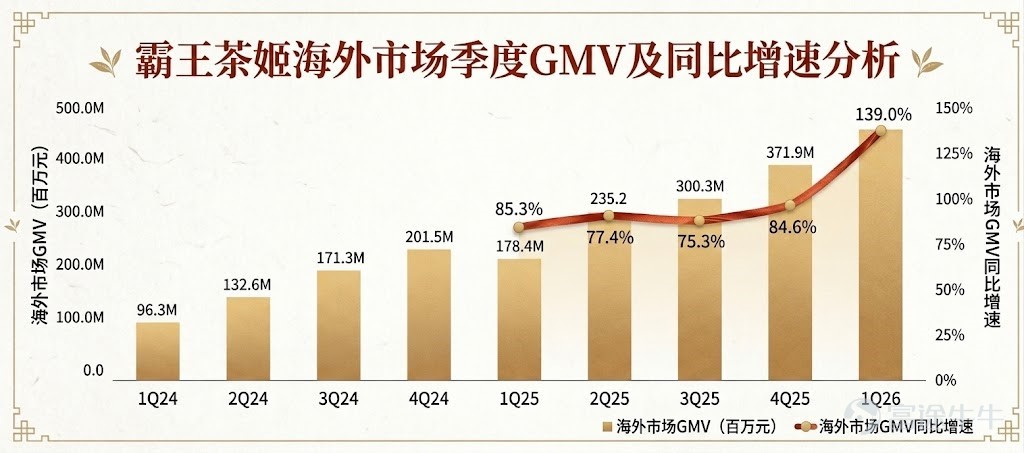
In Q1 2026, overseas GMV reached RMB 430 million, marking the fourth consecutive quarter of sequential growth and a year-over-year increase of 139%, significantly up from 84.6% in Q4 2025. Overseas store count grew from 156 at the end of 2024 to 345 by the end of 2025—more than doubling—and further increased to 374 by Q1 2026.

Chagee’s overseas expansion model is quite distinctive—it operates in new markets through either a wholly owned subsidiary or a tightly controlled joint venture, only gradually introducing franchise operations once the market matures. Founder Zhang Junjie explicitly stated during an earnings call that choosing a direct-operated model in the U.S. market is 'the hard but right path'—the goal isn’t just to open dozens of stores, but to make Chinese-style tea beverages as integral to American consumers’ lifestyles as coffee. All its outlets in markets like Singapore, Vietnam, the Philippines, and South Korea are company-operated. Even in Indonesia and Thailand, Chagee partners with local giants via joint ventures rather than opting for simple franchise licensing.
This model requires significant upfront investment and yields slower returns, but it ensures strict control over brand standards and user experience—an archetypal long-termist strategy focused on doing what’s difficult, slow, yet ultimately correct. In contrast, many other Chinese tea beverage brands have pursued asset-light franchise models when going global, achieving faster short-term store growth—but inconsistent product quality and service standards pose long-term risks.
Consider also the depth of localization efforts. In Indonesia, Chagee formed a joint venture with local retailer Erajaya and obtained halal certification—a basic prerequisite in a country with over 230 million Muslims. In Malaysia, the company forged a strategic partnership with hotel industry giant Lien Da Group, targeting hundreds of stores within three years. In the Philippines, Chagee launched pet-friendly stores tailored to local community culture. In South Korea, its flagship store in Seoul’s Gangnam district features softer textiles and abundant greenery, creating a 'tranquil oasis' for busy urban customers.
These details show that Chagee isn’t simply copying and pasting its domestic store model overseas; instead, it makes targeted adjustments in each market.
Finally, consider its pace of expansion. Zhang Junjie likens overseas growth to a 'marathon,' designating 2026 as the 'Year of Overseas Foundation Building,' with a target of adding approximately 200 new stores. While this number isn’t aggressive by industry standards, such disciplined pacing is actually more sustainable for a company sitting on over RMB 7 billion in cash reserves.
04 Conclusion: Stabilize, Profit, and Prevail
Let’s return to where we began: those who missed Chagee back then and those criticizing it today are making the same mistake—judging a long-term, profit-focused enterprise through the lens of short-term metrics used for 'internet-famous' brands.
The former focus on buzz, growth speed, and trending topics—ideally generating viral hits,热搜 (trending topics), and rapid social media traction in the short term. The latter prioritize profitability, healthy cash flow, franchisee stability, and long-term brand equity.
Investors in 2021 misjudged the company by mistaking 'steady profitability' for 'lack of sex appeal,' failing to recognize that avoiding cash-burning expansion is, in fact, a rare capability. Within the venture capital narrative that prioritizes scale above all, a profit-first business was systematically undervalued due to ingrained biases.
Five years later, the misjudgment lies in confusing the company’s deliberate 'adjustment phase' with a 'decline phase,' using a single volatile metric—same-store GMV—to completely dismiss a consistently profitable, fundamentally solid, and upward-trending enterprise.
During the late-March earnings call, founder Zhang Junjie said, 'A team that dares to confront problems head-on, excels at learning from experience, and is developing ever-clearer strategic thinking is the kind truly worthy of long-term trust.' The subtext of this statement is: if you only look at the data in your rearview mirror, you’ll never see the road ahead through the windshield.
Whether Chagee can ultimately become the 'global Eastern tea brand' it aspires to be remains uncertain. But one thing is clear: a company that has posted profits for 13 consecutive quarters, maintains strong cash flow, exercises restraint during good times, and remains candid during tough times deserves serious attention—regardless of the ultimate outcome.
Risk Disclaimer: The above content only represents the author's view. It does not represent any position or investment advice of Futu. Futu makes no representation or warranty.Read more
Comments
to post a comment
2