
Quantum Execute has established strategic partnerships with multiple leading institutions, marking the scaling phase of its institutional-grade algorithmic execution services
"Execution" is becoming the critical variable determining the success or failure of alpha. In cryptocurrency trading, execution is shifting from a behind-the-scenes infrastructure component to the core factor that dictates alpha outcomes. Slippage and transaction fees are two hidden costs that erode returns. For quantitative funds and large traders, even small basis-point differences accumulate into substantial costs.
Article author and source: Quantum Execute
I. About Quantum Execute
Quantum Execute (QE)is an AI-driven cryptocurrency execution infrastructure company. Its core team hails from top-tier North American quantitative and algorithmic trading firms, with cumulative trading volume approaching USD 10 billion. QE offers a comprehensive suite of institutional-grade execution algorithms—TWAP, VWAP, POV, Arrival Price, among othersThe platform supports major centralized and decentralized exchanges including Binance, OKX, and Hyperliquid.
Client coverage includesfinancial institutions, quantitative funds, listed companies, family offices, and high-volume traders.Quantum Execute has encapsulated its full execution capabilities into standardized "trading skills,"enabling AI agents to invoke them directly via API/MCP protocols—including mainstream large language models such as Claude, which can directly integrate Quantum Execute’s algorithmic services.
II. Strategic partnerships with leading institutions
QE is currentlyan algorithmic execution service provider partnering with leading digital asset institutions such as LTP, BIT (formerly Matrixport), and Amber Groupand other top-tier digital asset institutions,serving as an algorithmic execution service provider,offering execution services to downstream institutional clients and large-volume traders, as well as serving multiple quantitative trading firms and digital asset trading (DAT) companies. Given the current crypto market’s relatively scarce liquidity and accelerating institutional adoption,the necessity of algorithmic execution is being rapidly reassessed,Through strategic partnerships with institutional channels, QE is quickly becoming the execution standard layer in the crypto market.
III. Real-World Client Case Studies
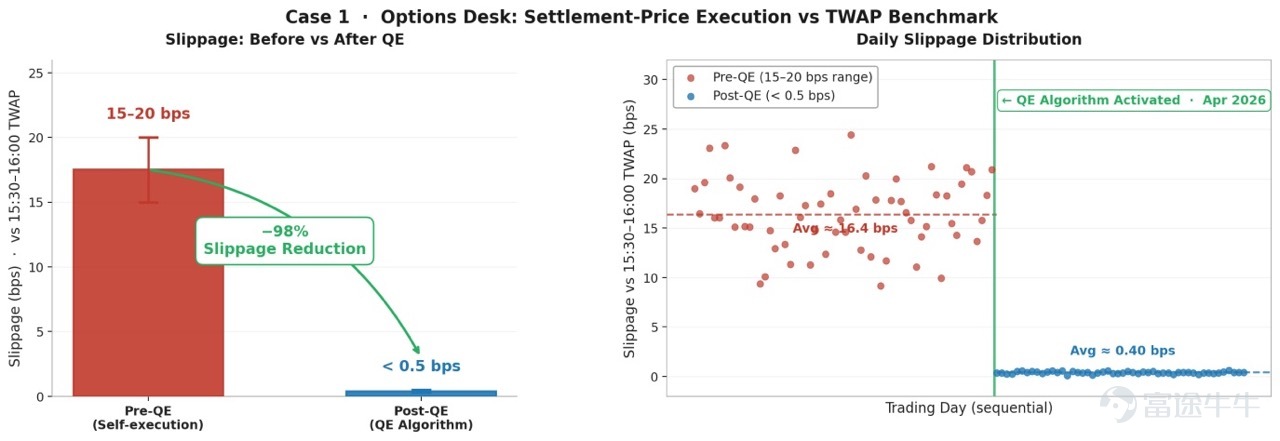
Case One | Options Trading Desk: Dual-Currency Settlement Execution
Scenario After exercise, a dual-currency product from a crypto options trading desk must be converted into spot or USDT, with the settlement price pegged to the daily 15:30–16:00 TWAP average,requiring extremely high execution precision.
Results: Prior to using QE, self-built scripts incurred execution costs of approximately 15–20 bps;after implementing QE’s TWAP algorithm in April 2026,slippage stabilized within 0.5 bps,with monthly trading volumes reaching hundreds of millions of dollars, resulting in monthly execution cost savings of hundreds of thousands of dollars.

Figure 1: Comparison of execution costs relative to the 15:30–16:00 TWAP benchmark before and after the options trading desk adopted the QE algorithm
Case Study 2 | Quantitative Firm: High-Frequency Strategy on Small-Cap Cryptocurrencies
real-world scenarios A quantitative firm client runs a minute-level rebalancing strategy, primarily trading small- and mid-cap cryptocurrencies, with average monthly trading volume of USD 60 million to USD 150 million.Poor market liquidity and wide spreads mean thatThe impact of execution quality on strategy returns is equally important as alpha itself.
Results: Before adopting QE (January–March 2026), the same strategy generated cumulative PnL near zero or even slight losses;After switching to the QE algorithm in April 2026 (with identical strategy logic), the QE algorithm reduced trading costs by 3–5 bps, significantly improved the strategy’s Sharpe ratio, and enabled consistent positive returns.

Figure 2: Comparison of cumulative PnL for the same strategy before and after adopting the QE algorithm
Case Study Three | Quantitative Firm: Cross-Sectional Strategy Controlled Experiment
real-world scenarios A quantitative firm client simultaneously ran two accounts using identical strategy signals—one in the experimental group employing the QE algorithm, and the other in the control group using the client’s proprietary algorithm.The nominal trading volume of the QE account was over five times that of the control group,Theoretically, a larger scale should incur higher execution costs.
Results: ran live for three consecutive months,Regardless of whether the underlying strategy generated profits or losses, the QE algorithm account consistently outperformed—earning an additional 1–2% in profitable months and losing 1–2% less in losing months, translating to an annualized alpha of approximately 15%.

Figure 3: Comparison of Return Curves Between the QE Algorithm and the Client’s Proprietary Algorithm
IV. Why the QE Algorithm Consistently Enhances Returns
QE does not provide basic exchange-native algorithms, but ratherIntelligent algorithms specifically designed for institutional clients—embedded with Flow Alpha and high-frequency Alpha signals,These algorithms dynamically adjust order slicing in real time based on order book liquidity and Alpha timing signals to reduce market impact and optimize execution prices.
This differentiated capability delivers particularly significant performance enhancement for medium- to low-frequency strategy clients (those with trading windows longer than one minute, such as minute-level, hourly, or daily rebalancing strategies)—all such client scenarios have already been validated as effective. The QE algorithm itself injects a component of high-frequency Alpha returns directly into the client’s strategy during execution,effectively adding an 'Alpha layer at the execution level.'
V. Execution Channel for the Agent Economy
It is precisely this 'institutional-grade execution capability' that enables QE to serve not only human-operated trading desks but also function as the foundational execution layer for the AI Agent ecosystem.Trading is shifting from 'humans clicking UIs' to 'machines calling APIs,' and from automated trading bots to on-chain strategy executors—an increasing number of use cases now require a standardized, high-quality execution channel.
QE has encapsulated its full execution capabilities into standardized 'trading skills,' enabling AI agents to invoke them directly via API/MCP protocols,Any third-party AI agent can access QE’s skill interfaces to obtain professional-grade execution capabilities, without needing to build their own trading infrastructure or understand market microstructure.

Figure 4: OpenClaw live trading workflow—natural language order entry → real-time monitoring → TCA report
6. Institutional-Grade Security and Operations
QE serves numerous institutional clients and adheres toSecurity and Stabilityinstitutional-grade requirements and practices:
▍ Risk controls embedded within algorithms The algorithm embeds logic to handle abnormal order book conditions, automatically detecting extreme market scenarios and triggering protective mechanisms to prevent losses caused by single-point failures.
▍ Real-time transparency Order execution status, trade details, and TCA reports are synced in real time to the client interface, with proactive alerts for critical events.
▍ 24/7 Operations Support Teams across both U.S. and Chinese time zones provide round-the-clock coverage of crypto markets, demonstrating consistent stability during multiple extreme market events over the past year.
About Quantum Execute
Quantum Execute (QE) specializes in providing institutional-grade algorithmic execution services for institutions and AI agents, with cumulative trading volume approaching USD 10 billion. New users can enjoy a 30-day free trial period.
Official Websitequantumexecute.com
Media EmailQuantumExecute@outlook.com
Telegramt.me/QuantumExecuteGroup
Risk Disclaimer: The above content only represents the author's view. It does not represent any position or investment advice of Futu. Futu makes no representation or warranty.Read more
Comments
to post a comment
6