
[Welcome Newcomers] Investment Beginner's Hub: Your trading journey starts here with ease

[Quick Start Guide for Beginners] Hesitant to enter the volatile Hong Kong stock market? These monthly dividend-paying ETFs come with built-in 'rental income' features, helping you defend your portfolio while earning dividends.
For many middle-aged individuals and investment beginners, the current investment environment has truly become somewhat overwhelming.
Bank fixed deposit rates are gradually declining, making it increasingly difficult for cash held in banks to keep up with inflation;
But if you want to invest in dividend-paying stocks, you might worry about the market’s constant roller-coaster swings. With work or family responsibilities already keeping you busy, who has time to monitor the market daily or carefully analyze financial statements to pick stocks?
What most people really want is simply a stable, predictable source of passive income—money that reliably lands in your pocket each month to help cover daily expenses.
If you share these concerns, then the“monthly dividend-paying” ETFs (especially Covered Call ETFs), which have grown increasingly popular in Hong Kong in recent years, are well worth your attention.
These types of products are practically designed forMiddle-aged individuals seeking cash flow and aiming to 'create their own long-term income' earlyas well asInvestment beginners who don’t have time to monitor the market or lack stock-picking skillsare designed for this purpose.
Why is this the case? Because these ETFs not only earn dividends from their underlying stocks but also generate additional 'option premiums' by having fund managers sell call options, thereby supporting high monthly distributions. As a result, they offer strong downside protection even in sideways or moderately rising markets, achieving true 'income plus capital preservation.'
Given how well these products align with investor needs, what options are actually available in the market? Currently, the Hong Kong stock market already offers several “monthly dividend” ETFs targeting different sectors, each with its own unique fee structure and dividend performance. Investors can choose based on the sectors they favor:
1. Steady and Conservative: CSI 300 Covered Call ETF
Inflationary pressures in the U.S. have prompted global central banks to adopt a more hawkish stance, meaning global risk assets will likely face further adjustment pressure. The CSI 300 Index has pulled back significantly from its October peak last year, and its current valuation provides a certain margin of safety for potential upside.
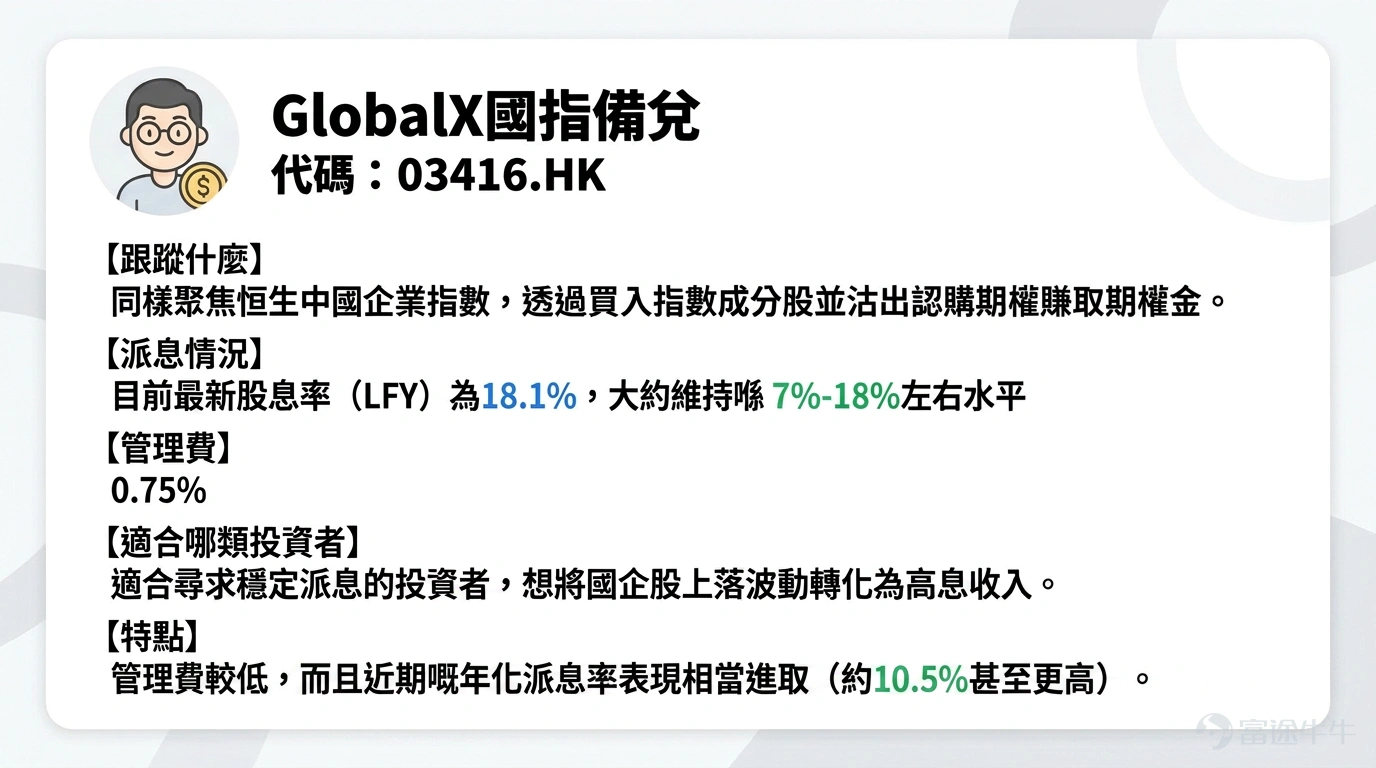
[What It Tracks] Also focuses on the Hang Seng China Enterprises Index, generating option premiums by buying index constituent stocks and selling call options.
[Dividend Policy] Aims to pay monthly dividends.
The latest trailing dividend yield (LFY) stands at 18.1%, generally ranging between 7% and 18%. It has consistently paid monthly dividends for 26 consecutive months, demonstrating strong dividend performance (Note: Listed in February 2024; dividend data as of June 4 is not yet recorded).
[Management Fee] 0.75%
[Suitable For] Investors seeking stable dividend income who wish to convert the price volatility of China state-owned enterprise stocks into high-yield income.
[Key Features] Also tracks traditional economy stocks in the Hang Seng China Enterprises Index, with the advantages of a relatively low management fee and an aggressive recent annualized dividend yield (approximately 10.5% or higher). In range-bound market conditions, its generous option premiums act like a thick sponge, effectively absorbing minor price fluctuations and providing investors with strong psychological cash flow support.
As of May 27, 2026; data sourced from GlobalX official website and Futubull app
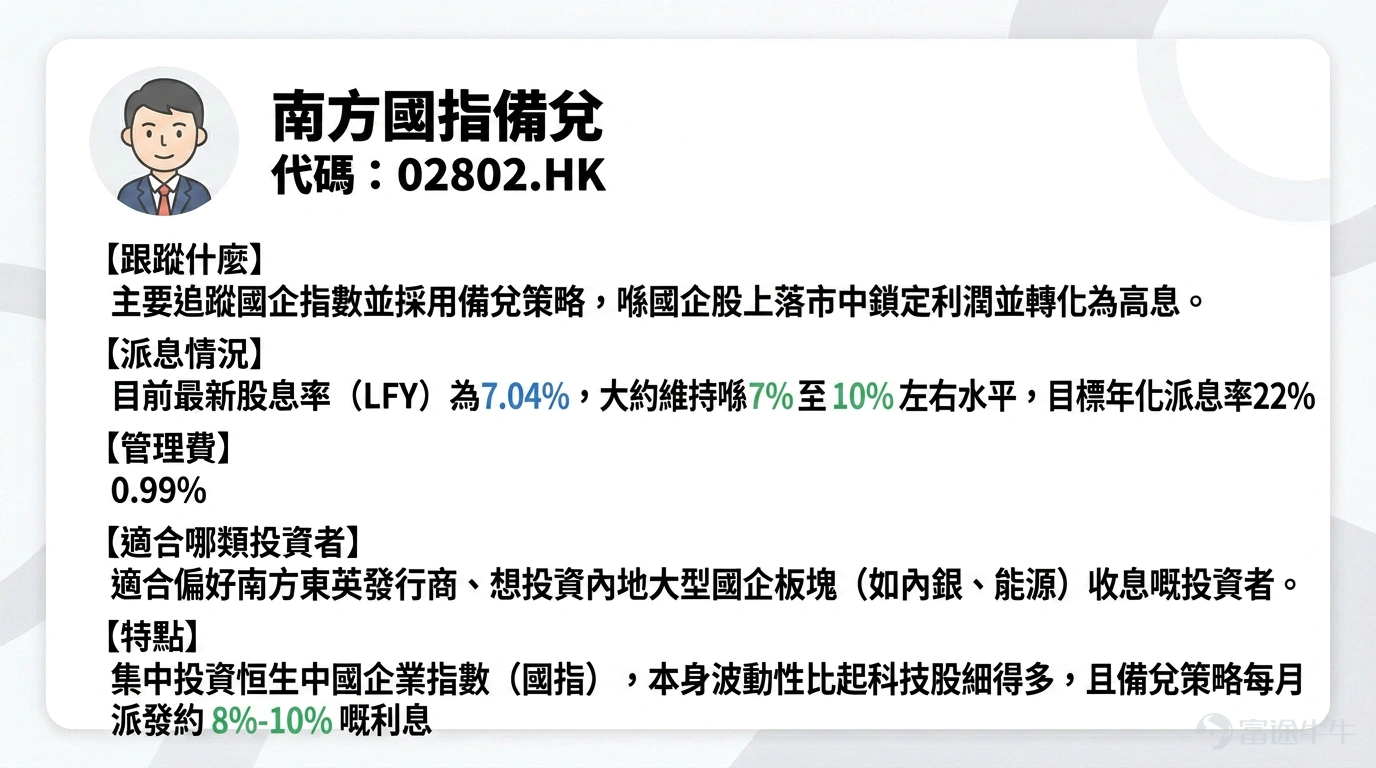
[What It Tracks] Primarily tracks the Hang Seng China Enterprises Index and employs a covered call strategy to lock in profits during volatile trading of China state-owned enterprise stocks and convert them into high dividends.
[Dividend Policy] Aims to pay monthly dividends.
The latest trailing twelve-month dividend yield is 7.04%, generally maintained within the range of approximately 7% to 10%. The target annualized dividend yield is 22%. Since its listing (note: listed in December 2025), it has recorded stable monthly dividends for four consecutive months.
[Fees] 0.99%
[Suitable For] Investors who prefer products issued by CSOP Asset Management and seek dividend income from large mainland Chinese state-owned enterprises (e.g., domestic banks, energy sectors).
[Key Features] This ETF primarily invests in the Hang Seng China Enterprises Index (HSCEI), which comprises numerous traditional state-owned enterprises (such as domestic banks and centrally owned energy stocks). Its volatility is significantly lower than that of tech stocks. Additionally, the covered call strategy generates monthly income of approximately 8%–10%, offering strong defensive performance in sideways or slightly declining markets, as the option premiums can effectively offset minor losses from declines in SOE stocks.
As of May 27, 2026. Data sources: CSOP Asset Management official website and Futubull app.
2. Betting on the Hong Kong Market: Hang Seng Index and High-Dividend ETFs
If you wish to broadly invest in Hong Kong’s most representative large-cap blue-chip stocks or prefer traditional high-dividend Hong Kong equities, the following two market-focused options are available:
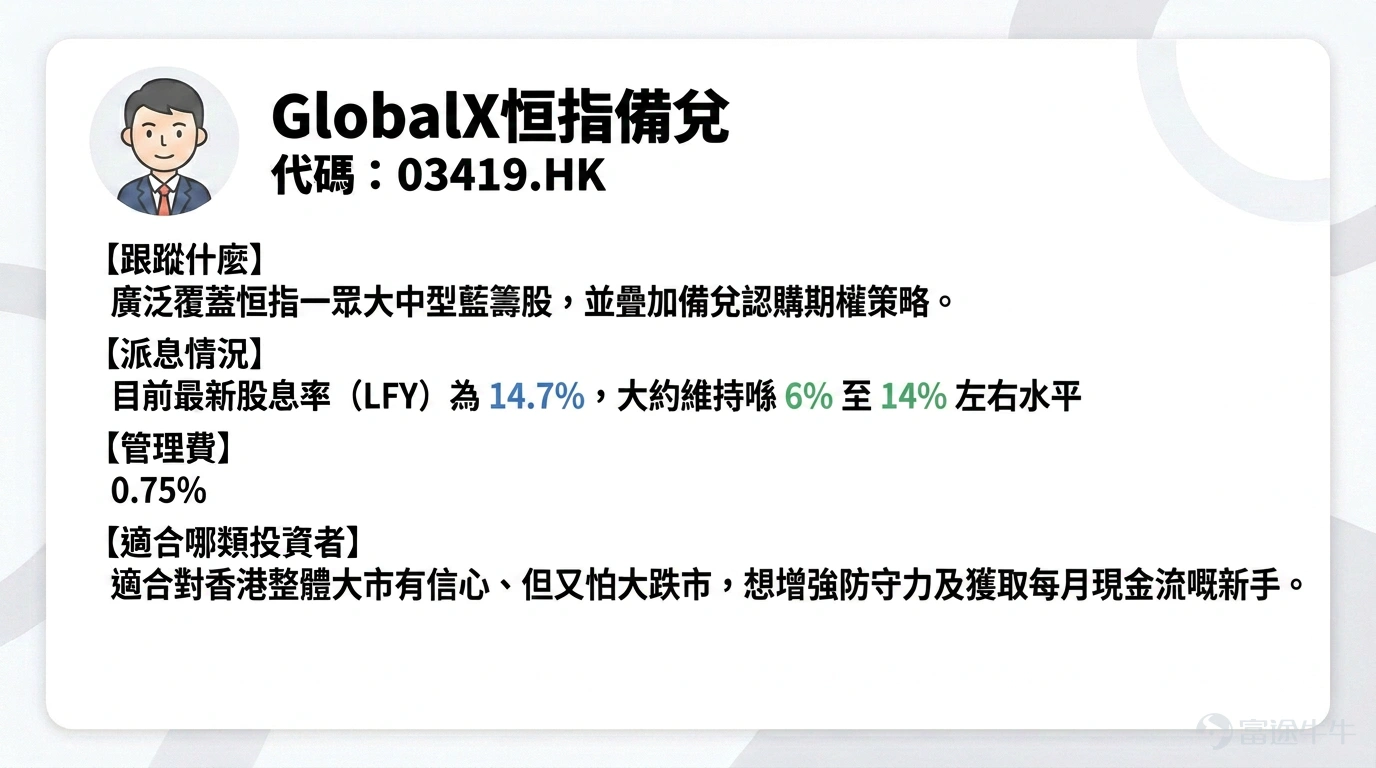
[Tracks What] Broadly covers large- and mid-cap blue-chip stocks in the Hang Seng Index, enhanced with a covered call options strategy.
[Dividend Policy] Aims to pay monthly dividends.
The latest trailing twelve-month dividend yield is 14.7%, generally ranging between 6% and 14%. It has maintained a consistent monthly dividend record for 26 consecutive months since its listing (Note: Listed in February 2024; the dividend payment scheduled for June 4 has not yet been recorded).
[Management Fee] 0.75%
[Suitable For] New investors who are confident in the overall Hong Kong market but concerned about sharp downturns, and who seek enhanced downside protection and a monthly cash flow.
As of May 27, 2026; data sourced from GlobalX official website and Futubull app
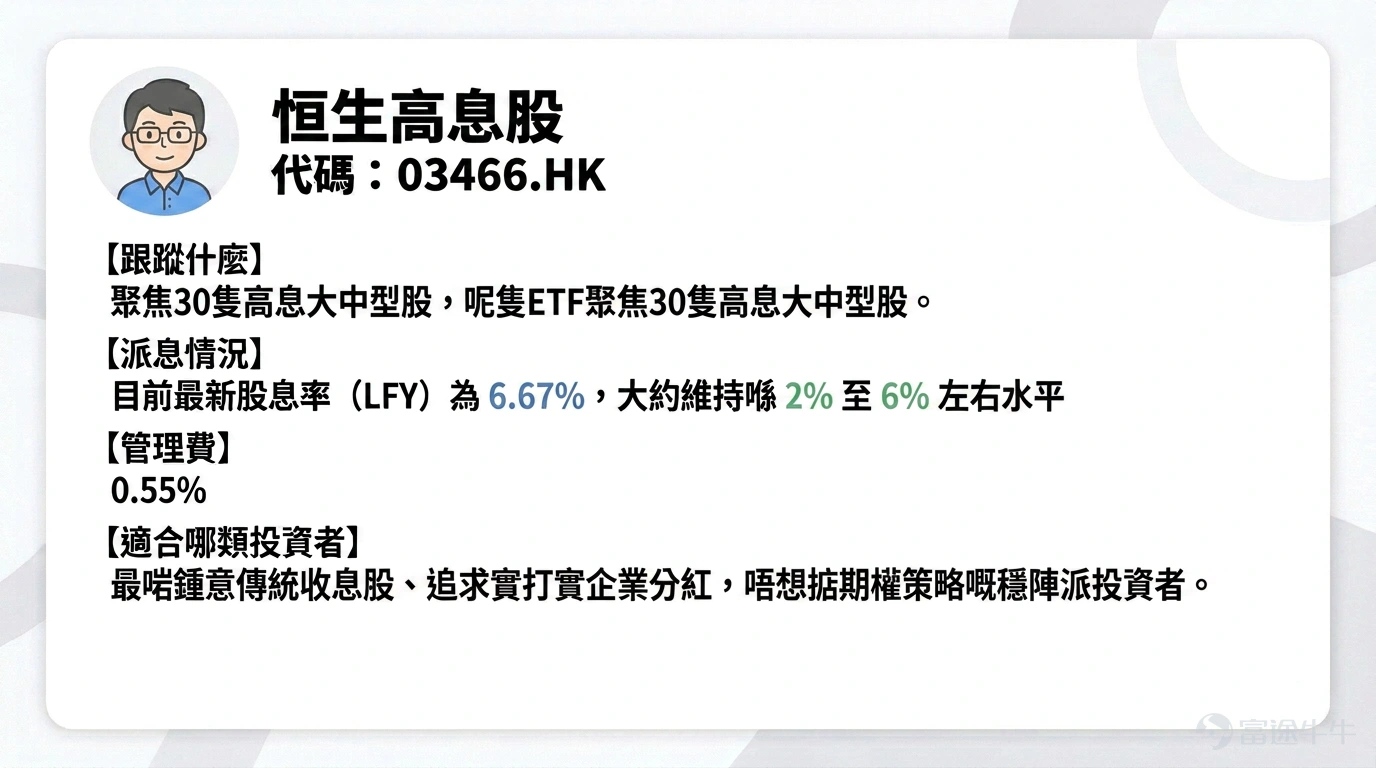
[Tracks What] Focuses on 30 high-dividend large- and mid-cap stocks. This ETF tracks 30 high-dividend large- and mid-cap stocks.
[Dividend Policy] Aims to pay monthly dividends.
The latest trailing twelve-month dividend yield is 6.67%, generally ranging between 2% and 6%. It has maintained a consistent monthly dividend record for 13 consecutive months since its listing (Note: Listed in February 2024; the dividend payment scheduled for June 9 has not yet been recorded).
[Management Fee] 0.55%
【Suitable for which type of investor?】Ideal for conservative investors who prefer traditional dividend-paying stocks, seek tangible corporate dividends, and avoid options strategies.
As of May 27, 2026. Data sources: Hang Seng Investment Management official website and Futubull app
3. Capture Tech Dividends: Hang Seng Tech Covered Call ETF
Many assume tech stocks don’t pay dividends—but with a covered call strategy, even the tech sector can deliver monthly income!
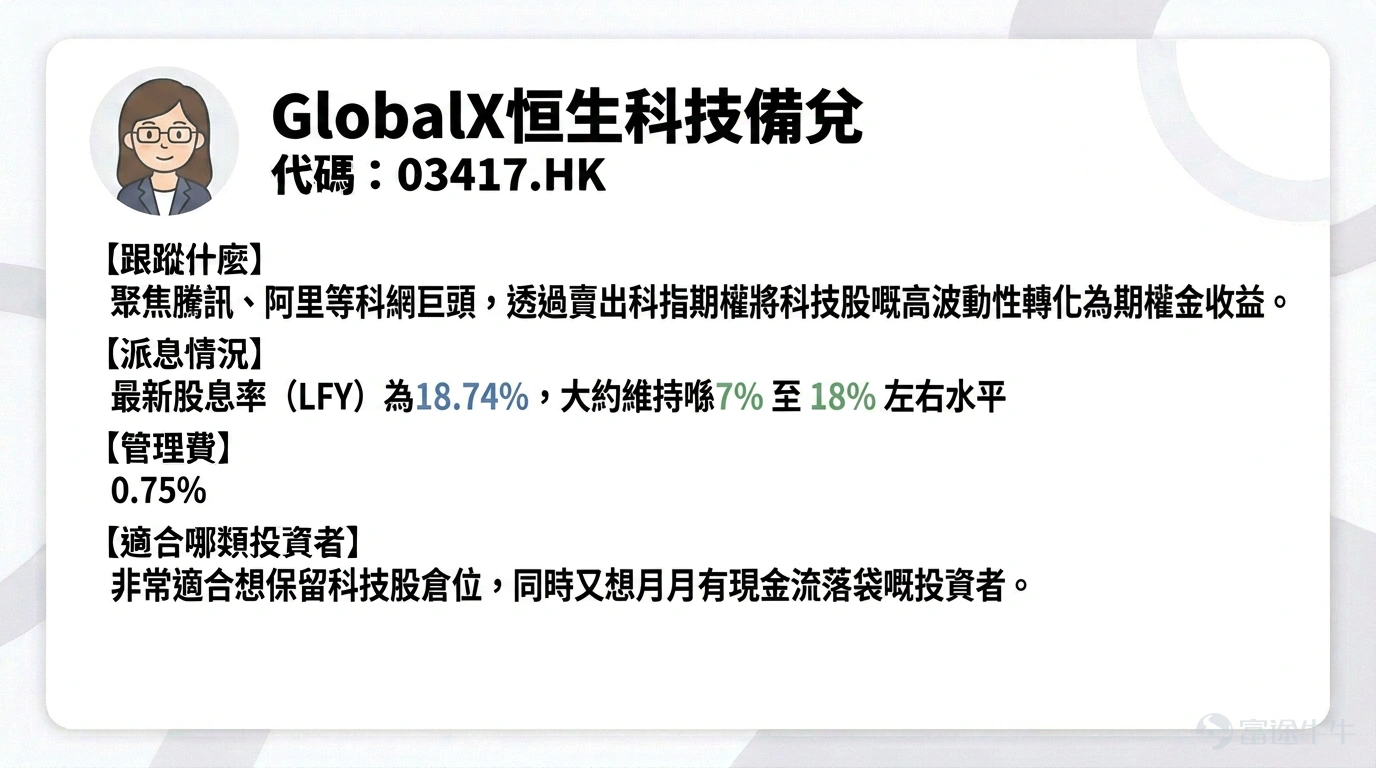
【What does it track?】Focuses on tech giants like Tencent and Alibaba, generating option premium income by selling Hang Seng Tech Index call options—turning the sector’s high volatility into yield.
[Dividend Policy] Aims to pay monthly dividends.
Due to the high volatility of tech stocks, option premiums are relatively generous. The latest trailing 12-month dividend yield is 18.74%, typically ranging between 7% and 18%. The ETF has paid monthly dividends for approximately 13 consecutive months (note: listed in March 2025; June 4 dividend not yet recorded).
【Management fee】0.75%
【Suitable for which type of investor?】Highly suitable for investors who wish to maintain exposure to tech stocks while receiving regular monthly cash flow.
As of May 27, 2026. Data sources: Hang Seng Investment Management official website and Futubull app
[What risks should you watch out for?]
Hang Seng Tech Covered Call ETF (03417.HK): Highly volatile; beware of the risk of 'earning dividends but losing capital'
If the tech sector experiences a sharp, one-sided decline (e.g., due to policy changes or macroeconomic factors), even if you collect the full 15% annual yield, a 30% drop in share price would still leave you with significant overall losses. If you have low risk tolerance or are sensitive to volatility,it’s advisable to avoid heavy positions in this ETF and instead diversify into other assets to spread risk。
FTSE China Index / Hang Seng Index Covered Call ETFs (02802.HK, 03416.HK, 03419.HK): Risk of 'boiling frog syndrome'
These ETFs concentrate investments in mainland China and Hong Kong markets, thus remaining exposed to concentration risk and emerging market volatility. Their biggest vulnerability is a prolonged 'slow-drip bear market' (i.e., gradual monthly declines). Over time, the option premium income may not offset the steady erosion of the underlying stock prices, leading to gradual capital depletion.
Hang Seng High Dividend Yield ETF (03466.HK): Offers more moderate dividend yields
This ETF does not employ an options strategy; its price performance depends entirely on the 30 traditional dividend-paying stocks it holds. Compared to monthly distribution covered-call ETFs, its yield is lower—but still generally higher than most individual dividend stocks over most periods.
[How to buy on Futu?]
Understand the benefits and risks. If you'd also like to start building your own monthly cash flow,Futubull Appbuying this type of ETF is actually very simple:
1. Open the Futubull App and tap 'Market' in the bottom menu.

2. Select 'ETF' from the tab at the top, then tapthe 'Hong Kong' market, where you’ll see categories like 'High Dividend ETFs' for easy comparison.
3. The quickest way is to directly click on the icon in the upper-right cornermagnifying glass (search icon)in the top-right corner and enter the stock ticker mentioned above.
4. After entering the quote page, click 'Trade' in the bottom-left corner, enter the number of shares and price you wish to buy, then click Buy—just like that, you become a shareholder and can look forward to receiving dividends every month!
Screening criteria: Top 5 most popular dividend-paying ETFs on the Futu app over the past two weeks, based on data from May 13, 2026 to May 27, 2026. Investing involves risks; investors should carefully read the fund information and related documents (including risk factors).
Risk Disclaimer: The above content only represents the author's view. It does not represent any position or investment advice of Futu. Futu makes no representation or warranty.Read more


Comments (4)
to post a comment
17
18