
Focus on COMPUTEX 2026! Will the entire AI supply chain ignite?

Earnings Playbook: Optical Interconnect Rides the AI Wave—Can Marvell’s Earnings Justify a New Valuation?
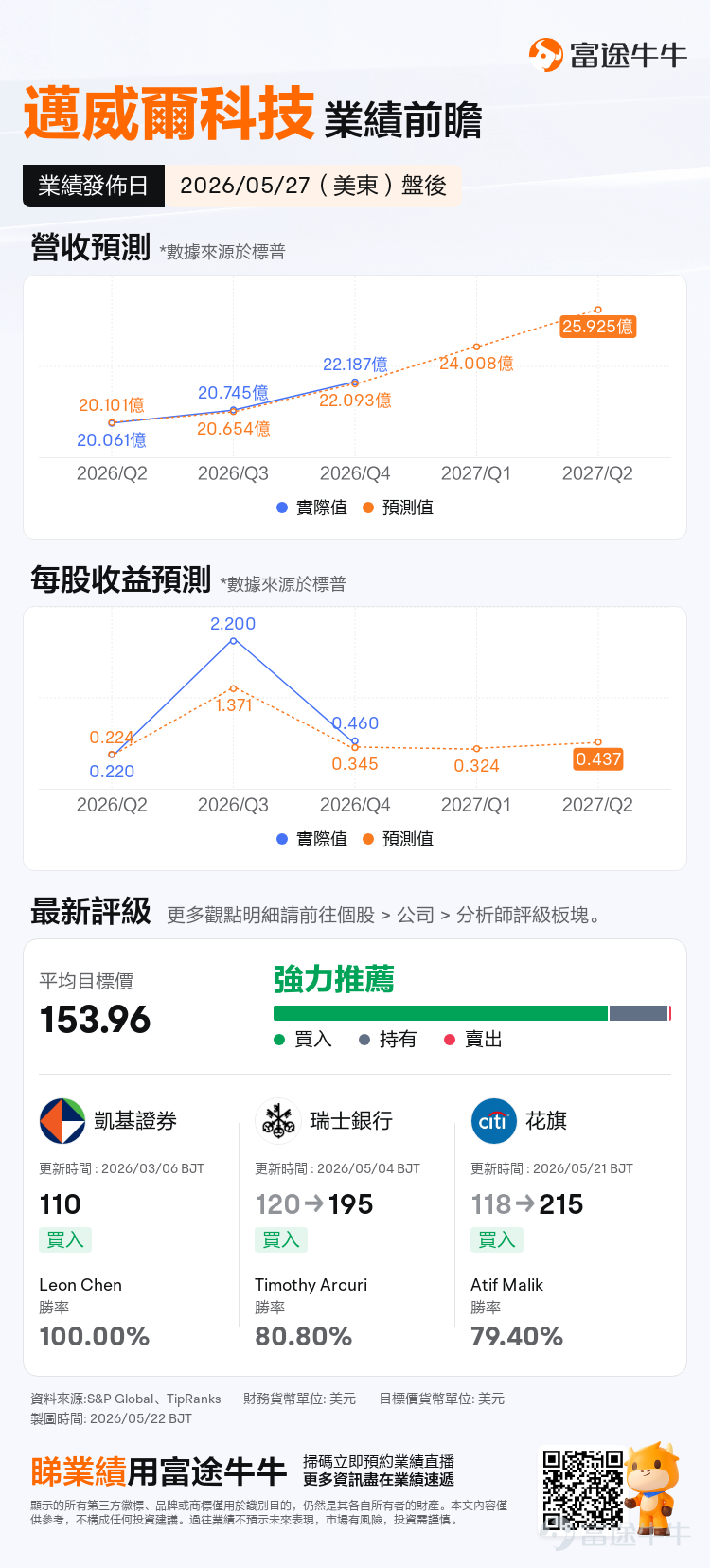
$Marvell Technology (MRVL.US)$ Will release its fiscal year 2027 first-quarter earnings after the U.S. market close on May 27.
The company previously provided FY2027 Q1 revenue guidance of approximately $2.4 billion, plus or minus 5%, and non-GAAP EPS guidance of $0.79, plus or minus $0.05. Market expectations have largely aligned with these levels. Analysts currently estimate Q1 FY2027 revenue at $2.401 billion, up 26.67% year-over-year, and EPS at $0.324, up 62.15% year-over-year.
Therefore, merely meeting expectations may not generate a strong positive reaction. Over the past period, market pricing for Marvell has already risen significantly. Investor focus has shifted from traditional communications, storage, and enterprise networking chips toward AI data centers, custom ASICs, optical interconnects, and high-speed networking chips.The market now needs to see 'better-than-expected results' and 'upward revisions to forward guidance'—evidence that the company is consistently proving itself as a key supplier in the expansion of AI infrastructure.

What exactly does Marvell do?
Within data center systems, Marvell plays a role in 'connectivity, data transmission, storage, and custom computing.'
The company’s current business can be broadly divided into two main segments. Data centers have become Marvell’s dominant narrative theme.In fiscal Q4 2026, Marvell’s data center revenue reached $1.651 billion, accounting for approximately 74% of total revenue.
The first segment is the data center business,which covers AI servers, cloud Ethernet switching, data center interconnects, storage systems, and AI-customized chips. In simple terms, as AI computing clusters scale up, the pressure to transfer data between servers, between chips, and across data centers intensifies. Marvell’s high-speed networking chips, optical interconnect DSPs, SerDes, switching chips, and custom ASICs are precisely positioned at the heart of this AI infrastructure upgrade cycle.
The second segment is communications and other businesses, including applications in enterprise networking, carrier infrastructure, consumer electronics, automotive, and industrial sectors. Historically, these businesses have been more cyclical in nature and less responsive than AI data centers, yet they still form a critical revenue base for the company.
Up 145% since the beginning of the year, with optical interconnect revaluation as the key driver
Marvell has already risen 145% year-to-date. Beyond the overall semiconductor sector rally, three underlying drivers are at work.
First, market expectations for AI-customized ASICs have been rapidly repriced.
As cloud providers face continuously rising costs for AI training and inference, they are placing increasing emphasis on in-house and customized chip solutions. Compared to relying solely on general-purpose GPUs, custom ASICs can significantly improve energy efficiency and reduce costs for specific workloads. Marvell has established expertise in custom chip design, high-speed interconnects, and deep relationships with data center customers, positioning it as another key beneficiary alongside Broadcom.
Second, bottlenecks in AI data center interconnects are being repriced by the market.
Initially, the market focused primarily on GPUs themselves; attention later shifted to HBM, servers, power supplies, and liquid cooling. Nowcapital is flowing further into optical communications, switching chips, SerDes, CPO, and silicon photonics. The larger the AI cluster, the more critical data movement becomes.
This is where Marvell’s value lies: it may not be the most dazzling compute chip company, but it plays a vital role in high-speed connectivity and data flow within AI factories.
Third, M&A activity and product positioning have reinforced the narrative around 'optical interconnects plus customized computing.'
The company previously announced its acquisition of Celestial AI, whose Photonic Fabric technology targets optical interconnects in AI computing systems, aiming to enhance performance and energy efficiency across data center compute, networking, and memory subsystems. For investors, the significance of such moves lies in Marvell’s strategic shift from being a discrete chip supplier toward offering system-level connectivity solutions for AI data centers.
Fourth, collaboration with NVIDIA has further expanded market expectations.
Marvell is collaborating with NVIDIA on NVLink Fusion and will participate in areas including semi-custom AI infrastructure, custom XPUs, scale-up networking, optical interconnects, and silicon photonics. The implication for the stock price is that this partnership places MRVL squarely within NVIDIA’s AI ecosystem narrative. As long as investment in AI infrastructure continues to grow, MRVL stands to benefit from a higher valuation premium.
What should investors really focus on in this earnings report?
1. Whether there are new customers or a clearer revenue trajectory for AI ASICs.
Custom chips remain Marvell’s most compelling growth driver.The trend of cloud providers developing their own AI chips is becoming increasingly clear: AWS’s Trainium3 is progressing smoothly, and Trainium4 is already in development; Google continues to vertically integrate its TPU ecosystem, and its Axion CPU may eventually support TPU clusters. Microsoft is another potential catalyst drawing market attention—there were earlier reports that Anthropic had discussed using Microsoft-designed AI chip servers with Microsoft, but this remains unconfirmed and should not be treated as a firm order for Marvell.
For Marvell, the real opportunity lies not just in a single primary chip. Rather, it’s the companion chips surrounding XPUs—such as CXL and NIC chips—that could become the source of sustained revenue. Once integrated into a cloud provider’s in-house AI chip platform, these companion chips tend to enjoy recurring shipments across successive platform iterations.
Management previously indicated that custom chip revenue has already doubled to $1.5 billion in FY2026 and is expected to grow by over 20% in FY2027. Moreover, revenue from CXL and NIC segments alone is projected to exceed $2 billion by FY2029. This signals that the market is no longer pricing in just a single customer project—it’s betting on Marvell’s ability to secure a broader foothold within cloud providers’ AI chip ecosystems.
On the earnings call, investors will focus on: whether the shipment cadence for existing AI custom chip customers is proceeding smoothly; whether there are any new major customers, new projects, or design wins; and whether management has raised its medium- to long-term AI revenue targets.
If the company can only offer vague statements like 'demand remains strong,' the market may view this as insufficient incremental information. At current share prices, investors need concrete details—not generalities—on specific customers, orders, and the timing of revenue realization.
2. Whether optical interconnects and high-speed networking chips are scaling in tandem
Market interest in optical modules, silicon photonics, co-packaged optics (CPO), high-speed switching, and data center interconnects has clearly intensified recently.
The larger the AI cluster, the more bottlenecks shift from 'insufficient compute' to 'inability to move data.' In the single-rack era, traditional electrical connections were sufficient; but in multi-rack or even larger-scale clusters, bandwidth, latency, and power consumption become critical constraints on efficiency. No matter how powerful the GPUs are, if data movement between chips and servers is inefficient, overall computational capacity is wasted. Marvell’s optical interconnects, silicon photonics, CXL, PCIe switching, and high-speed switching chips directly address the connectivity layer in this round of AI infrastructure upgrades.
This is also a key reason the market has recently repriced MRVL.Management previously indicated that data center revenue for fiscal year 2027 is expected to grow approximately 40% year-over-year, with interconnect-related revenue projected to increase by more than 50%, exceeding the prior expectation of around 30%.
If Marvell can demonstrate that its optical interconnect DSPs, switching chips, and high-speed connectivity products are benefiting from AI cluster expansion, the market will be more inclined to view the company as a core play in AI networking infrastructure.AI investment is expanding beyond GPUs, fundamentally reflecting trades on system-level bottlenecks. Whoever solves connectivity and data transfer efficiency challenges stands to gain new valuation upside.
3. Whether gross margins and expense control can keep pace with growth
AI ASICs and merger-and-acquisition integration will both affect the profit structure. The company previously guided for this quarter's non-GAAP gross margin to be between 58.25% and 59.25%, with non-GAAP operating expenses of approximately $575 million. Investors should focus on whether the ramp-up in AI business can deliver earnings elasticity, not just revenue expansion.
If revenue growth comes alongside rising expenses and gross margin pressure, market expectations for earnings leverage will weaken. For a stock price that has already risen significantly, profit quality is equally important.
Earnings Playbook
For Marvell, the key question about this earnings report isn't simply whether it's 'good or bad,' but whether it's 'good enough.' The latest available market data shows that MRVL's forward P/E is approaching 50 times。Wall Street analysts have been raising their price targets for the company, with the latest target of $300 set by HSBC.

The market has repriced MRVL from a traditional semiconductor company into a core AI infrastructure play. This shift has driven valuation upside—but also raised the bar for validation.Whether the stock can continue moving higher hinges on the company’s ability to demonstrate three things: sustained volume ramp in AI ASICs, continued acceleration in its data center business, and optical interconnect and high-speed networking chips emerging as new growth drivers.
Options market activity provides critical insights into market sentiment and expectations.Implied volatility (IV) remains elevated: as of May 26, MRVL’s options implied volatility (IV) stood at 95.29%., with an IV Rank (historical percentile rank) of 91 and an IV Percentile of 98%. This means the current implied volatility level exceeds that observed during 98% of the past year.Option pricing is very expensive, indicating that the market expects significant stock price volatility ahead. The options market is pricing in a ±13.41% move in the share price around this earnings announcement.

Technically, the stock has broken to a new all-time high, and its moving averages are in a bullish alignment, signaling a strong upward trend with a favorable medium-term outlook.; however, the current share price has deviated significantly from its key moving averages, with a 24-day bias ratio reaching 21.3%.There is divergence in fund flows, withon May 26, institutional funds (comprising ultra-large and large orders) recorded a net outflow of as much as $103 million, marking the third consecutive trading day of net outflows.
In terms of options strategy,
(1) If you already hold MRVL shares and have substantial unrealized gains, but are concerned about post-earnings uncertainty,
you may consider implementinga long collar strategy. Specifically, you can buy a put option at a lower strike for downside protection while simultaneously selling a covered call at a higher strike to offset the cost of the put. If the underlying stock rises, the sold call may be exercised, capping your overall profit potential. If the stock declines, the purchased put will generate gains, limiting your maximum loss.
This strategy suits investors who have already realized significant gains but do not wish to fully exit their position. At this juncture, the primary concern isn’t a sudden reversal in the company’s fundamentals, but rather a 'sell-the-news' reaction—even if earnings meet expectations. Recent institutional outflows over three consecutive trading days suggest some profit-taking has already begun at elevated levels. For shareholders holding the stock into earnings, partially locking in profits ahead of the report offers a more prudent approach than simply betting on results.
It can help prevent extreme drawdowns after earnings; if the stock continues to surge post-earnings, being assigned is equivalent to taking profits in tranches at a high price.
(The figure below illustrates the simulated profit and loss scenario of this strategy on the expiration date. The design image displayed on the screen is for demonstration purposes only and does not constitute any investment advice or guarantee; market conditions fluctuate frequently, and the prices shown do not represent actual values.)

(2) If you're bullish on MRVL's medium-term outlook but don't want to chase the price higher
they could consider selling puts.The core of this strategy isn’t betting on a big post-earnings rally, but rather collecting premium by leveraging high implied volatility (IV). If MRVL doesn’t fall below the strike price after earnings, the strategy has the potential to profit from time decay and the drop in IV. If it does fall below, the investor would be obligated to buy the corresponding number of shares at the predetermined strike price.
However, this type of strategy comes with a key prerequisite: one must be willing to accept the risk of a significant post-earnings decline in MRVL. Selling puts may appear to have a high win rate, but it inherently involves taking on tail-risk on the downside—position sizing should never be neglected just because the premium seems attractive.
(The figure below illustrates the simulated profit and loss scenario of this strategy on the expiration date. The design image displayed on the screen is for demonstration purposes only and does not constitute any investment advice or guarantee; market conditions fluctuate frequently, and the prices shown do not represent actual values.)

Finally, Option Sir brings a small perk for fellow investors, welcome to claim it.Options Beginner Pack
*This event is exclusive to invited HK users. Click to learn more.Detailed event rules>>
Market conditions are complex and volatile,Options StrategyOverwhelmed by choices? Futubull helps you build a portfolio in three steps.Options Strategymaking investing simple and efficient!

Option Risk Warning:An option is a contract that grants the holder the right, but not the obligation, to buy or sell an asset at a fixed price on a specific date or at any time before that date. The price of an option is influenced by various factors, including the current price of the underlying asset, the strike price, time to expiration, and implied volatility. Implied volatility reflects the market’s expectations for the level of volatility in the option over a future period. It is a data point derived inversely from the Black-Scholes option pricing model and is generally regarded as an indicator of market sentiment. When investors anticipate greater volatility, they may be more willing to pay a higher price for options to hedge risks, resulting in higher implied volatility. Traders and investors use implied volatility to assess the attractiveness of option prices, identify potential mispricings, and manage risk exposure.
Disclaimer:This content does not constitute any offer, solicitation, recommendation, opinion, or guarantee of any securities, financial products, or tools. The risk of loss in trading options can be substantial. In some cases, losses may exceed the initial margin deposited. Even if you set contingent orders such as 'stop-loss' or 'limit' orders, these may not prevent losses. Market conditions may make such orders unexecutable. You may be required to deposit additional margin within a short period. If you fail to provide the required amount within the specified time, your open positions may be liquidated. However, you will still be responsible for any shortfall in your account. Therefore, before trading, you should study and understand options and carefully consider whether such trading is suitable for you based on your financial situation and investment objectives. If you trade options, you should be familiar with the procedures for exercising options and the rights and obligations upon exercise and expiration. Options trading carries extremely high risks and is not suitable for all investors. Investors should carefully readCharacteristics and Risks of Standardized Options。
Risk Disclaimer: The above content only represents the author's view. It does not represent any position or investment advice of Futu. Futu makes no representation or warranty.Read more


Comments (3)
to post a comment
13
28