
Moutai's ESG Leap Lands It in S&P Global Yearbook: How Should Global Capital Markets Understand the Moat of Baijiu?
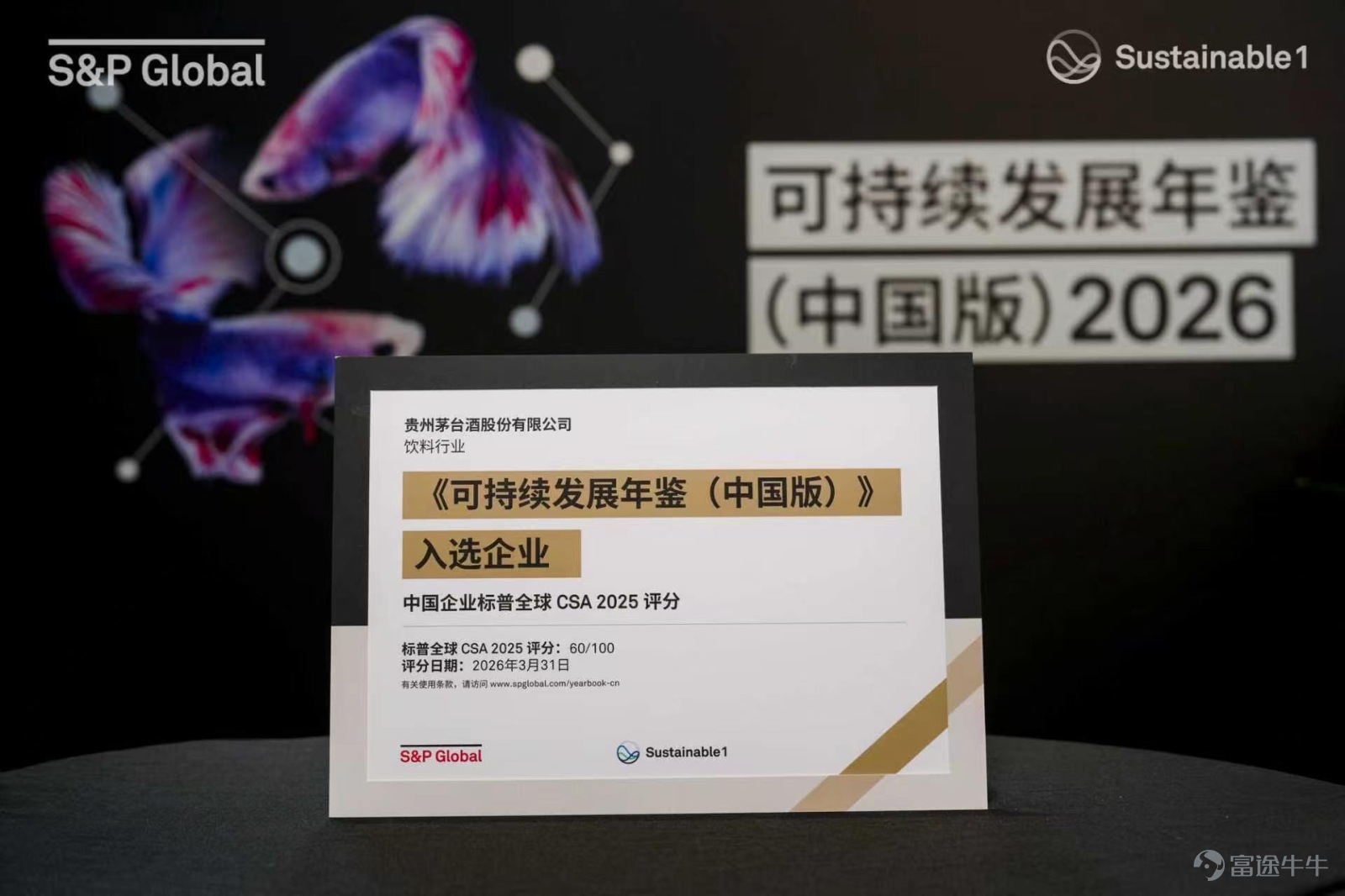
On May 21, Moutai engaged in discussions with S&P Global regarding the 'Sustainability Yearbook (China Edition) 2026.' On the same day, Kweichow Moutai was included in the yearbook for the first time and awarded the title of 'Industry Leader in Improvement.'


Of the 1,800 Chinese enterprises evaluated, only 190 were selected—an inclusion rate of just 10.6%. Viewing this solely as an ESG honor risks underestimating the underlying transformation.
Over the past few years, Kweichow Moutai has significantly accelerated its progress within international ESG rating systems. In 2025, it became the first company in the global baijiu industry to receive an MSCI ESG 'A' rating, and its S&P Global CSA score also rose to 60.
Behind this sharp improvement in scores, Moutai is entering a more standardized international evaluation framework.
Historically, capital markets have understood Moutai primarily through high gross margins, strong cash flow, brand premium, and dividend capacity. However, the true long-term moat for baijiu companies lies deeper—in the terroir of the Chishui River Valley, its unique microbes, raw materials, production techniques, aging cycles, channel discipline, and consumer trust.
While these factors are familiar to domestic investors, they have been difficult for overseas capital markets to quantify and compare directly. ESG is now offering a new translation mechanism.
As water resources, climate risk, supply chain stability, product quality, data security, consumer responsibility, and corporate governance are integrated into globally comparable frameworks like those of MSCI and S&P Global, Moutai’s traditionally culture-, brand-, and industry-experience-driven long-term value is beginning to be expressed through more trackable, verifiable, and comparable management metrics.
For Moutai, ESG is evolving from a tool for responsibility reporting into a new language for articulating its competitive moat.
01 ESG Is No Longer Just a Checklist of Responsibilities
Moutai has now published ESG reports for five consecutive years. Compared to earlier reports that largely highlighted responsibility initiatives, recent editions show clearer shifts toward management practices.
On one hand, Moutai has accumulated more quantifiable and trackable management outcomes on key issues such as supply chain, quality, data security, risk management, and corporate governance. On the other hand, these outcomes are being embedded into clearer governance structures, goal-oriented management systems, and external evaluation frameworks—enabling a seamless transition from internal management to external disclosure.
Water resources, climate change, ecological conservation, supply chain stability, product quality, consumer responsibility, data security, and corporate governance are all material issues affecting the long-term operational quality of enterprises. In recent years, Moutai’s ESG evolution has deepened precisely along these dimensions.
Digital governance is one representative entry point among them.
With the cumulative number of registered users on the 'iMoutai' platform approaching 80 million, Moutai’s engagement with consumers has become distinctly digital. Consequently, data security and user privacy protection are no longer merely technical issues—they now also concern consumer rights, digital operations, and corporate governance.

In 2025, Moutai achieved 'zero cybersecurity incidents' and 'zero user privacy breaches.' It also engaged a third party to conduct a compliance audit of personal information protection for the iMoutai app and obtained PIA Two-Star Certification. These metrics matter because they allow external markets to observe Moutai’s digital governance capabilities concretely, rather than relying solely on principle-based statements like 'valuing data security.'
Beyond improved data granularity, the more critical shift is that ESG management is evolving toward a closed-loop governance model.
In 2024, Moutai conducted its first enterprise-wide double materiality assessment, identifying not only the issues stakeholders care about but also evaluating how those issues impact the company’s business operations, financial condition, operating results, and cash flows.
By 2025, Moutai further refined its double materiality analysis mechanism by integrating industry trends and capital market priorities through targeted interviews and financial data modeling.
Meanwhile, key sustainability indicators have been incorporated into executive performance evaluations, using a 'positive incentives plus negative constraints' approach, supported by a three-tier governance system spanning 'decision-making—management—execution.'
This means Moutai’s ESG management is forming a clearer chain: first identifying which issues are material, then assessing how they affect operations and finances, followed by goal setting, performance evaluation, and accountability.
ESG is no longer just a disclosure exercise for the reporting department; it is gradually becoming embedded in the management chain linking the board of directors, executive leadership, specialized task forces, and individual business units.
This also explains why Kweichow Moutai has received greater recognition in recent years from international rating platforms such as MSCI and S&P Global.
From the perspective of rating agencies, a company’s ESG value depends not only on whether it engages in environmental protection, philanthropy, and employee care, nor solely on how much information it discloses, but rather on whether the company can identify key sustainability risks specific to its industry and demonstrate—through governance structures, management objectives, performance data, and external verification—that these risks are being effectively managed.
Moutai’s recent transformation has precisely followed this path.
02 How Moutai Entered the Global Spirits Industry Discourse
Leading global spirits companies have long moved beyond basic ESG disclosures focused only on environmental protection and philanthropy; instead, they now address sustainability across the entire value chain.
Rémy Cointreau emphasizes ‘terroir assets,’ integrating production regions, soil, climate, biodiversity, and farming partners into its sustainability framework; Pernod Ricard organizes its management chain ‘from grain to glass’; Suntory has turned water source protection, ecosystem restoration, and public education into brand assets; while beer giants like Asahi place greater emphasis on net-zero commitments, packaging circularity, low- and no-alcohol products, and metric-driven disclosures.
What these approaches share is their translation of what was once an abstract brand moat into tangible sustainable operational capabilities: terroir stability, raw material safety, water resilience, packaging and carbon emissions management, and consumer responsibility—all of which ultimately impact a spirits company’s long-term value.
Viewed through this lens, Moutai’s ESG disclosures over the past two years have begun aligning with the shared discourse of global spirits producers.
This is first evident in hard metrics commonly prioritized by global spirits companies—climate, water resources, energy, and supply chains.
In 2025, Moutai conducted climate scenario analysis and completed carbon footprint assessments for all core products; it procured 1,321,509,000 kWh of green electricity, achieving 100% green power coverage for both the Moutai and Heyixing production zones; and reduced water consumption per unit of product by 32.4% compared to 2023, thereby meeting its 2026 water-saving target ahead of schedule.

Supply chain management has also progressed from green procurement to imposing constraints on core suppliers. In 2025, Moutai has already surveyed energy use and carbon emissions data from 47 core suppliers—accounting for over 90% of its total procurement value—and set a target to reduce the carbon footprint of packaging materials used for Moutai liquor by 16% by 2028 compared to 2023 levels.
These actions align with a broader trend among global spirits companies toward strengthening ESG disclosures: moving beyond their own operations to address Scope 3 emissions, agricultural raw materials, packaging circularity, and supplier governance.
On these shared issues, Moutai has already established a foundation for dialogue with global spirits producers. The next critical step is to contextualize standardized metrics within the baijiu value chain to highlight its industry-specific characteristics.
For most consumer goods companies, water resources, energy, and packaging primarily relate to efficiency, cost, regulatory compliance, and brand responsibility. For Moutai, however, these issues have a more direct connection to its brewing environment, product quality, and brand stability.
The Chishui River, hydrological conditions, microorganisms, sorghum, wheat, and traditional production methods collectively form part of Moutai’s quality system. Environmental issues here are not merely external responsibilities—they are closer to essential inputs and brand assets.
While international spirits companies emphasize terroir, Moutai’s expression of terroir has its own distinct features. It encompasses not only land and climate but also microbial communities, brewing rhythms, production cycles, and the ecology of its designated production region. According to its 2025 report, Moutai has preserved over 8,800 strains of microbial cultures and maintains 328 wheat accessions and 800 sorghum accessions as germplasm resources for brewing ingredients.
Therefore, many of the metrics disclosed in Moutai’s ESG reporting should not be interpreted solely as general environmental or scientific data but must be understood within the context of the baijiu value chain.
The Chishui River represents natural capital; microorganisms underpin flavor profiles; sorghum and wheat ensure raw material security; and traditional craftsmanship reflects scarcity and time-intensive barriers to entry. For Moutai, these issues are not just about efficiency, cost, or compliance—they are directly tied to regional stability, quality formation, and brand exclusivity.
This approach ensures that Moutai’s ESG disclosures maintain international comparability while preserving the unique value logic inherent to the baijiu industry.
03 Capital Market Implications Behind ESG Ratings
The ESG frameworks of mature alcoholic beverage companies ultimately influence three types of capital market perceptions.
First is the identifiability of long-term risks.
The long-term risks faced by alcoholic beverage companies stem not only from short-term consumption cycles. Climate change, water resource constraints, volatility in agricultural raw materials, packaging regulations, alcohol consumption oversight, underage protection, advertising compliance, and supply chain stability all affect the quality of a company’s long-term operations.
ESG disclosures transform these risks from abstract judgments into observable and trackable management issues, thereby reducing uncertainty for external investors when assessing a company's long-term risks.
Second is the visibility of intangible assets.
A significant portion of premium alcoholic beverage companies’ valuations comes from brand, region of origin, craftsmanship, time, distribution channels, and consumer trust. These assets are extremely valuable but do not easily appear directly on balance sheets. ESG disclosures can convert some of these invisible assets into management metrics that capital markets can understand and track.
Third is accessibility to ratings, indices, and international long-term capital.
Institutions such as S&P Global and MSCI serve not only as rating agencies but also as critical data and index infrastructure providers for global capital markets. For global pension funds, sovereign wealth funds, ESG-themed funds, and passive investment vehicles, ESG scores, index inclusion, and sustainable investment screening have become key considerations in asset allocation processes.

Take S&P Global as an example: its Corporate Sustainability Assessment (CSA) scores are linked to the Dow Jones Sustainability Indices and related Best-in-Class index families. S&P’s methodology indicates that eligible companies are ranked within their industry based on CSA scores, and index constituents are selected according to specific index rules.
An improved rating does not directly trigger capital inflows, nor does it imply that ESG can substitute fundamental analysis. However, for a Chinese company seeking greater understanding from global investors, inclusion in mainstream ESG rating systems and enhanced international comparability inherently increases the likelihood of being included in research coverage, screening processes, and investment portfolios.
For the baijiu industry in particular, Moutai’s significance goes beyond a simple upgrade in its corporate rating.
For a long time, Chinese baijiu has been viewed by overseas investors as somewhat 'non-standard': it carries a high barrier to product understanding, reflects significant cultural differences in consumption, lacks comparable production regions and processes, and operates under a business model distinct from that of global spirits companies.
Moutai’s recognition in ESG also provides baijiu producers with a more globally capital-market-friendly communication template.
However, once integrated into a global comparability framework, Moutai will face higher expectations.
Compared with leading global spirits companies, Moutai already includes GRI indexing, double materiality assessments, climate scenario analysis, product carbon footprinting, third-party assurance, and supply chain decarbonization targets in its ESG disclosures. Yet, from the perspective of international investor usage patterns, there remains room to further modularize and granularize these disclosures.
International spirits companies like Diageo typically break down their annual reports, ESG data indexes, climate reports, methodology explanations, and assurance reports into multiple investor tools, facilitating item-by-item data extraction by rating agencies and enabling peer comparisons by investors.
By contrast, Moutai’s reporting still leans heavily on narrative styles common in Chinese-language disclosures—better suited for showcasing corporate responsibility, brand value, and governance philosophy—but could further enhance its international comparability, data granularity, and methodological transparency.
Regarding its collaboration with S&P Global, Moutai’s goal is not merely to secure a higher score, but rather to use the international rating framework to retrospectively calibrate its capabilities in governance, environmental management, supply chain, digitalization, and risk management.
For Moutai, the ultimate value of ESG lies not in telling an additional story about corporate responsibility, but in providing a more transparent, verifiable, and internationally comparable expression of its competitive moat—one traditionally rooted in culture, brand, and scarcity.
*The above content does not constitute investment advice, does not represent the views of the publishing platform, the market carries risks, invest with caution, and make independent judgments and decisions.
Risk Disclaimer: The above content only represents the author's view. It does not represent any position or investment advice of Futu. Futu makes no representation or warranty.Read more
Comments
to post a comment