
Bitget UEX Daily Report | US-Iran peace talks expectations rise; oil prices plunge 4.6%; Fed holds rates steady (May 26, 2026)


I. Key News Highlights
Federal Reserve Dynamics The Federal Reserve held rates steady, citing ongoing monitoring of Middle East developments and their impact on inflation.
In its recent meeting, the FOMC decided to maintain the target range for the federal funds rate at 3.5%–3.75%, with a split vote recorded.
Officials remain divided on the inflation outlook, with some members warning that further rate hikes may be necessary if inflation remains persistently high.
Easing geopolitical tensions in the Middle East could alleviate upward pressure on energy prices, indirectly supporting the Fed’s goal of achieving 2% inflation.
This development provides markets with relatively stable monetary policy expectations, while reduced geopolitical risk could further dampen inflationary pressures, supporting a recovery in risk asset valuations.
International Commodities Optimistic signals from US-Iran talks drive oil prices sharply lower
Trump stated that negotiations are progressing well and that he would not sign any agreement allowing Iran to develop nuclear weapons; US officials expressed optimism about resolving the dispute soon, and the appearance of the Iranian delegation in Qatar was seen as a positive signal.
Affected by this, WTICrude oilfutures posted significant declines, with Brent crude also falling sharply.
Market expectations of a potential reopening of the Strait of Hormuz have eased concerns over energy supply disruptions.
Progress in the talks has directly alleviated tensions in energy markets, creating short-term bearish pressure on oil prices, though details of any long-term agreement remain key to watch.
Macroeconomic policy SEC urgently halts third-party tokenized US stock trading plan
The SEC has put on hold the exemption scheme for 'third-party tokenized stocks' originally scheduled for launch this week, which would have allowed the issuance of digital tokens tracking stock prices without authorization from the listed companies and enabled 24/7 trading.
Regulators cited concerns over liquidity fragmentation and market fragmentation risks.
This move reflects regulators' cautious stance toward the integration of crypto and traditional finance.
The decision alleviates near-term market concerns about potential liquidity disruptions from tokenized equities, supporting stability in traditional securities markets, but also constrains the expansion potential of crypto-driven innovation in equities.
Commodities & Forex Performance
CurrentlyGold goods-0.47%, at $4,546 per ounce.
Spot silver-1.22%, at $77 per ounce.
WTI Crude Oil-4.9%, at $91.83 per barrel.
Brent crude oilSimultaneously retreated to $91.87 per barrel, as the potential reopening of the Strait eased supply risks.
US Dollar Index+0.05%, at 99.026.
Cryptocurrency performance
Bitcoin-0.55%, at $76,800.
ETH-0.45%, at $2,097.
Total cryptocurrency market capitalizationUp 0.1%, reaching $2.65 trillion.
Market liquidation overviewTotal liquidations in the past 24 hours amounted to $195 million, with long positions accounting for $105 million.
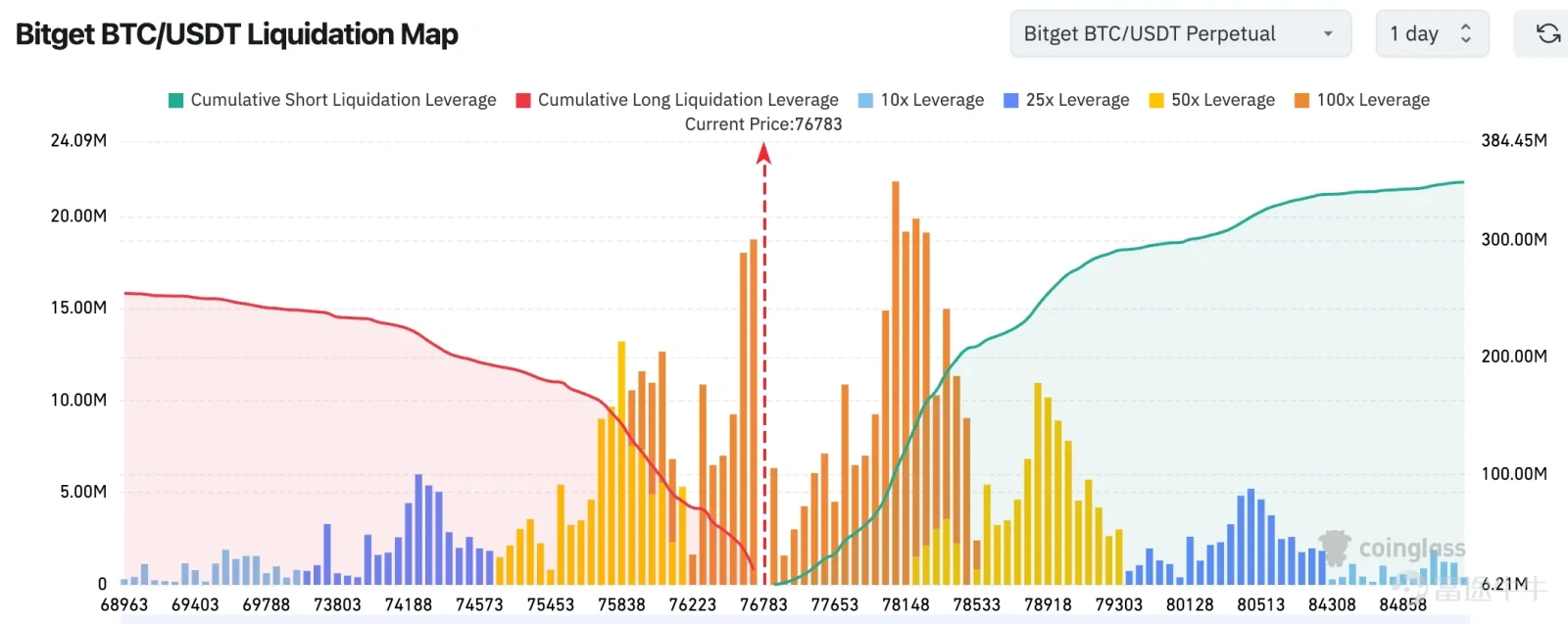
Bitget BTC/USDTLiquidation MapBitcoin is currently trading around $76,783. A significant cluster of high-leverage short positions awaits liquidation above the $78,000–$78,500 range, indicating clear short-side pressure buildup. In the near term, the market appears more inclined to push higher to trigger these shorts. If Bitcoin stabilizes above $77,500, it could further ignite a cascade of short-covering, accelerating price momentum toward the $79,000 zone.
During last week’s trading days (May 18 to May 22, Eastern Time), Bitcoin spot ETFs recorded net outflows of $1.257 billion. The largest outflow came from BlackRock’s ETF IBIT, with weekly net outflows of $1.008 billion, followed by Fidelity’s ETF FBTC, which saw weekly net outflows of $112 million.
US stock index performance
Dow Jones Industrial AverageClosed up 0.58% at 50,579.70 points, maintaining a consistently steady trend.
S&P 500Closed up 0.37% at 7,473.47 points, sustaining elevated volatility within a tight range.
NasdaqClosed up 0.19% at 26,343.97 points, primarily driven by strength in the technology sector.
Tech giant updates
Apple (AAPL)Closed at $308.82, up 1.26%, showing modest strength, supported by positive sentiment across the broader tech sector and its defensive characteristics attracting capital inflows.
Microsoft (MSFT)Closed at $418.57, down 0.12%, demonstrating relative resilience, as its cloud computing and AI businesses continue to provide solid fundamental support.
NVIDIA (), NVIDIA ()Closed at $215.33, down 1.90%, experiencing a slight pullback, primarily due to profit-taking pressure and short-term market rotation.
Amazon(AMZN)Closed at $266.32, down 0.80%, undergoing a mild correction, though fundamentals from its e-commerce and AWS cloud businesses remain robust.
Meta (META): Closed at $610.26, up 0.47%, posting a modest gain driven by strong expectations for advertising revenue.
Alphabet (Google, GOOGL): Closed at $382.97, down 1.21%, pressured by its removal from the Russell 1000 Value Index, reinforcing its positioning as a pure growth stock.
Tesla (TSLA): Closed at $426.01, up 1.95%, following broader market trends, with continued rising investor interest in EV deliveries and energy business performance.
Markets showed mixed performance overall; AI-related themes remain the core driver, though some high-valuation stocks face profit-taking pressure, signaling early signs of capital rotation.
Semiconductor sectorMixed gains and losses
Representative stocks: Qualcomm (QCOM) surged 11.60%, closing at $238.16;AMDGained approximately 4%–8% (with several recent days recording strong single-session gains), standing out notably.
Driving Factors: Demand for AI PCs, data center solutions, and automotive chips continues to exceed expectations. Qualcomm’s expanded Snapdragon collaboration with Stellantis and the launch of its custom AI data center silicon project served as direct catalysts. Russell index rebalancing further highlighted the appeal of pure growth names. Differentiation within the sector primarily stems from valuation disparities and capital rotation dynamics; AI remains the dominant theme, though mature-node semiconductor firms face increasing competitive pressures.
Market impact: Provides short-term sentiment support for the semiconductor supply chain, but significant volume-driven rallies in stocks like Qualcomm warrant caution regarding potential profit-taking. Over the medium to long term, the AI supercycle is expected to underpin sector-wide upside, with global semiconductor sales projected to grow by more than 26% by 2026.
Defensive and Europe-related sectorsModestly strengthening
Representative stocks: European defense stocks such as Rheinmetall and BAE Systems have recently shown solid performance; U.S. healthcare and consumer defensive sectors recorded modest gains.
Driving Factors: Optimism around U.S.-Iran peace talks has fueled the 'post-war trade' theme, with easing energy risks prompting capital rotation from pure safe-haven assets toward defensive, healthcare, and European cyclical sectors that could benefit from reconstruction and stabilization. The logic of increased defense budgets accumulated during periods of geopolitical tension remains intact despite de-escalation signals, as the trend of rising defense spending as a share of GDP across multiple European countries continues.
Market impact: This sector rotation reflects asset reallocation amid improving risk appetite, helping to lower overall market volatility. However, if peace talk details fall short of expectations, defensive sectors could regain safe-haven support. Investors may consider opportunities at the intersection of undervalued European assets and healthcare innovation.
Overall, sector rotation is accelerating, with AI-driven growth themes and beneficiaries of geopolitical easing jointly driving the market. Investors are advised to monitor trading volume changes to assess capital sustainability.
1. Alphabet (Google) – Russell Index Reclassification Event summary: In the June 2026 semi-annual Russell index reconstitution, Alphabet and AMD were fully removed from the Russell 1000 Value Index and reclassified as 100% growth stocks. Among the top ten companies by market cap, nine remained unchanged, with only Walmart replacing Eli Lilly and Co on the list. Alphabet’s market capitalization surged 141.9% over the past year, significantly outperforming other mega-cap peers.Market Analysis: Institutional analysts view this reclassification as a strong market endorsement of Alphabet’s long-term growth potential in AI, search, and cloud businesses, further widening the divergence between value and growth stocks. Investment banks such as Morgan Stanley note that Alphabet’s shift from value to pure growth may trigger rebalancing trades by passive funds, creating short-term liquidity pressure but reinforcing its weight in growth-oriented indices over the long term.Investment Insights: Investors can consider Alphabet as a core holding in AI and the digital economy, offering notable medium- to long-term strategic value, though they should remain cautious about volatility stemming from elevated valuations and potential antitrust risks.
2. Eli Lilly and Co – Drops Out of Top 10 Market Cap Ranking Event summaryAccording to the latest Russell Index rankings, Eli Lilly and Co was replaced by Walmart and fell out of the global top 10 by market capitalization, despite its market cap still hovering near $900 billion. Eli Lilly continues to see robust growth in obesity and diabetes treatments, but the relative strength of the retail sector has propelled Walmart’s ranking upward.Market AnalysisInvestment banks widely agree this shift does not reflect a deterioration in Eli Lilly’s fundamentals, but rather a market-driven revaluation favoring defensive healthcare and stable consumer retail sectors. Goldman Sachs noted that its GLP-1 drug pipeline still holds significant long-term upside potential, though the short-term rotation of capital from high-valuation biotech stocks into value-oriented consumer names warrants attention.Investment InsightsThe near-term reshuffling of rankings may exert downward pressure from fund outflows; investors are advised to monitor clinical trial progress for Eli Lilly’s innovative drugs. Over the long term, its leading position in the obesity and chronic disease treatment markets continues to support strong growth potential.
3. SK Hynix – Surging AI Demand for HBM Memory Event summarySK Hynix is facing unprecedented demand from global tech giants seeking to lock in supply of HBM memory, with tight market conditions expected to persist beyond 2026. The company is actively expanding related operations and benefiting from sharply rising capital expenditures in AI data centers.Market AnalysisInvestment banks unanimously view SK Hynix’s leadership in HBM as conferring strong pricing power. Despite competition from Samsung, the AI supercycle is driving rapid profit growth. Institutions such as UBS Group expect SK Hynix’s 2026 HBM capacity to be largely pre-sold, with gross margins likely to remain elevated, pushing its market cap close to the $1 trillion mark.Investment InsightsIn the short term, investors should consider overweighting AI memory theme beneficiaries and closely track the pace of HBM4/HBM4E capacity expansion. Long-term positioning should focus on the depth of SK Hynix’s partnerships with industry leaders like NVIDIA to capture opportunities during the semiconductor upcycle.
4. Samsung Electronics – Internal Labor Dispute Triggered by Chip Division Bonuses Event summaryMassive performance bonuses awarded to Samsung’s chip division employees—reaching up to approximately $400,000 for some—have sparked strong discontent from workers in the consumer electronics division. The union previously filed for an injunction, questioning the legality of the bonus agreement. The company eventually reached a compromise with the union by capping bonuses as a percentage of profits, though still below SK Hynix’s levels. A vote on the matter will conclude by May 27.Market AnalysisInstitutions are concerned that internal governance issues and inter-departmental conflicts could temporarily affect morale and supply chain stability, but strong overall demand for AI chips will provide a buffer. UBS Group noted that if strike risks are fully eliminated, Samsung's momentum in catching up in HBM4 could boost market confidence; conversely, potential production disruptions would exacerbate the global AI memory shortage.Investment InsightsIn the near term, closely monitor how union voting outcomes may impact the stock price and track internal coordination progress; over the long term, Samsung’s integrated competitiveness in memory and foundry services remains promising, especially against the backdrop of expanding AI infrastructure.
1. A plaintiff using the pseudonym 'Noah Doe' filed a lawsuit in a New York court seeking ownership of 39,069 dormant Bitcoin wallets, including the Satoshi Nakamoto address. These wallets are estimated to hold approximately 3.7 million Bitcoins, valued at around USD 290 billion. The plaintiff, acting through two Wyoming shell companies—ABC Company and XYZ Company—submitted a 901-page complaint on May 1, claiming the Bitcoins qualify as 'abandoned property' under New York’s lost property laws.
2. Cryptocurrency-linked political action committees (PACs) and executives have contributed over USD 500 million to the 2026 U.S. elections, with Republican candidates receiving significantly more funding than their Democratic counterparts.
3. Bhutan recently transferred another 90 BTC (approximately USD 7 million) to a Segwit address, possibly indicating an intent to transfer or sell to a third party.Arkhamnoted that since the beginning of this year, Bhutan has cumulatively transferred approximately USD 237.39 million worth of BTC from its custody addresses to Segwit addresses and currently still holds about USD 233.18 million worth of BTC.
4. IOSG Ventures clarified market rumors, stating it has neither held nor soldUNI、COMPrecently. The on-chain address referenced is not IOSG’s official wallet. IOSG stated that Arkham’s labels for this address—'IOSG Ventures' and 'Binance Deposit Change Address'—both carry a '?' symbol, indicating unverified tags. The address in question is actually a wallet used for Binance deposits and has no affiliation with IOSG.
Data release schedule
Monitor U.S. and global data
United States
Follow-up data such as consumer confidence
⭐⭐⭐
Preview of key events
May 26 (Tuesday)
U.S. May Conference Board Consumer Confidence Index
U.S. May Dallas Fed Manufacturing Business Activity Index
May 27 (Wednesday)
Key U.S. earnings reports: Marvell (MRVL), Snowflake (SNOW), Salesforce (CRM), Synopsys (SNPS) to report after market close ★★★★★;
May 28 (Thursday)
Key U.S. earnings reports: Dell (DELL), Costco (COST) to report after market close ★★★★★;
Q1 2026 GDP revision, initial jobless claims, and durable goods orders released simultaneously
April Core PCE (the Fed's most-watched inflation gauge) ★★★★★
Friday, May 29
US Chicago PMI for May released
Kansas City Fed President Schmidt, a 2028 FOMC voting member, delivers remarks
Fed Governor Bowman delivers remarks
*Key US equity market highlights this week:
With the critical window for a US-Iran ceasefire, core PCE inflation data, and Q1 earnings season wrapping up with reports from Marvell and Salesforce, heightened market volatility is expected.
Institutional perspectives
Analysts at major investment banks widely agree that positive progress in US-Iran negotiations is significantly easing risks of energy supply disruptions, injecting short-term optimism into global markets. Institutions including J.P. Morgan and Morgan Stanley note that if the Strait of Hormuz gradually reopens, oil prices could quickly fall below $90 per barrel, effectively alleviating inflationary pressures and providing the Federal Reserve with greater policy flexibility going forward. Nevertheless, most forecasts indicate the Fed will hold rates steady through 2026 until inflation clearly retreats.
Firms like Goldman Sachs emphasize that, against a backdrop of easing energy-related risks, in addition to AI-driven capital spending continuing to support tech stocks, 'post-conflict trade' themes could gain further traction. Healthcare, Europe-linked assets, and certain undervalued cyclical sectors may present attractive allocation opportunities. In crypto markets, reduced geopolitical tensions are boosting risk appetite, but outflows from spot ETFs warrant close monitoring, with overall volatility expected to remain elevated.
Overall, the market in the near term will hinge on the concrete outcomes of peace talks, the actual extent of energy price declines, and upcoming macroeconomic data releases. Investment banks advise investors to maintain a defensive stance while flexibly positioning in high-quality assets benefiting from the dual drivers of low oil prices and AI, paying close attention to valuation fundamentals alignment and avoiding excessive chasing of rallies.
Disclaimer: The content above has been compiled by AI search, with human verification for publishing purposes only. It is not intended as investment advice. Data mentioned in the text may inevitably contain biases; please refer to real-time market data for accuracy.
Risk Disclaimer: The above content only represents the author's view. It does not represent any position or investment advice of Futu. Futu makes no representation or warranty.Read more
Comments
to post a comment