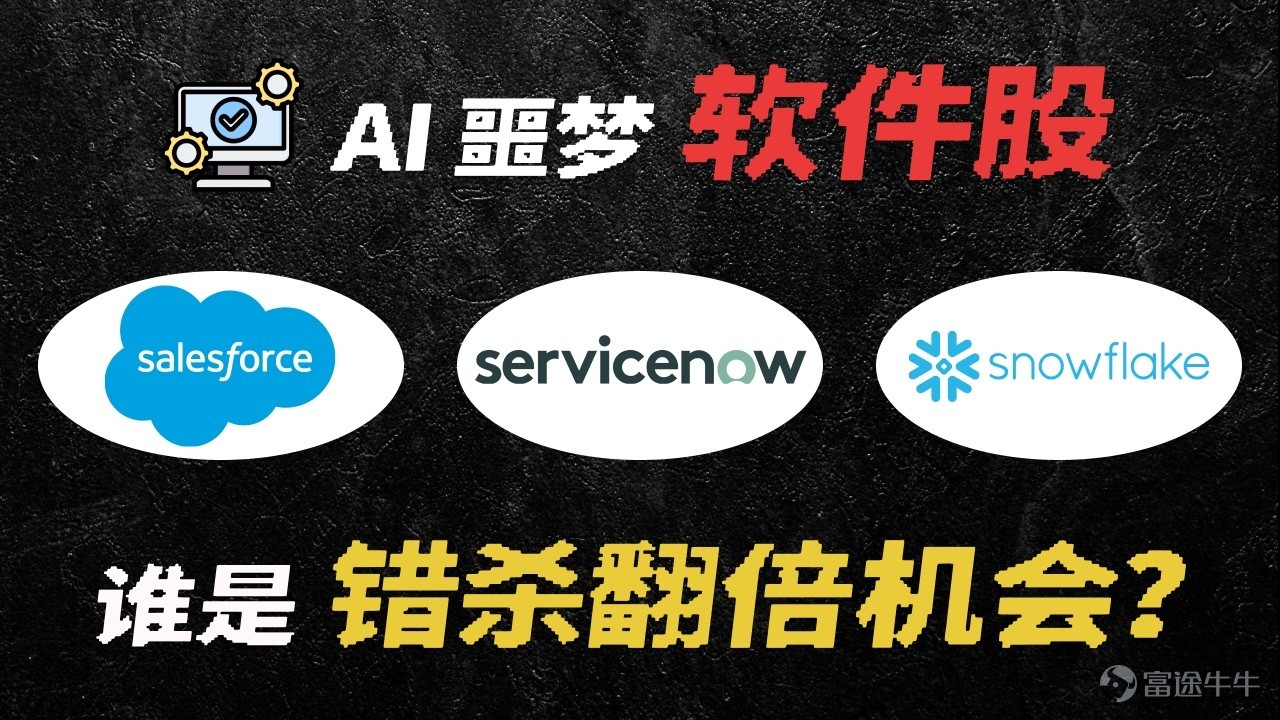

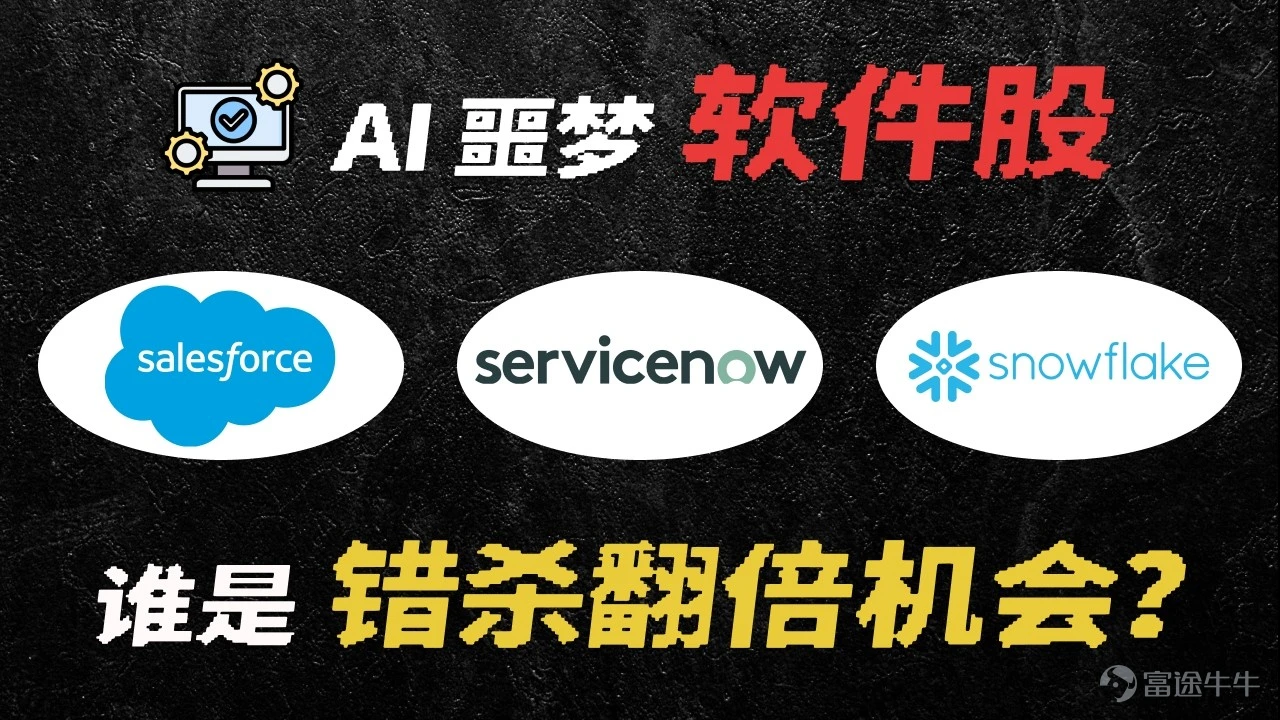
SaaS Software Stocks Under AI Disruption: Decoding the Bargain-Hunting Logic Behind Salesforce, ServiceNow, and Snowflake
Compiled & Organized by: Deep Tide TechFlow
Guest: Nico
Original Title: SaaS Software Stocks in the AI Nightmare: CRM vs. NOW vs. SNOW — Which Is the Truly Oversold Double Opportunity? A 10,000-Word Deep Dive Into the Next Wave of Software Stock Opportunities
Podcast Source: Nico Frontier Alpha
Broadcast Date: May 21, 2026
Over the past six months, Wall Street has used the term 'SaaS apocalypse' to describe a brutal sell-off, with Salesforce, ServiceNow, and Snowflake all halving from their peaks. Meanwhile, JPMorgan’s crowding model shows institutional positioning in semiconductors has surged to 99.3%, while software stands at just 22.8%—a historic divergence in market sentiment. At this juncture, investor Nico offers a view contrary to the mainstream narrative: AI isn’t killing the software industry; rather, it is weeding out companies that merely sell functional interfaces and rewarding platforms that provide infrastructure and governance. Although the software sector currently lags behind hardware in terms of industry momentum, it offers superior risk-reward and better value.
The most valuable part of this episode is the side-by-side analysis of three companies within the same evaluation framework: Salesforce (13–14x forward P/E, $14.4 billion in free cash flow, $50 billion share repurchase authorization) represents the 'margin-of-safety camp'; ServiceNow (with its AI Control Tower narrative and consistent endorsement from Jensen Huang for three consecutive years) is the 'clearest AI story camp'; and Snowflake (usage-based pricing, RPO up 42% year-over-year, yet still GAAP-loss-making) falls into the 'high-beta, high-risk camp.' On May 27, both Salesforce and Snowflake will report earnings on the same day, followed closely by Snowflake’s annual conference and Microsoft’s Build conference—these catalysts will form the most immediate near-term observation window.
'The software sector has been absolutely hammered—not because one company ran into trouble, but because the entire sector has effectively been sentenced to death by the market.'
'JPMorgan’s crowding model shows institutional positioning in the semiconductor sector has soared to 99.3%, while software stands at only 22.8%—a historically extreme sentiment divergence.'
'The good news for the hardware sector is that everyone has already bought in—it’s fully priced in. The bad news for software is that everyone has already sold—it now has room to bounce back. Over the next three months, if you look solely at industry momentum, hardware will undoubtedly be stronger; but if you consider upside potential, odds, and value, software might actually perform better.'
'Many of the functional interfaces that SaaS companies have traditionally monetized can now be prototyped in minutes using AI—without any coding experience whatsoever. What the market truly fears is that the scarcity and moat of SaaS functionality layers are collapsing.'
If an AI agent can do the work of 10 people, a company that previously needed to purchase 1,000 user seats now only needs 100. This is what Wall Street has recently been calling 'seat compression.'
Agents don’t need a UI, a dashboard, or a fancy interface—they only need data and APIs. This means SaaS software is being disrupted by AI, demoted from the primary enterprise workflow entry point to merely a backend data repository.
Buying Salesforce isn’t essentially about betting on a high-growth story at a valuation of dozens of times earnings, hoping it eventually succeeds in its AI transformation. Rather, it’s a trade based on comparing intrinsic value against current price—and right now, it truly sits at a relatively undervalued level.
Agentforce shifts the pricing model from per-user to per-task. Previously, revenue was tied to headcount; going forward, it will be tied to total workload. As long as the per-task billing model proves viable, Salesforce can smoothly transition from a seat-based economy to a task-based economy.
Microsoft’s Dynamics 365 combined with Copilot represents Salesforce’s biggest medium- to long-term threat. If salespeople in the future never open Salesforce directly, but instead let Copilot automatically update customer records within Outlook or Teams, Salesforce risks being relegated from a workflow front-end to just a backend database.
What ServiceNow aims to build isn’t another ChatGPT—it wants to become the governance, orchestration, and execution layer for enterprise-grade AI agents. Regardless of which AI model a company uses, as long as that AI enters enterprise workflows, accesses enterprise systems, or executes enterprise tasks, it must go through ServiceNow for governance and orchestration.
This positioning is similar to Apple’s iOS: Apple doesn’t build every app itself, but all apps run on iOS. ServiceNow intends to follow a similar path going forward.
Jensen Huang’s exact words were: 'ServiceNow is essentially the enterprise operating system for the AI era.'
"What Snowflake fears most isn't customers not using it—it's customers becoming too proficient. When enterprises realize their Snowflake bills are too high, they push engineering teams to optimize queries, compress storage, and even replace low-value tasks with open-source tools. This is the double-edged sword of its consumption model."
"Snowflake’s net revenue retention rate has declined from 131% to 126%, and now to the latest 125%. While still healthy, this downward trend indicates that existing customers are expanding at a slower pace than before."
"Among the three, Snowflake is the fastest-growing, has the most direct AI data infrastructure narrative, and is inherently insulated from traditional SaaS business model constraints—but it’s also the most highly valued, faces the fiercest competition, and has the weakest profitability profile. High reward potential, high risk."
"The narrative that 'AI is killing software' is overly simplistic. What’s actually happening is that AI is eliminating software that merely sells functional interfaces, while simultaneously rewarding platforms that provide infrastructure and governance. Not all software will be disrupted."
"During the dot-com bubble burst in 2000, the prevailing market narrative was that 'the internet would kill all traditional companies.' Yet in the end, the survivors weren’t just internet-native firms—they also included traditional companies that were the first to embrace the internet and integrate these tools into their core operations. Two decades later, the logic of the current AI wave is the same."
At the start of 2026, the narrative that 'AI is killing the software industry' ignited the entire U.S. equity market. Ever since, the entire software sector has been haunted by fears of AI-driven disruption. Even Microsoft, the sector leader, was not spared—its stock plunged more than 25% year-to-date, and from its all-time high, the maximum drawdown neared 40%, approaching the depths seen during the 2022 bear market. Meanwhile, once-popular software stocks like Salesforce, ServiceNow, and Snowflake have each lost more than half their market value. This isn’t an isolated company issue—it’s a market-wide death sentence for the entire software sector. Wall Street has dubbed this event 'SaaS Doomsday.'
For nearly the past six months, both retail and institutional investors have been doing the same thing: going long on hardware and shorting software, hammering the software sector relentlessly. Yet recently, several unusual signals have quietly emerged. JPMorgan’s crowding model shows institutional positioning in semiconductors has surged to a 99.3% crowding level, while software sits at just 22.8%—a historic divergence in sentiment. At precisely this moment, former U.S. President Trump quietly spent several million dollars buying dips in software stocks; Bill Ackman, Wall Street’s most renowned contrarian hedge fund manager, simultaneously took a major position in Microsoft, the largest software company; and Jensen Huang, CEO of NVIDIA—the world’s most valuable company—personally flew to Las Vegas for the third consecutive year to endorse a software firm.
So, is AI really going to kill the entire software industry, or is it offering us a once-in-a-decade opportunity to buy the dip? In today’s video, I’ll thoroughly break down three of the most representative software companies: Salesforce, ServiceNow, and Snowflake.
The panic over AI killing the SaaS industry and the resulting plunge in software stocks began back in January this year. On January 30, Anthropic—the company behind the Claude large language model—quietly released 11 plugins on GitHub called Claude Cowork. It was just a simple code repository accompanied by a blog post. Yet within 48 hours of its release, global software stocks hemorrhaged value. According to market estimates, the software sector lost a staggering $285 billion in market capitalization.
Why was everyone so panicked? A CNBC reporter conducted an experiment that kept every SaaS executive awake at night: using Claude Code, he replicated a website resembling Monday.com in just one hour—at a cost of only $5–$15. Monday.com is a publicly traded U.S. project management software company with a market cap in the billions of dollars. A single journalist, spending just an hour and a few dollars, built a functional demo that looked strikingly similar to Monday.com.
Of course, this doesn’t mean he actually replicated a public company. The real Monday.com includes enterprise-grade permissions, data security, integration ecosystems, sales channels—none of which can be built by AI in an hour. These require time and accumulated expertise. But what made this experiment truly alarming is that many of the user-facing features SaaS companies traditionally monetized can now be prototyped in minutes using AI, with zero coding experience required. Beneath this story lies the market’s real fear: the scarcity and moat of SaaS functionality layers are collapsing. The traditional per-seat SaaS pricing model may no longer hold up under the pressure of AI. This also reveals the ambition of foundational AI model providers—not just optimizing model performance anymore, but stepping directly into the application layer to claim a share of this massive pie.
SaaS stands for Software as a Service. At its core, it’s simple: move traditional on-premise enterprise software from local servers to the cloud, allowing customers to pay monthly or annually for access to the software. Over the past two decades, this model has been the biggest wealth-generating engine in the software industry.
Almost all SaaS companies base their pricing primarily on per-user (per-seat) subscriptions. If a company has 1,000 employees using the software, it must purchase 1,000 licenses and continuously pay recurring subscription fees—typically ranging from tens to hundreds of dollars per user per year. The more frequently and extensively the software is used, the stickier the customer becomes, because the company’s entire workflow and data become embedded in the SaaS platform, making short-term migration prohibitively costly. This is the fundamental reason why asset-light SaaS businesses have been able to generate profits so effortlessly—and why Wall Street has historically assigned SaaS companies sky-high valuations, often trading at dozens or even hundreds of times earnings over the past 20 years.
However, with the rise of the AI wave—especially as we enter the Agent era—the foundation of this business logic has started to crack. Market concerns about the SaaS sector mainly stem from two layers of risk.
The most immediate layer of panic stems from AI Agents replacing employees, causing a sharp decline in SaaS subscription counts and a steep drop in revenue and profits. SaaS companies traditionally charge per user—enterprises purchase as many seats as the number of employees using the software. However, with the advent of the Agent era, this logic has been completely upended: if one AI Agent can do the work of ten people, a company that previously needed 1,000 licenses now only needs 100. This is what Wall Street has recently been calling 'seat compression.'
The revenue formula for SaaS companies is 'number of customers × average seats per customer × price per seat.' For the past 20 years, all three variables have trended upward. Yet under the impact of AI Agents, the 'average seats per customer' metric is now facing its first structural downside risk. Markets fear that the SaaS business model could be disrupted by AI.
A deeper level of panic arises from the fact that, under Agent-based workflows, SaaS software is being bypassed entirely and relegated to a supporting role. This is the core reason behind the market’s intense anxiety. The traditional SaaS business model rests on an implicit assumption: software is designed for human use. Salesforce invests in UI design, attractive dashboards, and workflow optimization—all fundamentally aimed at cultivating user habits and increasing stickiness. But Agents don’t need UIs, dashboards, or polished interfaces; they only require data and APIs.
Once Claude can directly connect via plugins to your Salesforce, Notion, Google Drive, and Slack, workflows undergo a fundamental shift. Previously, a salesperson would open Salesforce directly to check customer data, track contracts, and monitor post-sale status—daily tasks heavily reliant on the Salesforce interface. Now, the salesperson can simply open Claude to handle these repetitive tasks, while Claude accesses Salesforce via APIs to read and write data—eliminating the need for the salesperson to interact with Salesforce’s software interface altogether.
This means SaaS software is being dimensionally disrupted by AI—demoted from the primary entry point in enterprise workflows to merely a backend data repository. The real danger lies in how this reshapes the value chain. Historically, users spent the most time interacting with SaaS applications; now, they spend more time engaging with AI Agents. Whichever layer captures the most user attention holds the greatest pricing power. In this scenario, SaaS software becomes a mere supporting actor to AI Agents. The strongest moat SaaS companies once had—their deep-rooted user habits and workflow entrenchment—was built on the premise that humans would heavily rely on UI interfaces. But Agents are dismantling that foundation, triggering widespread market panic.
Meanwhile, tight macro interest rate conditions and massive capital expenditures by big tech firms—almost entirely funneled into AI infrastructure—are continuously squeezing corporate software budgets. Long-duration software growth stocks have seen the steepest valuation compression. So far this year, the entire software sector has significantly underperformed the S&P and Nasdaq over the same period, creating a stark market bifurcation: investors are blindly going long on hardware and shorting software.
JPMorgan’s crowding analysis shows that semiconductor industry positioning has reached a historic high of 99.3%, indicating nearly all investors are positioned in the same direction. More notably, short interest in the software sector is steadily rising, and the squeeze risk indicator has hit an extreme level of 100%. When panic reaches such extremes, market inflection points—and potential contrarian signals—often begin to emerge.
These data points don’t necessarily mean capital will immediately exit hardware and rotate into software. Rather, they serve as a risk signal: hardware has become the most crowded trade among both retail and institutional investors, and the risk-reward of blindly buying hardware is deteriorating. Capital naturally seeks opportunities to rotate between sectors—shifting from overheated, fully priced hardware names to undervalued software names still weighed down by bearish sentiment but potentially poised for fundamental improvement.
The good news for the hardware sector is that everyone has already bought in, and it’s fully priced into the market; the bad news for software is that most investors have already sold off, leaving room for an upside rebound. My view on this is very clear: over the next three months, if we look purely at sector momentum, hardware will definitely be stronger; but if we consider upside potential, payoff ratio, and value proposition, software might actually fare better. In other words, hardware remains the primary AI theme, but it’s become overly crowded in the short term; software represents a catch-up play with higher elasticity and better payoff potential over the next three months.
This is largely because the software sector has been hammered so severely over the past few months. Amid AI-related panic, software stocks experienced broad and indiscriminate selling—investors dumped positions first and asked questions later. This indeed led to many high-quality software companies, which possess strong business moats, valuable data assets, and are actively embracing AI, being unfairly punished by the market.
Moreover, the software sector has numerous catalysts lined up over the next several weeks. For example, on May 27, both Salesforce and Snowflake will release their latest earnings reports on the same day. These results will address a core question: Is AI cannibalizing SaaS, or is it re-pricing SaaS? Immediately afterward, from June 1–4, Snowflake will host its annual conference in San Francisco, with a focus on data infrastructure and enterprise AI implementation. From June 2–3, Microsoft will hold its Build conference, centering on AI Agents, Copilot, developer workflows, and enterprise AI applications. The convergence of these catalysts could reinforce the rebound trend in software stocks. If the market starts believing that AI Agents aren’t here to kill software but instead require software platforms to land effectively, names like ServiceNow, Salesforce, and Snowflake could all benefit.
Salesforce’s ticker symbol is CRM—coincidentally matching its core business. It is the world’s largest customer relationship management (CRM) software company and one of the most iconic firms of the SaaS era. In simple terms, it helps businesses manage their customers. But ‘managing customers’ here doesn’t just mean letting sales reps log into a webpage and enter a few client details. Its real value lies in serving as the central system of record for enterprise customer data.
Who the customer is, which employees have engaged with them, what products they’ve purchased, where their contracts stand, whether there have been service complaints, and how many marketing touchpoints they’ve received—all the most critical data points across the customer lifecycle are consolidated within Salesforce. These constitute a company’s most valuable customer assets. AI can generate emails, summarize meetings, and auto-generate sales scripts—but without a reliable customer database, AI wouldn’t know how to perform these tasks. That’s why Salesforce occupies such a pivotal position. While AI may disrupt Salesforce’s front-end features, it likely won’t eliminate its core value.
On one hand, Salesforce is the quintessential traditional SaaS company, directly exposed to the pressure of AI-driven agent seat compression; on the other hand, it serves as the foundational data layer for many enterprises—not a trivial tool that can be easily swapped out. This duality forms the crux of our analysis: Is Salesforce an outdated software company destined to be disrupted by AI, or is it a cash-generating machine that the market has excessively discounted due to pessimism?
Salesforce currently serves over 150,000 enterprise customers, ranging from startups to Fortune 500 companies. The company was founded in 1999 by Marc Benioff, who previously worked at Oracle, where he became its youngest-ever vice president and was considered one of founder Larry Ellison’s most promising protégés. Benioff later launched his own venture, proposing a then-radical idea: enterprise software shouldn’t be sold on physical discs installed on clients’ servers, but should instead run in the cloud and be offered via monthly or annual subscriptions.
This concept was highly unconventional in 1999. At the time, industry giants like Microsoft, Oracle, and SAP primarily sold software licenses for on-premises deployment. Benioff stood alone championing the 'No Software' slogan—and ultimately, the SaaS business model prevailed, making Salesforce synonymous with the entire SaaS industry.
Marc Benioff is known for his sharp instincts and willingness to bet big on emerging trends. When he first introduced 'Agentforce' last year, the market dismissed it as mere marketing hype—but over the past few quarters, Agentforce has delivered impressive metrics. Its latest disclosed annual recurring revenue (ARR) has already reached $800 million, surging 169% year-over-year. Thus, your confidence in Salesforce’s ability to successfully pivot toward AI largely hinges on whether you believe in Marc Benioff himself.
Many people think Salesforce is just a CRM tool, but after more than 20 years of expansion and acquisitions, it has grown into a massive enterprise software platform.
At its core is Sales Cloud—the product that started it all—helping sales teams manage customers, opportunities, and the sales pipeline. The sales operations of countless global enterprises are built on this product. Following Sales Cloud, Salesforce launched Service Cloud, dedicated to customer service and post-sale support. When customers call to complain, email inquiries, chat online, or when backend ticket assignment and resolution workflows occur, they all run on Service Cloud. Expanding further, Marketing Cloud handles digital marketing, enabling precise targeting, email campaigns, and ad performance tracking; Commerce Cloud powers e-commerce, helping businesses sell online.
Together, these four clouds essentially cover every touchpoint between an enterprise and its customers—from lead acquisition and closing deals to after-sales service and repeat purchases—with dedicated products for each stage of the full customer journey.
But Salesforce’s ambitions go even further. Over the past few years, it has spent heavily on acquisitions: MuleSoft (for system integration—enterprises often run dozens of internal software systems, and MuleSoft connects their data), Tableau (for data visualization and business analytics, turning CRM customer data into charts and actionable insights), Slack (for internal workplace communication and collaboration, similar to China’s Feishu or DingTalk); and last year, Informatica (for enterprise data management, helping companies clean, integrate, and govern data scattered across various sources).
Pieced together, these acquisitions have enabled Salesforce to build a complete ecosystem centered around customer data. CRM sits at the core, surrounded by layers of integration, analytics, collaboration, and data governance. The newest and most critical piece of this puzzle is Agentforce—a recently launched AI Agent platform and Salesforce’s key strategic response to the AI disruption.
Salesforce operates on a classic SaaS model, charging per user. If a company has 100 salespeople needing CRM access, it buys 100 licenses—at roughly $100+ per user per month, billed annually. While each seat may seem affordable, for large enterprises with thousands or even tens of thousands of sales, support, and operations staff, this adds up to highly predictable, recurring revenue—the foundation of Salesforce’s ‘set-it-and-forget-it’ profitability over the past two decades.
However, the rise of AI has begun to undermine this comfortable revenue model. If an AI Agent can automatically research customers, draft emails, manage pipelines, and follow up with leads, will enterprises still need as many human sales reps? This fear—‘seat compression’—is precisely what worries the market, and Salesforce stands out as one of the prime examples investors scrutinize in this context.
Marc Benioff himself recognizes this threat. Starting last year, Salesforce initiated an aggressive yet pivotal shift in its business model: retaining per-seat licensing while introducing a new, usage-based offering aligned with the AI era—Agentforce. In simple terms, the traditional model charges based on ‘how many seats you buy,’ whereas the new model charges based on ‘how many tasks your AI Agents execute.’ Salesforce calls these usage units ‘Agentic Work Units’—the metric for work completed by AI Agents.
The logic behind this new model is astute. If AI truly replaces part of the human workforce, traditional seat counts may decline—but the number of tasks executed by AI Agents could surge dramatically. Where one salesperson might follow up with 20 customers a day, one AI Agent could handle 200 simultaneously. Even as human seats shrink, AI task volume could multiply by 2x, 10x, or more. If this usage-based pricing proves viable, Salesforce can smoothly transition from seat-based economics to task-based economics—and potentially increase revenue per customer significantly. Historically, revenue scaled with headcount; going forward, it will scale with total workload. That’s the transformative potential of Agentforce—it could fundamentally reshape Salesforce’s entire pricing architecture and business model.
Of course, this story hasn’t fully played out yet. Although Agentforce’s annual recurring revenue (ARR) has already reached $800 million and is growing very rapidly, it still accounts for less than 2% of Salesforce’s total annual revenue of $41.5 billion. Moreover, Salesforce faces even more severe seat compression pressure than any other SaaS company, because what Salesforce sells are seats for salespeople, customer service reps, and marketers—roles that AI agents are poised to replace first. In a 10,000-employee company, 3,000–5,000 Salesforce licenses might be purchased, but these are precisely the roles most vulnerable to automation: drafting emails, following up with customers, generating sales copy, and answering customer inquiries—all tasks where large AI models excel. Relying on just 2% of new business to offset the decline in traditional seat-based revenue will be extremely difficult.
If that’s the case, why do I still believe Salesforce deserves attention right now? Not because I’m convinced the Agentforce narrative will definitely outpace revenue from its legacy SaaS model, but because Salesforce currently trades at only 13–14x forward P/E—a valuation that already prices in pessimistic expectations. It also generates $14.4 billion in free cash flow and has a $50 billion share repurchase authorization.
Therefore, buying Salesforce isn’t about betting on a high-growth story at a 30x+ valuation and hoping it successfully transitions to AI; rather, it’s a value judgment based on intrinsic worth versus current price. Salesforce is indeed trading at a relatively undervalued level. That said, this margin of safety isn’t unconditional—if AI truly causes a noticeable decline in traditional seat-based revenue and Agentforce fails to compensate, Salesforce’s valuation could compress further. However, as long as its core business remains stable and buybacks continue, even partial realization of Agentforce’s potential could prompt the market to re-rate the stock, leading to a rebound in share price.
Salesforce’s strongest moat is the massive amount of customer data accumulated over the past 20+ years. A company that has used its CRM for 10 years may have millions of customer records, hundreds of thousands of sales workflows, and tens of thousands of custom fields. Migrating all of this elsewhere would essentially mean tearing down the company’s entire digital foundation and rebuilding it from scratch—the migration cost far exceeds the cost of simply continuing to pay for Salesforce.
So where is Salesforce vulnerable? Microsoft’s Dynamics 365, combined with Copilot, represents Salesforce’s biggest medium- to long-term threat. As the world’s largest software company, Microsoft’s B2B productivity suite is already deeply embedded in most large enterprises globally. Dynamics 365 is Microsoft’s CRM offering, directly competing with Salesforce’s core business, and has consistently grown at over 20% annually in recent years. Crucially, Dynamics 365 is deeply integrated with Copilot, Teams, and Outlook—tools employees use daily. If salespeople in the future never open Salesforce but instead let Copilot automatically update customer records within Outlook or Teams, Salesforce could degrade from a primary workflow interface into merely a backend database. This is Marc Benioff’s greatest concern and the biggest source of long-term uncertainty for Salesforce.
Latest financial results
Here’s how the final quarter of the last fiscal year looked: full-year revenue of $41.5 billion, up 10% year-over-year; total remaining performance obligation (RPO) of $72 billion, up 14%; free cash flow of $14.4 billion, up 16%; and $14.3 billion returned to shareholders, comprising $12.7 billion in share repurchases and $1.6 billion in dividends. Additionally, Salesforce just approved a new $50 billion share repurchase program. The new Agentforce business segment reported $800 million in ARR, up 169% year-over-year, with 29,000 deals signed.
However, an important caveat: those 29,000 deals don’t equate to 29,000 large enterprise clients, nor do they necessarily represent high-value contracts. This figure only indicates rapid product adoption. What ultimately drives valuation is whether Salesforce can increase average revenue per customer and net revenue retention going forward. During this earnings call, the company also raised its fiscal year 2030 revenue target to $63 billion.
Overall, Salesforce’s fundamentals are indeed very solid. During the last earnings call, CEO Marc Benioff himself stated that this was the company’s best year in history—and the strongest performance ever recorded in the software industry. He went on to say it’s actually a great marketing and buying opportunity, which is why the company is increasing its share repurchase authorization to $50 billion. This messaging was very clear: management is highly satisfied with the results and is directly pushing back against market sentiment, arguing that Salesforce’s stock has been oversold due to excessive pessimism.
At the time I’m making this video, Salesforce’s stock price is only $180, trading at a forward P/E of 13–14x. Compared to the 30x–40x+ valuations common during recent software bull markets, this represents a significant compression—marking its lowest valuation level in several years.
Catalysts and Risks
The bull case is straightforward: the stock is cheaply valued, generates stable cash flow, is executing aggressive share buybacks, and its new Agentforce business is accelerating rapidly. Salesforce’s earnings report on May 27 is highly anticipated and represents the most immediate near-term catalyst.
The bear case centers on its modest 10% growth rate—unimpressive by software industry standards—the lingering doubts about whether its business model could be disrupted by AI, and the high uncertainty surrounding the Agentforce initiative. The market’s biggest question is whether Agentforce can scale sufficiently to meaningfully lift the company’s overall revenue and profits and enable a full AI-driven transformation. These concerns will require time to resolve.
For the May 27 earnings call, investors should watch several key developments: First, whether Agentforce’s annual recurring revenue (ARR) continues to grow at over 100% year-over-year. A deceleration in growth would signal potential risks in the AI transition, so it will be crucial to see how management addresses this issue.
Second, whether there is any noticeable decline in SaaS seat-related revenue. If such a trend emerges, investors should tread carefully, as the market could further fuel the narrative that 'AI is eating SaaS.'
Beyond that, it’s also important to monitor whether the company maintains an optimistic outlook for the future and whether management continues to proactively address concerns about AI’s impact on the SaaS business model. These are all key points worth watching closely.
Looking solely at last quarter’s results, I believe management was very clear and optimistic—they don’t think AI will kill Salesforce; instead, they see AI elevating Salesforce from a SaaS application vendor to a platform for enterprise agents. However, from a data perspective, this story remains in its early validation phase. Personally, I don’t think it’s necessary to draw premature conclusions about whether Salesforce has been disrupted by AI or fully transformed its business around AI. What matters more to me is that its valuation is at one of the lowest levels in recent years, and combined with the company’s solid fundamentals, the current risk-reward profile and entry value appear quite attractive. That said, the long-term investment thesis still hinges on AI, and whether Salesforce can withstand the test of AI disruption will require time to validate.
Company Background
ServiceNow is the software company I mentioned earlier—the one that Jensen Huang has personally flown to Las Vegas to support for three consecutive years. If Salesforce manages a company’s external customer relationships, ServiceNow manages its internal employees and workflows. In simple terms, it serves as the central nervous system for enterprise internal operations.
Many internal corporate processes that require approvals, routing, execution, and documentation can run on ServiceNow. For example: submitting an IT ticket when your computer breaks; onboarding a new employee by setting up accounts, assigning equipment, and processing HR workflows; managing incident response when systems fail; or handling security alerts by assigning, escalating, and resolving them. Thus, ServiceNow is far more than just an IT ticketing system—it functions as a unified platform for virtually all internal enterprise workflows.
ServiceNow was founded in 2004 and is headquartered in Santa Clara, California. Its current CEO is Bill McDermott, who previously served as global CEO of SAP and has spent decades in the enterprise software industry. Since officially taking the helm at ServiceNow in 2019, McDermott has steered the company beyond its origins as an IT ticketing software provider toward becoming an 'enterprise-wide workflow platform.' His leadership style is highly distinctive—skilled at crafting grand narratives, executing large-scale deals, and winning major enterprise clients—a style that has become an advantage in the AI era.
product portfolio
Its core foundational business is IT Service Management (ITSM), which enterprise IT departments use to manage tickets, incident response, change releases, IT assets, and service requests. In the ITSM market, ServiceNow is the undisputed global leader. Building on this, the company expanded into IT Operations Management (ITOM). While ITSM primarily addresses 'how to handle issues after they arise,' ITOM focuses on proactively monitoring systems, identifying problems, and automating fixes wherever possible.
The company further expanded into HR Service Delivery, enabling processes such as onboarding, offboarding, leave requests, role transfers, and various employee service inquiries to be managed on ServiceNow. It also offers Customer Service Management (CSM)—an enterprise-grade customer support solution that overlaps somewhat with Salesforce’s Service Cloud but is more tailored to complex B2B scenarios, such as servicing large equipment, enterprise clients, and cross-departmental post-sales tickets. Additional offerings include Security Operations for security incident response and Strategic Portfolio Management, which helps CIOs manage project portfolios and decide which IT initiatives to fund or terminate.
Taken together, ServiceNow has evolved from a simple IT service management tool into an enterprise-wide workflow platform. This transformation is the fundamental reason behind its industry-leading renewal rate of 97%. Once a company migrates its IT, HR, security, and customer service workflows onto ServiceNow, replacing it is no longer just about swapping out a single software—it requires rebuilding the entire internal operational system, a process that carries very high switching costs.
Recent key acquisitions
In addition to its native product suite, ServiceNow has completed several pivotal acquisitions over the past year.
The first was Moveworks, an AI-powered employee service assistant. Instead of navigating multiple portals, employees can simply ask questions directly to an AI, which can look up policies, submit tickets, track progress, and even automatically resolve certain issues. Following the acquisition, Moveworks’ capabilities were integrated into ServiceNow’s Employee Center (EmployeeWorks).
The second was Veza, which specializes in identity governance and access management. In the age of AI agents, controlling 'who can access what data' has become critically important—not only for human users but also for AI agents themselves. Veza addresses precisely this challenge.
The third acquisition was Armis, a cybersecurity firm specializing in real-time asset visibility. Armis provides comprehensive visibility into all devices on an enterprise network—identifying which are vulnerable, which are communicating, and their overall status.
All three acquisitions share a common strategic objective: preparing for the large-scale adoption of AI agents within enterprises. For agents to operate effectively inside companies, they need to understand employee queries, know who has permission to access or modify specific data, and have full visibility into networked assets. These three deals respectively fill those capability gaps. That said, executing multiple major acquisitions in quick succession also introduces integration risks—particularly the $7.75 billion Armis deal—which we will explore in detail when discussing risks later.
Core AI Strategy: AI Control Tower
ServiceNow’s core AI strategy is called the AI Control Tower. This concept stems from a very practical problem. In the future, enterprises won’t rely on just one AI provider—they might use OpenAI’s GPT for customer service, Anthropic’s Claude for contract review, Microsoft’s Copilot for document collaboration, and Google’s Gemini for data analysis, while also developing many internal AI agents of their own.
This raises a critical question: with so many AI agents operating simultaneously within an enterprise, who manages them? Who decides what data they can or cannot access? Who ensures they don’t exceed their authorized permissions? And if something goes wrong, how is accountability assigned? These are precisely the issues the AI Control Tower aims to solve.
ServiceNow isn’t trying to build another ChatGPT. Instead, it aims to become the governance, orchestration, and execution layer for enterprise-grade AI agents—ensuring these AIs operate securely, compliantly, and in an auditable manner within enterprises. This is what sets ServiceNow apart from many other SaaS companies. While others are asking, 'Can I build my own AI agent to compete with ChatGPT, Claude, or Gemini for application-layer dominance?', ServiceNow has taken a smarter path: 'I won’t compete with you on foundational models; instead, I’ll manage the execution workflows once those models enter the enterprise.'
ServiceNow’s ultimate goal is simple: no matter which AI an enterprise uses, as long as that AI enters the company’s workflows, accesses its systems, or executes its tasks, it must do so under ServiceNow’s governance and orchestration.
Why ServiceNow?
This comes down to ServiceNow’s two decades of accumulated foundational capabilities. One key asset it possesses is the CMDB (Configuration Management Database)—essentially a comprehensive map of an enterprise’s IT assets and system relationships. It records everything: which servers exist, what applications are running, and what user permission structures are in place. Additionally, ServiceNow has operated a process engine for over a decade, through which all corporate approvals, executions, and collaboration workflows run. It also maintains complete audit logs, capturing who did what, when, and what changes were made at every step.
When AI agents enter an enterprise, they critically need exactly these three things: awareness of which systems are available for integration, adherence to established workflows when executing tasks, and full auditability of every action taken. Beyond this, ServiceNow has further strengthened its platform by acquiring Veza for identity and permission validation and Armis for real-time asset visibility.
At this year’s Knowledge conference, ServiceNow took another significant step forward by launching Action Fabric. This framework enables any third-party AI agent—whether Claude, GPT, Gemini, or Copilot—to leverage ServiceNow’s governance engine to execute enterprise-grade tasks. The underlying principle is clear: 'You can use whichever AI model you like, but execution and governance must go through my layer.' This logic closely resembles Apple’s iOS model—Apple doesn’t build every app itself, but all apps must run on iOS. ServiceNow is positioning itself to follow a similar trajectory.
Endorsed by Jensen Huang
The most compelling endorsement of this positioning comes from Jensen Huang. NVIDIA's CEO has attended ServiceNow's annual conference for the third consecutive year—not merely as a partner showing mutual support, but also because NVIDIA itself is a ServiceNow customer. NVIDIA’s internal supercomputer quoting system runs on ServiceNow; previously, generating a complete quote document took five days, but with AI workflows, it now takes just five minutes.
Jensen Huang’s exact words were: 'ServiceNow is essentially the enterprise operating system for the AI era.' This year, the two companies jointly launched Project Arc, where NVIDIA provides a secure AI computing sandbox and ServiceNow delivers enterprise-grade governance—illustrating their deeply integrated partnership. This demonstrates that ServiceNow’s AI Control Tower isn’t an isolated software concept; it’s already becoming part of the enterprise adoption narrative among AI ecosystem partners like NVIDIA, OpenAI, Google, and Anthropic.
Latest Financial Results
In the first quarter of this year, total revenue was $3.77 billion, up 22% year-over-year; subscription revenue was $3.671 billion, also up 22% year-over-year and exceeding the high end of guidance; total remaining performance obligations (RPO) stood at $27.7 billion, up 25% year-over-year; and customer renewal rates reached 97%. These figures confirm that ServiceNow’s fundamentals remain solid—it continues to be a software platform delivering roughly 20% growth, 97% renewal rates, high margins, and strong cash flow.
Performance in AI is even more impressive. The company raised its full-year target for AI-related annual contract value (ACV) from $1 billion at the start of the year to $1.5 billion. Note that this reflects contract value, not current-period revenue—it will gradually convert into actual recognized revenue over time. However, raising the target by 50% within a single quarter clearly indicates strong customer demand for its AI products and robust growth momentum.
Its stock price has already pulled back more than 50% from its all-time high, and its forward P/E ratio now stands around 21–24x. For a fast-growing, asset-light software company, this valuation range is indeed relatively undervalued.
Catalysts and Risks
The bullish case for ServiceNow is clear. First, its AI narrative is highly coherent: the AI Control Tower serves as the enterprise operating system for the AI era—the greater the AI adoption, the stronger the need for governance, auditing, permissions, and execution platforms. Second, its new AI business is demonstrably scaling: AI ACV has risen from $1 billion to $1.5 billion, showing tangible progress against its story. Third, its ecosystem of partners is formidable—OpenAI, Google Gemini, Claude, and NVIDIA are all integrating with or deeply partnering with ServiceNow, reinforcing its strategic position as the 'enterprise AI control tower.'
However, ServiceNow’s risks must also be acknowledged. Despite beating market expectations in its latest quarterly earnings report, the stock still dropped double digits after hours, reflecting extreme market pessimism—indicating that sentiment toward SaaS business models and AI transitions remains skeptical. Additionally, ServiceNow has recently closed three acquisitions, including the massive $7.75 billion deal for Armis, which will take time to integrate. The market will closely scrutinize how much of the raised revenue guidance stems from acquisitions versus organic growth. External risks include geopolitical tensions in the Middle East; last quarter, several large projects were delayed, negatively impacting subscription revenue growth by approximately 75 basis points.
Personally, I remain quite bullish on ServiceNow. Among the three companies discussed, it has the clearest, most straightforward, and most market-convincing AI narrative. Its AI Control Tower positioning won’t be threatened by AI—it will benefit directly from AI’s proliferation and stands a strong chance of becoming the most critical software platform in enterprise AI adoption. From a valuation perspective, its share price has already halved from its peak over the past year, and its forward P/E is now very low—similar to Salesforce—making it relatively inexpensive. The risk-reward profile and valuation upside are both compelling at current levels.
Company Background
In one simple sentence, this company is a hyperscale data warehouse for enterprises. If Salesforce manages customers and ServiceNow manages workflows, Snowflake manages data. All enterprise data—sales figures, user behavior, financial reports, system logs—is poured into Snowflake, where it can be analyzed, modeled, and used to run AI workloads.
product portfolio
At its core, Snowflake remains fundamentally a data warehouse and data lake. Enterprises ingest structured and semi-structured data into it and run SQL queries and analytics—this is Snowflake’s foundation and the source of most of its revenue. Built on top of this foundation is Snowpark, which allows developers to write code directly within Snowflake using Python, Java, or Scala to build data pipelines and machine learning models without moving data out of the platform, enabling end-to-end data processing and model training entirely within Snowflake.
Going a step further, Snowflake has heavily promoted its Cortex AI suite over the past year-plus, which includes two core products. Snowflake Intelligence targets business users, enabling them to interact with data using natural language. It automatically queries, analyzes, and generates insights from both structured and unstructured data stored in Snowflake and can proactively execute multi-step tasks—functioning more like an enterprise-grade AI agent. Cortex Code is aimed at developers. Unlike generic coding assistants, it is a Snowflake-native AI coding agent that understands Snowflake’s data schemas, permission settings, and compute environments, and can directly help write data pipelines, debug queries, and build AI applications—a highly powerful capability.
Thus, the roles of these two products are clearly delineated: Snowflake Intelligence is designed for business users, enabling those unfamiliar with SQL to directly ask questions of their data, use data, and have AI act on data-driven insights; Cortex Code is built for technical teams, empowering developers and data engineers to accelerate the development of data applications, data pipelines, and AI solutions.
Beyond its AI offerings, Snowflake also possesses two uniquely differentiated capabilities. The Snowflake Marketplace is a data-sharing and transaction platform where enterprises can buy and sell datasets or directly leverage third-party data for analysis. Data Clean Rooms enable privacy-preserving cross-organizational data collaboration—allowing two companies to conduct joint analyses without exposing their raw data. This capability is used by the advertising industry for cross-platform attribution, the pharmaceutical sector for collaborative clinical research, and the financial industry for anti-fraud cooperation. These two features represent hard-to-replicate competitive advantages.
Putting all these pieces together, Snowflake is evolving from a data warehousing tool into an AI data platform: at the base layer lies data storage and compute; the middle layer comprises developer tools and AI engines; and the top layer offers intelligent assistants for business users and a data marketplace. Snowflake aims not just to help enterprises store and query data, but to enable them to analyze, share, and build applications on a single governed data platform—and truly integrate AI into their business data. In terms of customer scale, Snowflake currently serves over 13,300 enterprise customers and processes 6.3 billion data queries daily.
business model
This is Snowflake’s key distinction from the two companies discussed earlier. Salesforce and ServiceNow primarily charge per seat, with customers paying fixed annual subscription fees; Snowflake operates on an entirely different model—it charges based on actual consumption of compute and storage resources, billing customers according to how many queries they run, how much compute power they use, and how much data they store, following the platform’s pricing formula.
This model has both advantages and disadvantages. On the positive side, as enterprise data consumption grows exponentially in the AI era—with every AI task requiring substantial compute and data queries—Snowflake’s revenue naturally scales upward alongside surging AI workloads. On the downside, if enterprises cut budgets or optimize their workloads, Snowflake’s revenue will decline correspondingly.
However, Snowflake has been aggressively promoting multi-year consumption commitment contracts in recent years. Its latest earnings report shows a Remaining Performance Obligation (RPO) of $9.77 billion, up 42% year-over-year, indicating that large customers are increasingly locking in compute budgets with Snowflake for several years ahead—signaling a relationship that is no longer purely transactional or easily abandoned.
Moat and Competitive Landscape
Its strength lies in data stickiness. Once data is loaded into Snowflake, all upstream and downstream analytical models, query scripts, and data pipelines are built on top of it, making migration extremely costly. This is Snowflake's core moat. Moreover, its Data Clean Rooms are relatively mature in terms of privacy protection and cross-organizational collaboration, making them hard to replicate.
Its weakness lies in the intensely competitive landscape. Its biggest rival is Databricks, whose latest annualized revenue run rate has reached $5.4 billion, up 65% year-over-year—more than double Snowflake’s 29% growth. Databricks’ most recent valuation exceeded $100 billion. Databricks also has a stronger position in machine learning and AI workloads. If Databricks goes public in the future, it will likely become one of the most closely watched IPOs in the enterprise software market, forcing Snowflake to face direct public comparison.
Beyond Databricks, the three major cloud providers also pose significant threats. AWS’s Redshift, Google’s BigQuery, and Azure’s Synapse are all continuously evolving and are natively integrated into their respective cloud ecosystems. These providers are both Snowflake’s partners and potential substitutes. Further down the stack, open-source or emerging tools like DuckDB and ClickHouse are nibbling away at the market in specific scenarios such as local analytics, real-time analytics, and low-cost querying. Thus, Snowflake’s competitive environment is even more complex than that of Salesforce and ServiceNow.
Counterintuitive Risk in Consumption Model
Here’s another counterintuitive point: what Snowflake fears most isn’t customers not using it—but customers using it too efficiently. Because Snowflake operates on a consumption-based model, the more customers query, compute, and store, the higher Snowflake’s revenue. Conversely, when enterprises realize their Snowflake bills are too high, they push engineering teams to optimize queries, compress storage, or even replace low-value tasks with open-source alternatives.
This is the double-edged sword of the consumption model: during periods of rapid growth, revenue naturally rises with customer usage; but once customers begin optimizing their usage, revenue growth slows accordingly. This trend is already visible in the data: Snowflake’s net revenue retention rate has declined from 131% to 126%, and most recently to 125%. While this figure remains healthy—indicating existing customers are still increasing their spending year-over-year—the downward trajectory suggests that expansion among existing customers is no longer as robust as before. This reflects both natural deceleration due to a larger base and customers actively optimizing costs and moderating their consumption pace.
Therefore, Snowflake resembles a high-growth, highly elastic, yet fiercely competitive AI data platform. This is both Snowflake’s greatest appeal and its biggest risk.
Latest Financial Results
Full-year product revenue was $4.47 billion, up 29% year-over-year—the fastest growth among the three companies. Product revenue for the latest quarter was $1.23 billion, up 30% year-over-year, slightly above the full-year growth rate. Remaining Performance Obligations (RPO) stood at $9.77 billion, up 42% year-over-year. The company added 740 net new customers in the latest quarter, a 40% year-over-year increase. Additionally, Snowflake signed its largest contract in history, exceeding $400 million. These figures indicate that demand for Snowflake shows no signs of slowing; on the contrary, large customers continue to sign even larger long-term contracts.
But the issue is also quite clear. Under GAAP, Snowflake still reported a full-year loss of approximately $1.33 billion, making it the only one among the three companies that has not yet achieved GAAP profitability. Stock-based compensation exceeds $400 million per quarter, totaling over $1.7 billion for the year, exerting significant shareholder dilution pressure.
Yet Snowflake remains the most expensive of the three, trading at an EV/Sales multiple of roughly 9x based on forward revenue—significantly higher than Salesforce.
Catalysts and Risks
On the positive side, Snowflake offers several key attractions. First, Snowflake does not follow the traditional SaaS model but instead operates on a consumption-based pricing model, which naturally benefits from the growth in AI workloads. In the near term, the more AI workloads run on its platform, the more revenue Snowflake generates. Second, remaining performance obligations (RPO) grew 42% year-over-year, indicating that large customers continue to sign larger long-term contracts, signaling strong revenue visibility. Third, both Snowflake Intelligence and Cortex Code are expanding rapidly, with over 9,100 accounts already using AI features.
In addition, Snowflake has two significant upcoming events: earnings release on May 27, followed immediately by its annual Snowflake Summit in San Francisco from June 1 to June 4. With these two catalysts occurring back-to-back, I personally believe the positives outweigh the negatives. Stock price volatility is likely to be substantial during this period.
However, we must also understand the risks ahead of time. First, persistent GAAP losses remain its biggest weakness. In a market environment that increasingly favors profitability and cash flow, Snowflake faces greater valuation pressure compared to Salesforce and ServiceNow. Second, Databricks is currently Snowflake’s fiercest competitor, and Databricks’ potential IPO could reshape the competitive landscape of the data platform sector. If, after going public, Databricks demonstrates faster growth, a stronger AI narrative, and more attractive valuations, capital could shift from Snowflake to Databricks. Additionally, shareholder lawsuits and insider selling—corporate governance-related noise—could also affect market sentiment, though these are not the primary focus at the moment.
Snowflake can be summarized in one sentence: among the three, it is the fastest-growing, has the most direct exposure to AI data infrastructure logic, and is inherently unaffected by the limitations of the traditional SaaS business model—but it is also the most highly valued, faces the fiercest competition, and has the weakest profitability profile. High reward potential, high risk.
After breaking down these three companies, I’d like to share my personal, subjective view.
If you prioritize margin of safety and favor a value investing approach, Salesforce is relatively the most stable option. Trading at a forward P/E ratio in the low teens, generating $14.4 billion in free cash flow, backed by a $50 billion share repurchase authorization, and demonstrating consistent profitability, it offers a relatively wide margin of safety for building and holding a position. However, its growth rate is only around 10%, so its upside potential may lack explosive momentum.
If you buy into the governance-layer logic of the AI Control Tower, ServiceNow may have the clearest AI narrative among the three companies. With growth exceeding 20%, a 97% renewal rate, a forward P/E ratio of 22x, and Jensen Huang’s personal endorsement for three consecutive years, its current valuation offers compelling value. However, this assumes you’re comfortable with the integration risks from frequent acquisitions and willing to tolerate high short-term stock volatility.
If you’re seeking maximum upside and can withstand the highest volatility, Snowflake represents a high-odds bet. Its biggest risks include failure to achieve profitability, continued losses, declining net revenue retention, and the potential IPO of its competitor Databricks, which could reset valuation benchmarks across the entire data platform sector. The risk and volatility are indeed substantial.
Beyond these three, if you’re looking for the most stable anchor in the software sector, Microsoft remains the top choice—it’s arguably the largest-cap software stock most severely oversold in this cycle. That said, I must emphasize this is solely my personal analytical framework and does not constitute investment advice. Everyone should make their own investment decisions based on their actual portfolio positions and after careful, rational analysis.
Finally, let’s return to the question posed at the outset: Is AI set to kill the entire software industry, or is it offering us a once-in-a-decade opportunity to buy the dip?
My view is that the narrative of 'AI killing software' has been overly simplified. What’s actually happening is that AI is eliminating software vendors that merely sell feature-based interfaces, while simultaneously rewarding platforms that provide infrastructure and governance capabilities. Not all software will be disrupted.
This is reminiscent of the dot-com bubble burst in 2000, when the prevailing market narrative was that 'the internet would kill all traditional companies.' In the end, the survivors weren’t just pure-play internet firms—they also included traditional companies that were quickest to embrace the internet and successfully integrated those tools into their core businesses, completing their digital transformation. Two decades later, the same logic applies to today’s AI wave. Software companies with genuine moats, deep data assets, and the ability to serve as AI infrastructure platforms will ultimately emerge as the biggest winners—and right now, they may just be standing at the beginning of a new upcycle.
Risk Disclaimer: The above content only represents the author's view. It does not represent any position or investment advice of Futu. Futu makes no representation or warranty.Read more

Comment (1)
to post a comment
8
10