
What to Watch in US Stocks | NVIDIA's Annual Shareholder Meeting Is Here—Why Even Beginners Should T

Tengsi | Global equities sharply diverging! How long can the high-growth expectations for AI hardware last?
Over the past year, the degree of divergence in global equity markets has resembled the extreme polarization seen during the 2000 internet bubble. However, a closer look at capital flows reveals a fundamental difference this cycle: capital allocation has become unprecedentedly precise, resulting in a market that clearly exhibits“survival of the fittest”characteristics.
On one hand, South Korean equities $iShares MSCI South Korea ETF (EWY.US)$ have led global markets higher, driven by strong performance in the semiconductor and AI export supply chains; on the other hand, $Hang Seng TECH Index (800700.HK)$ equities have remained persistently weak due to regulatory crackdowns and slowing growth expectations.
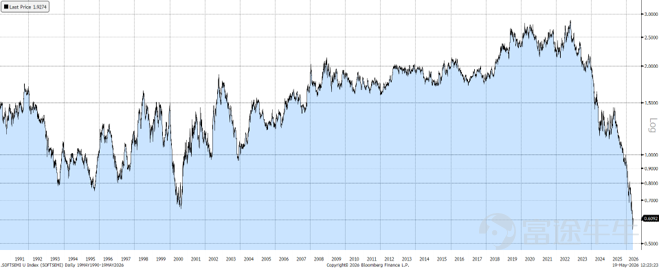
At the sector level,AI hardwareBenefiting from the explosive growth in demand for computing power, it has become a core target of capital追捧;Software sectorHowever, due to an immature business model and insufficient growth momentum, it faces valuation pressure and has entered a deep correction.
Behind this divergence, capital is reshaping its allocations through actual investment choices, revealing the market dynamics of a new era.

(Figure 1: U.S. Software vs. U.S. Semiconductors, Source: Bloomberg, as of May 19, 2026)

(Figure 2: HSCEI vs. KOSPI comparison chart, source: Bloomberg, as of May 19, 2026)
Structural Shift in Capital Flows
Digging deeper, capital is concentrating into AI hardware at an unprecedented pace. Unlike the late 1990s internet bubble era, $CISCO-T (04333.HK)$ With its price-to-earnings (P/E) ratio once approaching an inflated level of 200x, the current valuation of the AI hardware leader appears particularly rational.
Take $SK Hynix (000660.KR)$ for example: its current P/E ratio is only around 20×, and its 12-month forward P/E is even below 7×—figures that would be considered"cheap"。
SK Hynix's share price rally stems not from speculative hype but from surging demand for AI computing power, drivingHBMhigh-bandwidth memory (HBM)order surges.as well asNAND FlashThe"cyclical recovery" in memory chip pricesIn other words, this is a structural expansion driven by genuine demand and solid industry fundamentals, rather than merely a speculative frenzy fueled by capital inflows. The robust support from underlying industry fundamentals means the current AI boom is fundamentally different from the dot-com bubble of the past.

(Figure 3: Cisco stock price and P/E ratio, 1997–2005, source: Bloomberg, as of February 28, 2025)

(Figure 4: Hynix stock price and P/E ratio, 2021–2026, source: Bloomberg, as of January 31, 2026)

(Figure 5: NAND Flash spot price for TLC 512GB, source: Bloomberg, as of May 19, 2026)
The Myth of Low Valuation: A Warning from History
However, historical experience repeatedly warns us: low valuation has never been a“safe haven”. In many past equity bubbles, investors often assumed that as long as valuations had not stretched excessively, there was still ample room for share prices to rise. While this logic may hold true for a period, it is never a guarantee.
The Chinese real estate sector offers a stark lesson. For over a decade, leading Chinese property developers relied on“low valuation + high dividend yield”portfolios constructed a seemingly impregnable"safety"facade. Investors widely believed in the"housing prices only go up"core assumption and allocated substantial capital to real estate based on this belief. However, when this assumption was completely overturned in 2021, a sharp drop in housing demand triggered a concentrated outbreak of sector-wide risks, $ZHONGGUOHENGDA (45757.HK)$ leading companies such asa double whammy (Davis double dip), causing their share prices to plummet and valuation frameworks to collapse entirely.

(Figure 6: Evergrande stock price and P/E ratio, 2011–2026, source: Bloomberg, as of May 19, 2026)
This case serves as a stark warning for today’s AI hardware investments: if the"Strong growth in AI demand"Expectations are wavering—whether due to technological bottlenecks, slowing capital expenditure, or geopolitical risks—and even low P/E ratios may not prevent a reassessment of asset prices. The core risk lies not in how high or low valuation multiples are, but in the sustainability of the demand cycle.
The uniqueness of this cycle
*Different valuation fundamentals
During the dot-com bubble, many tech companies were in the"burning cash for growth"phase, lacking stable cash flows and earnings support; in contrast, today’s AI hardware companies generally exhibit strong profitability and healthy balance sheets, with valuations grounded in quantifiable fundamentals.
*Different demand drivers
The dot-com bubble was fueled by".com"Speculative enthusiasm around concepts is essentially a high-stakes bet on the future; however, the current drivers of AI demand—such as large language model training, autonomous driving, and cloud computing—have already demonstrated clear commercialization pathways and sustained order growth.
*Different market participant structure
In the past, retail investor frenzy and momentum-chasing sentiment were key drivers of bubble expansion; today, the market is dominated byInstitutional Investors, whose allocation behavior is more rational and disciplined, with stricter demands on fundamentals.
In conclusion
The essence of market divergence lies in capital’s“certainty”being repriced. The strong performance of South Korean equities and AI hardware reflects market confidence in high industry-chain景气度 (boom conditions) and robust real orders, while the correction in certain tech stocks and software sectors reveals investor concerns about the ability to deliver on growth promises.
In this AI-driven structural transformation, capital is no longer a blind follower but a discerning selector. Companies that can consistently deliver growth, possess core technologies, and hold pricing power will stand out amid the divergence, while those relying solely on conceptual hype without fundamental support will ultimately be weeded out by market scrutiny.
There are no perpetual winners in the market; only businesses aligned with cyclical shifts in fundamentals can navigate volatility and achieve sustainable success. Whether the current AI boom avoids repeating the dot-com bubble’s fate hinges not on the intensity of capital euphoria, but on the real pace of technology adoption and the continuous creation of industrial value.
The core viewpoints in this article are reprinted from Gaoteng International’s official WeChat public account post titled “Equity Market Outlook – May 2026: The Capital Logic and Risks Behind the Great Divergence in Global Equity Markets.” Special congratulations to Gaoteng International for winning the “Greater China Hedge Fund (Long/Short Equity, 5 Years)” award at the 2026 I&M Professional Investment Awards.

Li Yu, Chief Investment Officer – Equities, Gaoteng International

Risk Disclaimer: The above content only represents the author's view. It does not represent any position or investment advice of Futu. Futu makes no representation or warranty.Read more

Comments
to post a comment
1
5