
What to Watch in US Stocks | NVIDIA's Annual Shareholder Meeting Is Here—Why Even Beginners Should T

Wall Street Brief (May 23): U.S. equities continued their modest upward trend on Friday, with the Dow hitting a new intraday high and small caps outperforming large caps; rotation within the AI theme accelerated, high-valuation leaders showed clearer divergence, and Chinese ADRs came under significant pressure.
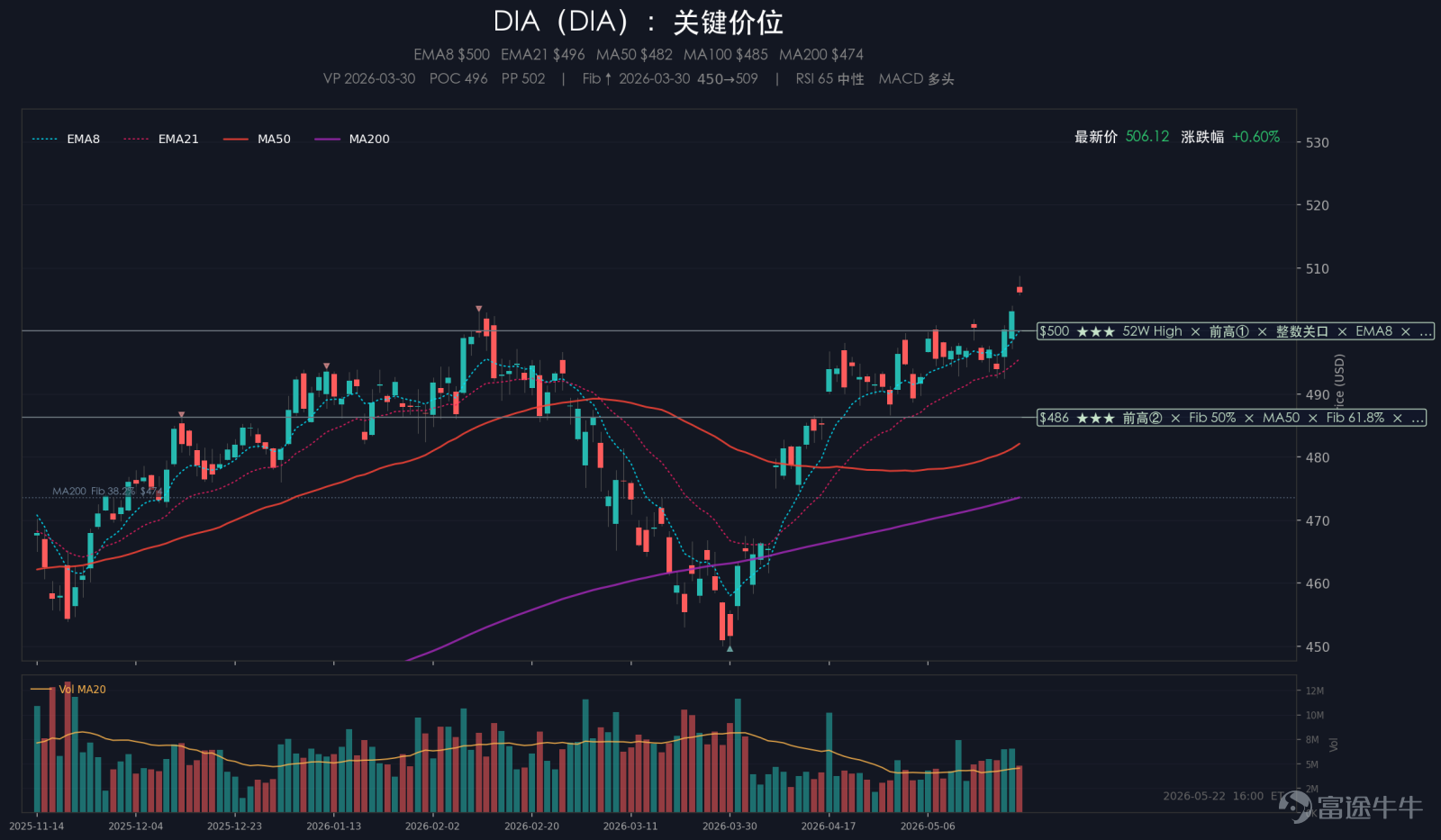
Summary: U.S. equities continued their modest gains on Friday, with the S&P 500 up 0.37%, the Nasdaq up 0.19%, the Dow Jones rising 0.58% to a new intraday high, and the Russell 2000 advancing 0.91%. The VIX closed at 16.70, down 0.36% for the day. Although indices kept climbing, the rally was not driven by a single heavyweight; instead, small caps and broader risk assets began to take the lead, while high-valuation market leaders exhibited more pronounced divergence. The key pricing drivers on the day were: first, Chinese ADRs weakened significantly amid regulatory concerns; second, weak consumer sentiment coexisted with resilient corporate earnings; third, within the AI theme, leadership rotated from core names toward software and cybersecurity. Across asset classes, markets simultaneously signaled a slowdown in risk appetite: the dollar index rose 0.12%, gold fell 0.76%, crude oil dropped 1.02%, and Bitcoin declined 2.44%.

I. Major Events
1. Weak consumer confidence coexists with resilient corporate earnings
The University of Michigan’s final May consumer sentiment reading fell to 44.8, down from the preliminary 48.2 and hitting a new historical low for the survey. Meanwhile, one-year inflation expectations were revised higher again, reflecting ongoing household concerns about the spillover of oil price shocks into broader living costs. In parallel, after-market retail and software earnings reports still included upside surprises, indicating corporate profits have not deteriorated in lockstep. As a result, the market did not shift directly into full defensive mode but instead rotated toward a structured allocation favoring 'earnings certainty plus reasonable valuations.' Against this backdrop, Friday’s gains resembled selective risk-taking rather than indiscriminate chasing.
2. Futu hit by regulatory shock; Chinese ADRs undergo repricing
Hit by regulatory scrutiny, Futu plunged 27.53% on the day—the most significant single-point shock among Chinese ADRs. Markets are concerned that compliance and operational outlooks now require repricing. In terms of transmission channels: first, Chinese brokerages and high-beta internet stocks came under immediate pressure; second, risk premiums for Chinese ADR ETFs and platform-type stocks rose in tandem; third, cross-market capital flows began to segment accordingly. This explains why, despite gains in major U.S. indices on the same day, the Chinese ADR complex still saw broad-based pullbacks. Without clear incremental positive developments in the near term, investors are likely to prioritize reducing exposure to positions with high uncertainty.
3. Rotation within the AI theme is accelerating, with divergence widening between leaders and sub-sectors.
The AI-related trade remained active on Friday, but market focus continued to broaden beyond a single leader. NVIDIA (NVDA) declined 1.90%, while software and cybersecurity sub-sectors gained strength—CIBR rose 2.59%, SKYY advanced 2.51%, and IGV climbed 1.65%. This indicates the market is shifting from a broad 'AI narrative' toward structurally pricing in the varying timing of profit realization across different segments. The significance of this shift lies in the transition of the AI rally from concentrated positioning to selective sub-sector rotation—volatility may increase, but opportunities could also widen. Going forward, the key will no longer be just daily moves in the leading names, but whether sub-sectors can sustain momentum and receive validation through earnings expectations.
II. Major Trends
At the index level, gains continued on Friday but with a modest slope. The S&P 500 rose 0.37%, the Nasdaq gained 0.19%, the Dow Jones increased by 0.58%, and the Russell 2000 advanced 0.91%. Among ETFs, IWM rose 0.93% and SPY gained 0.39%. Small caps continued to outperform large caps, indicating ongoing capital dispersion.
No fundamental shift has occurred in the medium-term structure. Over a three-month horizon, QQQ has risen 18.01%, significantly outpacing DIA’s 2.34% gain; growth-oriented SPYG is up 12.91%, compared to value-focused SPYV’s 3.46% increase. The tech theme remains the dominant driver over the medium term, though short-term volatility and rotation speed are intensifying.
In terms of breadth, SPY has gained 8.45% over three months, while RSP has only risen 1.65%, reflecting persistently high concentration. In other words, there is short-term dispersion but medium-term concentration—a combination typically associated with 'resilient index performance alongside more frequent style rotations.'
III. Market Sentiment
The VIX closed at 16.70, down 0.36% for the day, with volatility remaining low. The market has not amplified localized risk events into systemic risk-off behavior. The CNN Fear & Greed Index stood at 59, up from 58 previously, placing sentiment firmly in the 'greed' zone without any notable cooling.
Options data show a mix of offensive positioning and hedging. The CBOE total put/call ratio was 0.85, with the index options put/call ratio at 1.18 and the equity options put/call ratio at 0.68. Equity markets continue to absorb risk, but demand for index-level protection remains elevated, suggesting institutional investors are participating in the rally while maintaining portfolio hedges.
IV. Market Scan
1. Index ETFs:At the index ETF level, small-cap IWM rose 0.93% versus SPY’s 0.39% gain. This pattern aligns with the broader index performance, indicating that capital is broadening its participation rather than funneling incremental funds into a single heavyweight direction.
2. Industry sectors:Among sectors, healthcare (XLV) led with a 1.17% gain, while communication services (XLC) lagged, falling 0.55%. Defense and growth are not simply opposing forces; instead, they reflect a simultaneous state of 'defensive strength and internal growth rotation.' Within sub-industries, cybersecurity (CIBR) rose 2.59%, cloud computing (SKYY) gained 2.51%, solar energy (TAN) advanced 1.68%, software (IGV) climbed 1.65%, and robotics (BOTZ) rose 1.61%. These signals confirm ongoing rotation within the tech sector, as capital continues shifting from core computing infrastructure toward applications and supporting infrastructure.
3. Seven major tech companies:Divergence persists among the Magnificent Seven tech stocks: Tesla (TSLA) rose 1.95%, while NVIDIA (NVDA) fell 1.90%. As long as the core AI thesis remains intact, heightened volatility in leading names typically signals the market entering a phase of 'valuation digestion and sub-sector rotation.'
4. Chinese concept stocks:U.S.-listed Chinese stocks significantly underperformed major U.S. equity indices. NetEase (NTES) rose 1.93%, bucking the downtrend, while Futu (FUTU) plunged 27.53%, Tencent Music (TME) fell 3.72%, PDD Holdings (PDD) dropped 3.34%, JD.com (JD) declined 3.02%, the KraneShares CSI China Internet ETF (KWEB) slid 2.61%, and Baidu (BIDU) lost 2.58%. Risk appetite within the sector has contracted sharply, raising the difficulty of a near-term rebound.
5. Cryptocurrencies:Bitcoin fell 2.44%, with related risk assets showing clear divergence. MARA gained 1.92%, but Coinbase (COIN) dropped 4.43%, Circle (CRCL) declined 1.53%, and MicroStrategy (MSTR) fell 3.01%. This indicates that investor pricing along the crypto value chain is increasingly driven by company-specific narratives and differences in risk exposure, rather than merely tracking Bitcoin's price movements.
$S&P 500 Index (.SPX.US)$ $SPDR S&P 500 ETF (SPY.US)$ $NASDAQ 100 Index (.NDX.US)$ $Invesco QQQ Trust (QQQ.US)$ $Dow Jones Industrial Average (.DJI.US)$ $State Street® SPDR® Dow Jones Industrial Average® ETF Trust (DIA.US)$ $Russell 2000 Index (.RUT.US)$ $iShares Russell 2000 ETF (IWM.US)$ $Roundhill Magnificent Seven ETF (MAGS.US)$ $USD (USDindex.FX)$ $U.S. 10-Year Treasury Notes Yield (US10Y.BD)$ $iShares 20+ Year Treasury Bond ETF (TLT.US)$ $XAU/USD (XAUUSD.CFD)$ $SPDR Gold ETF (GLD.US)$ $CBOE Volatility S&P 500 Index (.VIX.US)$ $CME-Bitcoin RR Futures (JUL6) (BTCmain.US)$ $iShares Ethereum Trust ETF (ETHA.US)$ $NVIDIA (NVDA.US)$ $Tesla (TSLA.US)$ $Meta Platforms (META.US)$ $Amazon (AMZN.US)$ $Alphabet-C (GOOG.US)$ $Microsoft (MSFT.US)$ $Apple (AAPL.US)$
Risk Disclaimer: The above content only represents the author's view. It does not represent any position or investment advice of Futu. Futu makes no representation or warranty.Read more

Comments
to post a comment
4
1