
Fiber optic shortage triggers upstream supply concerns! Will fiber optic stocks continue to rise?

Quick Options Recap: Photonics Chip + Legacy Telecom — Two Low-Priced AI Stocks and Their Extreme Volatility
Happy Friday, fellow investors! Welcome to this week’s 'Hundred-Dollar Options Recap.'
This week, we’re discussing two rather unconventional underlyings—not $SPDR S&P 500 ETF (SPY.US)$broad market hedges, nor $NVIDIA (NVDA.US)$high-profile giants that everyone watches, but rather options on two low-priced stocks: the emerging photonics chip star $POET Technologies (POET.US)$and the veteran telecom giant $Nokia Oyj (NOK.US)$。
They share one common trait: their underlying stock prices aren’t high (both trading in the $12–$14 range), making their options cheap and easily accessible with just $100. Yet, their price action has been dramatically different—
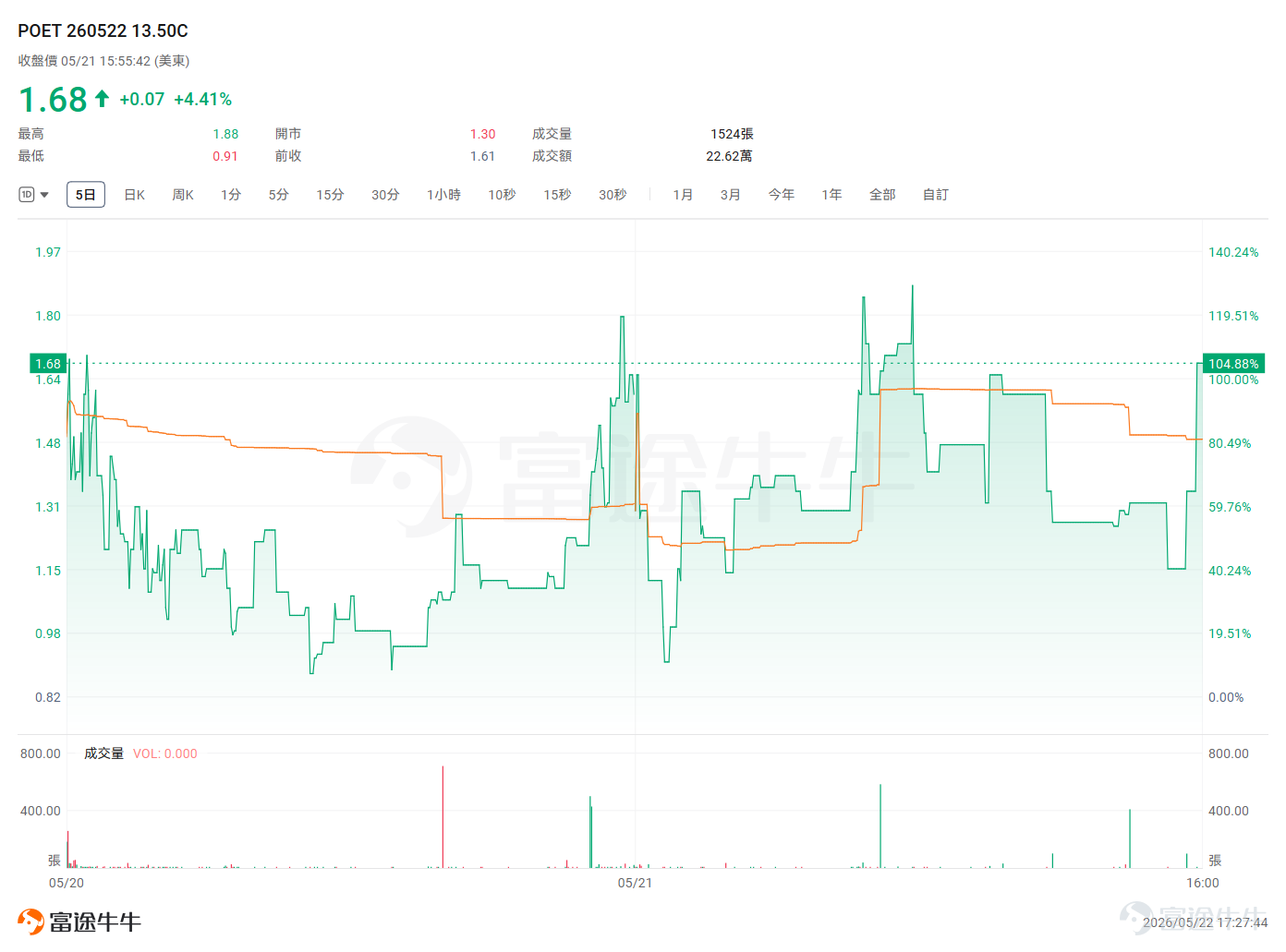
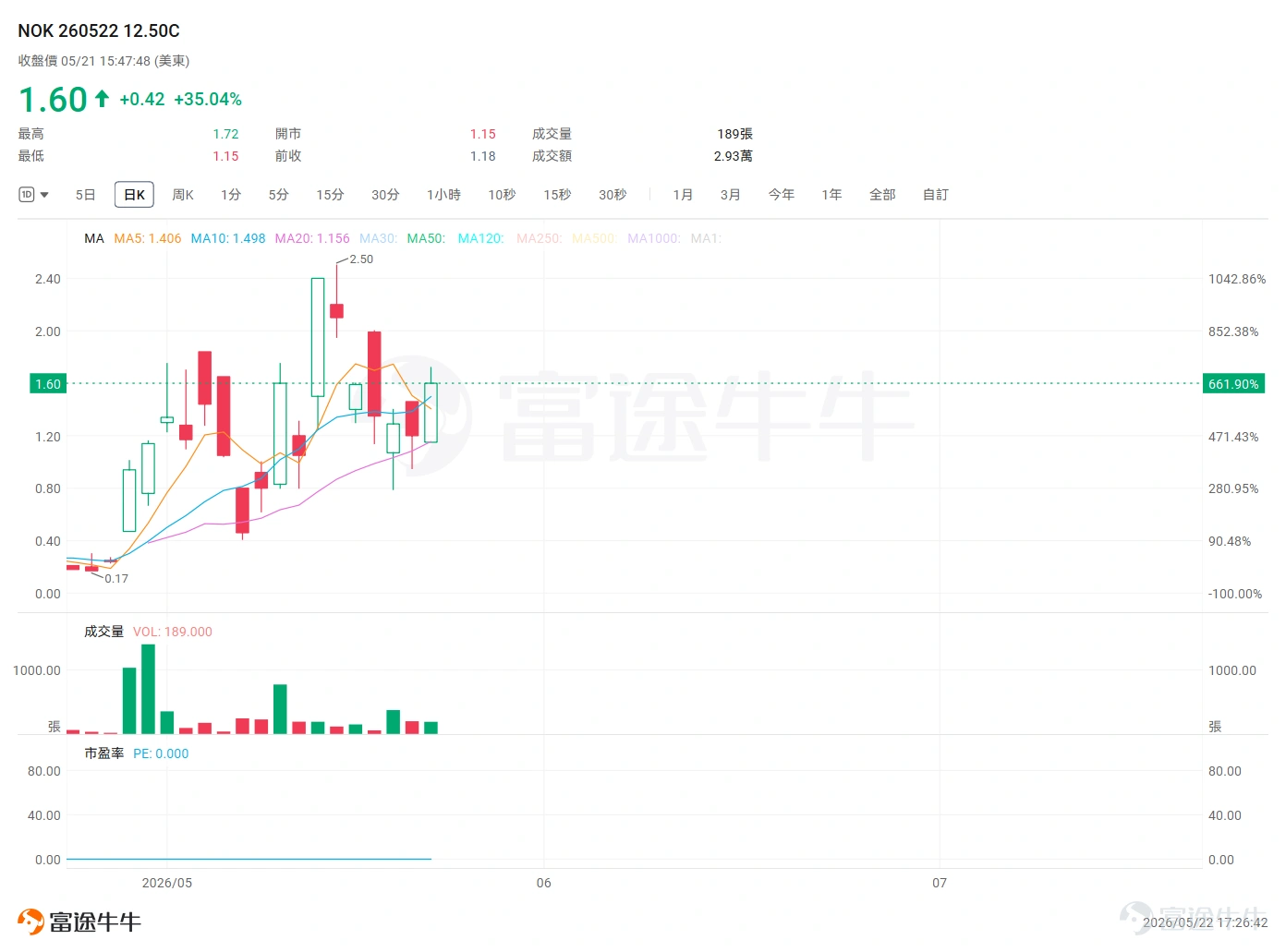
POET’s call option staged a 'last-minute comeback' two days before expiration, doubling from a low of $0.82 to $1.68; NOK’s call was even more dramatic, surging from $0.17 in early May all the way to $1.60.Has cumulatively surged nearly ninefold。
Today is the expiration date for these two contracts. Let’s see what result this $100 'lottery ticket' ultimately delivered.
Underlying #1: POET — Plunged on lost orders, violently rebounded, then entered a period of consolidation—a rollercoaster within a rollercoaster
POET Technologies is a semiconductor company focused on photonic integrated circuits (Photonic ICs). Its core product is its proprietary POET Optical Interposer platform—put simply, it uses light instead of electricity to transmit data, enabling faster speeds, lower power consumption, and smaller form factors.
Amid explosive demand for AI computing power, data centers are seeing sustained growth in demand for high-speed optical interconnects. Traditional electrical signaling between chips is approaching physical limits in terms of bandwidth and energy efficiency, making photonic technology a leading candidate for the 'next-generation interconnect' solution.
POET sits squarely in this high-growth segment, and its stock performance over the past month reads like a script:
Act One: Plunge on Lost Orders
Earlier, POET faced panic selling after rumors surfaced that it had lost a key customer order. For a small-cap photonic chip stock, the weight of a single client is extremely high—losing an order was effectively interpreted by the market as a complete rejection of its near-term growth thesis. The share price rapidly collapsed from its peak to a low, and many retail investors lost patience during this 'shakeout' and cut their losses to exit.
Act Two: Violent Rebound
However, the company soon announced new partnership developments and confirmed orders, triggering a sharp reversal in market sentiment. The stock surged violently from its lows, at one point jumping more than 20% intraday—from the $5 range in late March to over $12, doubling in value. Those who had sold out in frustration during the plunge watched helplessly as the stock took off the very next day.
Act III: Consolidation Through Volatility This Week
After experiencing a sharp plunge followed by a dramatic rally, POET entered this week into aConsolidating with fluctuationsphase. The underlying stock oscillated repeatedly around the strike price of $13.50, with bullish and bearish forces temporarily reaching equilibrium.

The movement of this call option over two days perfectly mirrored the underlying stock’s “consolidation through volatility” pattern:
May 20: It declined alongside the underlying stock, dropping as low as $0.82.
Late May 20 to market open on May 21: As the underlying stock stabilized and rebounded, the option jumped from $0.82 to open at $1.30.
Intraday on May 21: The underlying stock pushed higher, driving the option up to an intraday high of $1.88.
Close on May 21: The underlying stock pulled back, and the option settled at $1.68.
Rising from $0.82 to $1.68 within two days—more than doubling in value.
This call option’s price action illustrates an interesting phenomenon:One to two days before expiration, an originally out-of-the-money option can double in value due to a minor move in the underlying stock.The reason is that when an option is close to expiration and near at-the-money, its price becomes extremely sensitive to movements in the underlying stock. This is why short-dated options often experience 'multi-fold gains in a single day'—but the reverse is equally true: a 1% drop in the underlying stock can halve the option’s value.
Both gains and losses are magnified dramatically, making these options suitable only for traders with a clear short-term directional view who can enter and exit quickly. They are not appropriate for 'buy-and-hold' strategies.
Underlying #2: NOK — The 'Renaissance' of a Legacy Telecom Giant
Nokia—yes, that same Nokia once known for mobile phones—has long since transformed into a global leader innetwork infrastructure and communications technology.Its core businesses include 5G network equipment, optical networking, cloud and network services, among others.
Interconnecting data centers and deploying AI inference at the edge both require stronger optical networks and low-latency communication, allowing Nokia to ride the wave of AI-driven growth. The stock has been steadily strengthening since the beginning of the year, doubling in price so far—with a particularly sharp 60% surge in April alone.
This call option’s price action is a textbook example of a 'trending play':
Early AprilWith the underlying stock still around $8, the $12.50-strike call is out-of-the-money and priced at just $0.17—$17 per contract, roughly the cost of a meal.
April to mid-May: The underlying stock began accelerating upward, breaking above $12.50 into the in-the-money range. The option price surged from $0.17 to a high of $2.50—nearly a 15-fold increase$17 turned into $250.
Mid-May pullback: The underlying stock pulled back slightly, and the option price retreated from $2.50 to the $1.15–1.20 range.
May 21 rebound: The underlying stock strengthened again, driving the option price up from $1.18 to $1.60—a single-day gain of +35%.
From the low of $0.17 to yesterday's close at $1.60,the cumulative gain is approximately 841%.. If you bought a call for $17 in early May, it was worth $160 by yesterday—nearly a 9x gain.
This NOK call perfectly illustrates why low-priced stock options are the natural hunting ground for 'hundred-dollar players':
Underlying stock trading between $12 and $14,Options naturally cost less.For an at-the-money call, SanDisk (trading above $1,500) might cost several thousand dollars per contract, whereas NOK costs around $100—making the entry barrier vastly different.
Of course, the reverse also holds true: if NOK had traded sideways or declined during this period, the option would have expired worthless.
Both tickers this week share one key trait:The underlying stocks aren’t expensive, and the options are cheap—you can get in for as little as a few dozen to a hundred dollars.
That’s precisely the essence of 'playing options with a hundred bucks'—Not all great opportunities are in NVIDIA, $Tesla (TSLA.US)$Among these high-profile stocks, low-priced stocks in the $10–15 range often offer a lower entry barrier and higher leverage.
Advantages of low-priced stock options:
Low entry cost—one contract costs just tens of dollars
Small price movements in the underlying stock can generate significant option gains
Suitable for a 'give-it-a-try' mindset—you’re only risking the cost of a meal if it goes to zero
Disadvantages of low-priced stock options:
Poor liquidity and wide bid-ask spreads
Price swings in the underlying stock may be irrational (driven by retail investor sentiment)
Higher probability of expiring worthless compared to options on large-cap stocks
The core principle remains unchanged: only risk money you can afford to lose, trade based on logic you understand, and exit when it’s time to go.
Today is the expiration date for these two contracts. Regardless of the outcome, they have already provided holders with a generous profit window over the past few days/weeks. Turning paper gains into real profits depends not on luck, but on discipline.
Manage your positions well—see you next week~
Not comfortable with options basics? Study up before jumping in.
If, while reading this recap, you're still unclear about concepts like 'What is a Long Call?' or 'How to interpret strike prices,' don't rush to place orders—take some time first to solidify your foundational knowledge.Here’s a curated list of practical beginner resources—recommended for bookmarking:
Finally, here's a small perk for fellow Futubull investors, welcome to claim it.Options Beginner Pack *This event is only open to invited HK users, click to learn more.Detailed event rules>>

Disclaimer
This content does not constitute any offer, solicitation, recommendation, opinion, or any guarantee of any securities, financial products, or instruments. The risk of loss in trading options can be substantial. In some cases, your losses may exceed the initial margin deposited. Even if you set contingent orders, such as stop-loss or limit orders, they may not necessarily prevent losses. Market conditions may cause these orders to be unexecuted. You might be required to deposit additional margin within a short period. If you fail to provide the required amount within the specified time, your open positions may be liquidated. However, you will still be responsible for any deficit in your account as a result. Therefore, before trading, you should study and understand options and carefully consider whether such trading is suitable for you based on your financial situation and investment objectives. If you trade options, you should be familiar with the procedures when exercising options and upon their expiration, as well as your rights and obligations when exercising options and at expiration.
Risk Disclaimer: The above content only represents the author's view. It does not represent any position or investment advice of Futu. Futu makes no representation or warranty.Read more


Comments (2)
to post a comment
39
90