
Lip-Bu Tan declared that Intel aims to grow tenfold in 5–10 years! Will Intel keep rising?

Up over 30% in two days, ARM’s market cap surpasses $300 billion: Why the sudden re-rating, and what’s next for the stock?
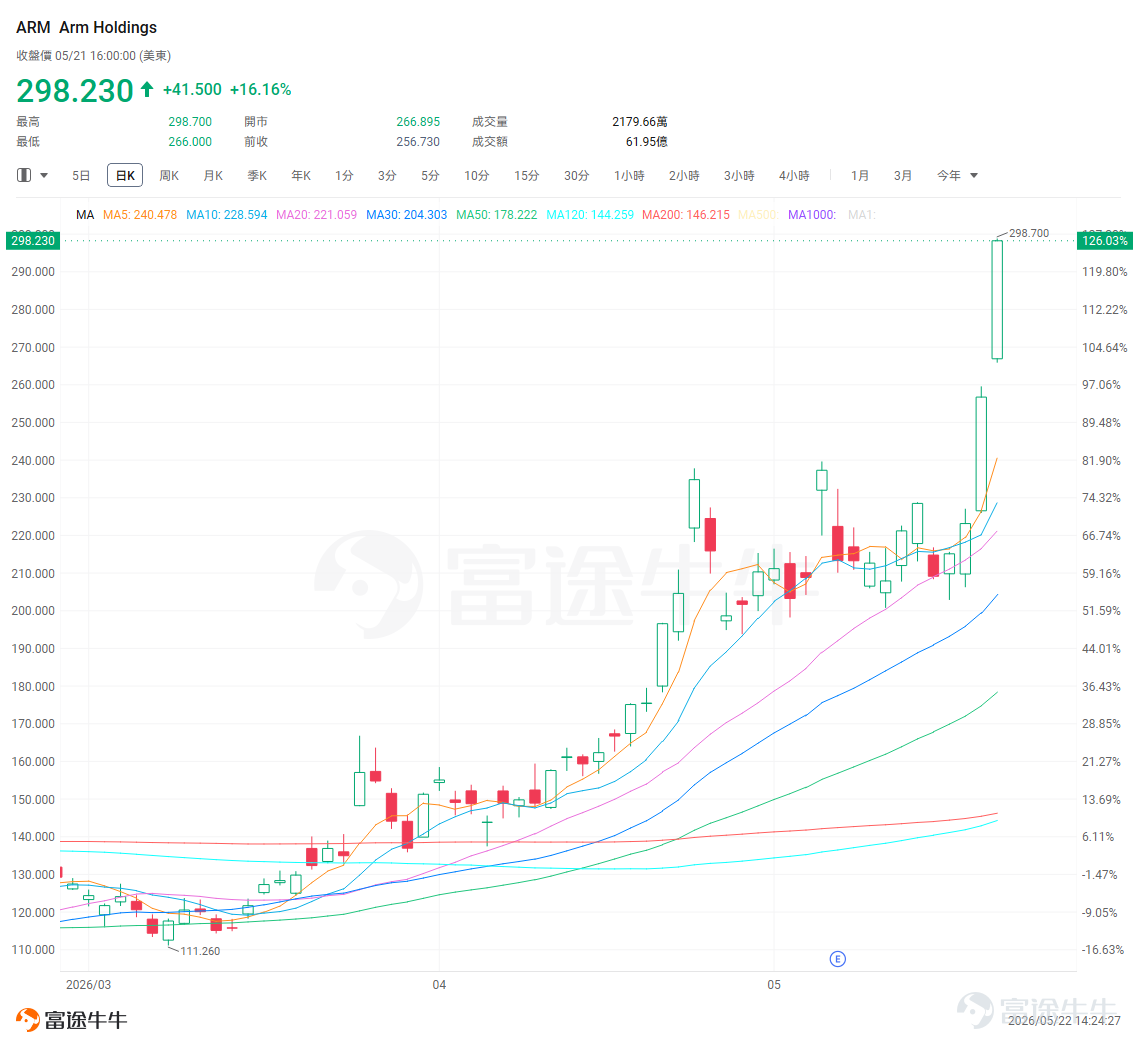
$Arm Holdings (ARM.US)$ Up more than 40% this week, ARM’s share price has approached $298 as of the latest trading data, giving it a market capitalization of approximately $312.5 billion—nearing the $300 billion milestone. Is this another wave of AI-driven sentiment speculation, or the beginning of a fundamental re-rating?

Why did ARM suddenly surge?
Bernstein provided a more aggressive valuation anchor this Monday. In its initial coverage of ARM, Bernstein assigned an 'outperform' rating with a $300 price target and a bull-case scenario of $390, positioning ARM as a core beneficiary of the CPU renaissance in the Agentic AI era.
The significance of this report lies not in introducing new granular data points, but in packaging previously fragmented elements—earnings reports, AGI CPUs, and Arm CPU penetration rates among cloud providers—into a cohesive, long-term investment narrative that the market can quickly trade on.
Moreover, Wednesday and Thursday coincided with a renewed upswing in sentiment around AI infrastructure investments. Around NVIDIA’s earnings release, market attention to the sustainability of AI-related capital expenditures intensified again, prompting capital to flow out from the GPU-focused theme into other infrastructure segments such as CPUs, networking, servers, and power.
ARM also has a relatively low free float, which inherently makes its stock price more volatile; when analyst reports, AI supply-chain sentiment, and sector-wide capital flows align, gains are rapidly amplified.
Thus, ARM was consolidated this week into a stronger, unified trading theme:
Agentic AI is driving a reassessment of CPU demand; the CPU renaissance is boosting Arm architecture’s share in data centers; and Arm’s own AGI CPUs are unlocking new revenue growth avenues.
This rally shouldn’t be simplistically interpreted as ‘a sudden new piece of news emerging this week.’ A more accurate description would be:The fundamental signals have long been present—the market simply assigned them a higher valuation anchor this week.Several factors combined to drive ARM's strong rally this week.
ARM's business model is evolving, with a growing backlog for AGI CPUs.
Historically, investors viewed ARM primarily through the lens of mobile chip IP licensing, low-power architecture, and a royalty-based model. ARM does not manufacture chips itself; instead, it generates revenue mainly through licensing fees and royalties. Customers using ARM’s architecture and IP to design chips first pay an upfront license fee, and then ARM collects a royalty on every chip shipped once volume production begins.
The advantage of this model is high profitability, low capital expenditure, and strong operating leverage.Its business model is sufficiently 'lightweight'—a highly attractive business with high margins and strong cash flow—but the market has consistently asked one question: after smartphone growth slows, what will enable ARM to break through its next revenue ceiling?
The launch of the AGI CPU has introduced a new variable into ARM’s revenue structure.
ARM unveiled its Arm AGI CPU in March.This marks the company’s first foray into its own data center silicon products. According to official documentation, the CPU supports up to 136 Arm Neoverse V3 cores and has a TDP of approximately 300W, targeting AI data centers and agentic AI workloads.
This move is highly significant, as ARM previously focused on selling IP and architecture licenses but is now moving deeper into the data center CPU value chain.
UBS Group reinforced this narrative in its report dated May 7, with a headline reading directly: 'ARM AGI CPU Backlog Doubles In 6 Weeks.' UBS noted that demand backlog for ARM AGI CPUs for fiscal years 2027 and 2028 stands at approximately $2 billion—double the roughly $1 billion cited at the time of the product’s announcement at the end of March.However, the company still guided for approximately $1.05 billion in revenue for the same period, suggesting that near-term constraints are more likely stemming from supply chain and capacity limitations rather than insufficient demand.
In the future, ARM could potentially have three layers of revenue:
The first layer is traditional IP licensing, which has been ARM’s core business historically.
The second layer is royalty income. As adoption of Armv9, CSS, and higher-value chips increases, per-chip royalty rates have room to rise further.
The third layer is revenue from ARM’s own AGI CPUs. ARM is no longer just selling architectures but is now also directly participating in revenue sharing from data center CPU products.
Bernstein is highly optimistic about this shift. It forecasts ARM’s revenue could exceed $26 billion by 2030, with EPS reaching $9.83, and the AGI CPU business alone potentially contributing $15 billion in revenue by fiscal year 2031.
However, there is also an implicit trade-off to consider here.
Although the in-house CPU business can lift the revenue ceiling, its profit margins will not be as high as those of traditional IP licensing.UBS Group noted that the long-term operating margin for AGI CPUs is expected to be in the mid-30% range, compared to approximately 65% for the IP licensing business. In other words, ARM is trading some margin for significantly larger revenue scale and a broader profit pool.
This has dual implications for valuation. The market may assign a premium for a higher revenue ceiling, but it will also begin reassessing whether ARM remains a 'software-like IP company' or is gradually evolving into a hybrid semiconductor company combining IP and chip businesses. The former commands extremely high valuations, while the latter must contend with the complexities of supply chains, inventory management, product delivery, and customer relationships.
In the era of CPU resurgence, what role does ARM play?
Over the past two years, investment in AI infrastructure has largely revolved around GPUs. Training large models and generating tokens through inference—GPUs have been the most easily understood core asset in the market. NVIDIA’s valuation expansion stems from this very logic.
However, Agentic AI brings a fundamental shift: AI is moving from 'answering questions' to 'executing tasks.' An AI agent doesn’t just generate a piece of text—it breaks down tasks, calls tools, reads files, writes code, accesses databases, coordinates multiple models, and replans its next steps based on outcomes. This process demands extensive task orchestration, memory management, scheduling control, and system coordination—all areas inherently reliant on CPUs.
Bernstein refers to this shift in its report as the 'CPU renaissance.' Its estimates show that traditional AI data centers require roughly 30 million CPU cores per gigawatt (GW) of computing power, whereas Agentic AI data centers could need about 120 million CPU cores—representing a fourfold increase. The CPU-to-GPU ratio may also converge from the current range of 1:4 to 1:8 toward 1:1 to 1:2.
Translated into investment terms, this means:If the next phase of AI involves automated task execution, CPUs will move from peripheral supporting roles back to the core of infrastructure.
ARM sits precisely at the intersection of this transformation.
On one hand, ARM architecture’s power efficiency aligns well with the increasingly stringent power constraints faced by data centers.One of the biggest bottlenecks for AI data centers today is no longer simply how many chips can be purchased, but whether higher compute density can be delivered within limited power, cooling, and rack space.
On the other hand,Cloud providers have already been accelerating adoption of ARM architecture over the past few years.For example, AWS Graviton, Google Axion, Microsoft Cobalt, and NVIDIA Vera CPUs. UBS Group also noted,ARM management expects further upside from deployments by hyperscale cloud providers and demand for higher-core-count CPUs.
However, Bank of America’s caution is also critical: the growth in ARM-based server CPU market share does not mean ARM Holdings will capture the entire corresponding total addressable market (TAM). By 2030, ARM-based CPUs could account for approximately 44% of the total value share. ARM would benefit through higher royalty rates, but that value will be distributed among cloud providers, NVIDIA, chip design firms, and system vendors.
Thus, this rally isn’t driven by baseless market speculation but reflects an evolution in the AI infrastructure narrative—from 'GPU-centric expansion' to a systems-level approach encompassing 'GPUs + CPUs + networking + power.' ARM happens to fill the piece most easily overlooked.
What should we watch next? Is it still worth chasing at current prices?
From a medium-term perspective, ARM’s story is indeed stronger now than it was a few months ago.Doubling demand for AGI CPUs, doubling data center royalties, and rising adoption of ARM CPUs by cloud providers—none of these trends can be fully explained by short-term sentiment alone. As long as AI data centers continue expanding and the value of CPUs in agentic AI keeps being validated, ARM has a solid foundation for a long-term valuation premium.
However, from a short-term view, after two consecutive days of gains exceeding 30%, the risk-reward ratio has already shifted. Current trading already incorporates a clear sentiment-driven premium. ARM has a relatively low public float, which inherently makes its stock price highly elastic; when capital flows in en masse, price moves are amplified. Conversely, if profit-taking emerges or market risk appetite declines, volatility could be extremely sharp.
As for how to assess the outlook ahead, let’s first look at major banks’ target prices:
If we take Bernstein’s $300 target price as the base case, the stock is already near that scenario. However, under Bernstein’s bull-case target of $390, there remains significant upside potential from current levels.
In a bull market scenario, four factors need to be monitored.
First, assess whether AGI CPU demand continues to be revised upward.The market already knows that fiscal year 2027/2028 demand is approximately $2 billion. If management subsequently raises demand guidance further or confirms additional customers, the stock price will continue to receive support.
Second, monitor whether supply chain bottlenecks ease.The key constraint has now shifted from 'whether there is demand' to 'whether delivery is possible.' If ARM secures more capacity, memory, and testing resources, revenue recognition could accelerate beyond current guidance.
Third, track Arm CPU penetration rates among cloud providers.The pace at which AWS, Google, Microsoft, and NVIDIA’s ecosystems adopt Arm CPUs will directly determine whether the market believes in Bernstein’s long-term model.
Fourth, watch gross margin trends.Once AGI CPU business starts contributing revenue, investors will reassess ARM’s overall gross and operating margins. Revenue growth is certainly important, but if margins decline more than expected, the valuation framework could be disrupted.
From a technical perspective,ARM remains in a very strong bullish trend.The stock price has posted consecutive high-volume, long bullish candles breaking above the previous resistance zone, with moving averages clearly aligned in a bullish formation and MACD continuing to strengthen—indicating that the trend momentum has not yet exhausted itself;
however, the main short-term concern is the excessively rapid pace of gains. The current price of USD 298 has significantly deviated from its moving averages, and the J-line of the KDJ indicator has already risen above 100,signaling pronounced short-term overbought conditions. The USD 300 level represents the first key resistance and also a psychological round-number barrier;if the stock breaks through this level on high volume and stabilizes above it, the next upside targets could be USD 315–320. However, any failure to sustain higher levels may trigger profit-taking.
On the support side, USD 266–270 marks the first critical support zone, aligning with the low of the latest strong bullish candle and the institutional defense area; USD 240–250 corresponds to the 5-day moving average and the prior breakout platform—if the price retraces and finds support here, the medium-term risk-reward becomes more attractive.
Options market signals point to “strong bullish sentiment in the near term, but with high volatility” . Implied volatility (IV) is at an extreme historical high, with ARM.US options currently showing an implied volatility of 89.13%, placing it at the 98th percentile historically;such elevated IV reflects intense market enthusiasm while also indicating that option premiums are extremely expensive.Open interest continues to accumulate, indicating sustained positioning and confrontation between bulls and bears, setting the stage for a potential 'gamma squeeze' or 'options expiration effect.'
(1) Investors who already hold positions—if they remain bullish but anticipate a short-term pullback due to overbought conditions
Investors holding positions who remain optimistic but expect a short-term pullback due to overbought conditions can consider switching to a 'protective collar' long position strategy: maintain their stock holdings while buying puts to hedge against downside risk. The premium received from selling calls can offset part of the cost of buying puts, thereby achieving lower-cost risk hedging.
The strike price of the put should reflect the floor you wish to protect, while the strike price of the call determines where you are willing to cap your upside. If ARM continues to rally, you can still participate in further gains; if the stock peaks near $300 and pulls back, the purchased put will help offset some profit erosion. Meanwhile, selling a high-strike call allows you to collect rich option premiums in a high implied volatility (IV) environment, subsidizing the cost of protection.
(The figure below illustrates the simulated profit and loss scenario of this strategy on the expiration date. The design image displayed on the screen is for demonstration purposes only and does not constitute any investment advice or guarantee; market conditions fluctuate frequently, and the prices shown do not represent actual values.)

(2) For new capital without an existing position, chasing the market after consecutive sharp rallies carries relatively high risk.
A more prudent approach is to wait for one of two signals: first, a pullback to the $266–$270 range that holds above key support, with declining volume yet stable price action; second, a breakout and sustained close above $300 on strong volume, confirming the market’s willingness to accept a higher valuation range. The former suits more conservative capital, while the latter aligns with trend-following traders.
In options trading, investors with a long-term bullish view on ARM’s re-rating narrative—and who are willing to acquire shares at a predetermined price—can employ a sell-put strategy. This approach is not about chasing momentum but rather betting that even if ARM pulls back, it will likely find strong buyer support. If, at expiration, the stock price remains above the strike price, the put expires worthless and you keep the full premium. If the price falls below the strike, you acquire the shares at your pre-set target price.
A key risk to note is that selling puts should only be done once the stock has pulled back near support levels or after support has been confirmed as valid. With the stock still trading at elevated levels, selling puts may offer attractive premiums, but if price breaks sharply below support on high volume, risk exposure escalates quickly—making it inadvisable to hastily sell puts and 'catch a falling knife.'
(The figure below illustrates the simulated profit and loss scenario of this strategy on the expiration date. The design image displayed on the screen is for demonstration purposes only and does not constitute any investment advice or guarantee; market conditions fluctuate frequently, and the prices shown do not represent actual values.)

Finally, Option Sir brings a small perk for fellow investors, welcome to claim it.Options Beginner Pack
*This event is exclusive to invited HK users. Click to learn more.Detailed event rules>>
Market conditions are complex and volatile,Options StrategyOverwhelmed by choices? Futubull helps you build a portfolio in three steps.Options Strategymaking investing simple and efficient!
Option Risk Warning:An option is a contract that grants the holder the right, but not the obligation, to buy or sell an asset at a fixed price on a specific date or at any time before that date. The price of an option is influenced by various factors, including the current price of the underlying asset, the strike price, time to expiration, and implied volatility. Implied volatility reflects the market’s expectations for the level of volatility in the option over a future period. It is a data point derived inversely from the Black-Scholes option pricing model and is generally regarded as an indicator of market sentiment. When investors anticipate greater volatility, they may be more willing to pay a higher price for options to hedge risks, resulting in higher implied volatility. Traders and investors use implied volatility to assess the attractiveness of option prices, identify potential mispricings, and manage risk exposure.
Disclaimer:This content does not constitute any offer, solicitation, recommendation, opinion, or guarantee of any securities, financial products, or tools. The risk of loss in trading options can be substantial. In some cases, losses may exceed the initial margin deposited. Even if you set contingent orders such as 'stop-loss' or 'limit' orders, these may not prevent losses. Market conditions may make such orders unexecutable. You may be required to deposit additional margin within a short period. If you fail to provide the required amount within the specified time, your open positions may be liquidated. However, you will still be responsible for any shortfall in your account. Therefore, before trading, you should study and understand options and carefully consider whether such trading is suitable for you based on your financial situation and investment objectives. If you trade options, you should be familiar with the procedures for exercising options and the rights and obligations upon exercise and expiration. Options trading carries extremely high risks and is not suitable for all investors. Investors should carefully readCharacteristics and Risks of Standardized Options。
Risk Disclaimer: The above content only represents the author's view. It does not represent any position or investment advice of Futu. Futu makes no representation or warranty.Read more


Comment (1)
to post a comment
21
57