
Waller's new policy measures are in the works! How should investors respond?

Daily Options Outlook | Markets Await Warsh Swearing-In; U.S. Government Boosts Quantum Computing Investment, Driving Related Stocks Higher and Sending Multiple Call Options Up Over 60x
Today's Options Opportunity Preview
On the macro front, at 23:00 tonight, new Federal Reserve Chair Kevin Warsh will be sworn in, prompting markets to reprice the Fed’s future reaction function. The Fed previously announced that Powell would serve as interim chair following the conclusion of his term until Kevin Warsh is sworn in as the new chair. According to JPMorgan’s interpretation, Warsh has publicly emphasized stronger inflation discipline, streamlined communication, and a more focused central bank mandate.
For trading, markets may worry that the new chair will have lower tolerance for inflation and pursue balance sheet runoff more aggressively, thereby increasing volatility in long-end rates. If Warsh delivers dovish signals or emphasizes policy continuity, growth stocks previously pressured by rates could see a rebound trade.
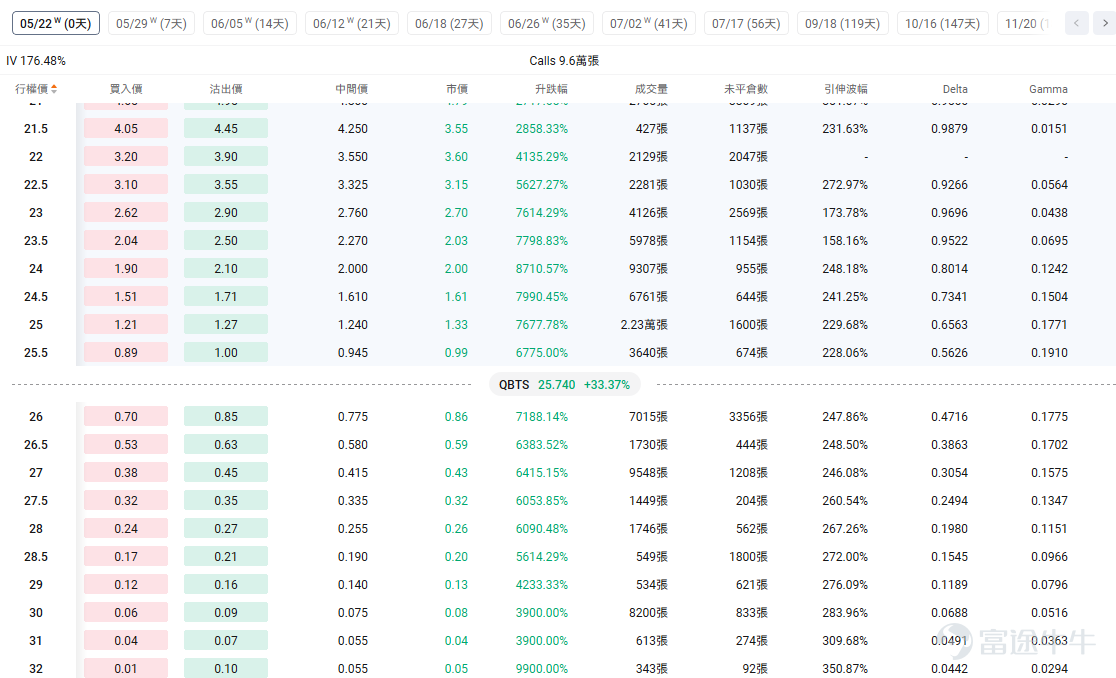
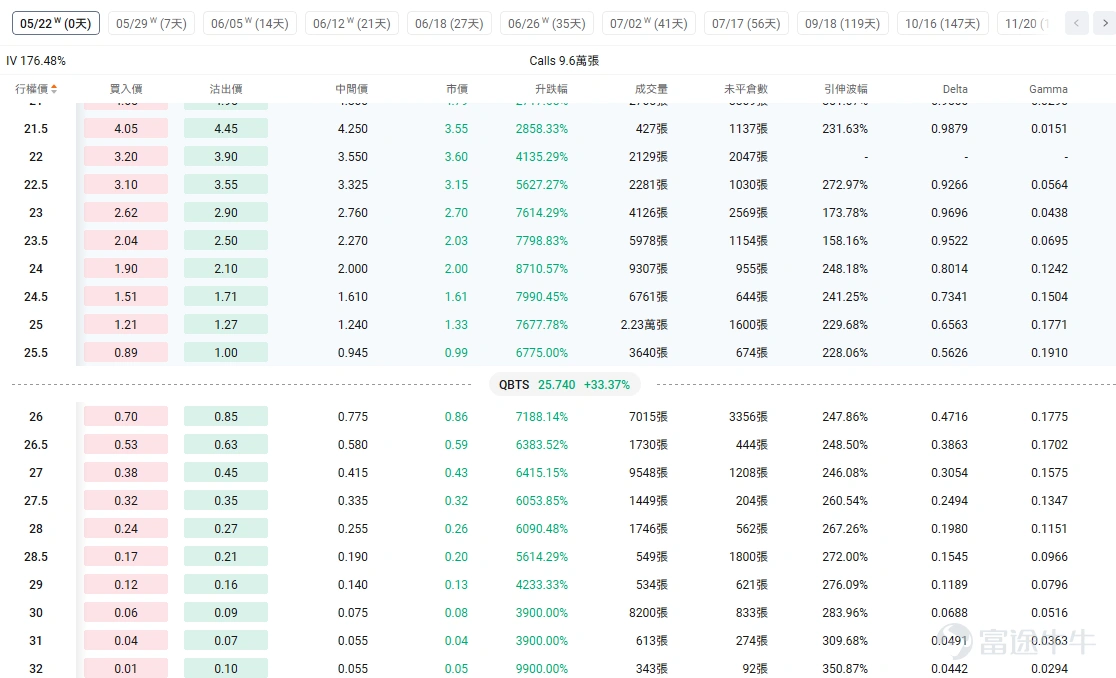
On the individual stock front, the U.S. government yesterday increased its investment in quantum computing, shifting the quantum computing theme from speculative hype to policy-backed funding validation. Multiple call options expiring today surged by over 60-fold. In pre-market trading today, quantum computing-related stocks continued to rise, $D-Wave Quantum (QBTS.US)$ up 2.88%, $IBM Corp (IBM.US)$ up 2.33%; previously confined to long-term speculative potential, this round of government funding directly targets quantum chip manufacturing, effectively providing policy endorsement for the industry’s supply chain development.
Options Market Recap
Index Options
On May 21 Eastern Time, trading volume in the U.S. equity index options market declined, with a total of 6 million contracts traded. The put/call volume ratio rose to 0.98.
As the upcoming expiration date approaches,$S&P 500 Index (.SPX.US)$ Options volume distribution showed the following characteristics: put option volume peaked at the 7,430 strike, while call option volume peaked at the 7,500 strike.

Single Stock Options
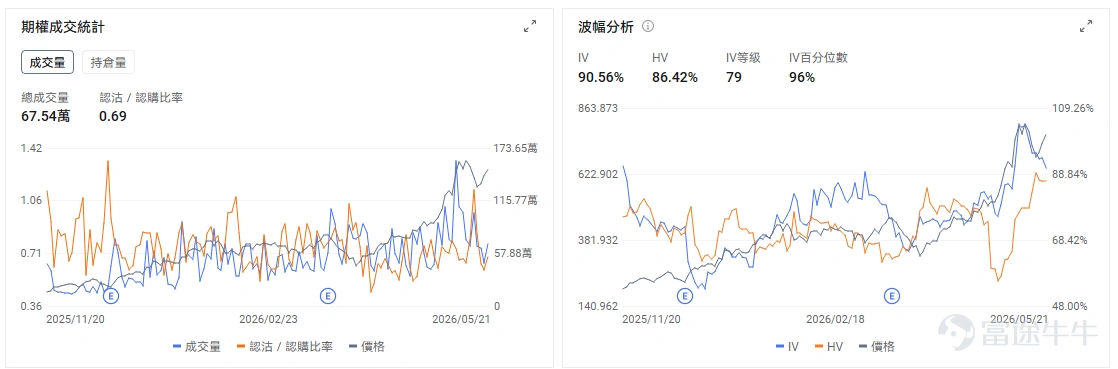
$Micron Technology (MU.US)$closed up 4.11%, with 675,400 options contracts traded and the put/call volume ratio rising to 0.69. Micron Technology’s share price rose, benefiting from growing demand for memory chips driven by AI data center construction and Samsung Electronics avoiding a strike.
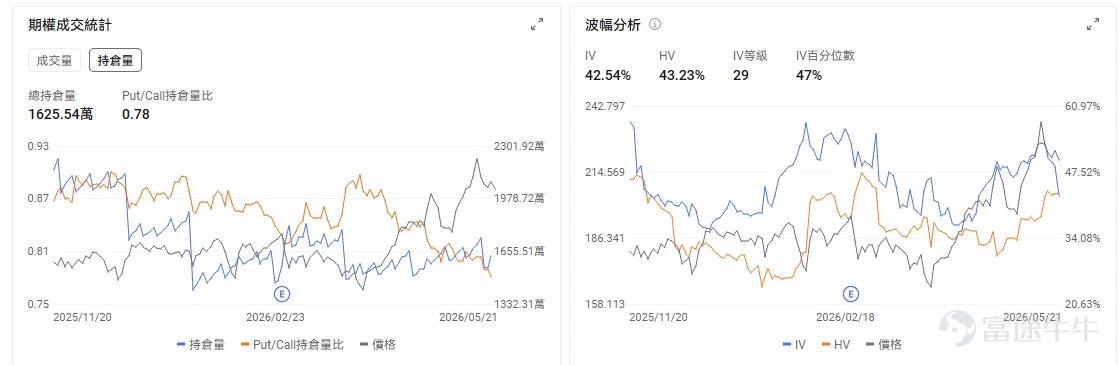
$NVIDIA (NVDA.US)$closed down 1.77%, with 4,553,400 options contracts traded and the put/call volume ratio falling to 0.43. NVIDIA reported Q1 revenue of $81.6 billion, up 85% year-over-year, and launched its Vera CPU, which is expected to generate $20 billion in revenue this year.
Top list of options trading volume
Among the top 10 stocks by options trading volume,$Advanced Micro Devices (AMD.US)$had the highest put/call volume ratio at 0.85. AMD began mass production of its sixth-generation EPYC processor 'Venice,' built on Taiwan Semiconductor’s 2nm process technology.
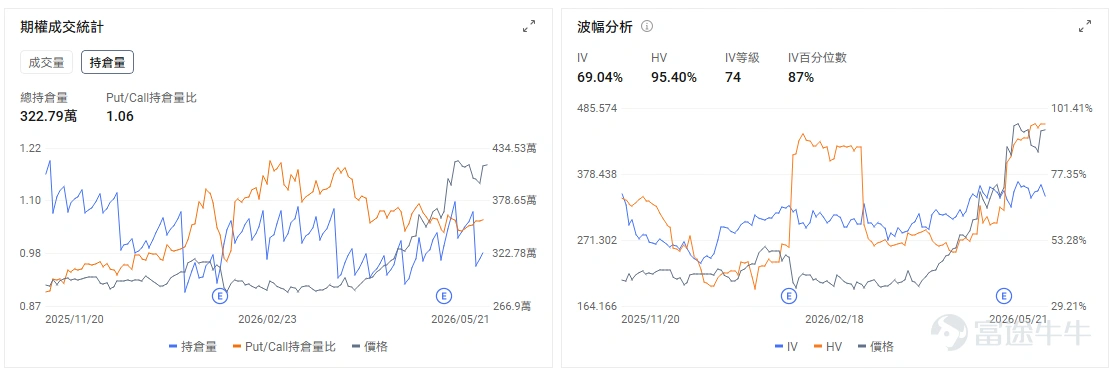
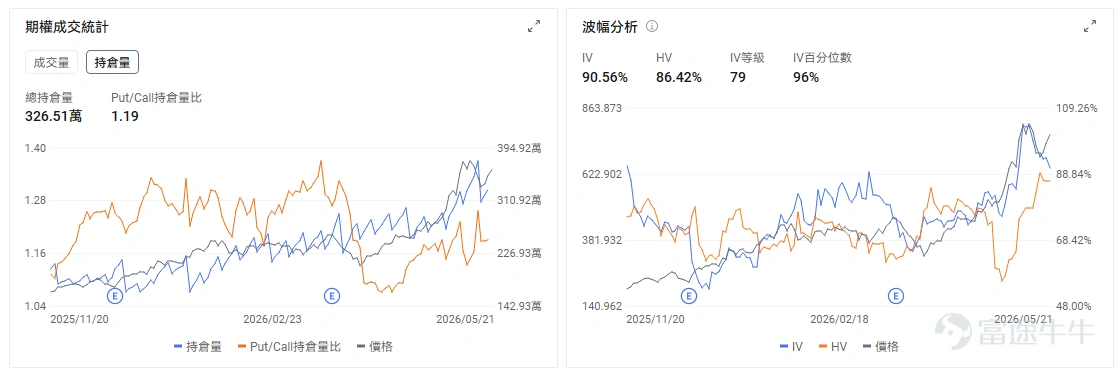
Implied volatility rankings (underlying market cap > $10 billion and options trading volume > 100,000)
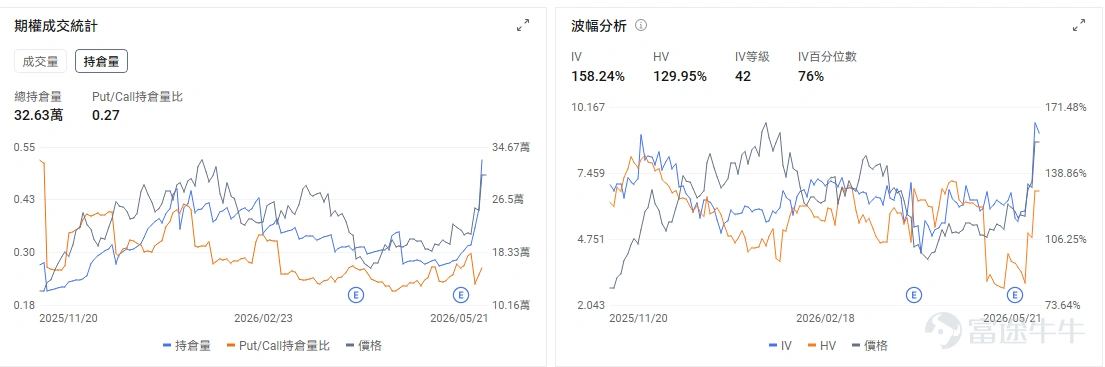
$T1 Energy (TE.US)$Implied volatilityreached the highest level at 158.24%, down 3.11% from the previous trading day. T1 Energy shares surged 34.5% to $9.26, hitting a three-month high, after Roth Capital refuted a short-seller report and maintained its buy rating.
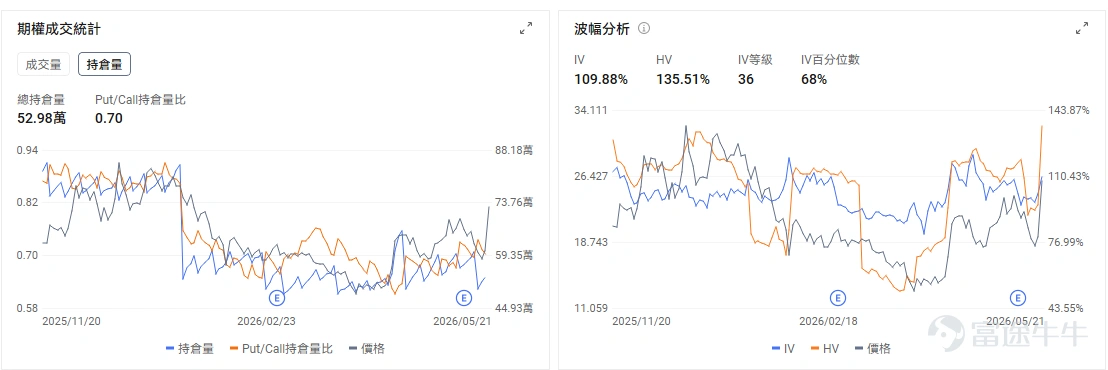
$D-Wave Quantum (QBTS.US)$saw the largest increase in implied volatility, reaching 109.88%, up 8.86% from the previous trading day. D-Wave Quantum received $100 million in funding from the U.S. government, which will acquire an equity stake in the company.
Risk Warning
An option is a contract that gives the holder the right, but not the obligation, to buy or sell an asset at a fixed price on a specific date or before that date. The price of an option is influenced by various factors, including the current price of the underlying asset, the strike price, time to expiration, and implied volatility.
Implied volatility reflects the market's expectation of the option's volatility over a certain period in the future. It is derived inversely from the BS pricing model of options and is generally considered an indicator of market sentiment. When investors anticipate greater volatility, they may be more willing to pay higher prices for options to hedge risks, resulting in higher implied volatility.
Traders and investors use implied volatility to assessOption priceto enhance attractiveness, identify potential mispricing, and manage risk exposure.Disclaimer
This content does not constitute any offer, solicitation, recommendation, opinion, or guarantee of any securities, financial products, or tools. The risk of loss in trading options can be substantial. In some cases, losses may exceed the initial margin deposited. Even if you set contingent orders such as 'stop-loss' or 'limit' orders, these may not prevent losses. Market conditions may make such orders unexecutable. You may be required to deposit additional margin within a short period. If you fail to provide the required amount within the specified time, your open positions may be liquidated. However, you will still be responsible for any shortfall in your account. Therefore, before trading, you should study and understand options and carefully consider whether such trading is suitable for you based on your financial situation and investment objectives. If you trade options, you should be familiar with the procedures for exercising options and the rights and obligations upon exercise and expiration. Options trading carries extremely high risks and is not suitable for all investors. Investors should carefully readCharacteristics and Risks of Standardized Options。
This content does not constitute any offer, solicitation, recommendation, opinion, or guarantee of any securities, financial products, or tools. The risk of loss in trading options can be substantial. In some cases, losses may exceed the initial margin deposited. Even if you set contingent orders such as 'stop-loss' or 'limit' orders, these may not prevent losses. Market conditions may make such orders unexecutable. You may be required to deposit additional margin within a short period. If you fail to provide the required amount within the specified time, your open positions may be liquidated. However, you will still be responsible for any shortfall in your account. Therefore, before trading, you should study and understand options and carefully consider whether such trading is suitable for you based on your financial situation and investment objectives. If you trade options, you should be familiar with the procedures for exercising options and the rights and obligations upon exercise and expiration. Options trading carries extremely high risks and is not suitable for all investors. Investors should carefully readCharacteristics and Risks of Standardized Options。
Risk Disclaimer: The above content only represents the author's view. It does not represent any position or investment advice of Futu. Futu makes no representation or warranty.Read more

Comments
to post a comment
2
6