
2026 IPO bonanza! Over 90% of new stocks rose on their debut

Tanium Pharma lists today: Two globally first-in-class antibacterial drugs nearing commercialization to tackle antimicrobial resistance
On May 22, Tanium Pharma, a biotech company focused on developing innovative therapies for bacterial infections and bacteria-related metabolic diseases, officially listed on the Main Board of the Hong Kong Stock Exchange. During its IPO subscription period, market response was extremely strong, with public offering subscriptions exceeding 9,000 times, ranking second among all Main Board IPOs in Hong Kong since 2026 in terms of oversubscription. $TENNOR THERAP-B (06872.HK)$
Against the backdrop of antimicrobial resistance (AMR) increasingly becoming a major global challenge, this company—now approaching commercialization—is striving to deliver novel solutions.
I. Two globally first-in-class products addressing China's most urgent unmet clinical needs
Dano Medical's core competitiveness stems from its proprietary multi-target conjugated molecule technology platform. This platform uses clinically validated pharmacophores—such as rifamycin, nitroimidazole, and quinoxalinedione—as building blocks to design conjugated molecules capable of acting through two or more distinct mechanisms simultaneously. In other words, this design enables a single molecule to attack multiple targets essential for bacterial survival. This not only enhances bactericidal activity, produces synergistic effects, and reduces off-target effects, but more importantly, requires bacteria to develop simultaneous mutations across all targeted pathways to confer resistance—significantly lowering the risk of antimicrobial resistance.
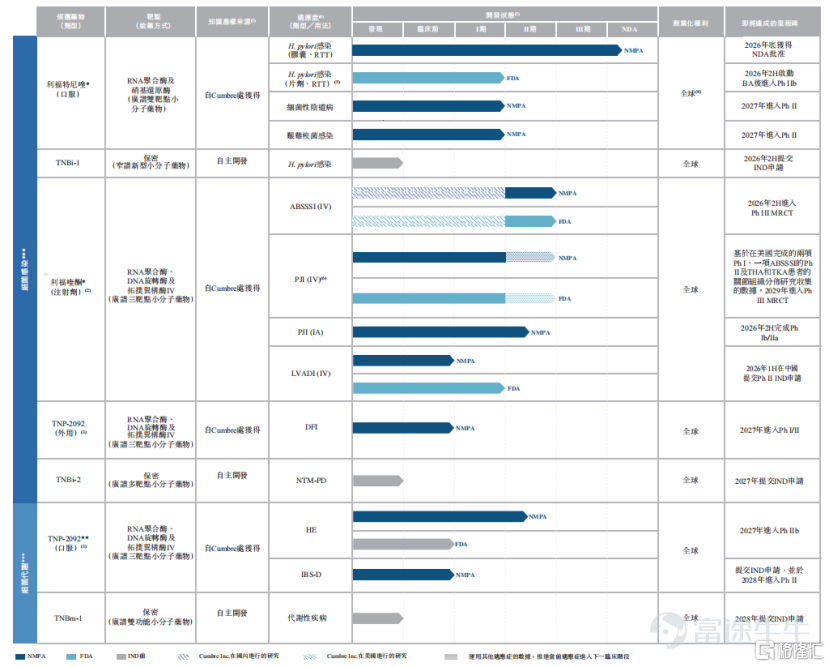
Based on this platform, the company has built a pipeline comprising seven innovative programs. All pipeline products are intended as first-line or initial treatment regimens, with two core candidates already in late-stage development.

Core Product One: Lifutonizole (TNP-2198)—redefining first-line therapy for 600 million infected individuals in China
Helicobacter pylori infection represents a widespread public health challenge in China. According to Frost & Sullivan, the number of infected individuals in China reached 621.1 million in 2024. However, several antibiotics used in the conventional first-line therapy—bismuth quadruple therapy (BQT)—have developed extensive resistance in China, leading to declining eradication rates. Additionally, the complex dosing regimen and high incidence of adverse reactions severely compromise patient adherence.
Lifutonizole, developed by Dano Medical, is a breakthrough investigational drug specifically designed to address these clinical challenges.
Lifutonizole is the world’s first—and as of May 4, 2026, the only—novel molecular entity candidate developed globally for treating Helicobacter pylori infection since the bacterium was discovered in 1982. According to the prospectus, lifutonizole is a novel antibacterial agent that exerts bactericidal activity through a multi-target synergistic mechanism involving inhibition of RNA polymerase and activation via nitroreductase.
In a Phase III clinical trial conducted across 40 clinical centers in China, the triple therapy regimen combining lifutonizole with amoxicillin and a proton pump inhibitor (RTT) achieved an eradication rate exceeding 90% in the modified intent-to-treat (mITT) population—outperforming the bismuth quadruple therapy (BQT) control group (92.0% vs. 87.9%; difference: 4.1%; non-inferiority test p<0.0001; superiority test p=0.034). In patients with multidrug-resistant infections, RTT demonstrated superiority over BQT (89.9% vs. 81.2%; difference: 8.7%; non-inferiority test p<0.0001; superiority test p=0.023). Furthermore, its simpler dosing schedule is expected to significantly improve patient adherence and transform the current landscape of Helicobacter pylori management.
Core Product Two: Rifquinoxone injection (TNP-2092)—the world’s only candidate drug in late-stage clinical development for treating implant-associated bacterial biofilm infections
Dano Medical’s second core product, rifquinoxone injection, is the world’s first novel molecular entity candidate shown in clinical studies—at achievable doses—to be potentially effective against biofilm-associated infections. It is also currently the only candidate globally in late-stage clinical development specifically targeting implant-related bacterial infections.
Rifquinoxone is a stable conjugated drug composed of two pharmacophores: rifamycin and quinoxalinedione. It acts through a triple-target synergistic mechanism—inhibiting RNA polymerase, DNA gyrase, and topoisomerase IV—which not only substantially reduces the risk of bacterial resistance but also enables bactericidal activity against persistent bacteria shielded within biofilms. In a completed U.S. Phase II clinical trial for acute bacterial skin and skin structure infections (ABSSSI), rifquinoxone demonstrated a higher early clinical response rate in the modified intent-to-treat (mITT) population (76.9%) compared to vancomycin, one of the most commonly used antibiotics (67.5%).
Rifamquinone is currently being developed for indications including prosthetic joint infection (PJI), left ventricular assist device infection (LVADI), and central venous catheter-related bloodstream infection (CRBSI). As of May 4, 2026, no innovative antimicrobial agents have been approved globally for the treatment of PJI, LVADI, or CRBSI, and rifamquinone has the potential to offer an important therapeutic option for infections associated with implantable medical devices.
In addition to its two core products, Dano Medical’s pipeline includes TNP-2092 oral formulation (a lead product) for hepatic encephalopathy (HE) and diarrhea-predominant irritable bowel syndrome (IBS-D), a topical TNP-2092 formulation for diabetic foot infection (DFI), and early-stage discovery programs TNBi-1, TNBi-2, and TNBm-1. The TNP-2092 oral formulation has completed four Phase I and II clinical trials in China and has generated proof-of-concept clinical data demonstrating its safety and efficacy in treating hepatic encephalopathy.
II. Commercialization Is Imminent, with a Clear Path Forward
For biotech companies, a clear commercialization pathway is as critical as robust clinical data. Dano Medical has already outlined a well-defined roadmap in this regard.
First, market launch of its core products is now in the final countdown. Lifutonazole was submitted for New Drug Application (NDA) to China’s National Medical Products Administration (NMPA) in August 2025 and has been accepted for review, with approval expected by the end of 2026. Additionally, the company has secured Fast Track designation and Qualified Infectious Disease Product (QIDP) status from the U.S. Food and Drug Administration (FDA) for both lifutonazole and rifamquinone, paving the way for future international expansion.
Second, key commercial partners are already in place. In November 2024, Dano Medical entered into an exclusive commercialization agreement with Grand Life Sciences for lifutonazole in Greater China (excluding Taiwan). Grand Life Sciences possesses a strong marketing network in gastrointestinal health management and will be responsible for market promotion and distribution, paying Dano Medical up to RMB 710 million in sales milestone payments. This lays a solid foundation for rapid post-launch scale-up.
According to the post-hearing prospectus, approximately 71% of the net proceeds from this offering will be allocated to the research and development, regulatory filings, and commercialization of core products. Going forward, the company plans to accelerate product launches, leverage its technology platform to expand its pipeline, pursue external collaborations to in-license assets, and explore global partnership opportunities—aiming to maximize the innovative value of its portfolio in addressing the challenge of antimicrobial resistance.
Conclusion
Against the backdrop of escalating antimicrobial resistance and significant unmet clinical needs, Dano Medical has built a differentiated anti-infective drug pipeline based on its multi-target conjugated molecule technology.
As the company approaches a critical phase of entering the capital markets, enhanced access to funding and resources will further accelerate its R&D and commercialization efforts, potentially delivering clinically valuable therapeutic options for bacterial infections and bacteria-related metabolic disorders, and injecting new momentum into China’s innovative anti-infective drug sector.
Risk Disclaimer: The above content only represents the author's view. It does not represent any position or investment advice of Futu. Futu makes no representation or warranty.Read more
Comments
to post a comment