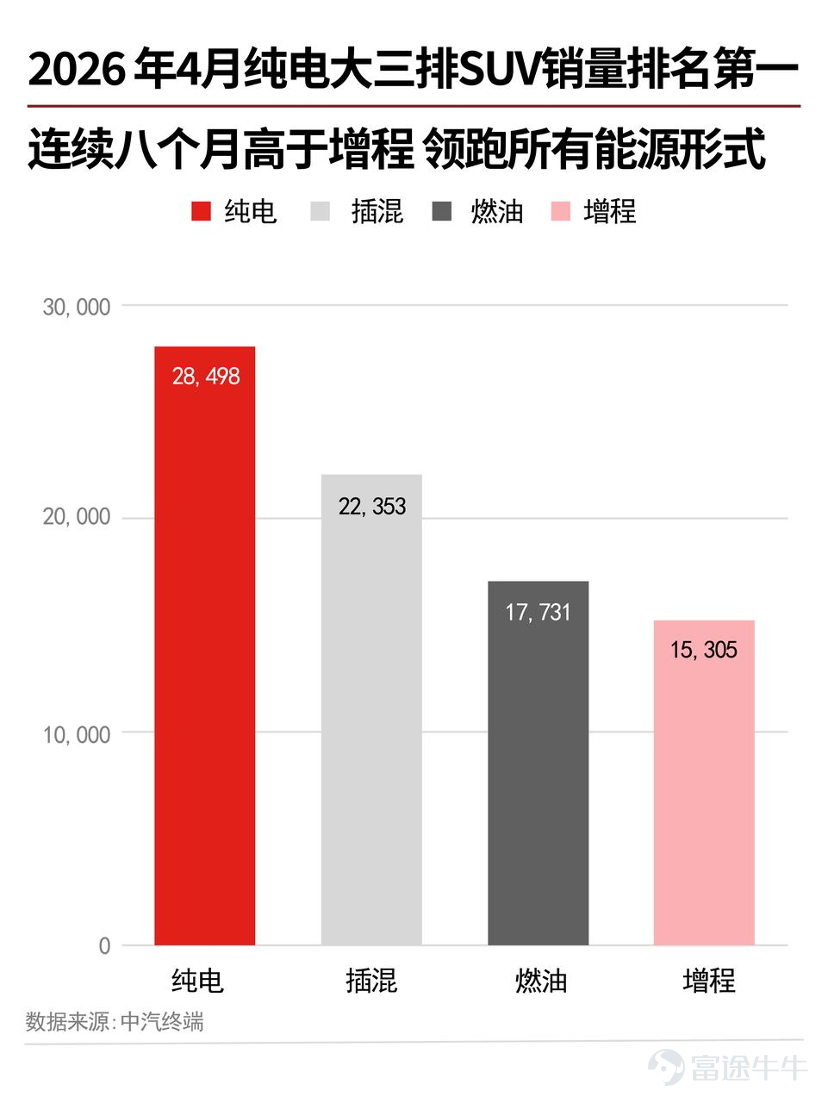

The large SUV market is undergoing a seismic shift: range-extended models are losing steam, while battery-electric vehicles dominate.
The most dangerous moment is often not when no one follows—but when everyone rushes in at once.
China’s auto market in 2026 presents just such a scenario in the large SUV segment. On the surface, this year still appears to be the 'year of range-extended EVs': an increasing number of premium SUVs—often labeled as 'Series 9'—are hitting the market, continuing to bet on 'gas-and-electric' powertrains in hopes of replicating the success formula of recent years.
This excessive concentration on the supply side has also fueled skepticism: do Chinese consumers really need so many five-meter-plus SUVs?
The answer is yes.
Over the past three years, monthly sales of large SUVs have grown from just over 10,000 units to more than 20,000—and this year have already surpassed 50,000. Undoubtedly, large SUVs remain the cherished favorite among Chinese consumers. Cui Dongshu, Secretary-General of the China Passenger Car Association, even stated plainly that three-row large SUVs will 'remain hot in China for another decade.'
However, the underlying driver of this growth wave has fundamentally shifted. According to the latest data from China Automotive Terminal, in April this year, battery-electric models led the three-row large SUV segment with sales of 28,498 units, while range-extended models sold only 15,305 units, slipping to last place.
Large SUVs remain hot sellers, but range extension is no longer the core engine of growth—consumers have quietly changed their answer.
Large SUVs are still a necessity—but the wind is changing.
Li Jun (a pseudonym), who runs two gas stations in a small Tier-4 or Tier-5 city in northern China, has recently gotten a taste of just how attractive large battery-electric SUVs have become.
Li Jun lives in the provincial capital and almost every week has to travel over 230 kilometers back to his hometown to manage his business. He used to drive a gasoline-powered car, burning at least 40 liters of fuel for a round trip—just the fuel cost him nearly 300 yuan. This year, with oil prices surging into the '9-yuan-per-liter era,' his travel costs instantly rose by nearly another 100 yuan. Even though he filled up at his own gas station, the price hike still left him exclaiming it was 'painfully expensive.'
In April this year, Li Jun purchased a large SUV from a new-energy vehicle brand and experienced the joy of saving money—even with a generous buffer factored in, his round-trip electricity consumption for driving the all-electric vehicle was only about 100 kWh. With off-peak home charging priced at RMB 0.3 per kWh, his cost came to RMB 30; even if he charged once en route on the expressway, his total cost would still remain under RMB 100.
Li Jun told Snow Leopard Finance that within city limits, gasoline vehicles consume more fuel while electric vehicles use less electricity, making the price gap even more pronounced.
Li Jun’s story is just a microcosm of Chinese consumers’ collective shift in preference.
One car owner complained on social media that he originally bought a range-extended electric vehicle to 'completely eliminate range anxiety,' but ended up lugging around a heavy, unused internal combustion engine every day across the city, incurring higher electricity consumption and maintenance costs—'the actual pure-electric range is actually quite limited.' Even more absurdly, when his range-extended vehicle ran out of battery, its highway fuel consumption exceeded 10 L/100 km, higher than that of his friend’s decade-old gasoline car.
For Chinese consumers, three-row and large five-seater SUVs remain essential, but they now have a clearer understanding than ever of what they truly want.
According to China Automotive Terminal data, in September 2025, sales of large three-row all-electric SUVs surpassed those of range-extended models for the first time and maintained their lead for the next eight consecutive months, with the gap widening steadily. By March this year, sales of large three-row all-electric SUVs had already reached 2.5 times that of range-extended models, with Nio ES8 and LeDao L90 serving as benchmark models in this segment.

This inflection point arrived even more abruptly than Nio founder, chairman, and CEO William Li had anticipated.
At the Beijing Auto Show in April, a subtle yet unmistakable signal emerged: among the 215 exhibited models, over 70% were new-energy vehicles, and the number of all-electric models (88) exceeded the combined total of plug-in hybrid and range-extended models—shifting away from the 'gasoline-or-electric' market dynamic of the past two years and completely dismantling the stereotype that 'range-extended vehicles better understand Chinese families.'
Underlying this shift is a clear industry signal: an increasing number of automakers believe that the core competitiveness of the new-energy vehicle market will ultimately return to the all-electric platform itself, rather than transitional solutions that offer both gasoline and electric options.
This trend reflects an industry-wide resonance in which nearly all major players are actively participating: from BYD’s Ocean Network, where 80% of new orders are for all-electric models, to Nissan’s NX8, whose all-electric version accounts for 80% of orders, and Li Auto—previously focused on range extension—accelerating its pivot toward all-electric vehicles with the i6 model driving deliveries. The market direction is now unmistakably clear.
Range-extended electric vehicles once defined the first half of China's new energy large vehicle market, but today, the baton of market influence has already been passed: the golden age of range extension is over, and the era of pure electric vehicles has begun.
From a temporary compromise to the ultimate solution
Throughout more than a century of automotive history, adopting an interim, compromise approach to reach a destination—when infrastructure and core technologies were not yet mature—has never been unusual.
At the end of the 18th century, steam-powered cars represented humanity’s first attempt to shift transportation from biological to mechanical propulsion. Several decades later, as internal combustion engine technology matured, steam cars vanished entirely from the historical stage. In the early 20th century, before electronic fuel injection became widespread, carburetors were an indispensable core component of gasoline vehicles. In the 1990s, early hybrid-electric models served as a critical transitional form between conventional internal combustion engine vehicles and pure electric vehicles—but today, they have nearly disappeared from the mainstream market.
Every transitional solution has simultaneously been both an attempt to break through the constraints of its predecessor and a prelude that paves the way for the next era.
In an era marked by range anxiety and soaring lithium prices, range-extended electric vehicles briefly surged in popularity, offering large-vehicle users at the time what seemed like the 'optimal solution'—combining the long-range advantage of gasoline cars with the low operating costs of electric vehicles, all at a lower price point and with greater perceived reliability and peace of mind.
But behind this seemingly perfect 'have-it-all' proposition lie numerous hidden costs that users inevitably pay for during actual use.
Let’s do a simple calculation:
Most mainstream pure electric vehicles require only one charge per week to meet daily commuting needs. Using off-peak residential electricity priced at approximately RMB 0.3 per kWh, the cost per kilometer can be as low as RMB 0.045. In contrast, range-extended vehicles typically offer only 150–200 km of pure electric range, and their range extenders often kick in to burn fuel well before the battery is fully depleted. If fueled by gasoline—at RMB 8 per liter and a consumption rate of 6.8 liters per 100 km—the cost per kilometer rises to about RMB 0.54, which is 12 times higher than that of a pure electric vehicle.
When fuel prices rise, users feel the impact on operating costs acutely. Driving on electricity costs mere cents per kilometer, while driving on gasoline costs dozens of cents per kilometer. Faced with such a stark cost difference, many users end up paying for two heavy powertrain systems and lugging around a bulky engine—effectively 'driving their electric car while sitting next to a gas tank.'
In terms of maintenance, pure electric vehicles feature only one powertrain system, resulting in simpler architecture and lower upkeep costs. Range-extended vehicles, however, carry two powertrain systems, leading to more potential failure points and significantly higher long-term maintenance expenses—leaving many owners who could afford the purchase price struggling with ownership costs, turning their vehicles into a heavy financial burden.
In high-frequency, large three-row family usage scenarios, this 'operational cost equation' significantly impacts users. 'It’s not that range-extended EVs are unaffordable—it’s that battery electric vehicles (BEVs) offer better value,' has become a genuine sentiment among many consumers.
As Cui Dongshu noted, amid widespread cost anxieties, consumer demand is accelerating its shift from internal combustion engine (ICE) vehicles to new energy vehicles (NEVs), making the market’s 'oil-electric divergence' increasingly pronounced.
In terms of user experience, compared with the structural disadvantage of range-extended platforms—where engines encroach on interior space—native BEV architectures leverage lightweighting and integration technologies to effectively address the pain points of spaciousness and comfort in large three-row vehicles, while also significantly expanding cabin cargo capacity.
Take Nio’s all-new ES8 as an example: even with six passengers onboard, its front trunk plus rear cargo area can still accommodate twelve carry-on suitcases, or easily fit a foldable stroller and a camping tent, satisfying users’ full-scenario travel needs.
Moreover, without engine noise and vibration, BEVs deliver a superior user experience. More importantly, thanks to a 900V high-voltage architecture that drastically reduces energy consumption, combined with nationwide coverage of five million public charging points and Nio’s three-minute battery swap network, range anxiety has been nearly eliminated—transforming refueling from a user pain point into a key experiential advantage.
According to the 'McKinsey China Automotive Consumer Insights 2026,' as many as 71% of respondents expressed optimism that public charging infrastructure will match the convenience of traditional gas stations by 2033.
Anlei Wei, McKinsey Global Director and Senior Partner, believes China’s NEV market is crossing a critical infrastructure inflection point. Plug-in hybrids and range-extended models have successfully cultivated a massive user base accustomed to electrified mobility, and as charging anxiety dissipates, these users are rapidly migrating toward pure electric vehicles.
2026: The Inescapable 'Nio Large Vehicle'
In this wave of rising large BEVs, Nio stands out as a highly representative case study.$NIO Inc (NIO.US)$$NIO Inc. USD OV (NIO.SG)$$NIO-SW (09866.HK)$
Over the past few years, while numerous automakers quickly entered the large vehicle segment via range-extended technology, Nio consistently bet on native BEV architecture and continued investing heavily in its battery swap network, battery systems, and premium BEV platform. In a sense, it was waiting for the maturation of infrastructure tailored specifically for large BEVs.
And now, that moment has arrived.
Whether it’s the expansion of charging infrastructure, advancements in battery-electric technology, or shifting consumer attitudes toward premium EVs, all are driving large SUV buyers from 'alleviating range anxiety' to 'pursuing a superior experience.'
The newly launched Nio ES8, which hit the market in September last year, has become the leader among large three-row SUVs: it surpassed 10,000 units in sales within 41 days of deliveries starting, reached 100,000 units in 215 days, and has been the top-selling model for over RMB 400,000 and large SUV segments for five consecutive months. In April—a month of overall market weakness—the ES8 recorded over 13,000 insurance registrations, making it the only large three-row SUV to exceed 10,000 units sold that month.

The reason the new ES8 has maintained strong sales for nine consecutive months without falling into the 'new car effect death valley' is precisely because it meets users’ comprehensive experience expectations across technology, space, intelligence, energy replenishment, and service. During Nio’s Q1 2026 earnings call, Li Bin stated that alongside strong pre-orders for the ES9, ES8 orders in the first 20 days of May reached their highest level since November of last year.
On May 27, the Nio ES9 will launch and begin deliveries. Compared to the new ES8 introduced just over half a year ago, the ES9 takes further strides in technology, interior space, intelligent features, and charging convenience—potentially amplifying the experiential advantages and market momentum of large three-row battery-electric SUVs.
By 2026, competition in the large SUV segment has shifted from comparing specifications to competing on user experience and differentiation. Nio, which already holds nearly 80% of the battery-electric large three-row SUV market with several benchmark models, is now aiming to expand its lead by extending its influence into the larger and more expansive five-seat SUV market.
On May 15, Nio’s ONVO brand launched its five-seat L80 SUV, starting at RMB 156,800 when purchased with Battery-as-a-Service (BaaS). A five-seat version of the ES8 will also debut in July. Nio President Qin Lihong noted that in Q1 this year, the ratio of battery-electric to extended-range models in the large five-seat SUV segment shifted from 1:23 a year earlier to 1:2.2—and by Q3 this year, battery-electric models will outnumber extended-range ones.
At that point, Nio’s three-row lineup—comprising the new ES8, ES9, and ONVO L90—combined with its five-seat offerings—the ONVO L80 and five-seat ES8—will fully cover the price range from RMB 150,000 to RMB 650,000. In 2026, no matter your budget for a large vehicle, Nio will be an unavoidable choice.
In Nio’s view, going fully electric isn’t just an option—it’s the inevitable endgame for the large vehicle market. Li Bin has repeatedly emphasized his market outlook on multiple occasions: by 2030, new energy vehicle penetration in China will exceed 90%, with battery-electric vehicles accounting for over 80% of that share.
The validity of Li Bin’s forecast is already reflected in Nio’s financial performance. On May 21, Nio released its Q1 2026 earnings report, reporting an operating profit of RMB 668 million—marking its second consecutive profitable quarter following Q4 of last year. Total revenue reached RMB 25.53 billion, up 112.2% year-over-year, while gross profit totaled RMB 4.86 billion, a 428.4% increase year-over-year.
It should be noted that the first quarter is widely regarded as the off-season for the auto market, and domestic vehicle sales this year declined by 5.9% year-on-year—a clear testament to the significance of these results.
Over the past eleven years, Nio has remained steadfastly committed to its pure electric vehicle strategy. Even during its most challenging periods, it never wavered in this direction, allowing it to build a comprehensive, systematic capability in R&D, manufacturing, quality control, and service for pure electric vehicles. 'This is the foundation built through our R&D investment of RMB 70 billion,' said Li Bin at the recent Beijing Auto Show. 'Without spending this money and going through three generations of iteration, you simply can’t accumulate capabilities to this level.'
An automaker’s technological pathway has never been about short-term product choices—it’s about long-term capability accumulation.
The value of extended-range electric vehicles lies in helping a large number of consumers make their first transition from internal combustion engine vehicles to new energy vehicles. In contrast, the real competition in pure electric vehicles centers on charging infrastructure, battery technology, electronic/electrical architecture, and the deep engineering expertise built around these capabilities over time.
As the market trend shifts decisively toward pure electric vehicles, Nio’s early investments are now transforming into competitive moats.

From this perspective, the changes unfolding today in the large-vehicle segment represent more than just a shift in powertrain type—they reflect a re-pricing of different technological pathways, driven by mature industrial infrastructure and evolved consumer understanding.
When the inflection point for large pure electric vehicles truly arrives, the resulting market tailwinds won’t be evenly distributed among every opportunist chasing trends; instead, they will favor players who have already built out the necessary infrastructure and technological foundations.
For Nio, the heavy-asset 'burden' carried over the past eleven years is now becoming the key leverage defining the second half of the pure electric era.
Author: Chen Xuning
Risk Disclaimer: The above content only represents the author's view. It does not represent any position or investment advice of Futu. Futu makes no representation or warranty.Read more

Comments
to post a comment
2