

What was your first ETF purchase?

【Quick Start for Beginners】What Should New Investors Buy? Monthly ETF Investments—No More Guessing Market Tops or Bottoms, and Earn Enough for Decades of Coffee? ☕

New investors, do you feel overwhelmed right after opening your account, unsure whether to go big or play it safe and what to buy? With the stock market swinging up and down every day, are you worried about buying right at the peak? In fact, instead of spending time trying to time the market or reading charts, beginners should consider the easiest, hands-off investment strategy—Monthly ETF Investing!
☕ Why invest in ETFs monthly? It can earn you decades’ worth of coffee money!
The biggest advantage of monthly ETF investing is using the 'dollar-cost averaging' strategy to smooth out your entry cost—you buy more shares when prices are low and fewer when prices are high, eliminating the hassle of watching the market daily. Additionally, ETFs hold a basket of stocks, effectively diversifying the risk of any single company blowing up, making them ideal for long-term investors seeking steady growth.
Here’s a down-to-earth example: Suppose you set aside $10,000 in spare cash each month to invest in a well-performing ETF. Over 5 years (60 months), your total principal invested would be $600,000. Assuming a conservative cumulative 5-year return of around 60%—similar to some recent stable ETFs—your profit would be approximately $360,000! What does this $360,000 represent?
👉 Enough for a $40 premium coffee every day for The year 2024!
👉 Or enough to easily cover your household utility bills—including electricity, water, gas, and air conditioning—for the next decade or more!
Harnessing time and discipline to let your wealth snowball—that’s the true appeal of monthly investing.
(💡 Friendly reminder: The above calculation is provided solely as an illustrative example to help readers understand monthly investment strategies. It should not be construed as a forecast of performance, an indication of future results, or a guarantee of returns. Dollar-cost averaging does not eliminate the inherent risks of fund investing. The market involves risk—please invest prudently!)
Given all the advantages of monthly ETF investments, which ETFs currently offer relatively higher returns through monthly contributions? Let’s take a look at the objective data together!
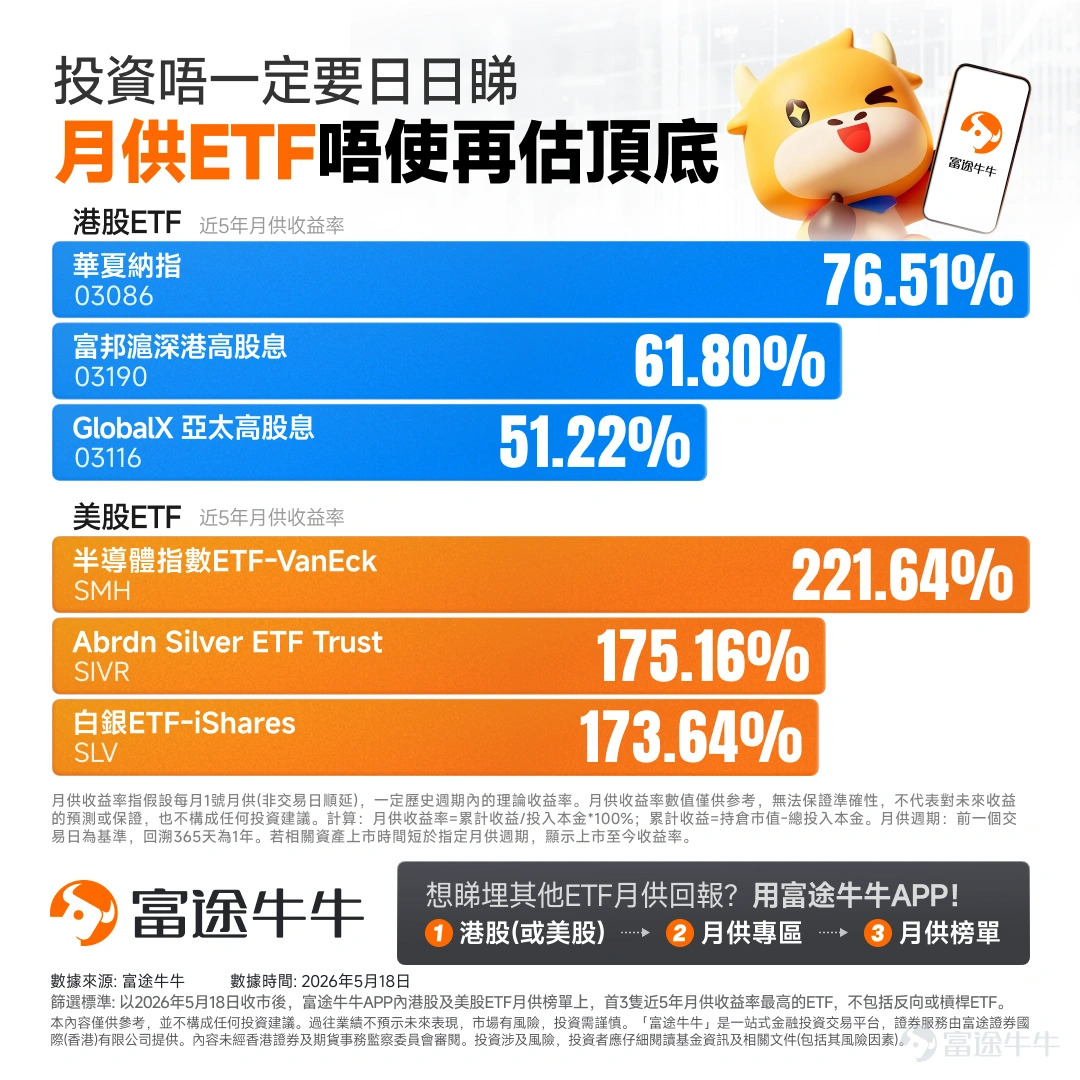
(Note: This ranking is based on objective data and excludes inverse and leveraged ETFs.)
🇭🇰 【Top Hong Kong-listed ETFs by Monthly Investment Returns (Past 5 Years)】
For investors who prefer using Hong Kong dollars directly and want to avoid currency exchange hassles, the Hong Kong market offers several quality options:
Analysis: Although listed in Hong Kong, this ETF tracks the Nasdaq-100 Index. Investing in it gives exposure to leading U.S. tech giants—an ideal choice for investors bullish on global technology trends and seeking to trade during Asian hours.
Analysis: Focuses on high-dividend stocks from both mainland China and Hong Kong markets. During volatile periods, high-dividend assets typically offer stronger downside protection, making them suitable for investors seeking stable cash flow and resilience.
– Analysis: Expands the investment portfolio to high-yield companies across the entire Asia-Pacific region, effectively diversifying the risk of concentrating in a single market (e.g., only Hong Kong or A-shares). A preferred core holding for income-focused investors.
🇺🇸 [Top US-listed ETFs by Monthly SIP Yield Over the Past 5 Years]
The US equity market offers extremely high liquidity. In recent years, certain sectors have delivered outstanding performance, benefiting from the tech and commodities cycles:
Analysis: This ETF pools the world’s leading chip design and manufacturing giants. The global AI boom in recent years has driven explosive demand for semiconductors, making it the top performer among monthly SIP investments.
Analysis: Tracks the price of physical silver. Silver serves dual roles as both a safe-haven precious metal and an industrial commodity (e.g., used in solar panels and new energy vehicles), benefiting from inflation expectations and rising industrial demand.
Analysis: One of the largest silver ETFs by assets under management, with an investment thesis similar to SIVR. A popular tool for investors hedging against inflation and capturing upside in the commodities market.
(💡 Reminder: The above rankings are based on the top 3 non-leveraged, non-inverse US and HK-listed ETFs with the highest 5-year monthly SIP yields as displayed in the Futubull app as of market close on May 18, 2026. Historical performance is for reference only and should not be construed as a guarantee, forecast, or assurance of future returns. Investing involves risks—please proceed with caution!)
Seeing US-listed ETFs delivering returns as high as 100%-200%, are you feeling tempted? But stay calm!Past performance does not guarantee future returns。
The ETFs with astonishing gains on the US stock leaderboard are primarily driven byrecently, specific sectors (such as AI semiconductors and commodities like precious metals) being in a major boom cycle, resulting in exceptionally strong sector performance. These thematic sector ETFs typically exhibit higher volatility:
1. Cyclical risk: Both semiconductors and commodities are highly cyclical; once supply exceeds demand or the hype fades, they could face significant pullbacks.
2. Overvaluation risk: After massive rallies, tech stocks are generally trading at elevated valuations; if earnings reports fall short of expectations, their prices can swing sharply.
We recommend beginners start their regular monthly investments withUse broad-market index ETFs (such as those tracking the S&P 500, Nasdaq-100, or large-cap high-dividend indices) as your core holding, and allocate a small portion of capital to sector ETFs—this way, you can sleep soundly while still capturing upside from sector rallies!
📱 So how do you set up monthly ETF investments on Futubull?
It’s actually very simple—just follow these two steps:
Step 1: Select an ETF using the following feature.
Navigation path:Open Market > ETFs > Major Markets > Choose from various types of ETFs
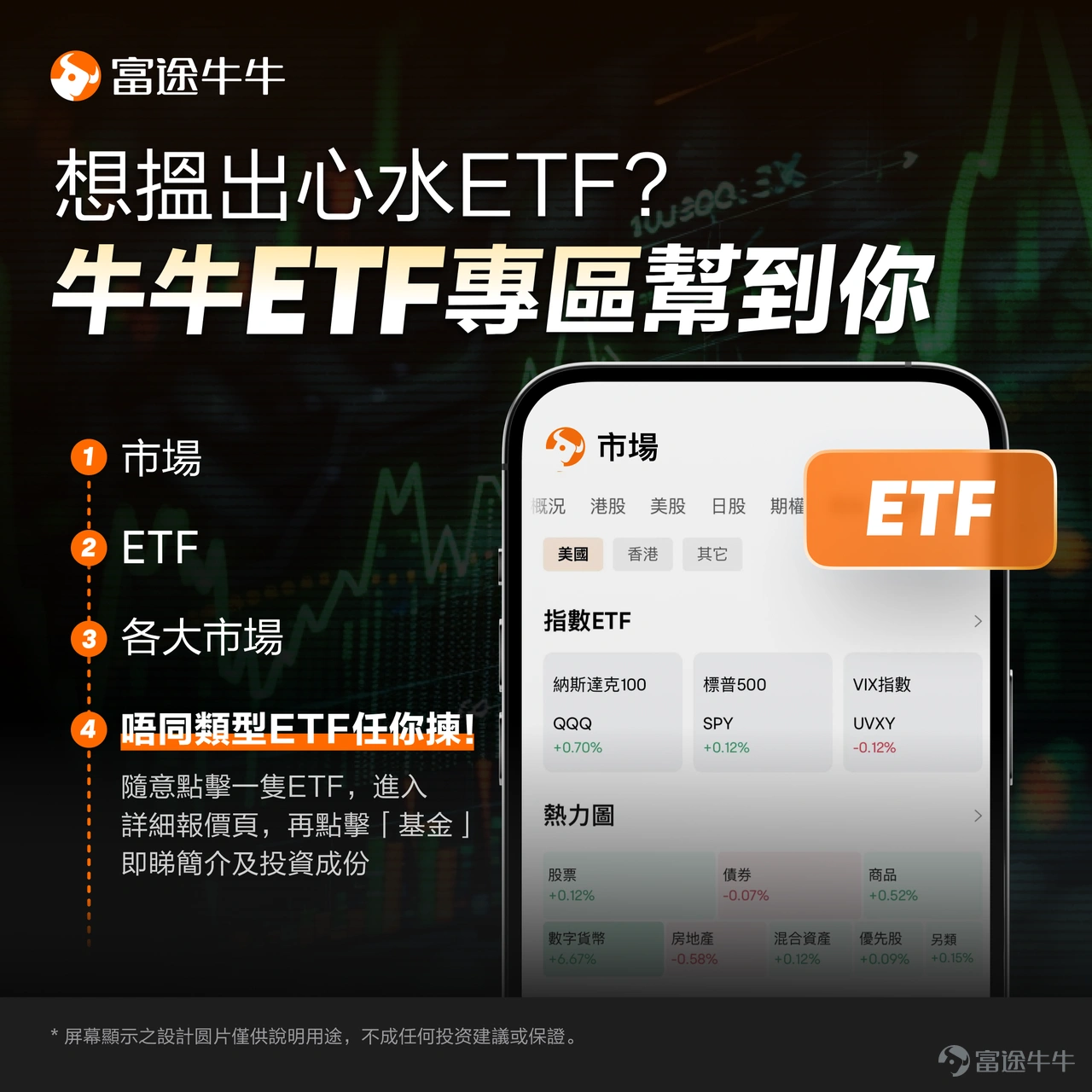
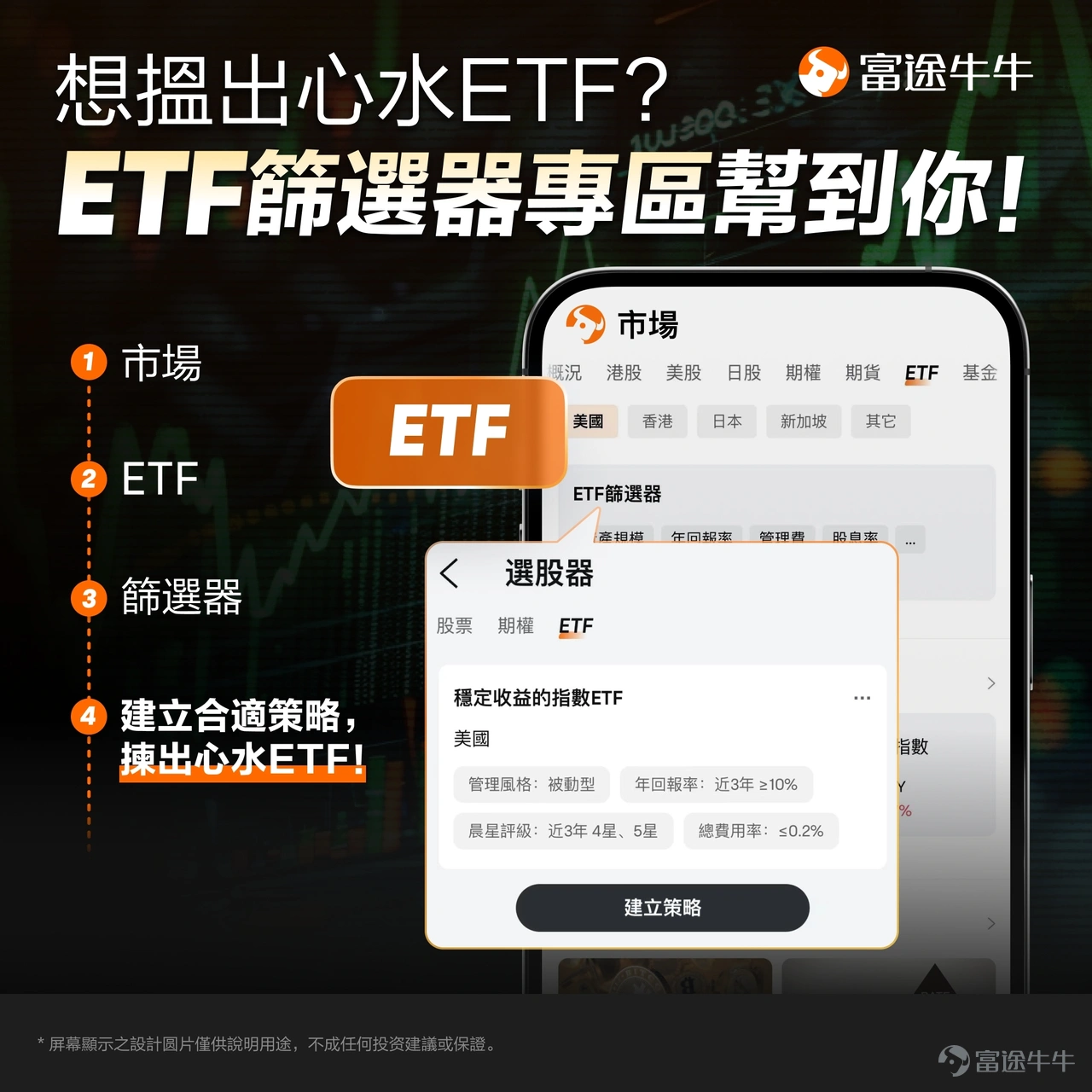
Looking for your ideal ETF? The ETF screener can help!
– Navigation path:Market > ETFs > Screener > Build a suitable strategy and pick your ideal ETF!
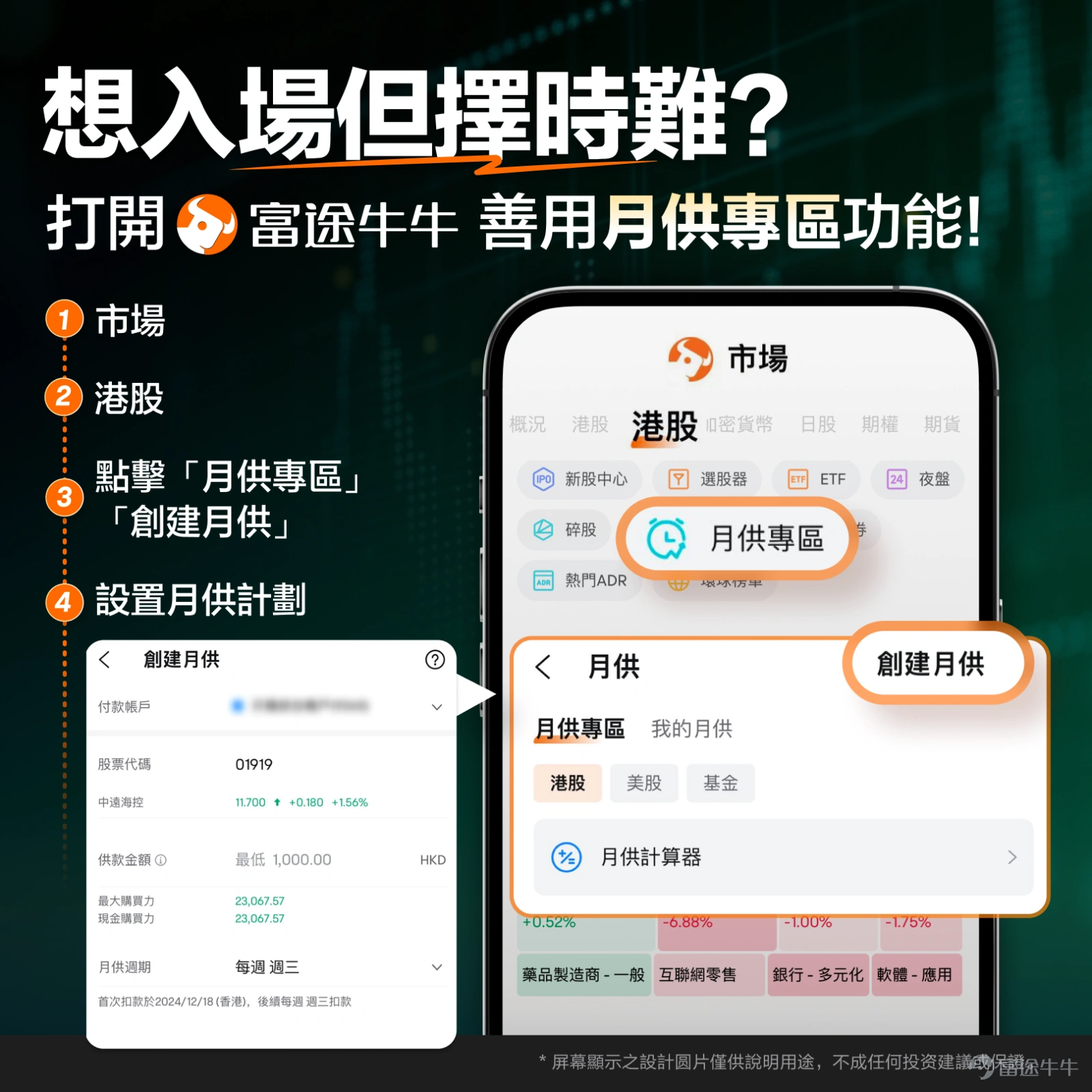
Step two: Set up a recurring investment plan. Once you've selected the ETF you'd like to buy, there are two ways to set up your plan:
1. You can tap the 'three dots' at the bottom of the ETF's detail page and select 'Recurring Investment' to configure it.
2. Alternatively, follow the instructions in the image below to go to the setup page, enter your desired recurring investment amount and frequency (e.g., weekly, monthly, etc.), and finally click 'Confirm Purchase' to successfully activate your recurring investment plan!

Risk Disclaimer: The above content only represents the author's view. It does not represent any position or investment advice of Futu. Futu makes no representation or warranty.Read more


Comments
to post a comment
8
2