
What to Watch in US Stocks | NVIDIA's Annual Shareholder Meeting Is Here—Why Even Beginners Should T

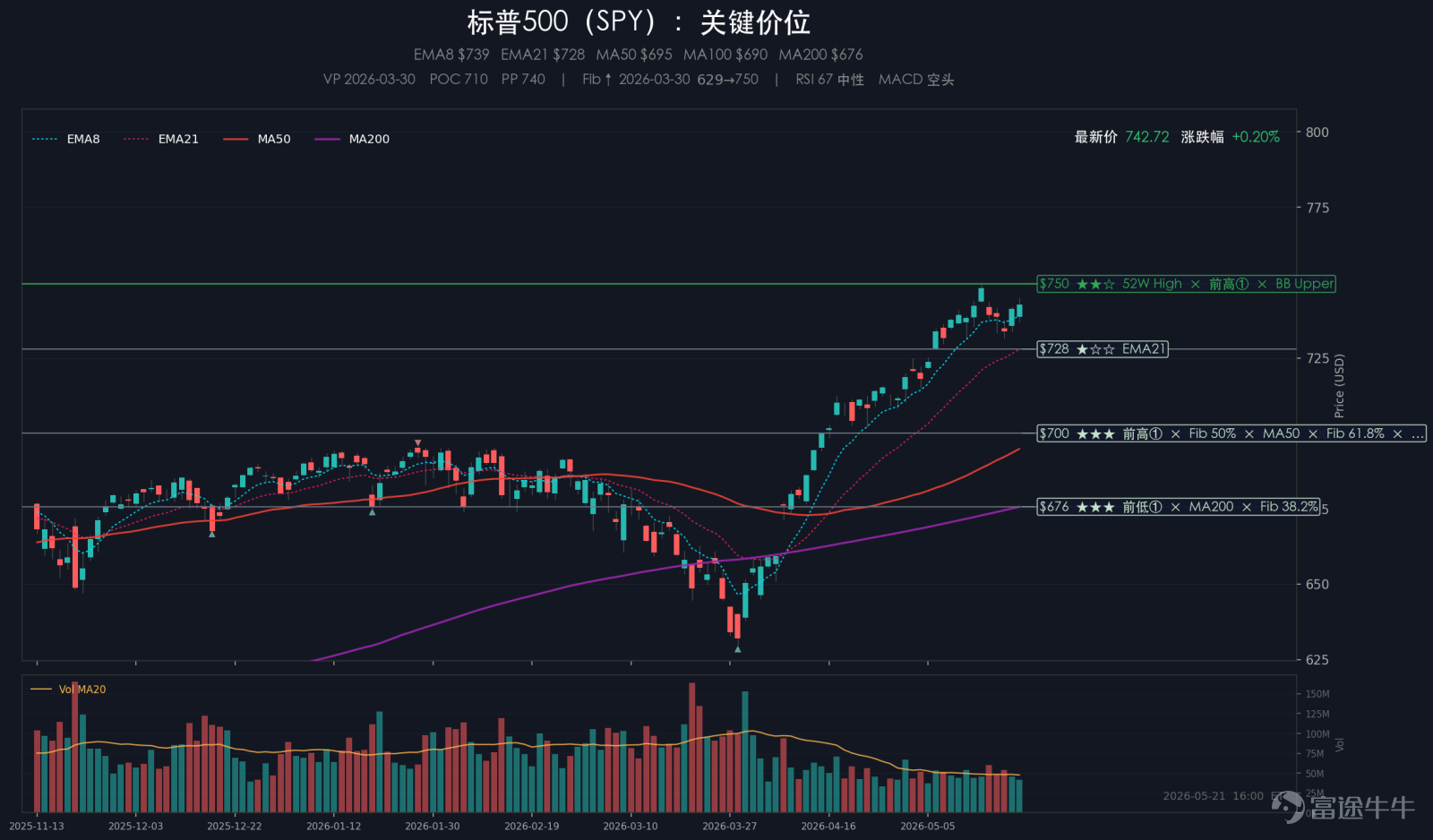
Wall Street Brief (May 22): U.S. equities edged higher on Thursday, with sentiment continuing to recover modestly, though not unilaterally optimistic; market participation tentatively broadened toward small caps and non-mega-cap names, while geopolitical risks remain unresolved.
Summary: U.S. equities edged higher on Thursday, with the S&P 500 up 0.17%, the Nasdaq up 0.09%, the Dow Jones up 0.55%, and the Russell 2000 rising 0.93%. Small-cap stocks significantly outperformed Nasdaq mega-caps, indicating that capital is no longer solely chasing large-cap tech names but is instead broadening out under a mildly risk-on environment. The VIX dropped to 16.76, down 3.90% on the day, reflecting continued moderate sentiment recovery, though index hedges have not been fully unwound. Key drivers of market pricing that day stemmed from unresolved disagreements between the U.S. and Iran over nuclear material handling, as well as the market’s recalibration of growth resilience and potential inflationary pressures following the U.S. manufacturing PMI hitting a four-year high. On a sector basis, utilities outperformed, while energy and consumer staples lagged; within sub-sectors, AI supply chain segments—particularly memory/storage and optical communications/optical modules—stood out. Across major asset classes, the U.S. Dollar Index rose 0.06%, gold fell 0.03%, crude oil declined 1.09%, and Bitcoin gained 0.17%.

I. Major Events
1. U.S.-Iran disagreement over enriched uranium remains unresolved
Iran’s Supreme Leader demanded that near-weapons-grade enriched uranium not be removed from Iran—a direct challenge to a key U.S. requirement in negotiations. Trump subsequently stated the U.S. would ultimately reclaim its uranium stockpile, centering the dispute squarely on the core issue of nuclear material disposition. This development has tempered optimism around U.S.-Iran talks, keeping geopolitical risk premiums elevated.
2. U.S. May manufacturing PMI rises to a four-year high
S&P Global's U.S. Manufacturing PMI rose to 55.3 in May, the highest level since May 2022. The report also noted that part of the growth stemmed from companies building inventory early to guard against war-related shortages and price hikes. This data reinforces the view that the U.S. economy remains resilient, but also reminds markets that improved growth does not equate to vanishing price pressures.
3. Walmart maintains conservative full-year guidance
Walmart reported solid quarterly sales, but the company kept its full-year sales and profit outlook relatively conservative, citing ongoing impacts from fuel costs and inflation on consumers. As a key barometer of U.S. consumer spending, Walmart’s guidance suggests consumer resilience has not disappeared, yet margin pressure and stress on lower-income households remain key areas to watch. This will influence market expectations for earnings in the retail and consumer sectors.
II. Major Trends
At the index level, Thursday’s gains were modest, but the internal structure conveyed more information than the headline moves. The Russell 2000 rose 0.93%, significantly outperforming the S&P 500’s 0.17% and the Nasdaq’s 0.09%. Among index ETFs, small-cap IWM gained 0.94%, while the Nasdaq-100 ETF QQQ advanced 0.19%. This indicates that large-cap tech stocks did not drive the market alone that day; instead, capital cautiously spread toward small caps and non-heavyweight names within manageable risk parameters.
In the short term, the breadth of the rebound has improved. Over a two-week horizon, QQQ rose 2.82%, SPY gained 1.52%, DIA added 1.51%, IWM turned positive from negative territory, and RSP also showed signs of a short-term rebound. Compared to earlier periods when only a few mega-cap stocks provided support, this shift more closely resembles a marginal recovery in risk appetite—though the strength remains far from extreme.
The medium-term structure still hasn’t fully broken away from concentration. Over three months, QQQ climbed 17.51%, SPY rose 8.02%, while RSP gained just 0.73%. Growth-focused SPYG increased by 12.91%, versus value-oriented SPYV up 2.63%. MAGS rose 11.02%, and XMAG advanced 5.08%. In other words, short-term dispersion is occurring, but over the past three months, the dominant framework remains tilted toward growth and mega-cap leadership.
III. Market Sentiment
Market sentiment is generally upbeat, but not unguardedly optimistic. The VIX closed at 16.76, down 3.90% on the day, continuing its decline in volatility—indicating investors have not amplified U.S.-Iran negotiation tensions or oil price disruptions into systemic risks. The CNN Fear & Greed Index stood at 58, down from 60 the previous day, still in the 'greed' zone but slightly cooler, reflecting uneven recovery in risk appetite.
Options market signals better illustrate this divergence. The CBOE total put/call ratio was 0.81, with the index options put/call at 1.03 and the equity options put/call at 0.73. At the stock level, investors remain willing to take on individual stock risk; however, the index put/call ratio staying above 1 suggests portfolio-level hedging remains partially in place. Combined with the falling VIX and a modest dip in the Fear & Greed Index, the current environment appears to reflect selective risk-taking rather than broad-based chasing of rallies.
IV. Market Scan
1. Index ETFs:The key takeaway among index ETFs is the relative outperformance of small caps. Small-cap IWM rose 0.94%, while the Nasdaq-100 ETF QQQ gained 0.19%—consistent with the Russell 2000 leading among the major indices and the Nasdaq posting the smallest gain. Capital is no longer concentrating solely in large-cap tech heavyweights; instead, as volatility recedes, investors are making a modest move back into small caps and broader market segments.

2. Industry sectors:Sector rotation did not show strong one-sided risk appetite. Utilities (XLU) led gains with a 1.10% rise, while energy (XLE) fell 1.12% and consumer staples (XLP) dropped 1.01%. This mix suggests investors are simultaneously participating in the small-cap rebound while maintaining a preference for stable cash-flow sectors; the pullback in energy mirrored the decline in crude oil prices, and the underperformance of consumer staples indicates that even within defensive sectors, strength was not uniform. At the sub-industry level, signs of AI supply chain dispersion became clearer. The optical communications/optical modules watchlist rose an average of 7.12%, and the AI storage watchlist gained 3.77% on average, both showing broad-based advances. This indicates capital is moving beyond just compute chips and drilling into infrastructure layers such as networking and storage. Clean energy segments also saw a rebound, with the solar ETF (TAN) up 3.08% and the clean energy ETF (ICLN) rising 3.07%.
3. Seven major tech companies:The Magnificent Seven tech stocks showed internal divergence. Netflix (NFLX) led with a 1.37% gain, while NVIDIA (NVDA) lagged, dropping 1.77%. NVIDIA’s earnings continued to demonstrate robust demand for AI infrastructure, yet its stock performance indicates the market has entered a more selective phase: strong fundamentals no longer guarantee immediate valuation expansion—investors now require clearer visibility on future profit conversion and room for valuation digestion.
4. Chinese concept stocks:Chinese ADRs were generally weak. Tencent Music (TME) was flat, outperforming the group; Bilibili (BILI) fell 3.93%, JD.com (JD) dropped 3.05%, Baidu (BIDU) declined 2.99%, Alibaba (BABA) slid 2.23%, and NetEase (NTES) decreased 2.12%. Against a backdrop of modest gains in the broader U.S. market, Chinese ADRs failed to participate in the risk-on rebound, reflecting continued investor caution toward this asset class.
5. Cryptocurrencies:Bitcoin rose 0.17%, showing limited overall volatility, but related equities performed stronger. Riot Platforms (RIOT) climbed 3.38%, Circle (CRCL) gained 2.92%, while Strategy (MSTR) dipped 0.58%. This suggests capital within the crypto ecosystem is not merely tracking Bitcoin’s price but is instead favoring names with higher trading elasticity or stronger policy-related narratives.
$S&P 500 Index (.SPX.US)$ $SPDR S&P 500 ETF (SPY.US)$ $NASDAQ 100 Index (.NDX.US)$ $Invesco QQQ Trust (QQQ.US)$ $Dow Jones Industrial Average (.DJI.US)$ $State Street® SPDR® Dow Jones Industrial Average® ETF Trust (DIA.US)$ $Russell 2000 Index (.RUT.US)$ $iShares Russell 2000 ETF (IWM.US)$ $Roundhill Magnificent Seven ETF (MAGS.US)$ $USD (USDindex.FX)$ $U.S. 10-Year Treasury Notes Yield (US10Y.BD)$ $iShares 20+ Year Treasury Bond ETF (TLT.US)$ $XAU/USD (XAUUSD.CFD)$ $SPDR Gold ETF (GLD.US)$ $CBOE Volatility S&P 500 Index (.VIX.US)$ $CME-Bitcoin RR Futures (JUL6) (BTCmain.US)$ $iShares Ethereum Trust ETF (ETHA.US)$ $NVIDIA (NVDA.US)$ $Tesla (TSLA.US)$ $Meta Platforms (META.US)$ $Amazon (AMZN.US)$ $Alphabet-C (GOOG.US)$ $Microsoft (MSFT.US)$ $Apple (AAPL.US)$
Risk Disclaimer: The above content only represents the author's view. It does not represent any position or investment advice of Futu. Futu makes no representation or warranty.Read more


Comments
to post a comment
5
2