
Hong Kong Market Barometer: CPO, PCB, and memory stocks rally in rotation! Are you on the right trai

MINIMAX-W pulled back from its intraday high and closed near the low; HK$660 has become a critical short-term support level. A confirmed rebound will not be established until the stock retakes HK$711.
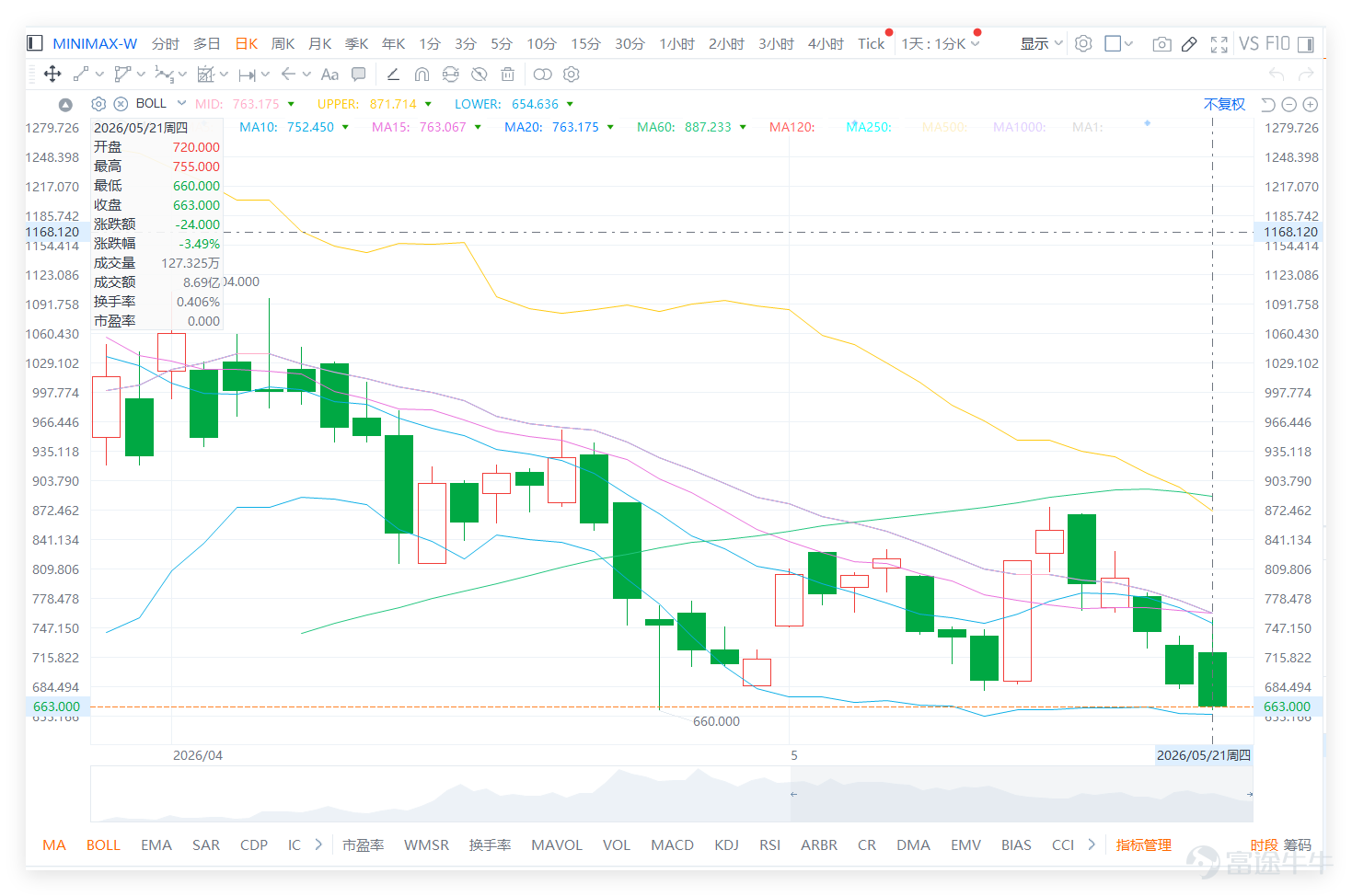
On the previous trading day (21st), the stock closed at HK$663.000, down HK$24.000, representing a single-day decline of 3.49%. On the surface, the share price showed a rebound, but what truly warrants attention is not the gain itself, but the intraday price structure. The stock reached an intraday high of HK$755.000 and a low of HK$660.000, yet closed at HK$663.000—near the session’s low. This indicates that the early or intraday rebound failed to hold, and selling pressure from above remains evident. For short-term retail investors, this kind of price action—where gains occur during the day but the close settles near the low—is often more concerning than a straightforward decline, as it signals that while a rebound opportunity emerged, buying support was insufficient, ultimately causing the price to be pushed back down by persistent selling pressure.

Technically, MINIMAX-W is currently trading at HK$663.000, still below the 10-day moving average (MA) at HK$752.450, the 20-day MA at HK$763.175, and the 30-day MA at HK$817.183. All three key short-term moving averages sit above the current price, reflecting that the recent move remains a weak rebound rather than a genuine shift to strength. Even though the stock briefly reached HK$755.000—nearing the 10-day MA around HK$752.450—it failed to sustain those levels, confirming significant resistance in the short-term MA zone. This aligns with sentiment observed in user comments: while many investors still hope for a rebound, more are focused on whether the HK$660 level will hold, whether the price can break above HK$680, and if a breakdown occurs, whether it might test HK$620 or even lower levels.
Regarding Bollinger Bands, the middle band is at HK$763.175, the upper band at HK$871.714, and the lower band at HK$654.636. The stock closed at HK$663.000, already near the lower Bollinger Band at HK$654.636, indicating a relatively oversold short-term position and proximity to a technically weak extreme zone. This situation has two implications: on one hand, blindly shorting near the lower band is unwise, as a technical rebound could occur at any time; on the other hand, proximity to the lower band does not guarantee a bottom—especially given the prior day’s rebound occurred on shrinking volume and closed near the low, with no clear signs yet of renewed strength. Therefore, the key focus at this stage is not speculating whether the stock will immediately reclaim HK$800, but rather confirming whether the HK$660.000 and HK$654.636 levels can hold firm.
The Relative Strength Index (RSI) stands at approximately 29.783, approaching oversold territory, which reflects persistently weak momentum. This indicates the stock has fallen to a relatively weak level, yet buyers have not yet clearly regained control of market rhythm. Typically, if the RSI is low and the stock manages to rally on higher volume and close near its session high, the odds of a short-term bullish reversal increase significantly. However, the opposite occurred: volume contracted, and the stock closed near the low, signaling inadequate rebound strength. Thus, while aggressive shorting at these levels is unwarranted, it is also too early to confidently initiate long positions.
From key comments, the market’s primary focus is whether support around HK$660 can hold. Some investors explicitly stated, 'HK$660 must hold,' while others noted that a breakdown could target HK$620 next. Meanwhile, bullish participants view the HK$600–HK$680 range as a support zone, suggesting staged accumulation below HK$680. Some even indicated they would consider entering if HK$660 reappears—but only with clear entry signals. This reflects a market sentiment that, while leaning bearish, is not uniformly pessimistic; instead, significant divergence has formed around HK$660. In other words, HK$660 is not just a technical low but also a psychological 'make-or-break' level for retail investors in the short term.
The core of bullish comments is the belief that the stock price has already fallen into a relatively low zone, making it suitable to wait for a rebound or accumulate in stages. Some investors mentioned support between HK$600 and HK$680, others hope the price returns to HK$800–HK$900, and some even expect further upside tomorrow, with targets ranging from HK$687 to HK$777. These comments reflect that some investors still view the current price range as an attractive level for buying on dips—especially as the price approaches the lower Bollinger Band, which technically supports the possibility of a rebound. However, this bullish rationale requires specific conditions to hold true; it cannot rely solely on the notion that the price is 'low.' The most basic prerequisites are holding above HK$660.000 and HK$654.636, followed by a clear break above the HK$711 area, before we can say the short-term rebound structure has started to improve.
Bearish comments predominantly focus on continuation of weakness, unreliability of the rebound, and potential further downside after breaching support levels. Some investors argue that HK$660 must hold, and if broken, the next target would be HK$620; others believe the stock cannot even reach HK$680, with some citing even lower targets. While these remarks sound pessimistic, they correlate with the current technical structure: the stock remains below the 10-, 20-, and 30-day moving averages, and the prior session’s failure to sustain gains after rallying to HK$755.000 undermines confidence in the rebound. As long as the price stays below the pivotal level of HK$711, bears and观望 (wait-and-see) participants retain strong justification for their stance.
Comments reflecting uncertainty and emotional distress highlight significant pressure among holders. Many investors express frustration, regret, heartbreak, desires to exit at breakeven, inquiries about whether to sell holdings, concerns over a potential break below HK$660, and worries about having bought near the top. Such sentiment underscores persistently weak market confidence—even the day’s price increase was insufficient to alleviate holder anxiety. The reason is clear: although the stock surged to HK$755.000 during the session, it closed at just HK$663.000, leaving those who bought at higher levels feeling increasingly uneasy as the rebound fizzled out. When the market broadly views rebounds as potential bull traps rather than genuine recoveries, clearer technical confirmation of strength is needed before sentiment can improve.
There are three common questions.
First, whether the HK$660 level can hold. From a technical analysis perspective, HK$660.000 was yesterday’s low and is also close to the lower Bollinger Band at HK$654.636, making it the most critical short-term support zone. If prices stabilize around this area, there remains potential for a technical rebound from current lows; however, if the HK$654.636 level is breached, weakness could persist, and attention should turn to support near HK$627.
Second, whether it’s suitable to enter the market at current prices. The current price is near the lower Bollinger Band, so blindly shorting is inadvisable. However, given the rebound occurred on shrinking volume, the closing price was near the day's low, and key moving averages remain above, the risk-reward ratio is only modestly neutral to slightly unfavorable. A more prudent approach would be to wait for confirmation signals rather than entering solely based on low prices.
Third, whether the stock can return to HK$800 or higher. Before discussing a move toward HK$800 in the short term, the price must first reclaim the HK$711 level, then challenge the resistance zone between HK$752.450 and HK$763.175. Only after overcoming these levels would a move higher become plausible. Until these key resistances are retaken, targeting HK$800 directly remains premature.
In terms of short-term positioning, the most critical levels to watch for MINIMAX-W are HK$660.000 and HK$654.636. If the price holds this zone and then breaks back above HK$711, a higher-quality technical rebound could develop, with the next resistance zone between HK$752.450 and HK$763.175. This area also aligns closely with the 10-day and 20-day moving averages, making it a key region to assess whether the rebound can shift from weak to strong. If the price merely bounces slightly off the lows but fails to surpass HK$711, it should still be viewed as a weak corrective rally, and holders should avoid excessive optimism.
Conversely, if the price breaks below HK$654.636—the lower Bollinger Band—downward momentum could extend further, with next support to watch near HK$627. Although the Relative Strength Index (RSI) is already at a low level, a breakdown does not necessarily imply risk-free shorting opportunities. However, for existing long positions, such a move would signal increased risk. Especially since the price already pulled back from recent highs yesterday, a subsequent break below the lower band would reinforce market perceptions of a 'failed rebound,' potentially worsening sentiment further.
Overall, MINIMAX-W’s issue isn’t a lack of rebounds, but rather the poor quality of those rebounds. The stock rose 3.49%, yet closed at HK$663.000 after retreating from a high of HK$755.000, accompanied by declining volume—indicating insufficient buying support during the bounce. In comments, bulls still anticipate establishing positions at lower levels and pushing back above HK$800, bears closely monitor whether the HK$660 support holds, and those on the sidelines show clear signs of emotional pressure. Technically, HK$660.000 and HK$654.636 serve as key short-term defense lines, while HK$711 marks the pivotal level for any meaningful rebound. Until the price reclaims HK$711, the move remains a weak corrective bounce; if HK$654.636 is lost, focus shifts to support near HK$627. At this stage, the risk-reward ratio is modestly neutral to slightly unfavorable, so the strategy should prioritize waiting for confirmed support holds and breakout signals rather than hastily trying to pick a bottom or chase rallies.
Reply to some investors' views:
@地表最強男人HK$660 is indeed a crucial short-term level, but a clear entry signal has yet to emerge. A more reliable confirmation would occur only if prices hold above HK$660 and subsequently break above the HK$711 level, which would carry stronger conviction than merely relying on low-level support.
@莎士比亚妞There is hope for a rebound, but strength has not yet been confirmed. Today saw gains, but the close was near the session low, and the rebound occurred on reduced volume—so for now, it can only be viewed as a weak technical pullback within a downtrend.
@17270841If the price can hold above both HK$660 and HK$654.636, a rebound attempt is certainly possible. However, until it breaks above HK$711, it cannot be considered a genuine breakout above resistance.
For more market analysis, stay tuned to Jenny's daily updates on 'Hong Kong Stock Warrants'!
Reminder: This article does not constitute any investment advice.
This article is for reference only and does not constitute any investment advice. Market data, opinions, and analysis contained herein may change at any time without prior notice. We are not responsible for any loss or damage caused by reliance on the information in this article. Technical analysis only shows whether certain technical conditions are met; asset performance should be comprehensively evaluated using other sources of information, and trading decisions should not be made solely based on this article. Please note that past performance is not indicative of future results.
#HKStocks #MINIMAX-W #LiveAnalysis #WarrantPick #WarrantGuide #DerivativesHedging #HKWarrantJenny #BlueChipStocks #TechnicalAnalysis
Risk Disclaimer: The above content only represents the author's view. It does not represent any position or investment advice of Futu. Futu makes no representation or warranty.Read more

Comments (2)
to post a comment
2
1