
NVIDIA's earnings report is out! Can it reignite the AI rally?

Options Sir Breaks Down the Hot Topic | NVIDIA’s Q1 Earnings Beat Expectations: From Blackwell to Rubin, How Will the Long-Term AI Narrative Materialize?
Amid the AI boom, NVIDIA has once again delivered an impressive earnings report. After U.S. market hours on May 20, 2026, $NVIDIA (NVDA.US)$ the company released its Q1 fiscal year 2027 results (corresponding to calendar Q1 2026): revenue reached a record $81.6 billion, up 85% year-over-year and exceeding the market expectation of $79.1 billion; adjusted earnings per share came in at $1.87, also above analyst forecasts. The Data Center segment, as the absolute core business, contributed $75.2 billion in revenue, a 92% year-over-year increase, serving as the strongest validation of robust demand for AI computing power.
Despite beating expectations across the board, the company's stock declined in after-hours trading, reflecting elevated market expectations for the AI leader.NVIDIA’s Q2 revenue guidance midpoint stands at $91 billion, above the analyst consensus but below some optimistic projections of $96 billion.
From the strong ramp-up of its Blackwell architecture to the imminent mass production of the Vera Rubin platform, NVIDIA is driving the long-term AI narrative from concept toward scalable implementation through rapid product iteration and full-stack integration.
I. Key Financial Highlights: Broadly Beat Expectations, AI Computing Power as the Core Engine, Profitability Stands Out
– Total revenue of $81.6 billion, up 85% year-over-year and 20% quarter-over-quarter, surpassing market expectations by 3.7%;
– Adjusted earnings per share of $1.87, above market expectations, with gross margin holding steady at the historically high level of 75%, demonstrating continued profitability improvement;
– Non-GAAP gross margin was 75.0%, higher than the market expectation of 74.5%, underscoring NVIDIA’s pricing power in the AI chip market.
The Data Center segment, benefiting from surging AI demand, accounted for over 90% of total revenue.As the core driver of NVIDIA's growth, its Data Center segment generated $75.2 billion in revenue this quarter, up 92% year-over-year and 21% quarter-over-quarter, accounting for 92% of total revenue—a direct reflection of surging demand for AI computing power. Growth was primarily fueled by GPUs based on the Blackwell architecture (GB200/GB300), with particularly strong demand for the GB300 and NVL7. Leading model developers and hyperscale cloud providers have already deployed hundreds of thousands of these chips, marking the fastest product ramp-up in NVIDIA’s history.
NVIDIA is boosting shareholder returns, announcing an $80 billion share buyback program and a dividend increase, underscoring its long-term confidence.The earnings report shows NVIDIA returned approximately $20 billion to shareholders this quarter through buybacks and dividends. It also announced a new $80 billion stock repurchase authorization and raised its quarterly dividend significantly from $0.01 to $0.25 per share—continuing to reward shareholders while signaling strong conviction in AI's long-term growth trajectory.
Its Q2 guidance midpoint stands at $91 billion—above the consensus estimate but below the most optimistic market expectations.NVIDIA provided Q2 revenue guidance for fiscal year 2027 with a midpoint of $91 billion, which exceeds analysts’ average forecast but falls short of the market’s most bullish expectation of $96 billion.
This guidance became the primary reason for the stock’s after-hours decline:Market expectations for NVIDIA have evolved—from merely 'meeting estimates' to consistently 'outperforming by a wide margin.' As a result, routine positive news is no longer sufficient to drive significant share price gains.
The transition to a new financial reporting framework may also be contributing to post-earnings stock volatility.NVIDIA disclosed it is transitioning to a new financial reporting framework, establishing two major market platforms: Data Center and Edge Computing. Within Data Center, it will separately report Hyperscale and ACIE markets (encompassing AI cloud, industrial applications, and enterprise solutions). The Edge Computing platform will focus on a range of data processing devices designed to support Agentic AI and embodied AI. This new framework affects investors’ ability to conduct comparable analyses across business segments.
II. Earnings Highlights: Rubin to Enter Mass Production in Q3, Major CPU Investment Boost, China Market Excluded from Guidance
1. From Blackwell to Rubin: Product Iteration Solidifies the Foundation of NVIDIA’s Long-Term AI Narrative
NVIDIA’s core competitive advantage in its AI narrative lies in its continuously evolving computing architecture and full-stack technology strategy. The Blackwell architecture is currently at the peak of its revenue realization phase,This quarter, Blackwell GPU shipments have continued to surge, driving data center revenue to double year-over-year, validating the robustness and sustainability of AI computing demand.
NVIDIA previously outlined a vision that cumulative revenue from the Blackwell platform and its successor, Rubin, could reach the trillion-dollar scale between 2025 and 2027—a forecast supported by the current execution pace.
The market has already priced in Blackwell’s ramp-up, and investors are now focused on whether the next-generation platform will be strong enough to sustain momentum.This is precisely why the Vera Rubin platform has drawn significant attention. On May 11, reports indicated that NVIDIA had finalized mass production plans for Vera Rubin with its ODM partners,It is planned to enter the trial production phase in June and begin shipping to major North American cloud service providers starting in July.The list of first batch customers includes Microsoft, Google, Amazon, Meta, and Oracle.
During the earnings call, Jensen Huang announced that volume shipments of Vera Rubin will commence in Q3 this year, a timeline accelerated relative to earlier plans, reflecting the company’s execution strength in process technology, design, and supply chain management.
The Vera Rubin platform includes the Rubin GPU, Vera CPU, BlueField-4 DPU, and next-generation NVLink and networking components. Designed as an end-to-end system optimized for Agentic AI inference workloads, it integrates seven specialized chips,enabling Vera Rubin to achieve up to 35 times the inference throughput of Blackwell.The significance of this platform lies in its marking NVIDIA's strategic shift from 'selling chips' to 'selling complete AI supercomputers/factories,' further locking in customers' long-term capital expenditures (CapEx).
CEO Jensen Huang stated on the earnings call that Vera Rubin is expected to remain supply-constrained throughout its entire lifecycle.
2. Major Push into CPUs: Unlocking a $200 Billion New Market
The most significant new information from this earnings call was NVIDIA’s official announcement that it is aggressively expanding into the CPU market.Management indicated that agentic AI and reinforcement learning present entirely new growth opportunities for CPUs. Building on the success of its Grace CPU, NVIDIA’s Vera CPU is well-positioned to capitalize on this trend. Vera is built on custom Arm cores and co-designed end-to-end with Rubin GPUs and NVLink, delivering up to 1.5x higher single-core performance, 2x better performance per watt, and 4x greater rack density compared to x86-based solutions.
Management expects CPU-related revenue to reach $20 billion this year.This opens up a new ~$200 billion market that NVIDIA had not previously deeply penetrated, and major hyperscalers and system vendors are already collaborating with NVIDIA to deploy Vera CPUs.
This strategy reflects NVIDIA’s ambition to comprehensively cover the entire AI infrastructure stack—GPUs excel at parallel computing, while CPUs handle sequential and complex logic tasks; together, they will better support future multimodal, long-context, and agent-based AI workloads.
3. China Market: Excluded from Guidance, but Still Holds Potential
NVIDIA’s earnings guidance explicitly excluded any China data center compute revenue from its Q2 outlook. Management noted that although the U.S. government has approved export licenses for H200 shipments to Chinese customers, no related revenue has been recognized yet, and uncertainty remains regarding whether these products will ultimately be allowed into China.
Management’s current conservative assumption of zero contribution from the Chinese market actually leaves room for future upside surprises, helping to reduce the risk of missing guidance.This also lends more credibility to the Q2 guidance of $91 billion, indicating sufficiently strong data center demand outside China.
As the world's second-largest AI market, China's latent demand remains a key variable in the long-term narrative. Any marginal improvement in China-related business could provide additional upside potential.
III. Options Strategy Reference:
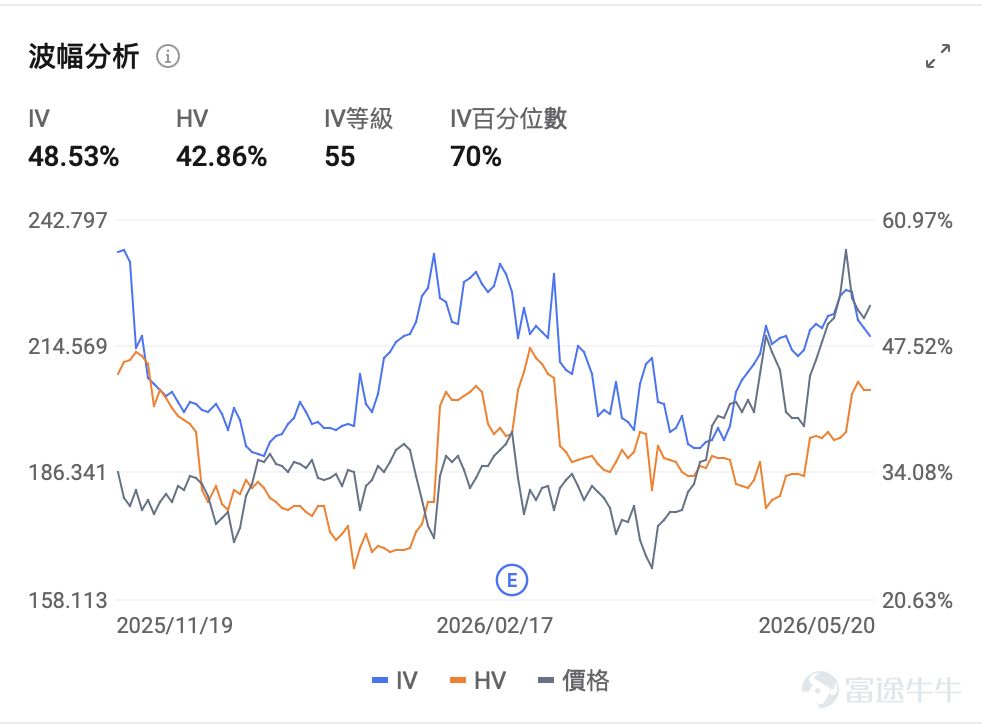
For investors, NVIDIA often faces an IV crush after earnings announcements. Implied volatility (IV) has already retreated somewhat from the peak seen a week before earnings but remains moderately elevated. As the uncertainty resolves, options premiums may quickly evaporate.

1. Short-term trading: Buy calls / Construct a bull call spread
Investors betting on a post-earnings dip followed by a rebound can buy call options after the IV crush. Caution is advised against purchasing short-dated out-of-the-money calls and overexposing positions, as IV crush combined with time decay could rapidly erode option value.

(The design images displayed on screen are for illustrative purposes only and do not constitute any investment advice or guarantee; market conditions change frequently, and the prices shown do not reflect actual market values.)
Investors bullish on NVIDIA’s post-earnings price appreciation but seeking to control costs may consider constructing a bull call spread to cap both potential gains and risk.

(The design images displayed on screen are for illustrative purposes only and do not constitute any investment advice or guarantee; market conditions change frequently, and the prices shown do not reflect actual market values.)
3. Existing positions: Sell covered calls / Buy protective puts / Implement a collar strategy
Investors holding NVIDIA shares can sell covered calls ahead of further IV decline or increased post-earnings volatility to enhance returns. If the stock rises to the call strike price, shares can be sold to lock in gains; if the stock trades sideways or declines, the premium collected helps offset downside risk.

(The design images displayed on screen are for illustrative purposes only and do not constitute any investment advice or guarantee; market conditions change frequently, and the prices shown do not reflect actual market values.)
Investors concerned about NVIDIA’s share price declining further after earnings may consider buying protective put options to hedge against downside risk.

(The design images displayed on screen are for illustrative purposes only and do not constitute any investment advice or guarantee; market conditions change frequently, and the prices shown do not reflect actual market values.)
They could also implement a collar strategy to balance potential returns and risk—holding the underlying stock while buying a put and selling a call, using the premium received from the sold call to offset part of the cost of the purchased put.

(The design images displayed on screen are for illustrative purposes only and do not constitute any investment advice or guarantee; market conditions change frequently, and the prices shown do not reflect actual market values.)
4. Long-term positioning: Cash-secured put selling
For investors bullish on the long-term AI trend but wary of short-term pullbacks and seeking to enter at lower prices, selling put options is an option: if the stock price falls, they acquire shares at their desired price; if it rises, they keep the premium—aligning well with a long-term bullish outlook.

(The design images displayed on screen are for illustrative purposes only and do not constitute any investment advice or guarantee; market conditions change frequently, and the prices shown do not reflect actual market values.)
Summary:
NVIDIA’s Q1 earnings once again confirmed that AI computing demand is not a short-term bubble but a long-term trend. From Blackwell’s strong execution to the imminent rollout of Vera Rubin, NVIDIA has built a technological 'moat' in AI computing through continuous innovation. Its $80 billion share buyback and increased dividend further underscore its long-term confidence.
In the near term, heightened market expectations have amplified share price volatility. Investors should not dismiss NVIDIA’s long-term value due to short-term price swings, and instead focus onRubin’s production ramp-up timeline, marginal shifts in China-related policies, and scaling of CPU businessThese three core signals offer a strategic guide to capturing long-term investment opportunities along the AI computing theme.
 Fellow investors, NVIDIA's revenue and data center business both exceeded expectations this quarter—how will you position your NVIDIA stock?
Finally, Option Sir brings a small perk for fellow investors, welcome to claim it.Options Beginner Pack
*This event is exclusive to invited HK users. Click to learn more.Detailed event rules>>
Market conditions are complex and volatile,Options StrategyOverwhelmed by choices? Futubull helps you build a portfolio in three steps.Options Strategymaking investing simple and efficient!

Option Risk Warning:An option is a contract that grants the holder the right, but not the obligation, to buy or sell an asset at a fixed price on a specific date or at any time before that date. The price of an option is influenced by various factors, including the current price of the underlying asset, the strike price, time to expiration, and implied volatility. Implied volatility reflects the market’s expectations for the level of volatility in the option over a future period. It is a data point derived inversely from the Black-Scholes option pricing model and is generally regarded as an indicator of market sentiment. When investors anticipate greater volatility, they may be more willing to pay a higher price for options to hedge risks, resulting in higher implied volatility. Traders and investors use implied volatility to assess the attractiveness of option prices, identify potential mispricings, and manage risk exposure.
Disclaimer:This content does not constitute any offer, solicitation, recommendation, opinion, or guarantee of any securities, financial products, or tools. The risk of loss in trading options can be substantial. In some cases, losses may exceed the initial margin deposited. Even if you set contingent orders such as 'stop-loss' or 'limit' orders, these may not prevent losses. Market conditions may make such orders unexecutable. You may be required to deposit additional margin within a short period. If you fail to provide the required amount within the specified time, your open positions may be liquidated. However, you will still be responsible for any shortfall in your account. Therefore, before trading, you should study and understand options and carefully consider whether such trading is suitable for you based on your financial situation and investment objectives. If you trade options, you should be familiar with the procedures for exercising options and the rights and obligations upon exercise and expiration. Options trading carries extremely high risks and is not suitable for all investors. Investors should carefully readCharacteristics and Risks of Standardized Options。
Editor/Doris
Risk Disclaimer: The above content only represents the author's view. It does not represent any position or investment advice of Futu. Futu makes no representation or warranty.Read more


Comment (1)
to post a comment
19
29