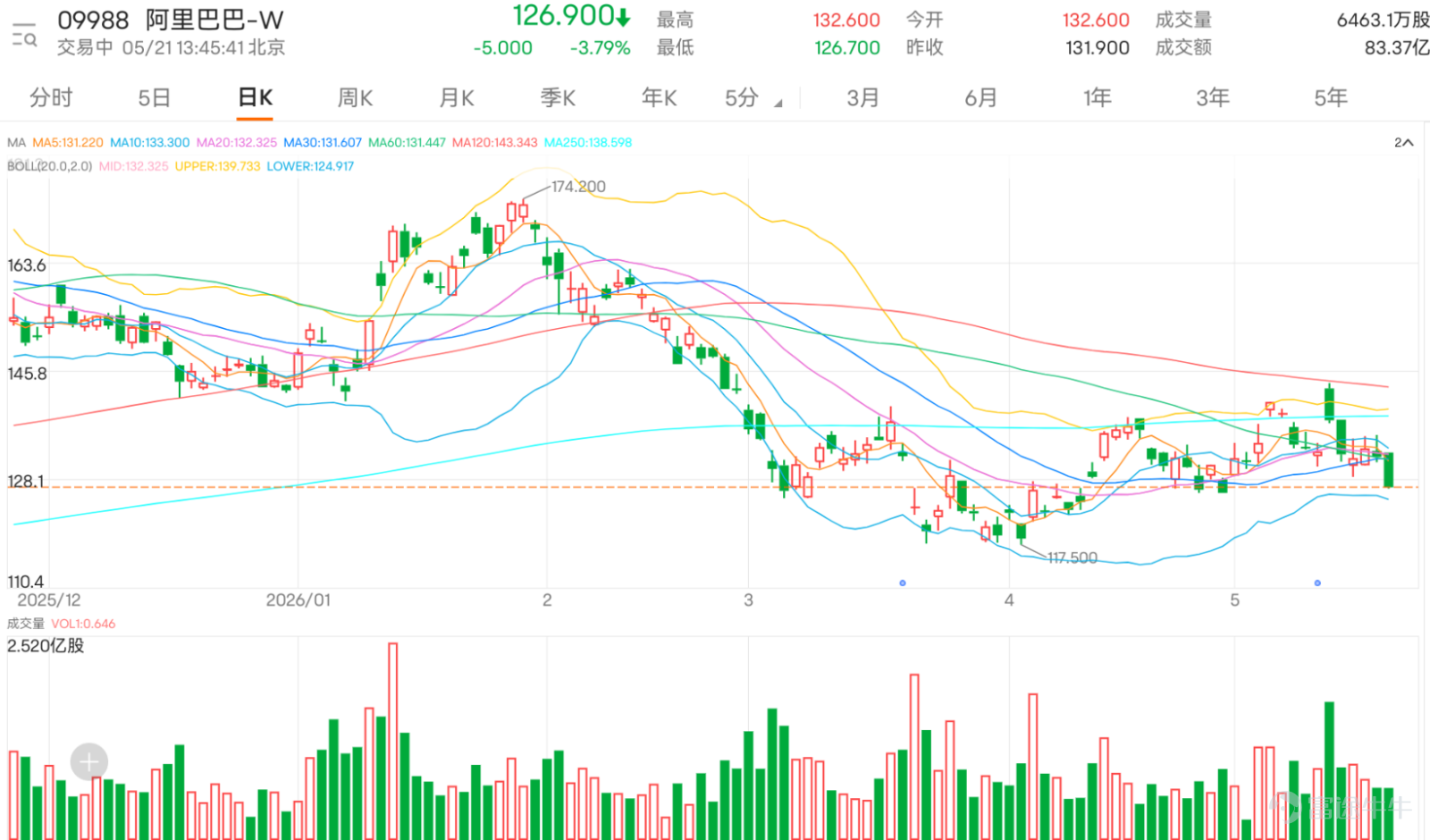

Alibaba's rebound stalled, marking two consecutive days of declines; key support levels under test
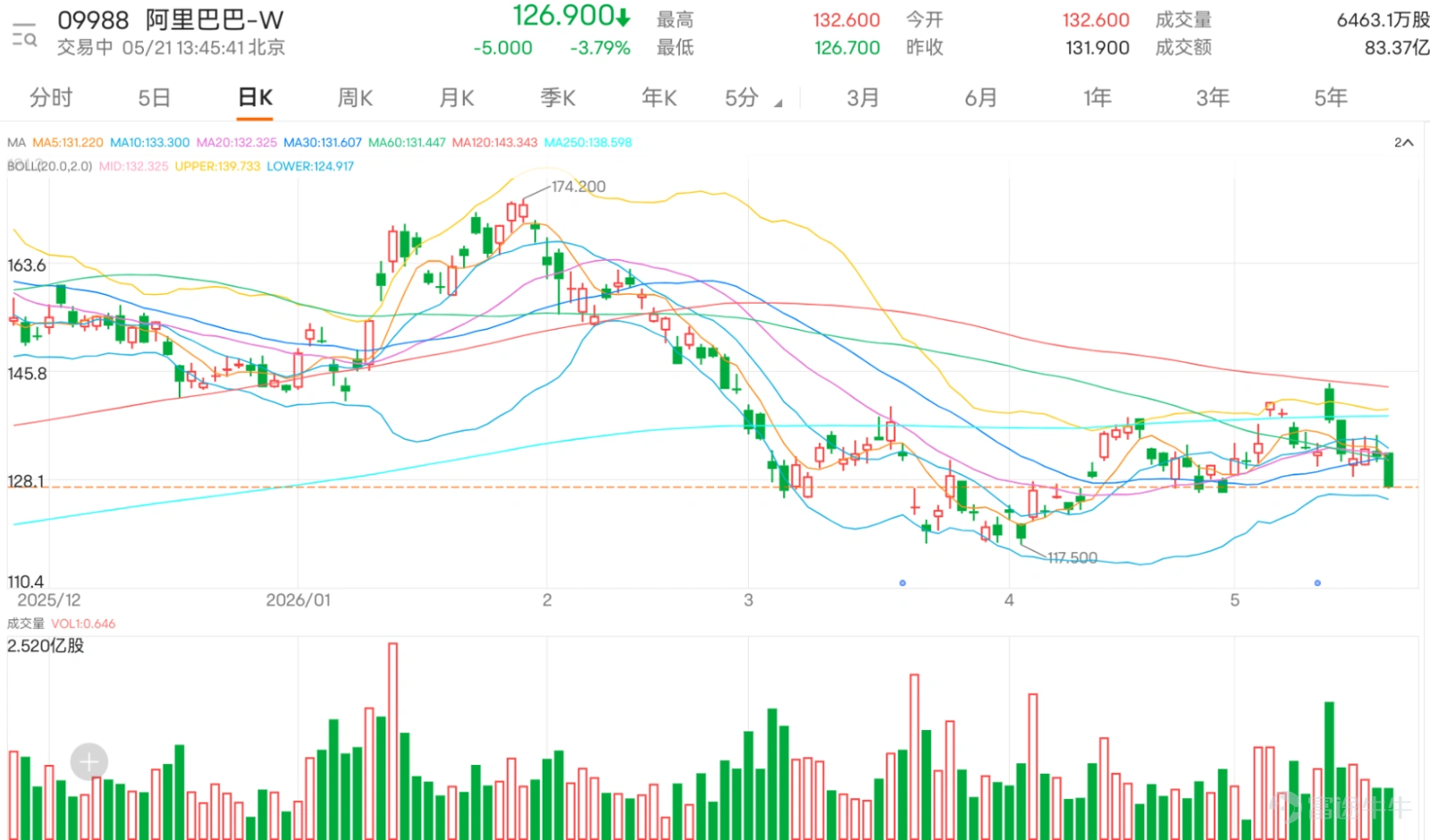
$BABA-W (09988.HK)$ The stock opened higher at HK$132.6 during the session but immediately pulled back, falling 3.71% to last trade at HK$127, indicating significant selling pressure in the HK$130–132 range. Technically, the current price has broken below all three short-to-medium-term moving averages: the 10-day (HK$133.42), 20-day (HK$132.39), and 30-day (HK$131.65), disrupting the near-term bullish structure.
Sentiment in comments is clearly weak—even more fatigued than the stock’s price action. Bullish remarks are not particularly strong; they mostly convey resignation, waiting, or intentions to buy again at lower levels. Some investors expressed hope for Jack Ma’s return to take charge, while others noted that the broader market could easily move higher but stubbornly refuses to do so. There were also comments from investors averaging HK$120 who have held for three months without profit and are now hesitating whether to exit. Such remarks indicate that retail confidence in Alibaba hasn’t vanished entirely, but their patience has been worn thin by repeated setbacks. It’s not that no one wants to be bullish on Alibaba—it’s just that every rally fails to sustain itself, making bullish sentiment increasingly cautious.
Bearish comments are noticeably more focused, centering around several key themes. First, there’s frustration over the stock’s prolonged underperformance—some described it as 'another wasted day,' complained that holding Alibaba consumes too much time, or said they’ve remained trapped in losses. Second, there’s disappointment that positive news fails to move the needle: investors pointed out that announcements related to chips, cloud computing, product launches, or other developments haven’t driven the stock higher—in fact, prices sometimes drop further after such news. Third, there’s suspicion that the market uses these positive headlines as opportunities to distribute shares, with retail investors stepping in as buyers. Taken together, these comments reveal Alibaba’s core issue right now: it’s not a lack of compelling narratives, but rather that the market is increasingly unwilling to assign a premium to those stories.
Comments expressing uncertainty or posing questions are also highly significant. Many investors asked why the stock suddenly weakened, what the market is trying to do, or whether this is repeating Xiaomi’s pattern of declining despite hosting events. Underlying all these questions is a common concern: Alibaba lacks near-term follow-through. The stock can rebound, generate news, and spark discussion, but whenever it approaches HK$134–135, it retreats. This gradually reinforces a market perception that Alibaba’s rallies tend to create short-term resistance zones rather than breakout opportunities.
Technically, Alibaba’s most critical near-term support zone lies between HK$130 and HK$131.65. A break below HK$130 would weaken the short-term structure, shifting focus to the lower Bollinger Band at approximately HK$125.561 as the next support level. On the upside, HK$134.700 represents the key pivot point. Only if the price reclaims and stabilizes above this level will it signal that near-term selling pressure is easing, opening the path toward HK$135.500 and the upper Bollinger Band at HK$139.549. Conversely, repeated rejection near HK$134.700–135.500 will reinforce this zone as a short-term distribution area.
Regarding Bollinger Bands, the middle band sits at HK$132.555, with the upper band at HK$139.549 and the lower band at HK$125.561. This pullback has pierced directly below the middle band. A recovery back above HK$132.555—and further breakout above HK$134.700—would indicate meaningful technical repair. However, continued trading below the middle band suggests insufficient rebound strength.
The Relative Strength Index (RSI) stands at approximately 46.879, reflecting a neutral-to-weak condition with no clear upward momentum. This aligns closely with the sentiment seen in user comments. Alibaba is neither deeply oversold nor showing signs of a strong breakout—it’s stuck in a frustrating sideways range. Such a position easily wears down holders’ patience and discourages short-term traders from taking large positions. To reverse this situation, Alibaba needs more than just another talking point; it must demonstrate real capital inflow through higher volume and a confirmed breakout.
Integrating sentiment and technical analysis, Alibaba isn’t entirely unattractive right now—but it lacks compelling near-term conviction for fresh long positions. Bulls still hope for broader market stabilization, renewed confidence in tech stocks, and revival of narratives around cloud computing and AI infrastructure. Bears argue that positive catalysts are ineffective, capital is exiting, and product launches have become exit opportunities. Amid this divergence, technical levels provide clear guidance: holding above HK$130 allows sideways consolidation and potential recovery; breaking above HK$134.700 is needed to signal renewed strength; but a breach below HK$130 would extend weakness, making HK$125.561 the next defensive level. In the near term, Alibaba offers neutral risk-reward.
Trading focus: Watch whether the HK$130.000–131.65 support zone holds. If it does, a sideways bounce is possible. A breakout above HK$134.700 would improve the technical outlook, targeting HK$135.500 and then HK$139.549. However, a drop below HK$131.000 would signal near-term weakness, shifting attention to support near HK$125.561.
Strategy 1 | Hold above the support range of HK$130.000–131.65 for a short-term bounce play
$UBALIBA@EC2612C.C (28856.HK)$ | Strike price: HK$156.88 | Effective leverage: 5.2x | Strike price is not particularly close to current market price; suitable for playing a continuation of the rebound after support holds firmly. Key focus: whether the stock price can retest HK$134.700
$GJALIBA@EC2611B.C (28882.HK)$ | Strike price: HK$156 | Effective leverage: 5.5x | Slightly higher leverage; suitable for capturing rebound elasticity when short-term buying interest improves. However, avoid holding positions if the price breaks below HK$131 support
$BIALIBA@EC2611B.C (27859.HK)$ | Strike price: HK$155.98 | Effective leverage: 5.6x | More responsive; suitable for quick in-and-out short-term trades after support holds firm, with an initial target near HK$135.500
Strategy 2 | Break above HK$134.700 to chase renewed strength
$UBALIBA@EC2607D.C (26262.HK)$ | Strike price: HK$165.1 | Effective leverage: 14.3x | High-leverage call warrant; suitable for chasing short-term strength after confirmation of a breakout above HK$134.700. Offers high elasticity but also high volatility
$BIALIBA@EC2607A.C (24561.HK)$ | Strike price: HK$165.1 | Effective leverage: 15.3x | Highest leverage; suitable for capturing a rapid upward move immediately after breakout. Not recommended for pre-breakout positioning
$HUALIBA@EC2607A.C (24348.HK)$ | Strike price: HK$165 | Effective leverage: 13.3x | Also targets extended rebounds post-breakout, but with slightly lower leverage than the most aggressive option—suitable for momentum chasing with moderately reduced volatility
Strategy 3 | Break below HK$131.000 to take a bearish view
$UBALIBA@EP2608A.P (26410.HK)$ | Strike price: HK$132.78 | Effective leverage: 5.2x | Strike price is close to current market price; suitable for capturing the initial phase of weakness after a break below HK$131, offering relatively direct responsiveness
$UBALIBA@EP2607A.P (20367.HK)$ |Strike price HK$130|Effective leverage 8.4x|Strike price is close to the short-term downside range after support was breached; suitable for shorting on confirmation of a breakdown below support, with higher elasticity
$CIALIBA@EP2611A.P (28938.HK)$ |Strike price HK$130|Effective leverage 3.8x|Lower leverage, suitable for bearish positioning without taking an overly aggressive short stance; focus on whether the share price retests HK$125.561
Investor Comment Replies
@才思敏捷的錢寧: When too many investors are bullish, it can easily create selling pressure, as everyone tends to exit at once if expectations aren't met.
@Casper ll: The market currently tends to move counter to retail investor expectations, so trading based purely on sentiment should be avoided.
@232134042: Weak market sentiment in Hong Kong weighs on valuations and trading volumes, and Alibaba is also affected by this environment.
@等待奇蹟: Taking profits early is a conservative short-term approach, as Alibaba has not yet shown a strong breakout.
@閃崩八年熊市磚家: Sentiment around the Nasdaq can influence Chinese ADRs, but Alibaba itself still needs to watch levels at HK$131 and HK$134.700.
Feel free to share your insights in the comment section. For more market analysis, please continue following ‘Hong Kong Stock Warrants Jenny’ for daily updates!
Reminder: This article does not constitute any investment advice.
This article is for reference only and does not constitute any investment advice. Market data, opinions, and analysis contained herein may change at any time without prior notice. We are not responsible for any loss or damage caused by reliance on the information in this article. Technical analysis only shows whether certain technical conditions are met; asset performance should be comprehensively evaluated using other sources of information, and trading decisions should not be made solely based on this article. Please note that past performance is not indicative of future results.
#HKStocks #RealTimeAnalysis #WarrantPick #WarrantGuide #DerivativesHedging #HKWarrantsJenny #Alibaba #09988 #BlueChipStocks #TechnicalAnalysis
Risk Disclaimer: The above content only represents the author's view. It does not represent any position or investment advice of Futu. Futu makes no representation or warranty.Read more

Comment (1)
to post a comment
2