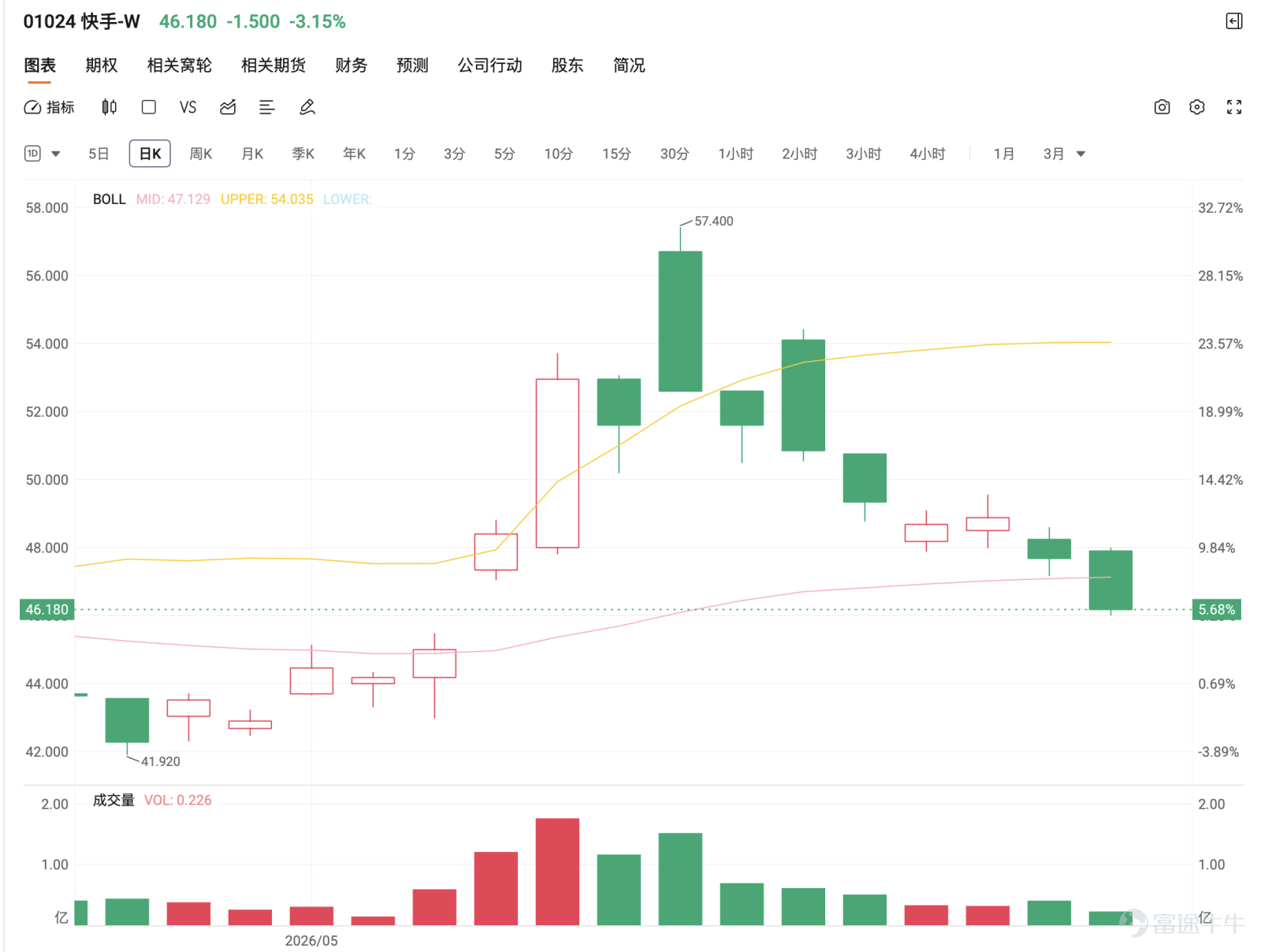

Kuaishou-W is currently trading at HK$46.18, breaking below the 10-day moving average of HK$50.258, with its rebound momentum clearly weakening.
Kuaishou-W closed yesterday (20th) at HK$47.680, down HK$1.200 or 2.45%. The share price retreated from an intraday high of HK$48.580, hitting a low of HK$47.180 and closing near the session low, reflecting ongoing short-term selling pressure. Today (21st), the stock declined another 3.10%, closing at HK$46.18. The current price is below the 10-day moving average of HK$50.258 and has failed to re-establish support at key rebound levels. Although it remains close to the middle Bollinger Band at HK$47.087, the trend hasn’t fully turned bearish yet; however, rebound strength has clearly diminished.
For short-term investors, sentiment in comments is clearly leaning toward disappointment and wait-and-see. Bullish voices still exist—some investors view the stock’s decline alongside the broader market as normal and believe there’s no need to monitor prices daily, while others remain confident that the stock is holding up well and still hope for an afternoon turnaround, strong rally, or counterattack against bears. Some also mentioned themes like AI, Kuaishou’s valuation potential, and increased AI investment, arguing that Kuaishou still has room for repricing. This shows the market hasn’t completely given up on Kuaishou, but bullish conviction remains weak—most are simply hoping the stock holds its ground until the next catalyst or capital inflow arrives.

Among bullish comments, phrases like 'holding up well' and 'holding firmly' best reflect the current price situation. Bearish remarks, however, are notably sharper. Many investors argue that Kuaishou’s rallies lack conviction, while bears appear more decisive; others point out that each time the stock surges HK$10–HK$8 on news, it eventually gives back all gains, making it unwise to chase entries. These comments reflect insufficient trust among retail investors in Kuaishou.
Another focal point of bearish commentary is market concern that Kuaishou’s earnings and the valuation of Keling (its AI division) may not be credible. Some comments highlight the decline in first-quarter EBITDA and note that Keling’s valuation relies on aggressive growth assumptions that the market may not accept. Such views indicate investors are beginning to question whether Kuaishou’s earlier AI and video-generation narrative is sufficient to support its share price. With the stock still trading below its 10-day moving average, market tolerance for thematic plays diminishes, and what were once seen as positive catalysts are now easily interpreted as pump-and-dump maneuvers or post-hype pullbacks.
Comments reflecting a wait-and-see stance best capture the current trading dilemma. Many investors are asking whether a reversal is possible in the afternoon, if prices are already too high, whether they should wait for higher volume, or if they should cut losses if the price breaks below HK$45. Others argue that unless institutional players show clear direction, it’s better to stay away and only enter upon seeing significant volume. This aligns with today’s trading data: Kuaishou’s turnover today was approximately 40.48 million shares—down from recent spikes and clearly contracting during this pullback. This low-volume decline suggests selling pressure hasn’t intensified dramatically, but also indicates insufficient buying interest to support a meaningful rebound, with no clear sign of fresh capital stepping in aggressively.
Technically, Kuaishou’s most critical support zone currently sits at HK$46.677, which aligns with the 30-day moving average. As long as this level holds, the stock still has a chance to consolidate around the Bollinger Band midline and attempt another rebound. However, if this support breaks, the short-term trend would turn bearish again, with the next support level seen near HK$40.148. This also explains why many comments have started referencing levels like HK$40, HK$41.9, or the HK$40–HK$43 range—once the HK$47 area is breached, market participants naturally shift their focus to lower support zones.
The key resistance level lies at HK$50.258—the 10-day moving average—which serves as the make-or-break threshold for whether Kuaishou can resume its rebound. Today, the stock only reached a high of HK$47.98, failing to approach the HK$50 mark. If the stock can subsequently hold between HK$47.180 and HK$46.677 and then break above HK$50.258, the uptrend could regain momentum, targeting the next resistance near HK$54.026. Otherwise, the price will likely remain trapped below HK$50, stuck in a weak consolidation pattern following a failed rebound attempt.
Regarding Bollinger Bands, the middle band is at HK$47.087, the upper band at HK$54.026, and the lower band at HK$40.148. The current price of HK$46.180 remains close to the middle band, which explains why Kuaishou has not yet shown clear signs of weakening. However, it is still far from the upper band and not too distant from the lower support, indicating that the stock is currently in an indecisive, neutral position. If the share price holds above the middle band and rebounds, it could still challenge the HK$50 level; if it breaks below the 30-day moving average and moves further away from the middle band, the market will likely refocus on the HK$40 area.
The Relative Strength Index (RSI) stands at approximately 40.013, indicating weak momentum with no signs of renewed strength. This suggests that while Kuaishou hasn’t collapsed, buying interest remains insufficient. To shift market sentiment, the company can’t rely solely on narratives around Keling, AI, valuations, or speculative news—it must demonstrate genuine capital inflow by pushing the share price back above HK$50.258. Otherwise, retail investors will continue treating every bounce as an opportunity to reduce positions.
In terms of short-term strategy, Kuaishou’s technical outlook would only regain rebound potential if it holds support between HK$47.180 and HK$46.677 and then breaks back above HK$50.258. In that scenario, the next upside target would be around HK$54.026. The next key support level lies near HK$40.148. For retail investors, the biggest mistake right now would be emotionally chasing the stock up or down within the HK$47–HK$50 range. Until Kuaishou breaks above HK$50.258, it remains in a pullback pattern following a prior rebound; conversely, unless it decisively breaks below HK$46.677, a confirmed breakdown cannot yet be confirmed. The most prudent approach is to wait for either a breakout or a breakdown before making a decision.
Key Deployment Points for Kuaishou-W (01024):
Strategy 1 | Bet on a rebound and recovery after holding support between HK$47.180 and HK$46.677
27772 | Strike Price: HK$50.88 | Effective Leverage: 4.0x | Strike price close to the critical HK$50 pivot level; suitable for deployment if the stock holds near HK$47 and begins to recover. This option offers moderate sensitivity, making it appropriate for early-stage rebound plays.
28048 | Strike Price: HK$50.04 | Effective Leverage: 4.5x | Strike price closer to the pivotal level; ideal for use when the stock rebounds from support and approaches HK$50 again, offering more direct responsiveness.
28020 | Strike Price: HK$49.92 | Effective Leverage: 4.6x | Strike price just above the current market price; suitable for short-term rebound plays aiming to recoup recent losses. However, if the stock fails to break above HK$50.258, heavy positioning should be avoided.
Strategy 2 | Test the upper band at HK$54.026 after breaking above HK$50.258
27772 | Strike Price: HK$50.88 | Effective Leverage: 4.0x | Suitable for relatively stable momentum-following deployment after a breakout above HK$50.258. The strike price is close to the breakout zone, making it well-suited for capturing continued upside after surpassing the key pivot level.
27802 | Strike Price: HK$50.00 | Effective Leverage: 4.3x | Strike price near HK$50; ideal for deployment after breakout confirmation, primarily targeting the move from HK$50 toward HK$54.026.
27806 | Strike price HK$49.90 | Effective leverage 4.6x | Higher leverage, suitable for short-term directional plays after the stock price breaks above HK$50.258; if trading volume improves, the response will be quicker. $UBKUASO@EC2611B.C (27772.HK)$$BPKUASO@EC2611B.C (27802.HK)$$MSKUASO@EC2610A.C (27806.HK)$
Strategy 3 | Weakens if it falls below HK$46.677, targeting around HK$40.148.
17479 | Strike price HK$49.83 | Effective leverage 2.3x | Strike price above current market price; more suitable for a relatively conservative bearish position after a break below HK$46.677, with higher tolerance for volatility.
17395 | Strike price HK$49.88 | Effective leverage 2.6x | Slightly higher leverage, suitable for capturing continued weakness after the stock price loses support at HK$46.677, primarily anticipating gradually increasing downside pressure.
29060 | Strike price HK$45.00 | Effective leverage 2.3x | Lower strike price, suitable for positioning after confirmation of a break below HK$46.677, targeting a deeper decline toward HK$40.148. $UBKUASO@EP2612A.P (17479.HK)$$CIKUASO@EP2612A.P (17395.HK)$$CIKUASO@EP2702A.P (29060.HK)$
Reminder: This article does not constitute any investment advice.
This article is for reference only and does not constitute any investment advice. Market data, opinions, and analyses contained herein may change at any time without prior notice. We assume no responsibility for any loss or damage resulting from reliance on the information in this article. Technical analysis only indicates whether certain technical conditions are met; a comprehensive evaluation of asset performance should combine other information, and trading decisions should not be made solely based on this article. Please note that past performance is not indicative of future results. Follow Jenny’s insights on Hong Kong stock warrants for more professional analysis. $Hang Seng Index (800000.HK)$$Hang Seng TECH Index (800700.HK)$$Hang Seng China Enterprises Index (800100.HK)$
Risk Disclaimer: The above content only represents the author's view. It does not represent any position or investment advice of Futu. Futu makes no representation or warranty.Read more


Comments
to post a comment
4