
Hong Kong Market Barometer: CPO, PCB, and memory stocks rally in rotation! Are you on the right trai

The Hang Seng Index’s rebound hasn’t yet signaled a genuine strengthening; what retail investors fear most isn’t a drop, but another false breakout above the 26,000 level luring them back into the market.
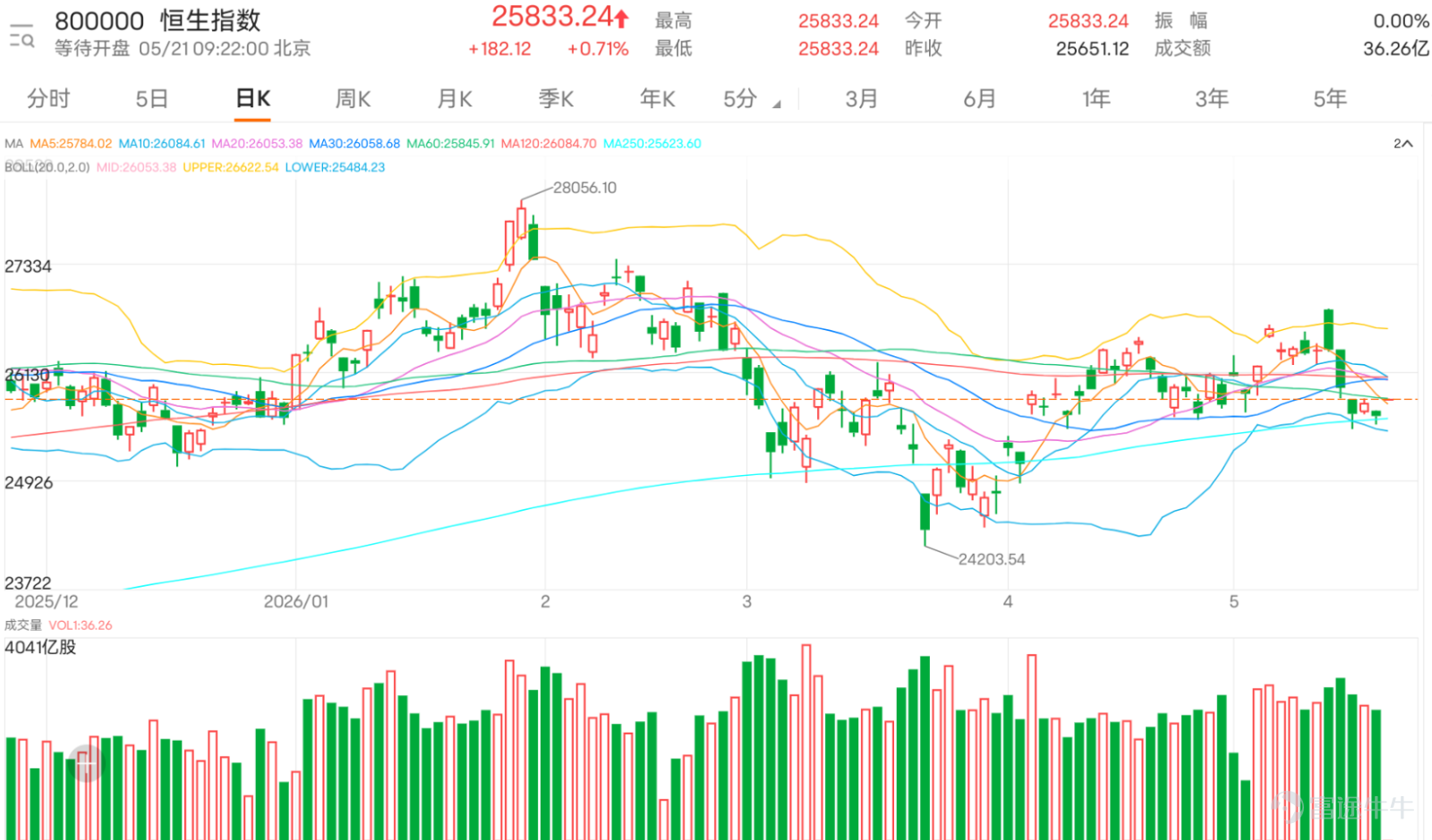
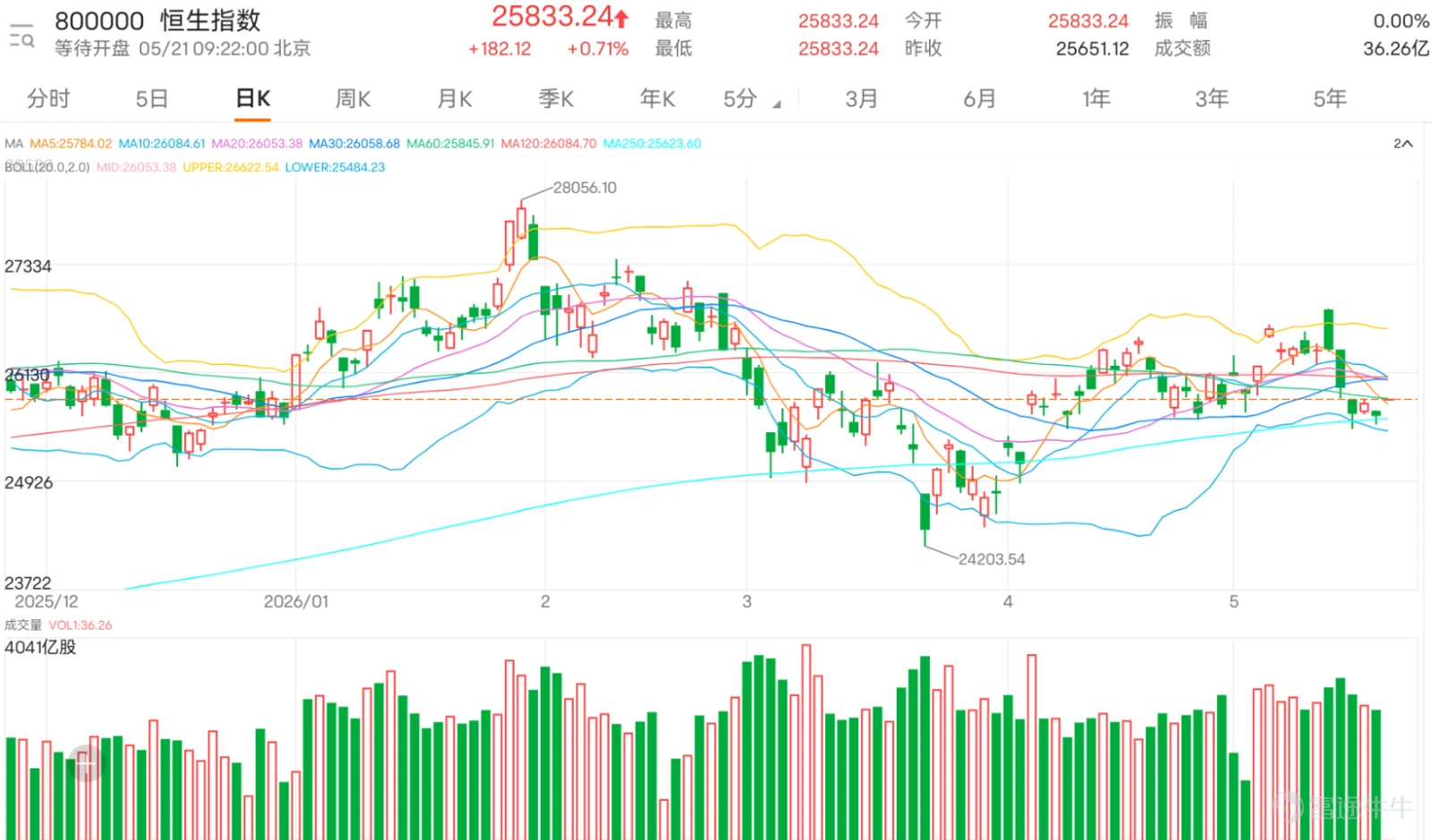
$Hang Seng Index (800000.HK)$ It closed at 25,651.12 yesterday, up 146.73 points or 0.57%. On the surface, the index rebounded from a low level and market sentiment stabilized slightly. However, from a technical perspective, this rebound has not yet confirmed a shift to strength. The key reason is that the current price remains below the 5-day moving average (26,056.10), 10-day MA (26,163.91), 20-day MA (26,069.88), and 30-day MA (26,060.68). All major short-term moving averages are still above the index, indicating that although the market has rebounded, it has not truly re-entered a strong zone.
Today’s comments clearly reflect that retail investor sentiment remains highly divided. On one hand, bullish investors believe the index could reclaim the 25,800 level, with some even expecting it to reach 26,500 tomorrow. Others noted that today’s session might reverse losses to close near the session high, suggesting some investors are beginning to anticipate a continuation of the short-term rebound. This sentiment is primarily based on the index stabilizing from its recent lows and the technical room for a bounce following the recent decline. However, this bullish sentiment remains largely speculative and short-term in nature, rather than signaling a true medium-term reversal, as most comments focus narrowly on targets like 25,800, a few hundred-point bounce, or short-run gains—not a broad renewed optimism toward Hong Kong equities.
On the other hand, bearish comments were noticeably more numerous and emotionally stronger. Some investors viewed the rebound merely as a ‘bull trap,’ while others argued that one should buy puts at higher levels or even anticipated a lower open or further declines tomorrow. This reflects insufficient market confidence in the rebound, with many short-term traders doubting that today’s gains signal a real trend reversal. Instead, they worry the index is being pushed higher only to trigger stop-losses on bull warrants before resuming its decline. This sentiment aligns with the technical structure, as the index currently trades below the Bollinger Bands’ midline at 26,069.88. The zone between 26,069 and 26,164 represents the most critical resistance area. As long as the index fails to break above and sustain levels within this range, bearish traders will continue viewing rallies as opportunities to short or deploy put warrants.
Observational and questioning comments are equally worth noting. Some believe the market today is 'stuck without clear direction,' others describe it as 'treading water,' while some are watching the bull-bear ratio and whether tomorrow will see 'double-sided squeezes' (i.e., both bulls and bears getting stopped out). These comments reflect that retail investors are currently less concerned about the broad trend and more focused on how short-term volatility is being exploited by institutional players. The market isn't simply bullish or bearish; rather, there's widespread concern that the index will oscillate repeatedly between 25,500 and 26,000 points, easily triggering stop-losses on both sides. This also explains why some investors caution against full positions—although volatility exists at current levels, the direction remains unclear, and heavy positioning can easily lead to forced stop-losses amid intraday swings.
Technically, the Hang Seng Index’s first short-term support level is at 25,555.06 points, which is currently the nearest defensive position relative to the prevailing price. As long as the index holds above 25,555, there remains a chance for a short-term rebound attempt, potentially retesting the 25,800–26,000 range. However, the true make-or-break zone isn’t at 25,800 but rather around 26,069 to 26,164 points. This is because the 20-day moving average (26,069.88), the 10-day moving average (26,163.91), and the Bollinger Bands’ midline all converge in this area. If the index only rebounds to around 25,800 before facing resistance, the move would still be a weak technical bounce. Only a decisive break and close above 26,069–26,164 would indicate conditions for short-term structural recovery.
Regarding the Bollinger Bands, the midline sits at 26,069.88, the upper band at 26,361.64, and the lower band at 25,058.13. The current price remains below the midline, indicating continued market weakness. Should the index subsequently break above the midline, it would then have room to advance toward the upper band near 26,361—only then would the stronger rebound mentioned by bullish commentators gain solid technical footing. Conversely, if the index fails to reclaim even 26,069, the short-term rebound could easily fizzle out and resume its downtrend, putting the 25,555 support level under renewed pressure.
The Relative Strength Index (RSI) stands at approximately 31.252, nearing oversold territory, reflecting weak short-term momentum. This level invites two interpretations: first, the index may be approaching an oversold state, creating a genuine need for a technical rebound; second, if any rebound remains feeble, it signals insufficient market support, suggesting weakness could persist. Therefore, at this stage, one cannot assume a strong rebound solely based on a low RSI—confirmation must come from breakout above resistance levels and accompanying volume changes.
In terms of trading volume, today’s turnover was approximately HK$262.1 billion. Recent volume bars have not shown significant expansion, and today’s rebound occurred on stable-to-lighter-than-average volume. This is currently the biggest concern. A genuinely strong rebound typically requires supportive volume, especially when the index rallies from a weak zone toward key moving averages. Without clear volume expansion, such a rebound is likely driven only by short-covering or intraday speculative flows. Today’s lack of notable volume increase suggests large-scale capital hasn’t returned aggressively, supporting the view that the current risk-reward ratio remains neutral-to-low.
Combining sentiment from comments and technical analysis, the Hang Seng Index still retains some room for a short-term rebound but has not yet reached a stage where a confirmed strengthening can be declared. Bullish traders should note that 25,800 is merely a psychological short-term threshold—the real breakout target lies between 26,069 and 26,164. Bearish traders, meanwhile, should recognize that if the index holds above 25,555 and gradually repairs upward, it may not immediately plunge toward 25,058. The most prudent strategy now is to treat 25,555 as the short-term defensive line and 26,069–26,164 as the confirmation zone for renewed strength. Until a breakout occurs, chasing longs offers poor risk-reward; conversely, aggressively shorting before a break below 25,555 risks getting caught in a short squeeze.
For short-term positioning: if the index holds above 25,555 and then decisively breaks above 26,069–26,164, the rebound could extend toward 26,361, potentially shifting market sentiment from cautious观望 to more positive. Conversely, if the index breaks below 25,555 again, weakness will likely persist, with the next support level near 25,058. For retail investors, the priority now isn’t guessing whether the market will rise or fall tomorrow, but avoiding aggressive chasing within the 25,555–26,164 range—precisely the zone where both bulls and bears are most vulnerable to being shaken out by choppy price action.May 20 [HK Stock Podcast] Part-1 – Hang Seng Index, Hua Hong Semiconductor, Kingboard Laminates
Key deployment levels: In the short term, watch whether support at 25,555 holds. If it holds, consider bullish warrants to play the rebound; only chase a recovery if the index breaks above the 20-day MA at 26,069 to the 10-day MA at 26,164. If 25,555 is breached, weakness will likely persist, and bearish positions could target around 25,058.
Strategy 1 | Hold above 25,555 for a short-term rebound play
$UB#HSI RC2810E.C (56201.HK)$ | Knock-out price: 25,500 | Effective leverage: 122.1x | A highly sensitive bullish warrant close to support, suitable only for quick short-term trades after confirming support at 25,555 holds. Strict stop-loss discipline is required if support comes under renewed pressure.
$HS#HSI RC2809D.C (56809.HK)$ | Knock-out price: 25,500 | Effective leverage: 128.3x | Offers higher rebound elasticity, suitable for intraday trades betting on a quick bounce after confirming the index doesn’t break below support. However, it has minimal margin for error and is not suitable for holding overnight.
$DS#HSI RC2810B.C (56453.HK)$ | Knock-out price: 25,500 | Effective leverage: 116.6x | Also positioned near support but with slightly lower leverage than the highest-elasticity option, suitable for those wanting to participate in the rebound without using the most aggressive leverage.
Strategy 2 | Break above 26,069–26,164 for short-term recovery play
$UB#HSI RC2810W.C (65625.HK)$ | Knock-out price: 25,300 | Effective leverage: 69.3x | Features a lower knock-out price compared to Strategy 1 products, making it suitable for chasing a sustained rebound after breaking resistance, with better error tolerance than at-the-money bullish warrants.
$BP#HSI RC2811G.C (57238.HK)$ | Knock-in level at 25,300 points | Effective leverage of 69.3x | Suitable for following through after confirming a breakout above the dense moving average zone; still offers high elasticity without being overly sensitive to intraday volatility
$GJ#HSI RC2810P.C (56538.HK)$ | Knock-in level at 25,300 points | Effective leverage of 65.8x | Slightly lower leverage, suitable for momentum chasing after a breakout with greater room for price swings; better aligned with a directional view toward 26,361 points
Strategy 3 | If support at 25,555 points is lost, adopt a bearish stance accordingly
$UB#HSI RP2812Q.P (59347.HK)$ | Knock-in level at 25,963 points | Effective leverage of 53.4x | Knock-in level just above 26,000 points, suitable for betting on accelerated downside after breaking below 25,555 points; offers high elasticity but beware of rebound risk
$HS#HSI RP2903X.P (59218.HK)$ | Knock-in level at 25,963 points | Effective leverage of 54.6x | High-leverage bear warrant, suitable for short-term bearish plays after breaching support; manage risk if the index quickly rebounds near the 26,000-point level
$MS#HSI RP2804M.P (59028.HK)$ | Knock-in level at 26,250 points | Effective leverage of 31.3x | Knock-in level above key resistance zone, offering larger margin for error; suitable for bearish positioning without being too close to current price
Investor Comment Replies
@Sam886: 25,800 is the first psychological level for a short-term rebound, but genuine strength requires a breakout above the 26,069–26,164 range.
@17569625: A short-term rebound is worth watching, but the current price remains below key moving averages; avoid rushing in—wait for confirmation of a breakout.
@232275662: A rebound of several hundred points is possible, but until the index breaks above 26,069–26,164, it remains a weak corrective bounce.
@責任感強的保羅: To target 26,500, the index must first break through resistance near 26,361 points; currently, it’s premature to confirm a move toward 26,500.
Reminder: This article does not constitute any investment advice.
This article is for reference only and does not constitute any investment advice. Market data, opinions, and analysis contained herein may change at any time without prior notice. We are not responsible for any loss or damage caused by reliance on the information in this article. Technical analysis only shows whether certain technical conditions are met; asset performance should be comprehensively evaluated using other sources of information, and trading decisions should not be made solely based on this article. Please note that past performance is not indicative of future results.
#HKStocks #LiveAnalysis #WarrantPick #WarrantGuide #DerivativesHedging #HKWarrantsJenny #HangSengIndex #HangSengTechIndex #BlueChipStocks #TechnicalAnalysis$Hang Seng TECH Index (800700.HK)$$Hang Seng China Enterprises Index (800100.HK)$
Risk Disclaimer: The above content only represents the author's view. It does not represent any position or investment advice of Futu. Futu makes no representation or warranty.Read more

Comments
to post a comment
5
8