
OpenAI Pioneers 'Long-Term Committed Capacity': AI Battle Extends Downstream—Who Has Valuation Reset Potential?
Overnight, the AI world witnessed a textbook example of 'undercurrents surging beneath a calm surface.'
On the surface, all market attention focused on the fierce competition over technology and talent: $Alphabet-C (GOOG.US)$ At its I/O conference, Google aggressively pushed to embed AI across its entire internet gateway ecosystem—search, Android, productivity tools, video, and even next-generation hardware; meanwhile, Anthropic, whose secondary market valuation has quietly surpassed OpenAI’s, directly poached OpenAI co-founder Karpathy, signaling its ambition to claim supremacy in pre-trained models.
However, while industry giants remain mired in the battle of 'racing to build models and poaching talent,'OpenAI has quietly extended its reach toward the ultimate hard currency of the AI era—computing power.
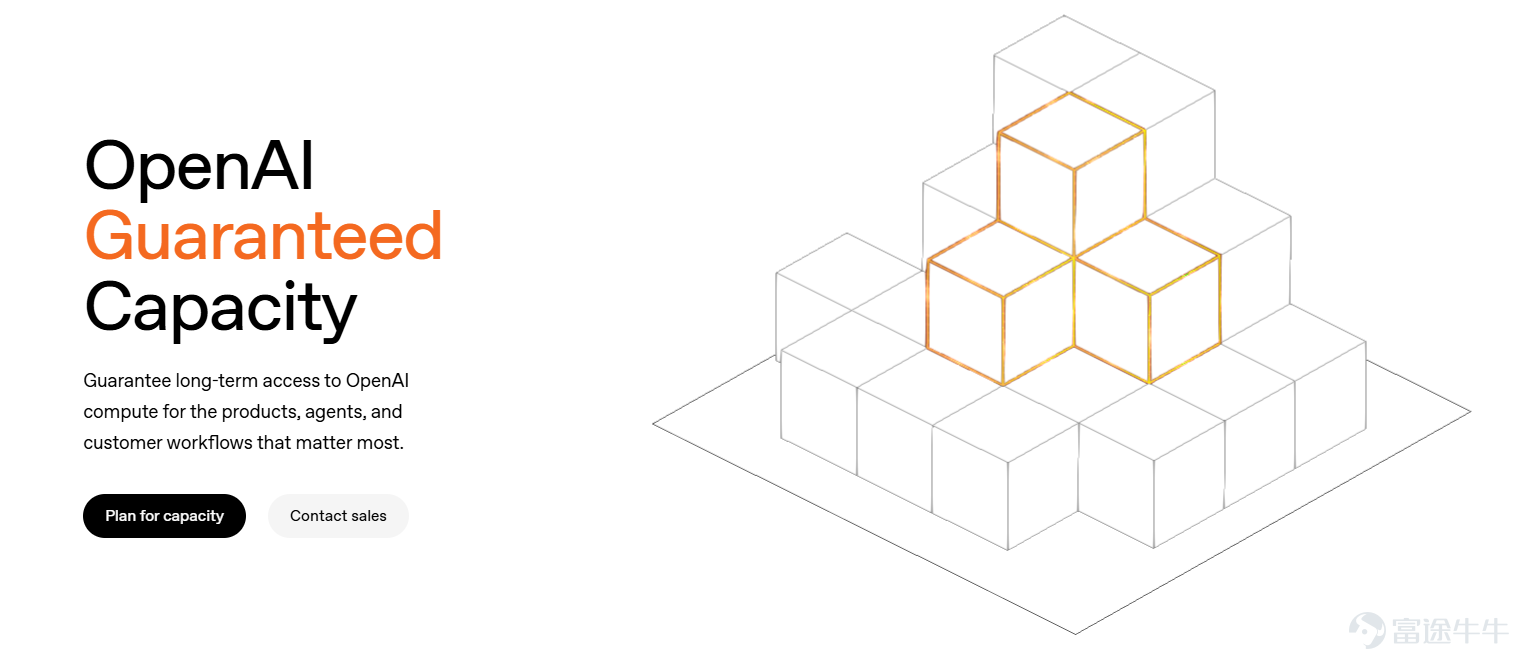
On May 19 (Eastern Time), OpenAI officially launchedits 'Guaranteed Capacity'product. Enterprise customers can sign computing capacity agreements ranging from one to three years to secure compute resources in advance, with longer-term commitments offering greater discounts.

Source: OpenAI
From technological rivalry and talent wars to today’s'commoditization of computing power futures,',OpenAI’s move sends a very strong signal: as model capabilities become increasingly homogeneous, true industry dominance and pricing power are rapidly shifting toward those who monopolize foundational computing resources.
This article will provide fellow investors with an in-depth breakdown,What exactly is this 'compute capacity long-term agreement'? What industry shifts does it signal—and more importantly, what investment opportunities should we watch?
What exactly is this 'compute capacity long-term agreement'?
In one sentence:OpenAI is selling 'compute annual passes' for the AI era.
In the past, enterprise customers typically paid for API usage on a pay-as-you-go basis. Now, they can sign compute capacity agreements lasting 1 to 3 years, locking in computing resources upfront—with longer terms offering greater discounts.
This mirrors the logic behind corporate airline annual tickets and cloud giants’ 'Reserved Instances (RIs)': buyers exchange long-term commitments for exclusive discounts and supply assurance, while sellers trade short-term concessions for certainty in future cash flows.
Notably,This marks the first time a major AI model provider has introduced such a demand-side strategy, representing a pivotal milestone in the industry’s commercialization journey.
Behind this 'rush to lock in orders'—is there deep-seated compute capacity anxiety across the supply chain?
In fact, this 'lock-in-the-future' logic is nothing new at the upstream end of the AI supply chain.Hardware giants have already proven with real money a fundamental rule of the AI era: securing supply chain commitments ahead of time is far more critical than gambling on spot-market availability.
Currently, buyers and sellers are engaged in a psychological standoff amid extreme supply-demand imbalance: buyers fear not rising prices, but rather a complete supply cutoff; sellers aim not only to raise prices, but also to secure firm order visibility before committing massive capital expenditures to expand capacity.
This deep-seated 'compute anxiety' is directly manifesting as an explosive surge in procurement commitments:
$NVIDIA (NVDA.US)$ : According to The Wall Street Journal, its latest quarterly report disclosed procurement commitments to suppliers totaling $95.2 billion—a staggering 89% quarter-over-quarter increase. The CFO explicitly stated the company has 'strategically locked in inventory and capacity to meet demand for multiple quarters ahead.'
$Broadcom (AVGO.US)$ : In its March earnings call, it prominently announced it had 'locked down its required supply chain,' safeguarding its target of reaching $100 billion in AI chip revenue next year—more than triple its current annual revenue.
$Advanced Micro Devices (AMD.US)$ : Its Q1 report showed procurement commitments have surpassed $21 billion, more than doubling in just three months.
Ultimately, whether it’s hardware giants placing massive pre-orders or OpenAI launching compute annual subscriptions, both essentially formalize tech behemoths’ profound anxiety over the 'AI arms race' into legally binding commercial contracts.
the commercialization loop for FSD is continuously being perfected, opening up new profit potential.The trend toward 'assetization' and 'financialization' of compute power is also accelerating—the CME Group plans to launch compute futures, targeting what many call the 'new oil' of the AI era.As Blackrock CEO Larry Fink noted: given the acute shortage in compute supply and extremely robust demand, compute futures could very well become a major new investment asset class.
In summary,From Chicago-based compute futures to today’s tokenized long-term agreements, AI business models are undergoing a fundamental shift—from short-term, on-demand usage to long-term demand locking.This trend undoubtedly injects strong medium- to long-term certainty across the entire supply chain. Looking further ahead, once long-term agreement models gain traction, demand visibility from downstream AI applications will seamlessly transmit upstream to compute providers. At that point, market assessments of industry health will no longer rely solely on forward-looking guidance from top executives, but will instead be anchored by clearer, more trackable long-term demand signals.
How does the Long-Term Supply Agreement (LTA) reshape valuation, and how can investors seize trading opportunities?
As 'commoditization of computing power' becomes a trend, Wall Street consensus is shifting. Recent in-depth reports from Morgan Stanley and JPMorgan have both focused on a key variable—Long-Term Supply Agreement (LTA)。
In other words, under current market conditions,Supply scarcity is the foundation of all negotiating power.
Tech hardware analyst Shawn Kim put it succinctly:Memory storage has become a critical bottleneck in AI infrastructure. Customers are signing LTAs to secure supply, transforming memory—a traditionally volatile cyclical business—into a predictable, high-margin, long-term cash flow stream.This not only benefits giants like Micron but also provides independent listed memory-focused companies such as SanDisk with more stable, long-term cash flow expectations, paving the way toward a new valuation framework.
For investors, this means the certainty of a 'profitability effect' is now concentrating in upstream infrastructure segments, and previouslyThe 'Inflation Era' of AI computing power has arrived! Unveiling how to capture price increases across the entire industrial chain and investment opportunities?this was also highlighted.The further upstream the computational power chain (chips, memory, GPUs),,the greater the physical constraints and the more advantageous the industrial landscape,The stronger the certainty of price increases and the longer their duration.

This 'price-increase supply chain,' triggered by AI compute capacity anxiety, is cascading down the industrial chain in sequential waves. We break it down into three major segments:
First wave: Absolutely scarce 'core computing power' and 'foundry & advanced packaging/testing'
Since GPU computing power directly determines the upper limit of supply for large model training and inference, this segment was the first to surge and holds the strongest pricing power.
Compute Power Brains (oligopolistic pricing power): Dominant industry giants reside here, $NVIDIA (NVDA.US)$ 、 $Advanced Micro Devices (AMD.US)$as well as$Broadcom (AVGO.US)$ Enjoying sustained premium profits thanks to formidable technological barriers.
Capacity Lifelines (manufacturing and packaging): The production of top-tier chips is heavily reliant on wafer foundry capacity and advanced packaging technologies (e.g., CoWoS). $Taiwan Semiconductor (TSM.US)$ They firmly hold critical positions, while $SMIC (00981.HK)$ 、 $ASE Technology (ASX.US)$ 、 $Amkor Technology (AMKR.US)$as well as$ASMPT (00522.HK)$ suppliers have also experienced a dual re-rating in both intrinsic value and valuation due to industry-wide capacity constraints.
Phase Two: Deepening Expansion in 'Storage' and 'Data Center Interconnect (DCI)'
As AI agents’ demand for ultra-long context windows and massive data throughput surges, the pricing-up trend has rapidly spread to data center hubs.
Storage: Double Boost from Volume and Price A price increase for memory chips in 2026 is now certain. DRAM prices are expected to rise by 60%–88% for the full year, while NAND will see a robust increase of 38%–74%. In addition to beneficiaries of HBM demand, $CSOP Samsung Electronics Daily (2x) Leveraged Product (07747.HK)$ 、 $CSOP SK Hynix Daily (2x) Leveraged Product (07709.HK)$ 、$Micron Technology (MU.US)$ , including standout performers such as $SanDisk (SNDK.US)$ , all saw remarkable gains this year.
Optical Communications Infrastructure Boom: The larger the scale of AI compute clusters, the more stringent the bandwidth requirements for Data Center Interconnect (DCI), fueling strong demand for optical communication networks.
from silicon photonics manufacturers $Marvell Technology (MRVL.US)$ 、 $Fabrinet (FN.US)$ , to the leading optical module company $Lumentum (LITE.US)$ 、 $Coherent (COHR.US)$ , and then to the optical fiber segment $Corning (GLW.US)$ and $YOFC (06869.HK)$ , indium phosphide $AXT Inc (AXTI.US)$ The entire supply chain is benefiting from the spillover of demand.
Third wave: Spillover into peripheral 'infrastructure' and 'end-user cloud/models'
The massive computing power behemoth requires extreme 'logistical support,' and cost pressures will ultimately be passed down the supply chain.
Energy and Cooling: At the end of computing power lies electricity. $Texas Instruments (TXN.US)$ 、 $Monolithic Power Systems (MPWR.US)$ power management and analog chip giants such as, as well as companies specializing in liquid cooling solutions $Vertiv Holdings (VRT.US)$ , are becoming indispensable 'shovel suppliers' in the AI gold rush. Additionally, high-end demand is driving both volume and price increases for base materials like copper-clad laminates (CCL) (e.g., $KINGBOARD HLDG (00148.HK)$、 $KB LAMINATES (01888.HK)$ ) and MLCCs (e.g., $Vishay Intertechnology (VSH.US)$ ).
End-user cost pass-through: As underlying infrastructure costs rise across the board, cloud service providers and model vendors have begun raising prices to pass on inflationary pressures. $Amazon (AMZN.US)$ 、 $Alphabet-C (GOOG.US)$ 、 $TENCENT (00700.HK)$ cloud giants such as $KNOWLEDGE ATLAS (02513.HK)$ 、 $MINIMAX-W (00100.HK)$ and leading model providers are adjusting their pricing strategies to shift rising compute costs down to end-user applications.
Summary: The 'Matthew Effect' under the LTA Model
Overall, the current AI industry’s LTA (Long-Term Agreement) modelwill intensify the 'wealth gap' among enterprise AI players.
On one hand, large players will continue to deepen their moats.Well-capitalized tech giants and top-tier unicorns can secure compute resources in advance by paying OpenAI’s 'long-term contract discount,' thereby stabilizing their API call costs and profit margins.
On the other hand, smaller application-layer players will face significant crowding-out effects.Without locking in compute capacity ahead of time, mid-tier applications may face risks such as slower response times or sudden spot-price hikes for compute power, severely squeezing the gross margins of application-layer (SaaS) companies lacking underlying compute support.
As investors, we therefore need to closely monitor marginal shifts in the industry:As computing power evolves from a consumable into a 'strategic futures asset,' market capital and pricing logic will inevitably concentrate further on AI foundational infrastructure with exceptionally high earnings visibility.
Risk Disclaimer: The above content only represents the author's view. It does not represent any position or investment advice of Futu. Futu makes no representation or warranty.Read more


Comments (9)
to post a comment
117
268