
[Welcome Newcomers] Investment Beginner's Hub: Your trading journey starts here with ease

【ETF】Worried about buying US stocks at high levels, and Hong Kong stocks keep swinging? Use ETFs in three steps to test the waters: conservative, aggressive, short-term trading
Recently, sentiment around US tech stocks remains relatively hot, with ongoing investor interest in themes like AI, semiconductors, and cloud computing; however, many investors are also concerned:‘Has the Nasdaq already gotten too expensive?’ ‘If I buy in now, will I end up underwater?’ ‘Hong Kong stocks keep fluctuating—every time I consider buying, I fear it’ll drop right after I chase the price.’
Actually, you don’t necessarily have to pick individual stocks right from the start, nor do you need to invest your entire capital at once.
For those with investment experience who are hesitant to take action due to fear of losses or buying at high prices, ETFs can be a relatively low-barrier tool.
In simple terms, an ETF is a basket of stocks/assets. It trades like a stock, but you don’t have to pick each holding yourself. You can start with a small position to test the waters, gradually understand the market, and then decide whether to add to your position.
1) For a more stable way to gain exposure to U.S. equities: consider the S&P 500 ETF $Vanguard S&P 500 ETF (VOO.US)$
If you believe U.S. stocks still offer long-term opportunities but prefer not to be overly concentrated in tech stocks,the S&P 500 ETF acts more like a 'core U.S. equity market position.'
It typically tracks large-cap U.S. companies and offers relatively diversified sector exposure—not reliant on just one or two stocks.
For investors who worry about picking the wrong stock yet still want exposure to the overall U.S. market performance, the S&P 500 ETF can serve as a starting point for observation and participation.
Who is it suitable for?
– Want to start investing in U.S. ETFs
– Don't want to pick individual stocks myself
– Want to build a core U.S. equity position gradually through dollar-cost averaging
– Afraid of entering at a market peak, so prefer placing small, incremental orders to test the waters
2) Bullish on tech leaders: Consider the Nasdaq-100 ETF $Invesco QQQ Trust (QQQ.US)$
If you’re particularly optimistic about AI, cloud computing, semiconductors, software, and platform-based tech companies,the Nasdaq-100 ETF is more tilted toward technology and growth stocks than the S&P 500.
The advantage is that you don’t have to bet on a single tech stock—for example, you don’t need to guess which company will definitely outperform; instead, you can gain exposure to a basket of large-cap tech and growth stocks through one ETF.
However, the Nasdaq-100 typically has higher volatility than the S&P 500—it can be very attractive when rising quickly, but also tends to drop sharply during pullbacks.
Who is this suitable for?
– Bullish on the long-term trend of U.S. tech stocks
– Don’t want to buy just one single tech stock
– Can tolerate higher volatility
– Want to use dollar-cost averaging to reduce the pressure of buying at high prices
3) Looking to capture AI sub-themes: consider the Roundhill Memory ETF $Roundhill Memory ETF (DRAM.US)$
If the Nasdaq-100 is considered a 'broad tech basket,' then Roundhill Memory ETF is more like a focused ETF targeting the AI memory/storage theme.
This type of ETF primarily focuses on areas such as AI data centers, HBM, high-end memory, DRAM, and NAND. In simple terms, as the market discusses growing AI computing power, it requires more memory and storage hardware—and companies in this space could benefit.
However, note that thematic ETFs are typically more concentrated and exhibit greater volatility compared to broad-market ETFs.
Therefore, they are better suited for small position sizing for observation, rather than taking a large position right from the start.
Who is this suitable for?
– Already has some experience investing in ETFs/U.S. stocks
– Wants exposure to niche opportunities within the AI industry chain
– Accepts the higher volatility typical of thematic ETFs
– Willing to test the waters with a small stake
4) With Hong Kong stocks fluctuating, if you want to 'earn while waiting,' consider Global X Hang Seng China Enterprises Covered Call ETF $Global X HSCEI Covered Call Active ETF (03416.HK)$
In recent years, Hong Kong stocks have often traded at relatively attractive valuations but with choppy price action, leaving many investors feeling:"I’m afraid to buy because it might stay flat, but I’m also afraid to miss out if it suddenly rallies."
At this time,Global X FTSE China H Index Covered Call covered call strategy ETFs like this can be a topic for discussion.
A covered call strategy can be simply understood as:holding index-related assets while simultaneously selling call options to collect option premiums.
Its key feature is that in a sideways or range-bound market, it may offer relatively stable cash flow; however, the downside is that if the broader market surges sharply, the upside potential could be capped due to the sold call options, potentially underperforming the market rally.
Also, a reminder:a high distribution yield does not necessarily mean profitability—distributions may include return of capital. Therefore, you shouldn't look only at the yield; you must also thoroughly understand the product's risks and strategy.
Who is it suitable for?
– Expect Hong Kong stocks to trade sideways in the short term
– Seeking dividend income / cash flow experience
– Don’t want to chase the Hang Seng Index at high levels
– Understand that a covered call strategy may cap upside potential
5) For aggressive short-term trading: consider the ProShares UltraPro QQQ (3x leveraged Nasdaq ETF) $ProShares UltraPro QQQ ETF (TQQQ.US)$
ProShares UltraPro QQQ (3x leveraged Nasdaq ETF) This is a leveraged ETF, which essentially aims to magnify the Nasdaq’s single-day performance.
If the Nasdaq rises, this ETF could rise even more; however, if the Nasdaq falls, losses will also be amplified.
These types of products are extremely volatile and are unsuitable as long-term core holdings—definitely not appropriate for a 'buy and forget' approach.
They are better suited for investors with short-term trading experience who know how to manage position sizing and set clear stop-loss levels.
Who is this suitable for?
– Has short-term trading experience
– Can tolerate high volatility
– Will strictly manage position sizing
– Understands that leveraged ETFs are not suitable for long-term holding
“Easier to find, simpler to understand, and confident enough to buy ETFs with small positions”—NiuNiu can help you!
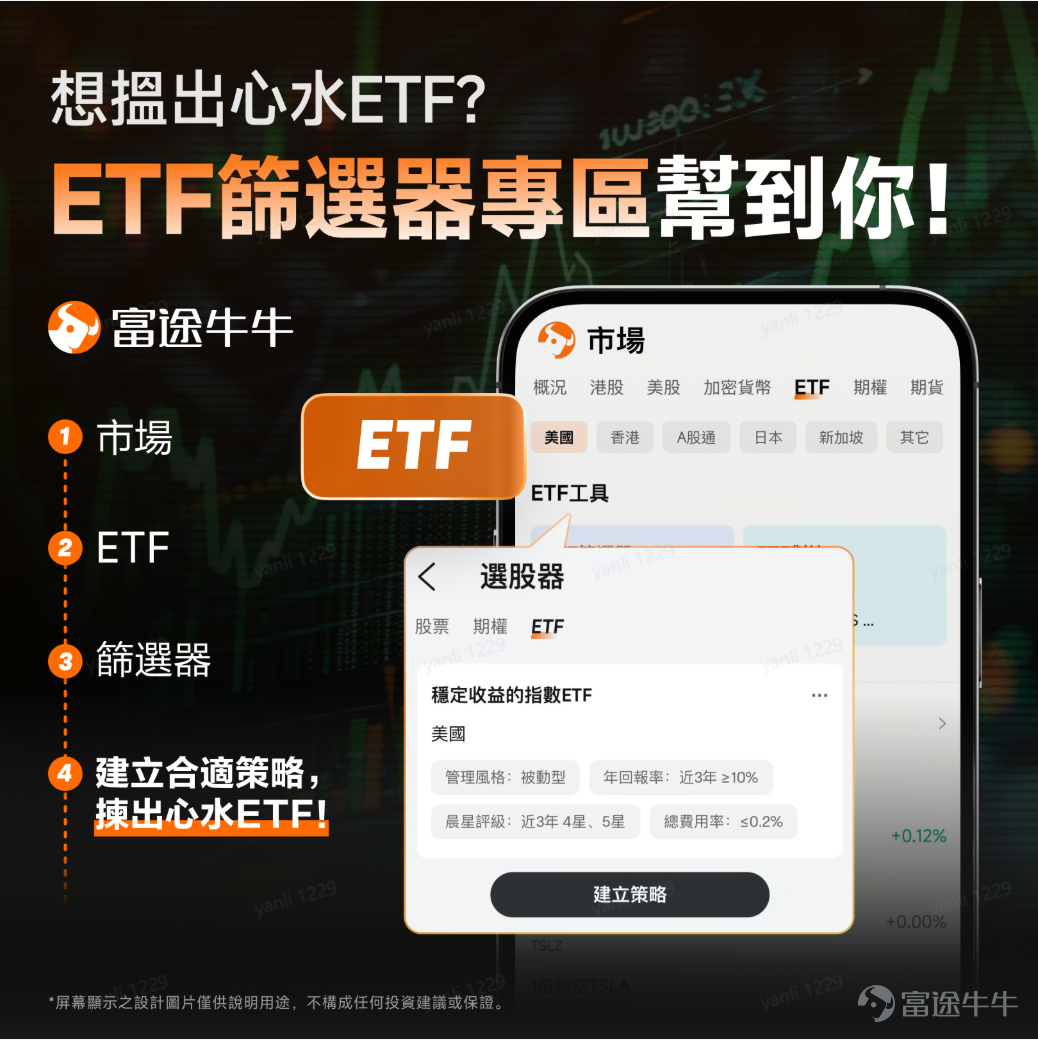
Dedicated ETF section: no need to search endlessly through the market yourself

The hardest part of investing is often not missing opportunities, but rather:Fear of buying right before a drop, fear of chasing highs, fear of getting stuck in a losing position.
ETFs may not eliminate all risks, but they can spare you from having to perfectly time the bottom or bet everything on a single stock.
If you're still not confident, you can start with these four steps:
Add to watchlist → Make small trial trades → Buy in stages → Gradually deepen your understanding
Which type of ETF are you most interested in right now?
Is it the S&P 500, Nasdaq-100, AI memory chips, Hong Kong covered call ETFs, or the 3x leveraged Nasdaq long ETF?
Feel free to leave a comment sharing your thoughts and biggest concerns.
The above content is for discussion and investment education purposes only and does not constitute investment advice or an offer to buy or sell securities. Investing involves risk; ETF prices may rise or fall, and past performance is not indicative of future returns.
Risk Disclaimer: The above content only represents the author's view. It does not represent any position or investment advice of Futu. Futu makes no representation or warranty.Read more

Comments
to post a comment
5
5