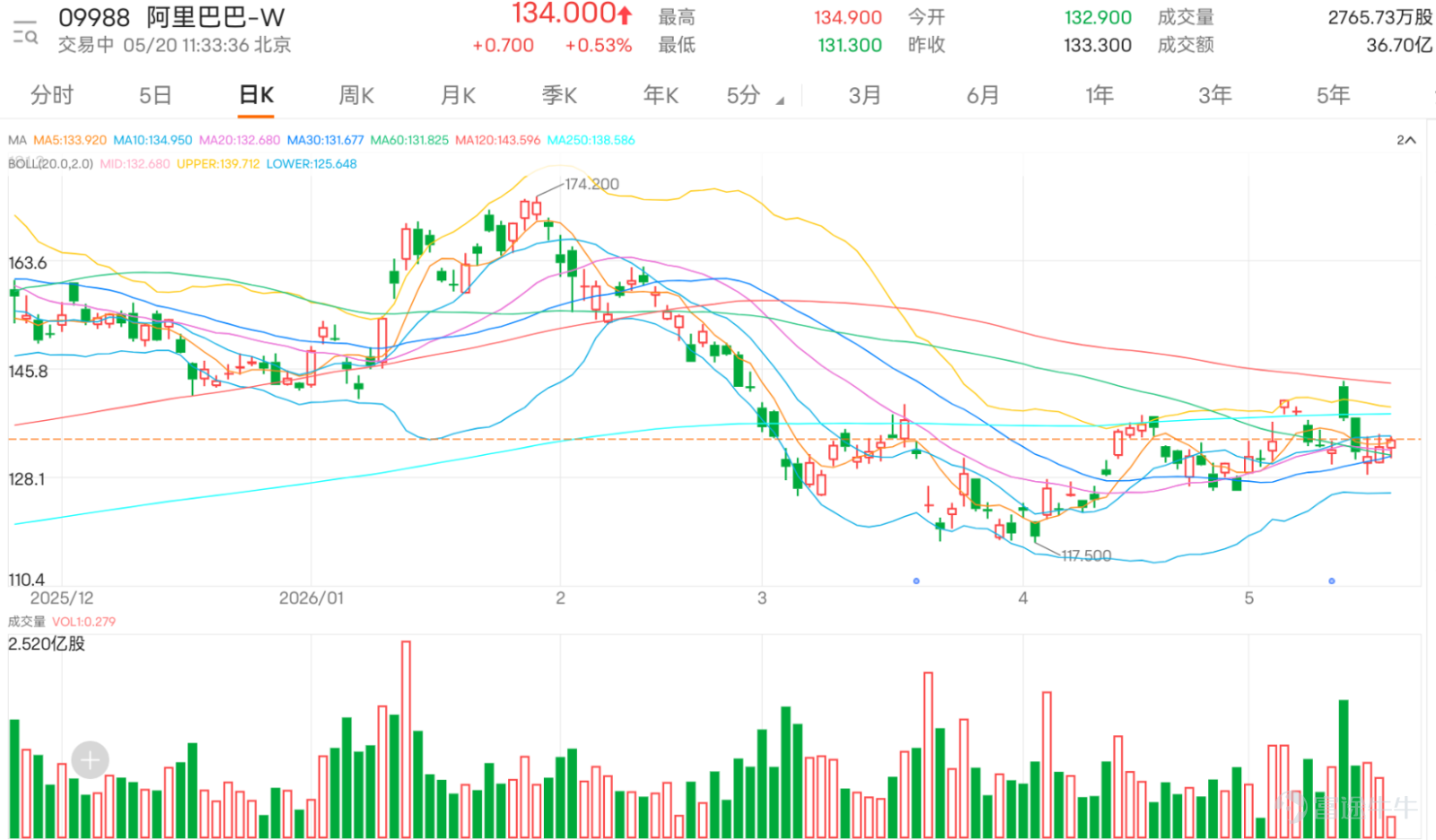

Alibaba has returned to the Bollinger Band midline; retail investors are waiting for AI cloud news to take effect, but without breaking above HK$134.93, it cannot yet be considered a genuine strengthening.
$BABA-W (09988.HK)$ Currently trading at HK$134, the short-term trend has improved slightly compared to earlier, but it has not yet reached a true strengthening phase. The share price has just moved back above the Bollinger Band midline of HK$132.775, indicating some recovery from weakness. However, the current price remains below the 10-day moving average of HK$134.930, reflecting persistent near-term resistance overhead. From investor comments, market sentiment is not uniformly bullish but rather a mix of anticipation, skepticism, impatience, and waiting for news. Bulls view Alibaba as China’s AI leader, believing that developments in its AI cloud business and Qwen-related news could serve as catalysts for revaluation. Bears or those on the sidelines argue the rally lacks momentum, volume is shrinking, the rebound feels insufficient, and some are still waiting for levels around HK$126, HK$127, or even HK$120 before considering entry.
This comment pattern shows Alibaba is currently not a consensus strong stock widely chased by the market, but rather in a recovery phase driven by news expectations. Among bullish comments, the most representative sentiment centers on AI and cloud businesses. For example, some investors directly cite Alibaba’s status as China’s AI leader as their reason for going long, while others mention Qwen’s ranking on Arena and Alibaba Cloud’s continued leadership in China’s AI cloud market share. These remarks reflect investors’ attempts to link Alibaba’s recent short-term price rebound to the core narrative of AI cloud, model capabilities, and cloud market share. In other words, the market is searching for a rationale to prove Alibaba is not merely a traditional e-commerce stock, but a tech platform once again worthy of an AI-driven valuation premium.
However, this bullish sentiment has not yet fully translated into strong price action. Although Alibaba’s current price is above both the 20-day moving average (HK$132.775) and the 30-day moving average (HK$131.147), it remains below the 10-day moving average of HK$134.930. This indicates the stock has recovered from a weaker position back above the midline, but still hasn’t broken through the most immediate short-term resistance. Merely holding above HK$132.775 suggests only modest technical repair; for short-term capital to gain greater confidence, the price must break above HK$134.930 and stabilize there, creating conditions to potentially challenge HK$139.947.
A common question in comments is whether Alibaba has truly begun a breakout. Many investors post messages like “about to launch,” “you’re the strongest today,” or “go up!”—some even expect daily gains of 1% and raise medium-term targets significantly higher. This reflects high expectations among existing holders. However, from a technical perspective, a true breakout isn’t confirmed by a single day’s rise alone—it requires breaking above HK$134.930. That level coincides with the current 10-day moving average and serves as the key confirmation point for a short-term rebound. Until this level is breached, the price may simply oscillate between HK$132 and HK$135.
The second common question concerns whether upcoming news is sufficient to drive the stock price. Comments frequently reference the Cloud Conference, major announcements, Qwen, and Alibaba Cloud’s AI market share, clearly showing that short-term market focus is squarely on AI cloud and model-related news. Such developments can improve sentiment—especially now that Alibaba’s price has just returned above the Bollinger Band midline. If accompanied by expanding trading volume, these catalysts could indeed push the price toward HK$134.930 and further toward HK$139.947. However, today’s trading volume showed no significant increase; it was notably lower than recent high-volume days and remained moderately flat. In other words, the price rise so far lacks strong volume confirmation, indicating capital isn’t rushing in broadly. If volume fails to pick up even after news materializes, the rebound may remain capped by short-term resistance.
The third question is whether it’s still reasonable to wait for lower entry points like HK$126, HK$127, or even HK$120. Some investors say they’ll buy only at HK$126 or HK$127, while others believe HK$120 is a good entry zone. This shows many onlookers are unwilling to chase at current levels and prefer to wait for a pullback. Technically, Alibaba’s first support level is at HK$130.500, followed by the Bollinger Band lower band at HK$125.603. Only if the price falls back below the midline (HK$132.775) and then breaks below HK$130.500 would it likely test the HK$125.603 area again. Thus, while HK$126 isn’t entirely without technical relevance, it assumes the price first retreats below the midline and loses HK$130.500. Without that signal, waiting directly for HK$126 can only be viewed as a relatively conservative dip-buying strategy.
Among bearish and wait-and-see comments, the most evident sentiment is dissatisfaction with the insufficient upside. Some investors remarked, 'A one-point gain isn’t satisfying,' while others asked, 'Is the grinding over yet?' or noted, 'This modest move barely reaches 200, does it?' Some even stated they had already exited their positions. This reflects that Alibaba has failed to deliver adequate returns to holders over the recent period, so despite today’s price increase, market confidence has not been fully restored. Another group of comments expressed concern that the stock might pull back tomorrow or after news releases, suspecting the late-session rally was merely a trap to lure buyers chasing the stock. Such skepticism aligns with trading activity—since the rebound hasn’t been accompanied by a clear surge in volume, investors naturally worry the uptrend may be short-lived.
Technically, the most critical level to watch for Alibaba right now is the pivot at HK$132.775. The current price of HK$133.300 is just above this level, indicating that in the short term, the stock has moved back from a weaker zone toward the mid-Bollinger Band. If the price can hold steady above HK$132.775 over the next one to two trading sessions, market confidence in a price recovery will strengthen. A breakout above HK$134.930 would significantly improve the short-term technical structure, setting the next target at HK$139.947. Conversely, if the price falls back below HK$132.775, the brief advantage of returning to the midline would vanish; and if it further breaks below HK$130.500, the short-term trend would turn weak again, with support to watch near HK$125.603.
The Relative Strength Index (RSI) stands at approximately 49.386, reflecting a neutral reading with no clear sign of strength yet. This suggests Alibaba isn’t weak enough to be out of control, but also not strong enough to confirm the start of a new upward cycle. For the market to shift from观望 (wait-and-see) to active participation, it needs not only supportive catalysts like AI Cloud and Cloud Conference news, but also a decisive break above HK$134.930 accompanied by higher trading volume. Otherwise, the divergence seen in retail investor comments will persist: bulls will keep hoping for an AI-driven re-rating, bears will continue waiting for a drop to the HK$126–HK$127 range, and existing holders will remain trapped by overhead resistance near HK$138–HK$139.
Overall, Alibaba’s short-term risk-reward profile remains neutral. The current price has just moved back above the middle Bollinger Band—a mildly positive repair signal—but since it hasn’t yet broken through the 10-day moving average at HK$134.930 and trading volume hasn’t noticeably expanded, it’s premature to conclude a full-strength reversal. A more prudent strategy is to first monitor whether HK$132.775 holds as support. If it stabilizes and then breaks above HK$134.930, the rebound confirmation would strengthen, potentially driving the price toward the next target of HK$139.947. However, if it drops below HK$132.775 and further breaches HK$130.500, that would signal a failed recovery, likely pushing the price down toward HK$125.603. At this stage, Alibaba’s narrative is generating more buzz than its price action, but the decisive factor for short-term direction remains whether HK$134.930 can be convincingly breached.May 19 [HK Stock Podcast] Part 2 – CNOOC, Alibaba, Xi Yu

Key trading levels: In the short term, first watch whether HK$132.775 can hold as support—holding here allows for a rebound play; a breakout above HK$134.930 would set the stage to target HK$139.947; if the price breaks below HK$132.775 and further loses HK$130.500, it could retest support near HK$125.603.
Strategy 1 | Rebound play if HK$132.775 holds as support
$UBALIBA@EC2609B.C (26544.HK)$ | Strike Price: HK$145.98 | Effective Leverage: 6.3x | Strike price ~9.5% above current price, relatively close to spot—suitable for capturing short-term rebounds after price stabilizes above the Bollinger midline, offering direct sensitivity.
$BPALIBA@EC2609C.C (26771.HK)$ | Strike Price: HK$145.95 | Effective Leverage: 6.4x | Similar terms but slightly higher leverage—ideal for short-term plays targeting a bounce from above HK$132.775 toward the HK$134.930 resistance zone.
$UBALIBA@EC2609E.C (27406.HK)$ | Strike Price: HK$150.98 | Effective Leverage: 7.3x | Higher strike price with greater elasticity; suitable for chasing upside momentum after rebound strength improves, but avoid using before the price stabilizes above HK$132.775
Strategy 2 | Enter long on a breakout above HK$134.930 to confirm recovery
$UBALIBA@EC2608F.C (26538.HK)$ | Strike Price: HK$150.09 | Effective Leverage: 7.7x | Strike price is approximately 12.6% above current price, offering high elasticity; suitable for capturing upward momentum toward HK$139.947 after breaking above HK$134.930
$BIALIBA@EC2608E.C (26562.HK)$ | Strike Price: HK$150.09 | Effective Leverage: 8.1x | Higher leverage; suitable for short-term momentum chasing after breakout, with emphasis on maintaining the stock price above HK$134.930
$HSALIBA@EC2611B.C (28972.HK)$ | Strike Price: HK$160.00 | Effective Leverage: 5.8x | Higher strike price but longer time to expiry; suitable for retaining more time value after breakout confirmation, better aligned with expectations of sustained recovery
Strategy 3 | Deploy short positions if price falls below HK$130.500, targeting a test of HK$125.603
$UBALIBA@EP2607C.P (26011.HK)$ | Strike Price: HK$127.28 | Effective Leverage: 7.3x | Strike price near key support zone below; suitable for capturing short-term downside momentum toward HK$125.603 after breaking below HK$130.500
$CIALIBA@EP2607A.P (24526.HK)$ | Strike Price: HK$127.38 | Effective Leverage: 7.6x | Higher leverage; suitable for chasing weakness after confirming a break below HK$130.500, but risk must be managed if price rebounds above HK$132.775
$UBALIBA@EP2608A.P (26410.HK)$ | Strike Price: HK$132.78 | Effective Leverage: 5.2x | Strike price closer to current price, offering more immediate sensitivity to initial weakness; suitable for early deployment after breaking below the midline, rather than waiting until price approaches HK$125.603
Reply to investor inquiries
@小牛668: About to kick off! To confirm initiation, step one is holding firmly above HK$132.775, and step two is breaking above HK$134.930.
@24633200: It won't rise much at once—just 1% daily would take it to NT$260 in three months. For short-term trading, don't look too far ahead; the share price first needs to break above NT$134.930 before it can realistically challenge NT$139.947.
@18632969: Strong support. Wait for it to test NT$127 first. NT$127 is close to the lower support zone at NT$125.603, but this level will only become more meaningful after the price drops below NT$130.500.
@32298170: There are many open short positions. If these shorts haven’t been covered yet, a breakout above NT$134.930 could trigger short-covering rallies; if the breakout fails, downward pressure from these short positions will persist.
@15097918: Around NT$120 is a possible entry point. NT$120 is below current technical support levels. In the short term, focus first on NT$130.500 and NT$125.603—don’t jump straight to NT$120.
Feel free to share your insights in the comment section. For more market analysis, please continue following ‘Hong Kong Stock Warrants Jenny’ for daily updates!
Reminder: This article does not constitute any investment advice.
This article is for reference only and does not constitute any investment advice. Market data, opinions, and analysis contained herein may change at any time without prior notice. We are not responsible for any loss or damage caused by reliance on the information in this article. Technical analysis only shows whether certain technical conditions are met; asset performance should be comprehensively evaluated using other sources of information, and trading decisions should not be made solely based on this article. Please note that past performance is not indicative of future results.
#HKStocks #RealTimeAnalysis #WarrantPick #WarrantGuide #DerivativesHedging #HKWarrantsJenny #Alibaba #09988 #BlueChipStocks #TechnicalAnalysis
Risk Disclaimer: The above content only represents the author's view. It does not represent any position or investment advice of Futu. Futu makes no representation or warranty.Read more
Comment (1)
to post a comment