
Zhipu AI's market cap surpasses HK$1 trillion! Is China's AI sector at a structural turning point?

Hua Hong Semiconductor rebounded strongly, breaking through the midline level of HK$117.9, with technical indicators turning from weak to strong; short-term resistance seen at HK$127
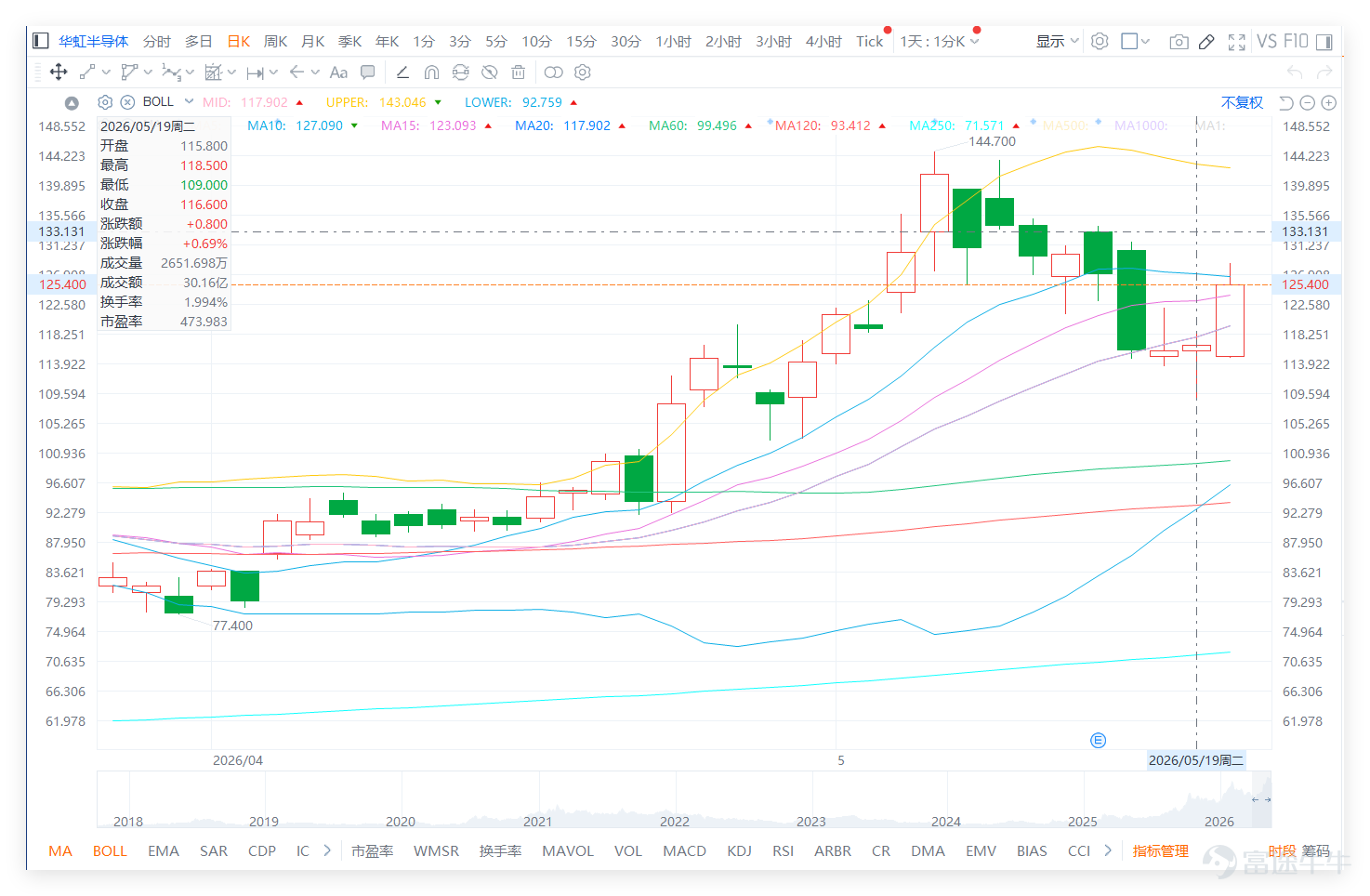
$HUA HONG GRACE (01347.HK)$ It closed at HK$116.600 the previous day (19th), entering a consolidation phase after retreating from recent highs.
Although the share price remains above the 30-day moving average of HK$108.583, it has fallen below both the 10-day moving average of HK$127.090 and the 20-day moving average of HK$117.902, indicating a clear cooling of the prior short-term strength following its sharp rally. The previous day's closing price of HK$116.600 dropped below the middle Bollinger Band at HK$117.902, shifting the short-term trend from strong to weak consolidation. Until the price reclaims and stabilizes above HK$117.902, any rebound should be viewed merely as technical correction following the pullback from highs, insufficient to confirm renewed strength.

Huahong Semiconductor’s technical signal is 'Neutral' (consolidating with a bearish bias). Compared to peers, $SMIC (00981.HK)$ it closed at HK$68.50, with an RSI around 45 (slightly weak), and a technical signal of 'Neutral' (range-bound with softness). This indicates the semiconductor sector as a whole is in a 'high-level correction' phase. Although Huahong shows willingness to rebound, its recovery is constrained by sector leaders like SMIC, which have yet to regain strength, leaving the sector lacking broad upward momentum and making short-term recovery more difficult.

Market sentiment toward Huahong is clearly split. Bulls still believe Huahong is one of the more explosive stocks in the semiconductor sector. Some investors see the HK$110 level as a buying opportunity on dips, while others anticipate a reversal signal followed by a rally toward HK$120, HK$125, or even a return to HK$144. These comments reflect that, despite the recent sharp run-up from lows, many retail investors still regard Huahong as a strong performer undergoing only a short-term correction. On the other hand, bearish comments are highly concentrated, with market participants worried this is merely distribution following a sharp rally. If HK$110 fails to hold, they expect prices to fall to HK$100—or even lower targets like HK$95, HK$90, or HK$80. This shows that market divergence over Huahong has shifted from 'whether it will keep rising' to 'whether HK$110 can hold.'
Among bullish comments, a representative view is that below HK$110 is an accumulation zone. Some note that the drop from the high of HK$144 to around HK$110 is already substantial, and since fundamentals haven’t changed significantly, prices below HK$110 should be seen as a good entry point. Others have already started building positions at HK$110, viewing the dip as a rebound-buying opportunity. This dip-buying rationale has some technical merit: Huahong’s current price of HK$116.600 remains above the 30-day moving average of HK$108.583, and the range between HK$109.000 and HK$108.583 represents the key short-term support zone. As long as this zone holds, the price action can still be interpreted as consolidation after a sharp rally—not a full-fledged weakening trend.
However, bulls should note that Huahong is no longer in a strong uptrend but has already broken below the Bollinger Band midline and is now awaiting recovery. The midline currently sits at HK$117.902, and the previous day’s close of HK$116.600 was below this level, indicating the stock has not yet returned to a healthier range. If the price continues oscillating between HK$110 and HK$117, it remains in weak consolidation. Only if it can break back above HK$117.902 will it have the conditions to recover toward HK$127.090. In other words, for those targeting HK$125 or HK$127, the first step isn’t merely holding above HK$110—it’s reclaiming and stabilizing above HK$117.902.
Bearish comments primarily focus on three key points.
First, many believe Huahong Semiconductor’s recent rally was too sharp, and the capital that pushed the price up earlier still holds substantial profits—meaning any pullback could simply be distribution rather than a genuine reversal.
Second, there are concerns about the HK$110 support level breaking down. Many comments note that if the stock fails to hold HK$110, it could quickly drop to HK$100, or even further to HK$95 or HK$90.
Third, there is skepticism regarding valuation and trading volume—for example, some point out low turnover, excessive valuation, and suggest that bullish commentary from institutions might actually signal an opportunity for them to offload shares.
While these views carry emotional bias, they clearly reflect the typical market fear surrounding sharply rallied stocks pulling back from highs: retail investors dread being the last ones holding the bag.
Technically, Huahong’s most critical support zone lies between HK$109.000 and HK$108.583. HK$108.583 coincides with the 30-day moving average and is key to maintaining its short-to-intermediate-term structure. If this zone holds, Huahong can sustain its high-level consolidation pattern and potentially rebound toward HK$117.902 and then HK$127.090. However, if it breaks below HK$108.583—losing even the 30-day moving average—the near-term downtrend will likely extend further, with attention shifting to support near HK$102.468. Comments frequently mentioning HK$100, HK$103, and HK$95 reflect the market’s preemptive pricing of downside scenarios once HK$110 support fails.
On the resistance side, HK$117.902 is the first critical threshold that must be reclaimed. Yesterday’s closing price of HK$116.600 is close to this level, but proximity alone isn’t enough—it must demonstrate sustained strength above it. Only if the share price breaks back above HK$117.902 will the market sentiment gradually shift from 'high-level correction' to 'technical recovery.' A subsequent break above HK$127.090 would indicate short-term conditions have genuinely improved, opening the door to higher targets. Levels such as HK$143.046 and the prior high of HK$144.700 remain distant objectives for now; discussing a return to those highs is premature until both HK$117.902 and HK$127.090 are firmly reclaimed.
Regarding volume, recent turnover has noticeably declined compared to the earlier surge phase, indicating a period of low-volume consolidation. This carries dual implications. Positively, the pullback from recent highs hasn’t triggered extreme volume spikes, suggesting no panic selling has emerged yet. Negatively, rebounds have lacked strong volume confirmation, implying limited buying interest in the short term. If Huahong only stages a low-volume bounce toward HK$117–HK$120, caution is warranted as selling pressure may reappear overhead. A more credible recovery would require both a decisive move above HK$117.902 and clear volume support—otherwise, the rally lacks conviction.
Comments from观望 (wait-and-see) traders best reflect retail investor stress. Some ask whether they should cut losses or switch positions if holding at HK$139, while others wonder how much further the stock might fall—could it drop to HK$100? Is this a 'catching-a-falling-knife' situation? Underlying these questions is significant psychological pressure faced by those who bought near the top after Huahong plunged sharply from its peak of HK$144.700. For investors holding around HK$139, expecting a quick return to breakeven is unrealistic—the current price is far from cost basis, and HK$127.090 and HK$143.046 remain major resistance levels. Even if the stock rebounds only to HK$117.902 or HK$127.090 in the near term, risk management should involve staged exits rather than waiting passively for a full recovery to HK$139.
Common market questions include: First, is it safe to buy the dip near HK$110? Technically, the HK$109.000–HK$108.583 zone is indeed a key support area—if it holds, small-position speculative buying for a bounce has technical merit. However, since the price remains below HK$117.902 and hasn’t confirmed strength, heavy positioning is inadvisable. Second, could the stock reach HK$100? If HK$108.583 breaks, the next support shifts to HK$102.468, heightening market anxiety about a test of HK$100. Third, can it reclaim HK$125 or HK$130? To target HK$125, the stock must first break above HK$117.902 and move toward HK$127.090; without even stabilizing above HK$117.902, any talk of HK$125+ remains mere hopeful speculation.
Overall, Huahong Semiconductor offers a neutral-to-low risk-reward profile in the near term. The share price remains above the 30-day moving average, suggesting its short-to-intermediate structure hasn’t fully broken down—but having already breached both the 20-day moving average and the Bollinger Bands midline, its prior strength has clearly cooled. Strategically, the immediate focus is whether the HK$109.000–HK$108.583 support zone holds. If it does—and the stock subsequently reclaims HK$117.902—a recovery toward HK$127.090 becomes feasible. Conversely, a break below HK$108.583 would extend weakness, directing attention to HK$102.468. Huahong isn’t devoid of rebound potential, but not every decline should be treated as a buying opportunity at this stage. The definitive confirmation of a shift from weakness to strength remains a sustained close above HK$117.902, while the key risk threshold is HK$108.583.
Latest update (as of the morning of May 20):
Huahong Semiconductor is currently trading at HK$125.700, up sharply by approximately 7.80%. It has successfully broken through the key resistance at HK$117.90 and is approaching HK$127.09 (the 10-day moving average). This indicates a strong V-shaped rebound in the short term, shifting the technical posture from 'consolidation with weakness' to 'robust recovery.' If it can stabilize above HK$127, further short-term recovery becomes likely.
Reply to some investors' views:
@精明能幹的卡瑞達: Next stop is 144
HK$144 is near the previous high. Before revisiting this target, the stock must first reclaim HK$117.902 and HK$127.090.
@大灣區金融遺址: Luckily just switched over from SMIC and waiting for the signal to turn green
Hua Hong exhibits greater volatility than SMIC, but it has not yet stabilized above HK$117.902; risk management remains essential even after switching brokers.
@20160918: Rising to HK$125
To reach HK$125, the stock must first break above HK$117.902; only then will it be positioned to challenge the nearby resistance at HK$127.090.
Based on the above analysis, the strategies for deployment can be divided into the following main approaches:
Key trading levels: The HK$109.000–HK$108.583 range serves as short-term support. Holding above this zone allows for a rebound play targeting a recovery above HK$117.902. A breakout above HK$127.090 would signal improved rebound momentum. However, a drop below HK$108.583 could extend weakness toward approximately HK$102.468.
Strategy 1 | Play rebound after holding above HK$109
$UBHUAHO@EC2608A.C (24990.HK)$ | Strike price: HK$140.09 | Effective gearing: 4.3x | The strike price is about 20% above the current share price, offering higher elasticity—suitable if the stock holds the HK$109 support and rebounds toward reclaiming HK$117.902.
$GJHUAHO@EC2607A.C (27277.HK)$ | Strike price: HK$116.98 | Effective gearing: 4.6x | The strike price is close to the current share price, better suited for capturing a short-term bounce—but only if the stock does not fall below HK$108.583, not for chasing in a weak market.
$BIHUAHO@EC2607C.C (24321.HK)$ | Strike price: HK$127 | Effective gearing: 4.9x | The strike price is near the next rebound target of HK$127.090—ideal for short-term recovery plays toward resistance after the stock rebounds from support levels.
Strategy 2 | Chase technical recovery after breaking above HK$117.902
$UBHUAHO@EC2608A.C (24990.HK)$ | Strike price: HK$140.09 | Effective gearing: 4.3x | Suitable for chasing momentum after surpassing the key pivot level; the product’s elasticity sufficiently supports a move from a weak zone back toward HK$127.090.
$BIHUAHO@EC2608B.C (24790.HK)$ | Strike price HK$140.09 | Effective leverage 4.6x | Also offers relatively high elasticity and is better suited for short-term momentum plays after a breakout above HK$117.902, making it more aggressive than lower-leverage products.
$MBHUAHO@EC2609A.C (27192.HK)$ | Strike price HK$136.888 | Effective leverage 3.8x | Features milder leverage, suitable for investors seeking exposure to a breakout recovery without taking on excessive volatility risk.
For more market analysis, stay tuned to Jenny's daily updates on 'Hong Kong Stock Warrants'!
Reminder: This article does not constitute any investment advice.
This article is for reference only and does not constitute any investment advice. Market data, opinions, and analysis contained herein may change at any time without prior notice. We are not responsible for any loss or damage caused by reliance on the information in this article. Technical analysis only shows whether certain technical conditions are met; asset performance should be comprehensively evaluated using other sources of information, and trading decisions should not be made solely based on this article. Please note that past performance is not indicative of future results.
#HKStocks #HuaHongSemiconductor #Real-TimeAnalysis #WarrantSelection #WarrantGuide #DerivativesHedging #HKWarrantsJenny #Blue-ChipStocks #TechnicalAnalysis
Risk Disclaimer: The above content only represents the author's view. It does not represent any position or investment advice of Futu. Futu makes no representation or warranty.Read more


Comments (2)
to post a comment
5