
Hong Kong Market Barometer: CPO, PCB, and memory stocks rally in rotation! Are you on the right trai

Baidu's AI-driven optimism struggles to overcome technical resistance; HK$133.7 becomes the key short-term level for bulls vs. bears
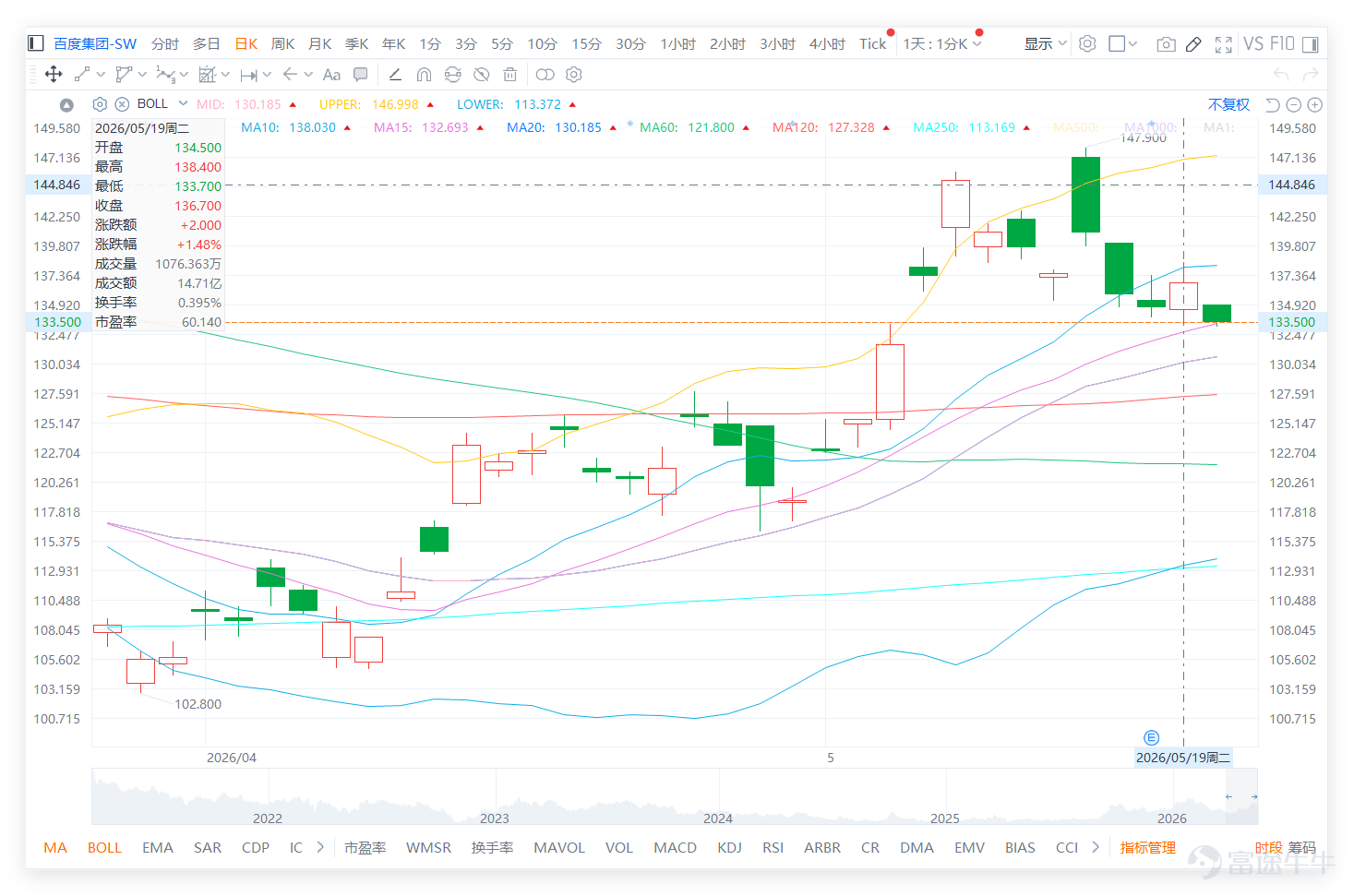
$BIDU-SW (09888.HK)$ It closed at HK$136.700 on the previous day (19th), currently consolidating after a short-term rebound. The share price remains above the 20-day moving average of HK$130.185 and the 30-day moving average of HK$124.777, indicating that the prior rebound structure hasn’t been fully broken. However, the price of HK$136.700 is below the 10-day moving average of HK$138.030, reflecting a cooling of short-term momentum.

Baidu’s technical signal is 'Buy' (consolidating, awaiting direction). Compared with peers, $TENCENT (00700.HK)$ Closed at HK$460.00, with RSI around 35 (relatively weak); $BABA-W (09988.HK)$ Closed at HK$133.30, with RSI around 50 (neutral); $MEITUAN-W (03690.HK)$ Closed at HK$83.05, with RSI around 46 (relatively weak). This indicates that large-cap internet stocks are generally in a 'consolidation and bottom-building' phase. Baidu's RSI is relatively higher compared to peers, suggesting that market expectations around its AI potential are still being priced in, but without strong sector-wide momentum, a breakout remains challenging.

Investor comments reveal a highly divided market view on Baidu. On one hand, bulls argue that Baidu is being repriced along the AI theme, citing Kunlun Chip, Apollo Go (‘Luobo Kuaipao’), and rising AI-related revenue as reasons for potential catch-up gains. On the other hand, bears point to Baidu’s weak price action, low trading volume, and insufficiently differentiated AI competitiveness, even expressing concerns about the entire US-listed China tech sector lacking pricing power. This sentiment mix shows Baidu is not entirely weak but has yet to enter a strong upward phase.
The core bullish argument centers on whether Baidu can once again be viewed by the market as one of China’s key AI plays. Some investors believe Baidu already belongs in the ‘AI cohort’ and should strive to shine; others compare Baidu with Alibaba, Zhipu AI, and other AI-themed names, arguing that Baidu’s share price and valuation still have room to catch up. Notably, some comments highlight that core AI-related revenue reached RMB 13.6 billion, accounting for 52% of Baidu’s total non-GAAP revenue—the first time it has exceeded half. Such data reinforces bullish conviction that Baidu is no longer just an old-school search company but is now being fundamentally supported by its AI business. This is currently the most important market narrative for Baidu.
However, bullish sentiment has not yet fully translated into strong price performance. Baidu closed yesterday at HK$136.700, still above the middle Bollinger Band at HK$130.185, but failed to break above the 10-day moving average at HK$138.030. This level represents the first key hurdle for sustaining a short-term rebound. If the share price can decisively break above HK$138.030, market confidence in AI-driven re-rating and catch-up potential would strengthen, opening the door to test the next resistance near HK$146.998. Conversely, if the price continues to stall around HK$138, investor skepticism—expressed as ‘so weak,’ or ‘what kind of gain is this?’—will persist.
Bearish comments primarily focus on Baidu’s lackluster rebound strength. Some investors bluntly described it as ‘very weak,’ ‘this weak,’ or ‘what kind of rally is this?,’ reflecting dissatisfaction with Baidu’s performance yesterday. This disappointment aligns with trading volume trends: recent volume has notably declined compared to prior high-volume days, indicating a period of consolidation on reduced volume. Although the stock rebounded slightly yesterday, the absence of significant volume expansion suggests the move lacks strong institutional or smart-money support. For short-term traders, an AI-related stock showing only a modest bounce without clear breakout volume is easily viewed as a laggard that hasn’t truly ignited.
Another group of bearish comments questioned the competitiveness of Baidu’s AI narrative. Some argued that Zhipu AI sees higher usage than Baidu, others doubted the moat of foundational model companies, and some noted that Baidu’s search business remains under pressure, casting doubt on whether AI-related revenue will be sufficient to justify a valuation re-rating. These comments reflect that the market isn’t failing to grasp Baidu’s AI concept, but rather remains skeptical about whether Baidu can translate this AI story into sustained growth. Precisely for this reason, Baidu needs to convince the market through a decisive breakout in its share price—not just through news or concepts alone. Technically, that convincing level is RMB 138.030.
Comments reflecting a wait-and-see attitude better capture the true sentiment of short-term retail investors. Some asked whether Baidu is about to turn around, while others pressed for clarity on which direction it might take; some focused on high short interest, while others noted low trading volume and turnover. Underlying these questions is a market still lacking clear direction. Although Baidu’s current price sits above both its 20-day and 30-day moving averages—indicating it hasn’t yet weakened—it has also failed to break above its 10-day moving average, leaving investors uncertain whether this consolidation represents a pause within an ongoing uptrend or a gradual weakening following a rebound.
Technically, Baidu’s current support levels stand at RMB 133.700, RMB 130.185, and RMB 124.777. RMB 133.700 serves as the immediate short-term support—if this level holds, the stock still has room to consolidate above the mid-Bollinger Band. RMB 130.185 is more significant, aligning with both the mid-Bollinger Band and the 20-day moving average. If the price breaks below RMB 133.700 and then loses RMB 130.185, it would signal weakening in the rebound structure, shifting focus downward to RMB 124.777. In other words, Baidu’s technical setup hasn’t deteriorated yet, but its margin for error is now concentrated in the zone between RMB 133.700 and RMB 130.185.
On the upside, HK$138.030 is the immediate short-term pivot point. Yesterday’s close at HK$136.700 is close to this level, but without a confirmed breakout, the rebound remains unconvincing. A sustained move above HK$138.030 could pave the way for a retest of HK$146.998—the upper Bollinger Band and the next target if the short-term rally extends. To meet market hopes for a push toward HK$150, Baidu must first clear the HK$138 barrier; otherwise, HK$150 remains merely an emotional target rather than a technical one.
The Relative Strength Index (RSI) stands at approximately 55.435—neutral-to-bullish—but has cooled off from earlier highs. This suggests Baidu is not in a weak position and retains more stable momentum than many other tech and internet stocks, yet it hasn’t entered a strongly bullish state either. If the RSI can rise in tandem with a breakout above RMB 138.030, the short-term recovery would carry greater conviction. However, if the price continues to trade sideways near RMB 138 on low volume, momentum may keep declining, prompting renewed market focus on the support levels at RMB 133.700 and RMB 130.185.
In terms of trading volume, Baidu’s biggest issue right now is the lack of noticeable expansion during the rebound. The prior decline from recent highs didn’t see extreme volume spikes, suggesting selling pressure hasn’t yet reached panic levels—a positive sign. However, the rebound has similarly lacked volume expansion, indicating limited buying enthusiasm. This low-volume consolidation pattern is best managed by focusing strictly on key support and resistance boundaries rather than prematurely predicting a major rally or sell-off. Only a hold above RMB 133.700 combined with a breakout above RMB 138.030 would signal buyers regaining control; conversely, a break below RMB 133.700 would raise concerns about a test of RMB 130.185.
Overall, Baidu’s short-term risk-reward profile remains neutral. The stock still trades above the mid-Bollinger Band, its structure intact, and the AI-driven re-rating narrative along with catch-up potential persists. However, until it breaks above RMB 138.030, chasing the stock offers only average value. The core market divergence centers on whether Baidu’s AI story can truly drive a valuation re-rating. Bulls believe Kunlun Chip, Apollo Go (‘Luobo Kuaipao’), and rising AI revenue contribution will attract fresh capital, while bears argue that Baidu’s underperformance, insufficient volume, and lack of pricing power among U.S.-listed Chinese stocks remain headwinds. Technically, resolving this divergence is straightforward: a break above RMB 138.030 extends the short-term rebound; a drop below RMB 133.700 weakens the rebound structure.
At this stage, the most prudent strategy is to monitor whether the RMB 133.700 support holds firm. If it holds and the price subsequently breaks above RMB 138.030, Baidu could test the RMB 146.998 area again, giving more substance to market hopes for RMB 150. Conversely, a break below RMB 133.700 would shift attention to the RMB 130.185 support level; if even that level fails, the short-term rebound structure would weaken significantly. Baidu still has a chance for an AI-driven re-rating, but it must first break above RMB 138 to genuinely transition from consolidation into a sustained rebound.
Latest update (as of the morning of May 20):
Baidu is currently trading at HK$134.100, down approximately 1.90%, nearing its first support level at HK$133.70. Comparatively, Tencent (00700) is trading around HK$459.00 (down ~0.22%), and Alibaba (09988) around HK$132.50 (down ~0.6%). This shows the broader internet sector is generally soft, and Baidu’s key support is now under pressure. A break below HK$133.70 would likely trigger a test of the middle Bollinger Band support at HK$130.19 in the short term.
Reply to some investors' views:
@Xiaoxiannv8: Large head-and-shoulders top
If it breaks below HK$130.185, downside risk will increase; until then, it remains in a consolidation phase requiring observation.
@31737798: short it
For shorting, a more ideal confirmation would come after breaking below HK$133.700. Currently, the price is still above the midline, so chasing shorts here offers only average risk-reward potential.
@只做期權: You pushed it this high—do you really have pricing power? It’ll just drop again tomorrow.
If it fails to break above HK$138.030, a pullback is indeed likely; only a breakout can shift the short-term sentiment.
Based on the above analysis, the strategies for deployment can be divided into the following main approaches:
Key deployment levels: HK$133.700 is short-term support. Holding above it allows waiting for a retest of HK$138.030 to play for continued rebound, with an upside target of HK$146.998 upon breakout. If it falls below HK$133.700, defend HK$130.185; a breach there would weaken the rebound structure.
Strategy 1 | Play for rebound after holding above HK$133.700
$UBBAIDU@EC2609A.C (28166.HK)$ | Strike price HK$140 | Effective leverage 4.6x | Strike price near upper resistance zone—suitable when share price holds above HK$133.700, betting on a short-term retest of HK$138.030–HK$140.
$UBBAIDU@EC2610A.C (27686.HK)$ | Strike price HK$151.21 | Effective leverage 4.5x | Strike price about 10% above current price—offers balanced risk and flexibility, suitable for staged deployment while the stock remains above the midline but hasn’t yet confirmed a breakout.
$BIBAIDU@EC2609A.C (28265.HK)$ | Strike price HK$140 | Effective leverage 4.8x | Better suited for capturing short-term bounces, deployed when the stock rebounds from around HK$133.700 and approaches the pivotal level of HK$138.030 again.
Strategy 2 | Enter long on breakout above HK$138.030 to capture continuation of rebound
$UBBAIDU@EC2607B.C (25832.HK)$ | Strike price HK$160.09 | Effective leverage 8.0x | High leverage—suitable for chasing momentum only after a clear breakout above HK$138.030; not recommended for heavy positioning before the breakout.
$HSBAIDU@EC2607E.C (25866.HK)$ | Strike price HK$160.09 | Effective leverage 7.9x | Also highly elastic—ideal for short-term trades aligned with breakout confirmation, targeting an upward move toward HK$146.998.
$UBBAIDU@EC2610A.C (27686.HK)$ | Strike price HK$151.21 | Effective leverage 4.5x | Moderate leverage—suited for investors seeking exposure to the upside after breakout while avoiding excessive volatility.
Strategy 3 | Switch to defensive or bearish stance after breaking below HK$133.700
$UBBAIDU@EP2607B.P (24276.HK)$ | Strike price HK$131.7 | Effective leverage 5.6x | Strike price just below HK$133.700—ideal for betting on a pullback toward HK$130.185 after breaching near-term support.
$BPBAIDU@EP2607B.P (24542.HK)$ | Strike price HK$131.9 | Effective leverage 5.8x | Bearish option close to support zone—best used when price breaks below HK$133.700 and fails to rebound.
$UBBAIDU@EP2607A.P (20739.HK)$ | Strike price HK$113.78 | Effective leverage 7.4x | Distant strike price with higher leverage—suitable for aggressive shorting only after a confirmed break below HK$130.185.
For more market analysis, stay tuned to Jenny's daily updates on 'Hong Kong Stock Warrants'!
Reminder: This article does not constitute any investment advice.
This article is for reference only and does not constitute any investment advice. Market data, opinions, and analysis contained herein may change at any time without prior notice. We are not responsible for any loss or damage caused by reliance on the information in this article. Technical analysis only shows whether certain technical conditions are met; asset performance should be comprehensively evaluated using other sources of information, and trading decisions should not be made solely based on this article. Please note that past performance is not indicative of future results.
#HKStocks #Baidu #Real-TimeAnalysis #WarrantSelection #WarrantGuide #DerivativesHedging #HKWarrantsJenny #Blue-ChipStocks #TechnicalAnalysis
Risk Disclaimer: The above content only represents the author's view. It does not represent any position or investment advice of Futu. Futu makes no representation or warranty.Read more

Comments
to post a comment
3