
Xiaomi announces a new HK$20 billion share buyback program—will the stock price get a boost?

The battle around HK$30 for Xiaomi is not over yet: retail investors are still waiting for earnings to rescue the market, but the odds of a meaningful rebound remain limited until the stock stabilizes above HK$31.
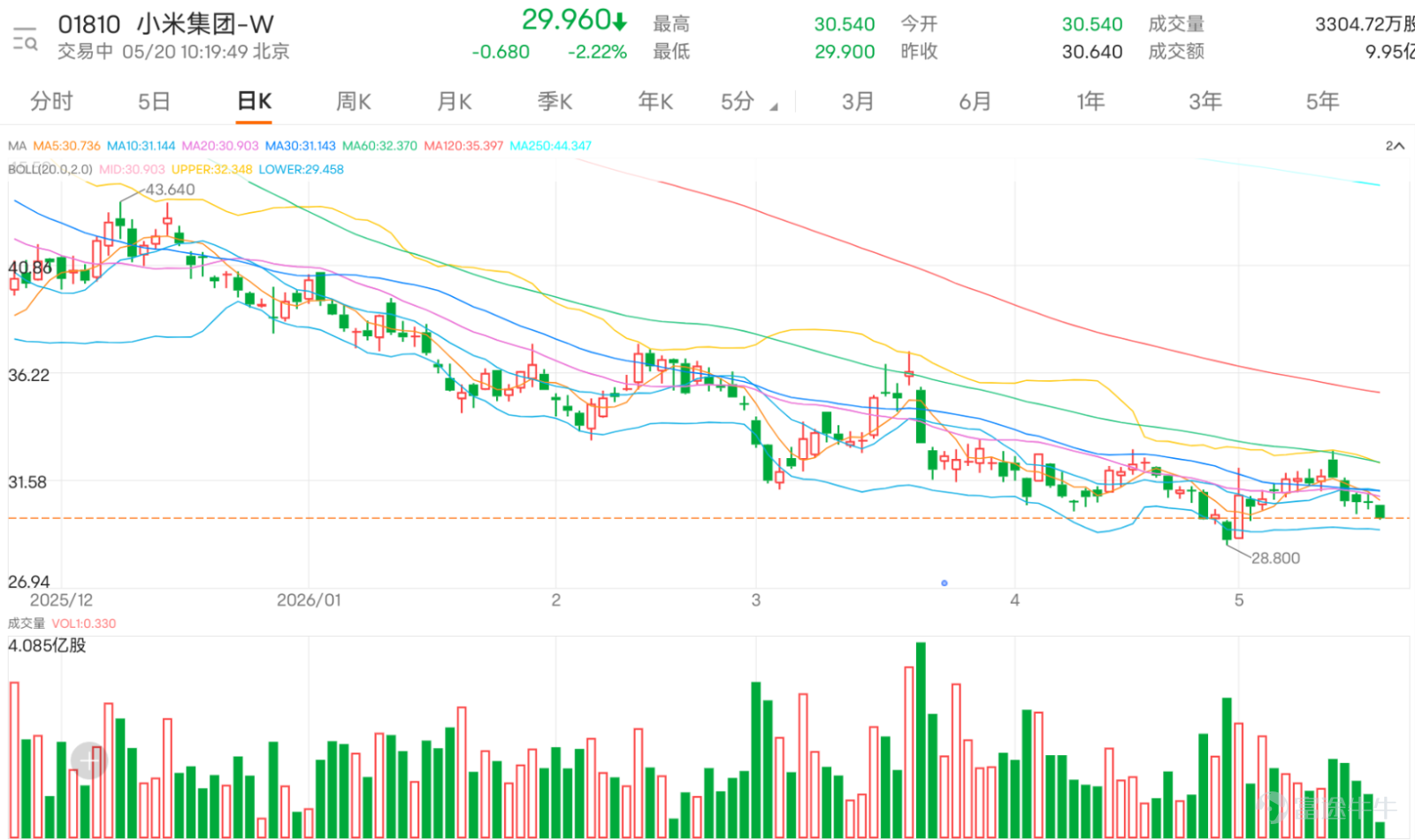
$XIAOMI-W (01810.HK)$ Current price is HK$29.96, and in the short term, the stock remains in a weak consolidation pattern. The share price is currently hovering around HK$30, but judging from technical structure and investor comments, market sentiment remains unstable, with retail investors clearly leaning toward disappointment, wait-and-see attitude, and awaiting catalysts. The key issue right now isn't whether Xiaomi will rebound, but whether any rebound can firmly re-establish support above the resistance zone of HK$31.025 to HK$31.230. Until the price reclaims this range, it will remain stuck in a weak trading band, insufficient to confirm a meaningful recovery.
Based on filtered comments, market views on Xiaomi are highly divided, though pessimism clearly outweighs optimism. Bullish arguments mainly fall into three categories: First, some investors believe the HK$30 level still offers buying value—for example, one comment mentioned buying at HK$30.48 and adding more if it drops further, reflecting that some retail investors still view the HK$30 area as a support zone. Second, some investors pin their hopes on upcoming earnings or other news, arguing that current low trading volumes stem from the market waiting for earnings, after which activity should pick up. Third, some note that Xiaomi has shown relative resilience amid broader market weakness, with a few even discussing whether a relatively complete head-and-shoulders bottom pattern is forming. These bullish comments indicate the market hasn’t entirely given up on Xiaomi, as a group of investors still believes the stock has defensive value near HK$30.
However, this bullish sentiment has not yet translated into strong buying pressure. Technically, Xiaomi’s current price remains below the 10-day moving average (MA) at HK$31.230, the 20-day MA at HK$31.025, and the 30-day MA at HK$31.174, indicating that the stock has yet to recover its short-term moving averages. In other words, even if some investors are willing to accumulate shares near HK$30, the price still hasn’t reclaimed these key MAs, reflecting insufficient buying support. For short-term traders, this is critical—because a genuine sign of strength shouldn’t just be 'holding above HK$30,' but rather a clear breakout and sustained close above HK$31.025 to HK$31.230.
Bearish comments express sentiment more directly, primarily focusing on several types of concerns. First is disappointment with the stock price trend itself—many comments mention daily declines, rapid drops but slow rebounds, and a belief that 'there’s no lowest, only lower,' even suggesting the stock must hit new lows before any rebound occurs. This reflects retail investors’ growing impatience with short-term rebounds. Second is anxiety over uncertainty in market news—for example, some investors cite earnings reports, delivery targets, news related to the YU7, and whether significant volatility will occur around these announcements. Third is skepticism toward capital activity and share buybacks; some comments claim low-price buybacks are merely for show, while others question whether institutional buying now is simply paving the way for future selling. Although emotional, these remarks indicate low market confidence in a near-term price recovery.
Comments reflecting hesitation or posing questions better illustrate current retail investor sentiment toward Xiaomi. Some ask whether there’s a pullback opportunity today, others mention targeting HK$25, and some note they’re still holding positions at HK$32. The common thread among these remarks is that investors aren’t purely bullish or bearish but are instead stuck in indecision around the HK$30 level. For those holding positions, HK$30 appears to be a psychological threshold below which they’re reluctant to cut losses—but since the price has persistently failed to break back above HK$31, their psychological pressure continues mounting. For those yet to enter, HK$30 seems close to support, but repeated mentions in comments of HK$25, new lows, and waiting for earnings reports make the market hesitant to chase the stock at this level.
Technically, Xiaomi’s current support levels stand at HK$30.340 and HK$29.509, with resistance at HK$31.025, HK$31.230, and HK$32.541. The pivot point lies near HK$31.025. These technical levels clearly show Xiaomi is currently in a narrow and awkward position in the short term. It’s not far from the HK$30.340 support—if this holds, the price may remain range-bound around HK$30 and await another attempt to challenge HK$31. However, if HK$30.340 breaks, the next key level would be the lower Bollinger Band at approximately HK$29.509, which would significantly heighten market panic over a potential breach below HK$30.
Regarding the Bollinger Bands, the middle band sits at HK$31.025, the upper band at HK$32.541, and the lower band at HK$29.509. The current price of HK$30.640 is below the middle band, placing it in a relatively weak zone. This indicates that although the price hasn’t yet reached the lower band, it has not returned to the healthier territory above the middle band. If the price merely holds around HK$30 without breaking above HK$31.025, it suggests short-term capital is only providing support at lower levels without sufficient strength to drive a meaningful recovery. Conversely, if the price reclaims HK$31.025 and further stabilizes above HK$31.230, it could signal the beginning of a short-term structural repair, creating conditions for a potential rebound toward HK$32.541.
The Relative Strength Index (RSI) stands at approximately 38.281, indicating weak momentum but not yet entering extreme oversold territory. This suggests Xiaomi is not in a severely oversold state where a high-probability bounce is imminent; rather, it remains within a weak zone gradually digesting selling pressure. For short-term traders, this position is particularly prone to misjudgment—the price appears to have declined significantly, yet technically it hasn’t reached extreme oversold levels; it seems ripe for a rebound, yet lacks clear breakout signals. Therefore, it’s unwise to rely solely on 'it has already fallen a lot' as a reason to buy; one should still wait for the resistance zone between HK$31.025 and HK$31.230 to be reclaimed.
Volume analysis supports this assessment. Trading volume has recently contracted, with the latest session showing notably lower turnover compared to previous high-volume days. After a rebound, the price failed to stabilize above HK$31, and during the subsequent pullback, volume did not spike in a panic-driven manner—suggesting the market hasn’t experienced broad-based selling. However, the rebound also lacked accompanying volume, indicating insufficient buying interest. In other words, Xiaomi is neither experiencing panic-driven freefall nor a strong rally; it’s in a classic phase of weak, low-volume consolidation. Under such conditions, the price may grind sideways around HK$30, but without expanding volume and a clear breakout above resistance, any rebound is likely to fail again.
From a market sentiment perspective, Xiaomi’s biggest current issue is eroded confidence. Bullish investors are still waiting—for earnings results, for share buybacks, for positive news, and for broader market support—while bearish investors keep emphasizing the downtrend, HK$25, new lows, and exit strategies. When discussion about a stock shifts from 'how high can it go?' to 'will it break below HK$30?', 'should we wait for earnings?', or 'could it really reach HK$25?', it signals that bulls have not regained short-term market control. Even if some investors believe HK$30 is a good entry point, such buying is more speculative—aiming to capture a short-term bounce—rather than conviction-driven positioning based on confirmed strength.
Regarding common questions: First, is it advisable to establish positions near HK$30? Technically, HK$30.340 is the immediate short-term support. If the price holds here, small speculative positions betting on a bounce have some basis—but since the resistance zone between HK$31.025 and HK$31.230 remains intact, the risk-reward ratio is only modestly favorable, and heavy positions are unwarranted. Second, could the price fall to HK$25? Based purely on current technical levels, the immediate focus should be on HK$30.340 and HK$29.509; only if HK$29.509 breaks would market participants seriously consider even lower targets. Thus, jumping straight to HK$25 as a short-term baseline is premature. Third, will the earnings report change the trend? Many commenters are awaiting earnings, but without technical confirmation, news events may only cause volatility—not necessarily a sustained reversal.
Overall, Xiaomi has not yet broken out of its weak consolidation phase. HK$30.340 serves as the first line of short-term support, while HK$29.509 represents a more significant downside support level; the range between HK$31.025 and HK$31.230 remains the critical resistance zone determining whether any rebound can gain traction. If the stock holds above HK$30.340 and breaks back above HK$31.025, short-term sentiment could improve; only if it further stabilizes above HK$31.230 would it be positioned to target HK$32.541. Conversely, a break below HK$30.340 could push the price toward HK$29.509, further amplifying bearish sentiment among retail investors. At this stage, the most prudent strategy is to avoid chasing the stock before it breaks above HK$31. Should it fall below HK$30.340, expectations for a rebound should be scaled back. While short-term rebound opportunities for Xiaomi aren’t absent, confirmation signals are still lacking—the level where confidence truly warrants an increase remains a sustained close above HK$31.025.

Key trading focus: Watch whether HK$30.340 holds as short-term support. Holding above this level allows for tactical rebound positioning; only a breakout above HK$31.025–HK$31.230 provides conditions for technical recovery. A drop below HK$30.340 could lead the price toward HK$29.509.
Strategy 1 | Hold above HK$30.340: Short-term rebound play
$UBXIAMI@EC2609E.C (28195.HK)$ | Strike Price: HK$37.01 | Effective Leverage: 7.5x | Strike price ~20.8% above current price, offering higher elasticity—suitable for betting on a rebound after holding above HK$30.340, but avoid heavy positions until breaking above HK$31.230
$BIXIAMI@EC2609F.C (26555.HK)$ | Strike Price: HK$36.99 | Effective Leverage: 7.6x | Slightly higher leverage—ideal for early-stage short-term rebounds, aiming to capture the move from the HK$30.340 support level up past HK$31
$HSXIAMI@EC2609E.C (28627.HK)$ | Strike Price: HK$37.01 | Effective Leverage: 7.5x | Similar terms but higher liquidity—suited for intraday rebound trades requiring better execution flexibility
Strategy 2 | Break above HK$31.025 to HK$31.230; enter on confirmed recovery
$UBXIAMI@EC2610C.C (28164.HK)$ | Strike price HK$39.80 | Effective leverage 6.8x | Strike price ~29.9% above current price, near the upper end of out-of-the-money range—suitable for chasing a higher-beta recovery after price breaks above HK$31.230
$HUXIAMI@EC2610A.C (28250.HK)$ | Strike price HK$38.90 | Effective leverage 7.4x | Strike price ~27% above current price, offering higher leverage—ideal for short-term momentum plays after breakout; not suitable for heavy positioning while price remains capped below HK$31
$BPXIAMI@EC2611A.C (28619.HK)$ | Strike price HK$39.10 | Effective leverage 6.1x | More moderate leverage—suited for positions seeking additional time and volatility buffer after breakout confirmation
Strategy 3 | Break below HK$30.340; deploy for further weakness toward HK$29.509
$HSXIAMI@EP2607A.P (23111.HK)$ | Strike price HK$29.86 | Effective leverage 7.8x | Strike price close to key support zone—ideal for capturing short-term downside toward HK$29.509 after breaking below HK$30.340
$BIXIAMI@EP2608A.P (26045.HK)$ | Strike price HK$28.16 | Effective leverage 7.3x | Lower strike price—suited for extending short positions if support fails, best when expecting declines beyond HK$29.509
$UBXIAMI@EP2608A.P (26121.HK)$ | Strike price HK$28.16 | Effective leverage 6.7x | Slightly lower leverage but still responsive—appropriate for bearish setups seeking modest room for volatility, avoiding overly deep-out-of-the-money products that may experience excessive swings during rebounds
Reply to investor inquiries
@21858307: Xiaomi, hang in there—for short-term sentiment to genuinely improve, price must first hold above HK$30.340 and then break above HK$31.025.
@雪奈的飯錢: The bottom is at HK$7. Based on current technical levels, near-term focus remains on HK$30.340 and HK$29.509—avoid using excessively low targets for short-term judgments.
@26516936: Is it really forming a perfect head-and-shoulders bottom? To establish a stronger bottom structure, it must first break above the range of HK$31.025 to HK$31.230; otherwise, it remains in a weak sideways consolidation.
@想入肥肥: Today shows signs of stabilization—but not yet fully confirmed, as the price is still below HK$31.025 and HK$31.230. True stabilization depends on whether it can reclaim this zone.
@Luna4moon: Heading toward HK$25—short-term focus is on whether HK$29.509 holds; HK$25 remains a relatively distant, pessimistic scenario for now.
Feel free to share your insights in the comment section. For more market analysis, please continue following ‘Hong Kong Stock Warrants Jenny’ for daily updates!
Reminder: This article does not constitute any investment advice.
This article is for reference only and does not constitute any investment advice. Market data, opinions, and analysis contained herein may change at any time without prior notice. We are not responsible for any loss or damage caused by reliance on the information in this article. Technical analysis only shows whether certain technical conditions are met; asset performance should be comprehensively evaluated using other sources of information, and trading decisions should not be made solely based on this article. Please note that past performance is not indicative of future results.
#Hong Kong Stocks #Real-time Analysis #Warrants Selection #Warrants Strategy #Derivatives Hedging #Hong Kong Stocks Warrants Jenny #Xiaomi #01810 #Blue Chip Stocks #Technical Analysis $Hang Seng Index (800000.HK)$$Hang Seng TECH Index (800700.HK)$
Risk Disclaimer: The above content only represents the author's view. It does not represent any position or investment advice of Futu. Futu makes no representation or warranty.Read more

Comments (3)
to post a comment
1
3