
What's trending in US stocks? The market posts a third straight day of losses—storage stocks come to

Wall Street Brief (May 20): U.S. equities extended losses on Tuesday as unresolved geopolitical tensions and elevated long-end Treasury yields further tightened market risk pricing; small-cap and high-valuation assets came under pressure, and gold fell below 4,500.
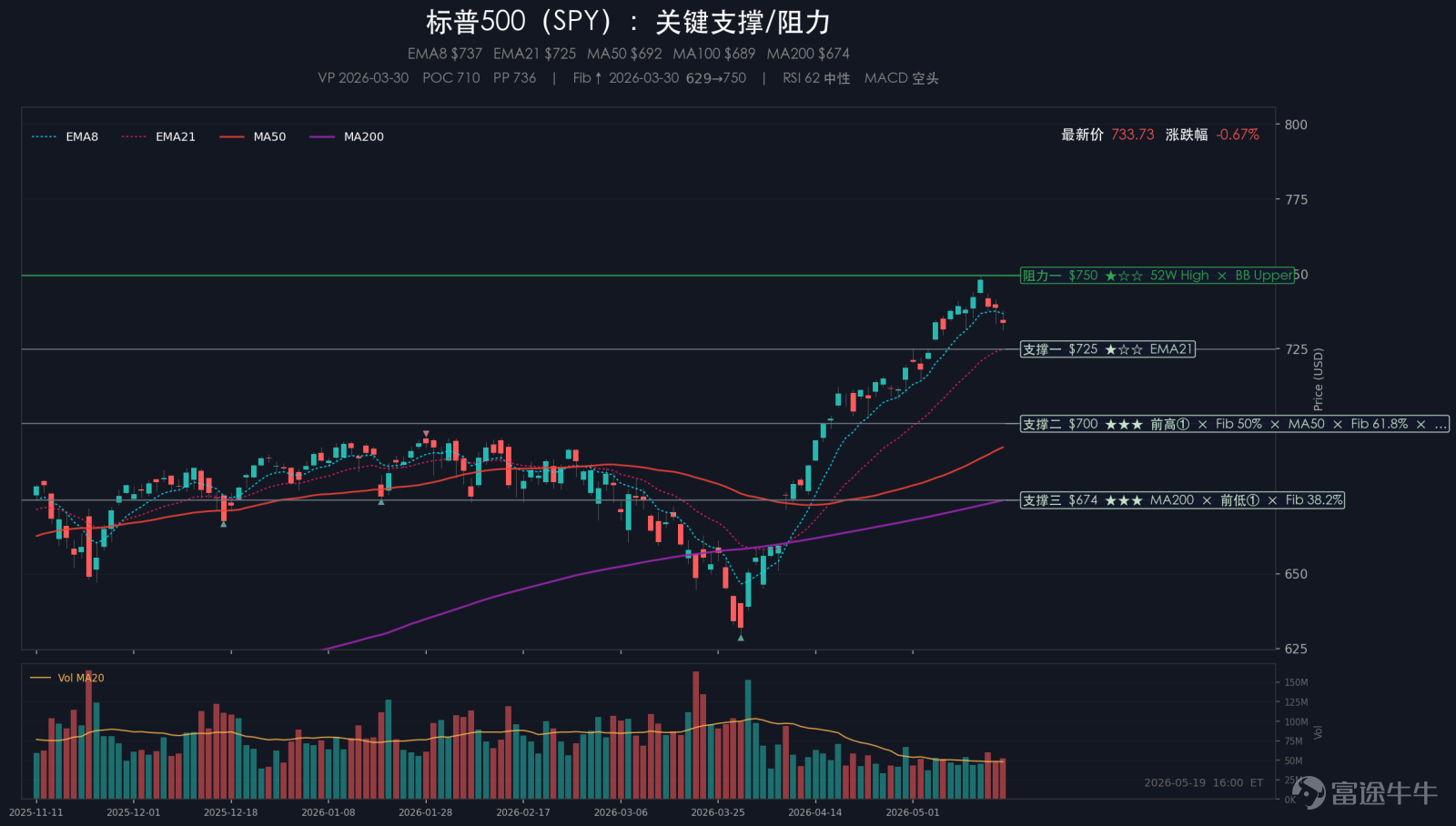
Summary: U.S. equities continued to retreat from recent highs on Tuesday, with the S&P 500 down 0.67%, the Nasdaq down 0.84%, the Dow Jones down 0.65%, and the Russell 2000 down 1.01%. The VIX rose to 18.06, up 1.35% on the day—markets are not in panic mode, but risk appetite continues to cool. The day’s most significant developments again centered on Iran: Trump stated the U.S. might need to strike Iran again, while also noting Iran still wishes to reach a deal; the negotiation window remains open, but military risks persist. Additional pressure came from long-end Treasuries, with the 30-year yield hitting a multi-year high and the 10-year yield rising to its highest level since January 2025, further compressing valuation room for small-cap and high-multiple assets. Sector-wise, Energy (XLE) and Health Care (XLV) held up relatively better, while Materials, Financials, Industrials, and Consumer Discretionary lagged. Across major asset classes, the dollar index rose 0.34%, gold dropped 1.84%, crude oil gained 1.50%, and Bitcoin declined 0.47%.

I. Major Events
1. Trump says the U.S. may need to strike Iran again
On Tuesday, Trump said the U.S. might need to strike Iran again, while also stating that Iran still hopes to reach an agreement. He added that he had previously been about an hour away from ordering an attack. This statement maintains the key dynamic from the previous day: the negotiation window remains open, but military risks have not truly disappeared. This keeps energy supply, inflation expectations, and policy trajectories tightly linked in a state of tension. All four major equity indexes declined, and energy-related risks did not translate into broader risk-off sentiment. Markets now face a complex scenario unlikely to resolve quickly: the probability of conflict escalation remains, while energy prices stay elevated.
2. Long-end U.S. Treasury yields hit multi-year highs
Long-end U.S. Treasuries faced continued selling pressure on Tuesday, with the 30-year yield rising to near its highest level since 2007 and the 10-year yield climbing to its highest point since January 2025. The bond market is repricing persistent inflation and policy rate risks. This shift in financial conditions was the core factor weighing on equities during the session. Small-cap stocks, which are most sensitive to funding costs, saw the Russell 2000 fall 1.01%. As long-end rates continue to rise, markets will first reduce tolerance for valuation expansion and then refocus on cash flow quality and balance sheet resilience.
II. Major Trends
At the index level, Tuesday marked another day of cooling off from recent highs. The S&P 500 fell 0.67%, the Nasdaq declined 0.84%, the Dow Jones dropped 0.65%, and the Russell 2000 slid 1.01%. Among ETFs, DIA fell 0.61%, showing relative resilience, while IWM dropped 1.08%, making it the weakest performer. The continued underperformance of small caps indicates that risk appetite has not genuinely recovered.
The intermediate-term structure remains dominated by large-cap growth, but short-term market breadth has clearly deteriorated. Over a two-week horizon, QQQ rose 2.92%, SPY gained 1.38%, RSP fell 0.80%, and IWM dropped 3.38%. Over three months, QQQ advanced 16.40%, SPY climbed 7.49%, while RSP declined 0.32%. The prior rally remained concentrated in market-cap-weighted and mega-cap growth stocks, with equal-weighted portfolios and small caps failing to show meaningful follow-through.
On a style basis, growth continues to lead, but its ability to broaden out is weakening. Over three months, SPYG rose 12.20%, significantly outpacing SPYV’s 2.30% gain; MAGS climbed 11.27%, ahead of XMAG’s 4.09%. The market’s intermediate-term leadership hasn’t reversed yet, but rising long-end rates and geopolitical risks are dampening investors’ willingness to chase higher prices.
III. Market Sentiment
The VIX closed at 18.06, up 1.35% on the day. While this move was modest, it aligns with broad-based declines across the four major indices, indicating tighter risk pricing compared to the previous session. The market isn’t in panic mode yet—this appears more like a recalibration of risk budgets amid elevated levels. The CNN Fear & Greed Index stood at 60, down from 62 previously, still in the ‘greed’ zone but continuing to cool. Sentiment remains controlled but no longer supports indiscriminate buying. Investors are shifting focus from ‘record-high indices’ to ‘how long high oil prices and high interest rates can persist.’
On the CBOE Put/Call front, the total Put/Call ratio stood at 0.71, with the index options Put/Call at 0.78 and the equity options Put/Call at 0.67. Put/Call ratios remain low, indicating no panic-driven demand for protective puts in the options market. However, the simultaneous softening of both VIX and the CNN Fear & Greed Index suggests investors are reducing risk more through spot and sector positioning rather than concentrated hedging via options.
IV. Market Scan
1. Index ETFs:All major index ETFs declined, with the Dow ETF DIA falling 0.61%—relatively resilient—and the Russell 2000 ETF IWM dropping 1.08%, the weakest performer. Small caps continued underperforming large caps, consistent with IWM’s 3.38% two-week decline, underscoring deepening pressure from interest rates on financing-sensitive assets.
2. Industry sectors:Among sectors, Energy (XLE) led gains with a 1.17% rise, followed by Health Care (XLV) up 1.10%. Materials (XLB) lagged, down 2.35%, while Financials (XLF) fell 1.24%, Industrials (XLI) dropped 1.18%, and Consumer Discretionary (XLY) declined 1.11%. Capital hasn’t fully exited equities but is clearly favoring relatively defensive areas like energy and health care.
Within sub-sectors, Oil & Gas Exploration (XOP) rose 1.33%, the strongest performer. Gold Miners (GDX) fell 3.86%, Uranium (URA) dropped 3.04%, Copper Miners (COPX) declined 3.03%, Solar (TAN) slid 2.62%, and Robotics (BOTZ) fell 2.36%. This pattern shows divergence within the commodities complex: energy is supported by geopolitical risks, while precious metals and resource stocks are pressured by a stronger dollar and rising long-end yields.
3. Seven major tech companies:The Magnificent Seven tech stocks were broadly weaker. Apple (AAPL) rose 0.38%, the relative outperformer, while Google (GOOG) fell 2.09%, the weakest link. Microsoft (MSFT) dropped 1.44%, and NVIDIA (NVDA) declined 0.77%. There was no single point of collapse in tech, but against the backdrop of rising long-end rates and elevated AI expectations, investor tolerance for large-cap growth names has diminished.
4. Chinese concept stocks:Chinese ADRs showed clear divergence. PDD Holdings (PDD) rose 2.50%, and JD.com (JD) gained 2.47%, both relatively strong. Futu (FUTU) plunged 5.47%, significantly underperforming. E-commerce leaders continue to attract capital, whereas trading-platform-type assets are proving more sensitive to shifts in risk sentiment.
5. Cryptocurrencies:Bitcoin fell 0.47%, while crypto-linked stocks showed mixed performance. MARA rose 2.13%, MicroStrategy (MSTR) declined 1.20%, Robinhood (HOOD) dropped 3.88%, and Circle (CRCL) slipped 0.32%. Bitcoin itself saw only a modest decline, but high-beta financial platforms came under pressure, indicating that capital remains selective toward crypto-related equities rather than staging a broad-based recovery.
$S&P 500 Index (.SPX.US)$ $SPDR S&P 500 ETF (SPY.US)$ $NASDAQ 100 Index (.NDX.US)$ $Invesco QQQ Trust (QQQ.US)$ $Dow Jones Industrial Average (.DJI.US)$ $State Street® SPDR® Dow Jones Industrial Average® ETF Trust (DIA.US)$ $Russell 2000 Index (.RUT.US)$ $iShares Russell 2000 ETF (IWM.US)$ $Roundhill Magnificent Seven ETF (MAGS.US)$ $USD (USDindex.FX)$ $U.S. 10-Year Treasury Notes Yield (US10Y.BD)$ $iShares 20+ Year Treasury Bond ETF (TLT.US)$ $XAU/USD (XAUUSD.CFD)$ $SPDR Gold ETF (GLD.US)$ $CBOE Volatility S&P 500 Index (.VIX.US)$ $CME-Bitcoin RR Futures (JUL6) (BTCmain.US)$ $iShares Ethereum Trust ETF (ETHA.US)$ $NVIDIA (NVDA.US)$ $Tesla (TSLA.US)$ $Meta Platforms (META.US)$ $Amazon (AMZN.US)$ $Alphabet-C (GOOG.US)$ $Microsoft (MSFT.US)$ $Apple (AAPL.US)$
Risk Disclaimer: The above content only represents the author's view. It does not represent any position or investment advice of Futu. Futu makes no representation or warranty.Read more


Comment (1)
to post a comment
5