
Hong Kong Market Barometer: CPO, PCB, and memory stocks rally in rotation! Are you on the right trai

Hang Seng Index at 25,797: Retail investors rushing to chase bulls or bears—real pivot point remains at 26,111
$Hang Seng Index (800000.HK)$ It closed at 25,797.67 points yesterday, and short-term market sentiment has clearly become polarized. On one hand, some investors believe the broader market has stabilized after consecutive declines and even expect it to challenge above 26,000 points tomorrow. Some comments directly mentioned holding bull certificates overnight, taking profits early tomorrow morning, capturing the day's high, or closing above 26,000 points—reflecting growing bullish conviction that a rebound from lows is underway. On the other hand, bearish participants have not exited; instead, they view today’s rebound as a chance to re-enter short positions and worry that after a brief rally, the market could reverse again, forming an even clearer daily-chart downtrend. This state of simultaneous enthusiasm among bulls and bears indicates the market isn’t transitioning into a one-sided uptrend but is instead at a sensitive juncture where direction must be re-determined following the rebound.
From key comment themes, retail investors are less concerned about the medium-term trend and more focused on whether today’s rebound is reliable, if 26,000 can be reclaimed, whether bull/bear warrants can be held overnight, and whether the 25,200–25,500 support zone might be revisited. Bullish comments center around ideas like 'stabilization,' 'institutional buying,' 'strong close in A-shares,' 'mysterious forces,' and 'SMIC’s strength lifting the broader market'—showing investors are seeking catalysts for the rebound from either capital flows or strength in key heavyweight stocks. Such sentiment is common after sharp selloffs: once a noticeable bullish candle appears following rapid declines, market mood quickly shifts from panic to betting on a bounce.
However, bearish comments also warrant attention. Some investors see today’s rally as a shorting opportunity, noting the index hasn’t truly reclaimed key moving averages. If the upward push fails and the market retreats again, this could merely be a weak rebound. Comments such as 'Failed breakout, now reversing,' 'Big institutions will sell again tomorrow after today’s surge,' and 'Rally faster—we need fuel for the market' reflect bearish traders who aren’t afraid of the bounce but are instead waiting for higher levels to initiate or add to short positions. This shows that although sentiment has improved somewhat, consensus optimism hasn’t formed—trading remains largely short-term speculation.
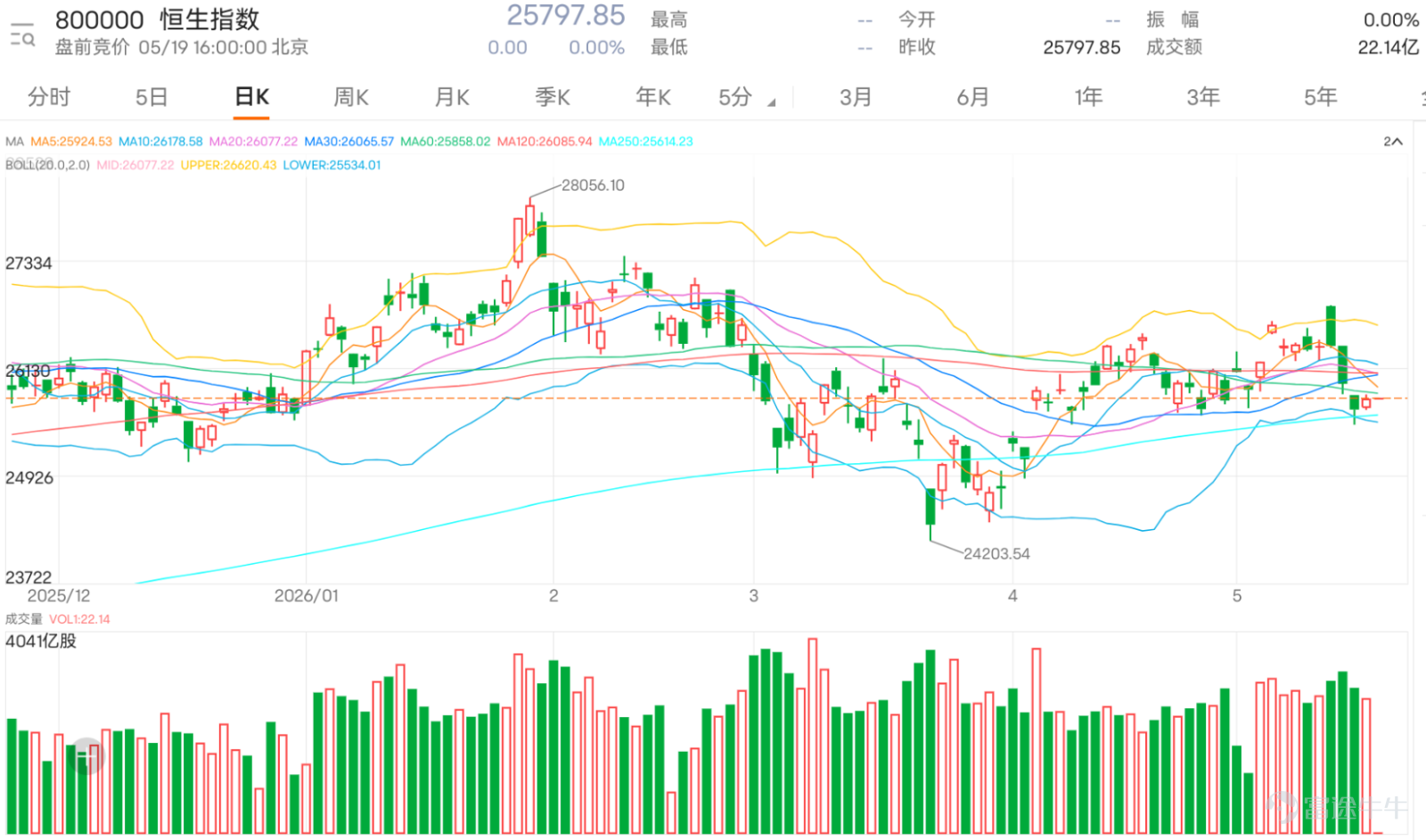
Comments expressing hesitation or posing questions better reflect genuine retail investor sentiment. Some ask, 'Is this a real rally?', 'Why the sharp surge?', or 'Should I hold overnight?' Others mention repeated failed attempts to chase rallies have damaged their confidence, even making them fearful of holding bull/bear warrants overnight. This reveals the core issue isn’t a lack of direction but rather unclear directional signals. At 25,797.67, the index sits close to the support zone between 25,556.35 and 25,671.12 below, yet hasn’t reclaimed the resistance and moving average cluster at 26,042.85, 26,111.69, and 26,220.16 above. Thus, the current price is caught precisely between 'support intact at lows' and 'upside recovery incomplete.'
Technically, the Hang Seng Index remains in a post-rebound pullback pattern in the short term. The current level of 25,797.67 sits below the 10-day MA (26,220.16), 20-day MA (26,111.69), and 30-day MA (26,042.85). While the index still holds above the lower Bollinger Band at 25,556.35, it has already retreated beneath key moving averages. In other words, a low-level rebound alone doesn’t confirm market strength—the true recovery zone lies not at 25,800 but within the dense moving average cluster between 26,042 and 26,220. Notably, the 26,111.69 level serves as a critical pivot point; until the index firmly reclaims it, the rebound should be viewed only as a technical bounce within a weak trend.
Bollinger Bands also show the same signal. The middle band is at 26,111.69 points, the upper band at 26,667.03 points, and the lower band at 25,556.35 points. The current price is just above the lower band, theoretically meeting conditions for a short-term rebound. However, since it remains below the middle band, the market is still operating within a relatively weak zone. The Relative Strength Index (RSI) stands at approximately 35.925—momentum is weak but not yet at an extreme oversold level—suggesting room for a rebound, though the index may not have fallen enough to trigger a strong recovery. If buying interest stems only from short-covering rather than genuine, volume-backed accumulation, the rebound’s strength will likely be capped around 26,042 and 26,111 points.
In terms of trading volume, there has been no significant surge recently; volumes have remained relatively stable at a moderate level. This is quite important: the absence of panic-driven high volume during the decline suggests selling pressure may not have been fully exhausted, while the lack of noticeable volume support during rebounds indicates limited enthusiasm among investors to chase higher prices. In other words, although market sentiment shows signs of a short-term rebound today, there is insufficient volume to confirm a genuine trend reversal. For short-term retail traders, this type of market environment often leads to being 'caught long after chasing highs' or 'squeezed after selling low'—a lose-lose scenario.
Currently, the most reasonable assessment is that the Hang Seng Index (HSI) offers a neutral-to-low risk-reward ratio in the short term. If the support zone between 25,556 and 25,671 points holds firm, the index could still attempt another move toward 26,042 and 26,111 points. Only if it breaks above and sustains levels above 26,111 points can we consider the short-term structure as initially repaired, opening the door to test 26,220 points. Conversely, if the index breaches 25,556 points—losing even the Bollinger Band lower band—concerns will intensify over support near 25,270 points, and bearish commentary about filling the gap below will likely regain prominence.
Therefore, for investors holding bull certificates, the key isn’t simply whether the index will surpass 26,000 points tomorrow, but whether the 25,556–25,671 support zone can hold. As long as this support area remains intact, low-strike bull certificates still offer some rebound potential. However, since the current price remains below multiple moving averages, positions should not be overly aggressive, and any rebound should not be mistaken for a full trend reversal. For bear certificate holders, clearer shorting opportunities would emerge only if the index rebounds to the 26,042–26,111 range and faces resistance again. Jumping into bearish positions too early at current lows risks getting squeezed by technical rebounds. At this stage, the biggest pitfall to avoid is blindly chasing either bulls or bears near the 25,800 level due to abrupt shifts in market sentiment.
Overall, the Hang Seng Index (HSI) has not yet completed a bullish reversal. Bullish sentiment is recovering, but bearish capital is still waiting for a rally to initiate fresh shorts. Observers are focused on whether to hold positions overnight, whether the current move is a genuine rally, and whether the index will fill the gap below. What truly shifts the short-term outlook isn’t a single day’s gain or loss, but whether the index can firmly re-establish support above the critical level of 26,111 points. Until that happens, any rebound remains a weak technical correction. If the index breaks below 25,556 points, downside risks will expand again. In terms of short-term strategy, treat 25,556–25,671 points as the key support zone and 26,042–26,111 points as the resistance zone to test the rebound. Only chase momentum if resistance is broken; only turn bearish if support fails. Avoid excessive optimism before a breakout and avoid blindly chasing shorts before a breakdown. Key deployment focus: First, monitor whether the 25,556–25,671 support zone holds. If it does, consider tactical long positions targeting a technical rebound. A close above both 26,042 and 26,111 points would confirm repair conditions. If 25,556 is breached, the trend could weaken further.

Uploading...
Add an image description (optional, up to 50 characters)
Strategy 1 | Hold above the 25,556–25,671 support zone for short-term rebound plays
$UB#HSI RC2810E.C (56201.HK)$ | Knock-in Price: 25,500 | Effective Leverage: 78.2x | A highly elastic option near the support zone, suitable for intraday rebound plays if the index stabilizes near the lower boundary—but strict adherence to the support level is essential.
$UB#HSI RC2809X.C (56993.HK)$ | Knock-in Price: 25,488 | Effective Leverage: 73.7x | Slightly lower knock-in than 25,500, better suited for chasing rebounds after support confirmation. Offers high elasticity but limited buffer.
$UB#HSI RC2810O.C (56732.HK)$ | Knock-in Price: 25,450 | Effective Leverage: 67.9x | Provides slightly more cushion than the previous two options, ideal for traders seeking high leverage without positioning too close to the knock-in level for short-term rebound plays.
Strategy 2 | Break above 26,042 and 26,111 points to confirm recovery and chase momentum
$UB#HSI RC2812L.C (56202.HK)$ | Knock-in Price: 25,400 | Effective Leverage: 60.0x | Knock-in price set below the main support zone, suitable for momentum chasing after the index breaks above moving averages, offering a balanced mix of elasticity and downside buffer.
$UB#HSI RC2810W.C (65625.HK)$ | Knock-in level: 25,300 pts | Effective leverage: 49.6x | Wider buffer zone—suitable for those seeking more room after a breakout to reduce intraday whipsaw risk
$UB#HSI RC2810I.C (56210.HK)$ | Knock-in level: 25,250 pts | Effective leverage: 45.3x | Among the three, offers the widest defensive buffer—ideal for stable trend-following positions after breakout confirmation; not suited for those chasing maximum explosive upside
Strategy 3 | Go short if the index breaks below 25,556 pts and fails to rebound
$UB#HSI RP28127.P (58118.HK)$ | Knock-in level: 26,348 pts | Effective leverage: 36.3x | Knock-in level close to upper resistance zone—ideal for capturing sustained weakness after support breaks; offers higher flexibility but requires strict risk control if a rebound occurs
$DS#HSI RP2803S.P (58253.HK)$ | Knock-in level: 26,350 pts | Effective leverage: 36.9x | Higher leverage—best for shorting on weakness shortly after 25,556 pts is breached; key point: stop-loss must be executed before the index reclaims 26,042 pts
$UB#HSI RP2812C.P (58876.HK)$ | Knock-in level: 26,389 pts | Effective leverage: 34.4x | Slightly higher knock-in level—better suited for short positions that allow minimal room for a minor rebound; deploy after a failed rally above 26,042 pts
Reply to investor inquiries
@233751472: Down 1,300 points consecutively—rebound confirmed as expected. Technical basis supports buying bull warrants after such a drop, but current price remains below moving averages; bull warrants must strictly respect support levels and avoid excessive aggression.
@新股IPO: Driven mainly by SMIC’s strength. Strength in individual heavyweight stocks can improve market sentiment, but the Hang Seng Index itself has yet to reclaim key moving averages—confirmation still hinges on the index’s positioning.
@233872969: It’s that time again—holding overnight bull warrants to collect dividends carries significant risk, as the index hasn’t stabilized above key moving averages; a break below the support zone would signal renewed weakness.
@小小小小小富婆: Today my system flagged institutional buying activity... Is this just testing the waters or acting on insider information? Genuine capital inflows should manifest as a clear breakout above moving averages with significantly higher volume; current turnover isn’t notably elevated yet—continued observation needed.
@責任感強的保羅It's obvious that many bullish warrants are just noise—anyone shouting 'bull bull' is likely either spreading misinformation or acting as a stock tout or bank promoter. Stay cautious! If the market can't sustain an upward move, it's actually an extreme bear market in disguise. When the broader market plunges and then bounces slightly, it might drop another 100–200 points only to fall over 1,000 points again! Risk management is the most critical aspect of trading bull/bear warrants. Currently, the overall market hasn't shown clear signs of strength, so exposure to bull warrants should not be excessive. Be cautious if the index breaks below the 25,556 level.
Feel free to share your insights in the comment section. For more market analysis, please continue following ‘Hong Kong Stock Warrants Jenny’ for daily updates!
Reminder: This article does not constitute any investment advice.
This article is for reference only and does not constitute any investment advice. Market data, opinions, and analysis contained herein may change at any time without prior notice. We are not responsible for any loss or damage caused by reliance on the information in this article. Technical analysis only shows whether certain technical conditions are met; asset performance should be comprehensively evaluated using other sources of information, and trading decisions should not be made solely based on this article. Please note that past performance is not indicative of future results.
#HongKongStocks #RealTimeAnalysis #WarrantPicks #WarrantStrategies #DerivativesHedging #HKWarrantsJenny #HangSengIndex #HangSengTechIndex #BlueChipStocks #TechnicalAnalysis
Risk Disclaimer: The above content only represents the author's view. It does not represent any position or investment advice of Futu. Futu makes no representation or warranty.Read more

Comment (1)
to post a comment
4