
Breaking the cycle with 'storage as king'? Memory chips become AI's core asset

Option Sir Breaks Down the Hot Topic | Behind the Memory Sector Pullback: Is This the Top, or Just Short-Term Shaking Out?
Since April, the memory sector has been on a strong upward trajectory, $Micron Technology (MU.US)$ 、 $SanDisk (SNDK.US)$ doubled, $Western Digital (WDC.US)$ surging by 69%.Wall Street is hailing the expectation of AI development, declaring 'memory is a critical node for AI advancement—long-term bullish!'
However, memory-related stocks have recently faced a pullback—for example, Micron (MU) dropped 5.95% yesterday, and SanDisk (SNDK) fell 5.3%. The market can’t help but wonder: Is this a good entry point for memory stocks? Is this dip a temporary correction or a short-term peak? Don’t worry! Let’s examine the following information:
Why are memory chip stocks declining now?
This pullback is driven more by sentiment and positioning rather than a clear deterioration in fundamentals.
Following the sharp rally led by artificial intelligence, investors are reacting to four key concerns:
 1. Previous gains were overly concentrated, prompting profit-taking and panic-driven selling; 2. Samsung’s former chip chief warned that memory chip prices could fall in the second half of next year due to supply increases led by China; 3. Yangtze Memory Technologies (CXMT)’s rapid revenue growth has further intensified concerns about future DRAM supply; 4. Strike risks at Samsung, which theoretically support higher prices, have instead created short-term supply chain uncertainty in practice.
 Although there appear to be many reasons for the decline, none of these headlines prove that the memory upcycle expected by 2026 has already ended.They simply remind us that, unless storage prices are locked in by long-term agreements and cannot be raised, the future trend for storage remains positive, as it is still a demand-driven industry.
Fundamentals remain strong.
Current earnings data from memory companies still appear robust.Bank of America emphasized that $Kioxia Holdings (285A.JP)$ NAND average selling prices in the first quarter of 2026 more than doubled sequentially,and its second-quarter 2026 sales guidance indicates a sequential increase of +74.5%, reflecting continued strength in sales performance.Phison Electronics has also demonstrated strong performance during this upcycle, with sales rising year-over-year237%and pre-tax profit margin45%, net profit margin38%。
Spot market data also does not show a broad-based pullback. According to Bank of America data,the spot price of 16GB DDR5 rose 2% week-over-week and surged 639% year-over-year, while the price of 1TB NAND wafers increased 1% week-over-week and climbed 386% year-over-year.South Korea's semiconductor exports in the first ten days of May remained close to historic highs$8.5 billion, with year-on-year growth still at150%。
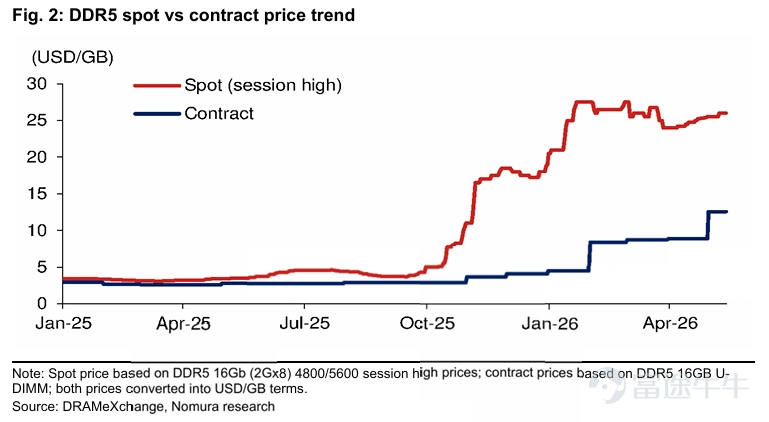
Nomura Securities' chart comparing DDR5 spot and contract prices has signaled another key development. Its data shows that, based on the peak spot price for DDR5 16GB and the contract price for DDR5 16GB U-DIMM, DDR5 spot prices surged sharply from late 2025 into early 2026 and remained elevated through April and May. Contract prices, which lag behind spot prices, have also risen in a stepwise pattern.This indicates that not only has tight supply driven up spot market prices, but memory pricing embedded in future contract terms is also continuing to rise.
![Since April, the memory sector has been on a strong upward trajectory, $Micron Technology (MU.US)$ 、 $SanDisk (SNDK.US)$ doubled, $Western Digital (WDC.US)$ surging 69%.Expectations around AI development have led Wall Street to exclaim, “Memory is a critical node for AI advancement—bullish long-term!” However, memory-related stocks have recently faced a pullback. For example, MU dropped 5.95% yesterday, and SNDK fell 5.3%. Investors are now wondering: Is this still a good time to enter the memory trade? Is this decline a temporary correction or a sign of a short-term top? Don’t worry! Let’s examine the following information: Why Are Memory Chip Stocks Falling Now? This pullback is driven more by sentiment and positioning than by any significant deterioration in fundamentals. Following the sharp rally led by artificial intelligence, market participants are reacting to four key concerns: [Dollar]1. Previous gains were overly concentrated, prompting profit-taking and panic-driven unwinding; [Dollar]2. A former Samsung chip executive warned that memory chip prices could decline in the second half of next year due to increased supply driven by China; [Dollar]3. Yangtze Memory Technologies (CXMT)'s rapid revenue growth has further heightened concerns about future DRAM supply; [Dollar]4. Although strike risks at Samsung are theoretically supportive of prices, they have created short-term supply chain uncertainty in practice. Although there appear to be many downward pressures, none of these headlines substantiate a memory upcycle within 2026...](https://nnqimage.futunn.com/sns_client_feed/999908/20260519/web-1779189158636-9RCjMg3jx5.png/big?area=2&is_public=true&imageMogr2/ignore-error/1/format/webp)
A bigger shift: from a price cycle to a contract cycle
Therefore, the most critical variable is no longer spot prices, but the quality of long-term agreements (LTAs).
JPMorgan stated that as memory costs have risen sharply and procurement risk has become a tangible operational concern, memory is increasingly becoming a strategic asset for cloud service providers. They believe that compared to multi-year supply negotiations in the past, upfront payments represent the biggest change, as they signal predictable order volumes and include features such as advance payments, fixed pricing, and floating pricing.
The key question is whether these contracts are enforceable.Once these contracts are sufficiently backed by guarantees to ensure fulfillment,Long-term agreements will enhance visibility into revenue, profit margins, and cash flow,The memory storage sector is highly likelyto gradually shift from the traditional price-to-book (P/B) valuation framework toward a price-to-earnings (P/E) framework, aligning more closely with strategic AI infrastructure assets.
![Since April, the memory sector has been on a strong upward trajectory, $Micron Technology (MU.US)$ 、 $SanDisk (SNDK.US)$ doubled, $Western Digital (WDC.US)$ surging 69%.Expectations around AI development have led Wall Street to exclaim, “Memory is a critical node for AI advancement—bullish long-term!” However, memory-related stocks have recently faced a pullback. For example, MU dropped 5.95% yesterday, and SNDK fell 5.3%. Investors are now wondering: Is this still a good time to enter the memory trade? Is this decline a temporary correction or a sign of a short-term top? Don’t worry! Let’s examine the following information: Why Are Memory Chip Stocks Falling Now? This pullback is driven more by sentiment and positioning than by any significant deterioration in fundamentals. Following the sharp rally led by artificial intelligence, market participants are reacting to four key concerns: [Dollar]1. Previous gains were overly concentrated, prompting profit-taking and panic-driven unwinding; [Dollar]2. A former Samsung chip executive warned that memory chip prices could decline in the second half of next year due to increased supply driven by China; [Dollar]3. Yangtze Memory Technologies (CXMT)'s rapid revenue growth has further heightened concerns about future DRAM supply; [Dollar]4. Although strike risks at Samsung are theoretically supportive of prices, they have created short-term supply chain uncertainty in practice. Although there appear to be many downward pressures, none of these headlines substantiate a memory upcycle within 2026...](https://nnqimage.futunn.com/sns_client_feed/999908/20260519/web-1779189158597-wpgK5pjJ7a.png/big?area=2&is_public=true&imageMogr2/ignore-error/1/format/webp)
Valuation Re-rating: While not yet at Taiwan Semiconductor’s valuation levels, the valuation logic for memory storage has already begun to shift.
Currently,$Taiwan Semiconductor (TSM.US)$ Due to strong order visibility, high customer stickiness, and leading-edge process technology, it still commands a relatively high valuation premium within the hardware industry. As previously noted, if long-term agreements can similarly provide memory companies with greater order predictability, the sector’s valuation framework will evolve accordingly. Nomura pointed out thatTaiwan Semiconductor currently trades at approximately20x forward price-to-earnings (P/E), whereas Samsung and SK Hynix are trading at only around6 times, leaving room for upward valuation re-rating.
![Since April, the memory sector has been on a strong upward trajectory, $Micron Technology (MU.US)$ 、 $SanDisk (SNDK.US)$ doubled, $Western Digital (WDC.US)$ surging 69%.Expectations around AI development have led Wall Street to exclaim, “Memory is a critical node for AI advancement—bullish long-term!” However, memory-related stocks have recently faced a pullback. For example, MU dropped 5.95% yesterday, and SNDK fell 5.3%. Investors are now wondering: Is this still a good time to enter the memory trade? Is this decline a temporary correction or a sign of a short-term top? Don’t worry! Let’s examine the following information: Why Are Memory Chip Stocks Falling Now? This pullback is driven more by sentiment and positioning than by any significant deterioration in fundamentals. Following the sharp rally led by artificial intelligence, market participants are reacting to four key concerns: [Dollar]1. Previous gains were overly concentrated, prompting profit-taking and panic-driven unwinding; [Dollar]2. A former Samsung chip executive warned that memory chip prices could decline in the second half of next year due to increased supply driven by China; [Dollar]3. Yangtze Memory Technologies (CXMT)'s rapid revenue growth has further heightened concerns about future DRAM supply; [Dollar]4. Although strike risks at Samsung are theoretically supportive of prices, they have created short-term supply chain uncertainty in practice. Although there appear to be many downward pressures, none of these headlines substantiate a memory upcycle within 2026...](https://nnqimage.futunn.com/sns_client_feed/999908/20260519/web-1779189158524-G0UAtFRTbb.png/big?area=2&is_public=true&imageMogr2/ignore-error/1/format/webp)
Options Signal: Is now a good time to enter the market?
Taking Micron Technology (MU) as an example, current options signals show a put/call volume ratio of 0.84%, implied volatility (IV) at 95.05%, and IV percentile at 98%.Even after the recent decline, market sentiment remains mixed, but participants broadly expect the stock price to continue experiencing significant volatility.
![Since April, the memory sector has been on a strong upward trajectory, $Micron Technology (MU.US)$ 、 $SanDisk (SNDK.US)$ doubled, $Western Digital (WDC.US)$ surging 69%.Expectations around AI development have led Wall Street to exclaim, “Memory is a critical node for AI advancement—bullish long-term!” However, memory-related stocks have recently faced a pullback. For example, MU dropped 5.95% yesterday, and SNDK fell 5.3%. Investors are now wondering: Is this still a good time to enter the memory trade? Is this decline a temporary correction or a sign of a short-term top? Don’t worry! Let’s examine the following information: Why Are Memory Chip Stocks Falling Now? This pullback is driven more by sentiment and positioning than by any significant deterioration in fundamentals. Following the sharp rally led by artificial intelligence, market participants are reacting to four key concerns: [Dollar]1. Previous gains were overly concentrated, prompting profit-taking and panic-driven unwinding; [Dollar]2. A former Samsung chip executive warned that memory chip prices could decline in the second half of next year due to increased supply driven by China; [Dollar]3. Yangtze Memory Technologies (CXMT)'s rapid revenue growth has further heightened concerns about future DRAM supply; [Dollar]4. Although strike risks at Samsung are theoretically supportive of prices, they have created short-term supply chain uncertainty in practice. Although there appear to be many downward pressures, none of these headlines substantiate a memory upcycle within 2026...](https://nnqimage.futunn.com/sns_client_feed/999908/20260519/web-1779189158369-D67KoL4q76.png/big?area=2&is_public=true&imageMogr2/ignore-error/1/format/webp)
1. If you witnessed the recent memory-sector rally—dubbed a 'mythical surge'—and want to enter but fear buying at the top:
you couldbuy one call option. Compared with buying the underlying stock directly, call options require less capital, limit potential losses, and can still capture some of the stock’s upside movement.
Of course, IV is currently elevated, meaning options are relatively expensive, and short-dated options suffer faster time decay. Therefore, if you plan to enter a position, longer-dated options may be more suitable.

The design images shown on screen are for illustrative purposes only and do not constitute any investment advice or guarantee; market conditions change rapidly, and displayed prices may not reflect real-time data.
2. If you’ve already captured profits from the recent memory-sector rally but are reluctant to exit your position now:
you couldWhile holding the underlying stock, sell a call option at a higher strike price to 'collect rent,' forming a Covered Call strategy.Even if the stock price doesn’t rise, you can still earn income from the short option position. If the stock price rises above the strike price and the call is exercised, you can sell your shares to lock in profits—the only loss being the potential upside beyond that point.

The design images shown on screen are for illustrative purposes only and do not constitute any investment advice or guarantee; market conditions change frequently, and the prices depicted may not reflect actual market levels.
If you're concerned about a short-term pullback in the stock price, you could alsobuy a put optionto purchase 'insurance' for your stock position. Even if the stock price drops temporarily, gains from the put option will partially offset losses from the decline in the stock.
If you're worried that buying a single put is too expensive, you could also sell another put below the strike of the purchased put, creating aBear Put Spread. The premium received from selling the put helps offset part of the cost of buying the put, while also providing some downside protection for your stock position—making it a more moderate risk-reward strategy compared to a single-leg option.
The design images shown on screen are for illustrative purposes only and do not constitute any investment advice or guarantee; market conditions change frequently, and the prices depicted may not reflect actual market levels.

The design images displayed on screen are for illustrative purposes only and do not constitute any investment advice or guarantee; market prices fluctuate frequently, and the prices shown in the images do not reflect actual market conditions.

The design images displayed on screen are for illustrative purposes only and do not constitute any investment advice or guarantee; market prices fluctuate frequently, and the prices shown in the images do not reflect actual market conditions.
Finally, Option Sir brings a small perk for fellow investors, welcome to claim it.Options Beginner Pack
*This event is exclusive to invited HK users. Click to learn more.Detailed event rules>>
Market conditions are complex and volatile,Options StrategyOverwhelmed by choices? Futubull helps you build a portfolio in three steps.Options Strategymaking investing simple and efficient!
![Since April, the memory sector has been on a strong upward trajectory, $Micron Technology (MU.US)$ 、 $SanDisk (SNDK.US)$ doubled, $Western Digital (WDC.US)$ surging 69%.Expectations around AI development have led Wall Street to exclaim, “Memory is a critical node for AI advancement—bullish long-term!” However, memory-related stocks have recently faced a pullback. For example, MU dropped 5.95% yesterday, and SNDK fell 5.3%. Investors are now wondering: Is this still a good time to enter the memory trade? Is this decline a temporary correction or a sign of a short-term top? Don’t worry! Let’s examine the following information: Why Are Memory Chip Stocks Falling Now? This pullback is driven more by sentiment and positioning than by any significant deterioration in fundamentals. Following the sharp rally led by artificial intelligence, market participants are reacting to four key concerns: [Dollar]1. Previous gains were overly concentrated, prompting profit-taking and panic-driven unwinding; [Dollar]2. A former Samsung chip executive warned that memory chip prices could decline in the second half of next year due to increased supply driven by China; [Dollar]3. Yangtze Memory Technologies (CXMT)'s rapid revenue growth has further heightened concerns about future DRAM supply; [Dollar]4. Although strike risks at Samsung are theoretically supportive of prices, they have created short-term supply chain uncertainty in practice. Although there appear to be many downward pressures, none of these headlines substantiate a memory upcycle within 2026...](https://nnqimage.futunn.com/sns_client_feed/999908/20260519/web-1779189158370-BhEEo6TNha.webp/big?area=2&is_public=true&imageMogr2/ignore-error/1/format/webp)
Option Risk Warning:An option is a contract that grants the holder the right, but not the obligation, to buy or sell an asset at a fixed price on a specific date or at any time before that date. The price of an option is influenced by various factors, including the current price of the underlying asset, the strike price, time to expiration, and implied volatility. Implied volatility reflects the market’s expectations for the level of volatility in the option over a future period. It is a data point derived inversely from the Black-Scholes option pricing model and is generally regarded as an indicator of market sentiment. When investors anticipate greater volatility, they may be more willing to pay a higher price for options to hedge risks, resulting in higher implied volatility. Traders and investors use implied volatility to assess the attractiveness of option prices, identify potential mispricings, and manage risk exposure.
Disclaimer:This content does not constitute any offer, solicitation, recommendation, opinion, or guarantee of any securities, financial products, or tools. The risk of loss in trading options can be substantial. In some cases, losses may exceed the initial margin deposited. Even if you set contingent orders such as 'stop-loss' or 'limit' orders, these may not prevent losses. Market conditions may make such orders unexecutable. You may be required to deposit additional margin within a short period. If you fail to provide the required amount within the specified time, your open positions may be liquidated. However, you will still be responsible for any shortfall in your account. Therefore, before trading, you should study and understand options and carefully consider whether such trading is suitable for you based on your financial situation and investment objectives. If you trade options, you should be familiar with the procedures for exercising options and the rights and obligations upon exercise and expiration. Options trading carries extremely high risks and is not suitable for all investors. Investors should carefully readCharacteristics and Risks of Standardized Options。
Risk Disclaimer: The above content only represents the author's view. It does not represent any position or investment advice of Futu. Futu makes no representation or warranty.Read more


Comments (18)
to post a comment
115
234