
Entering the Agent-driven era! Google's market cap targets $5 trillion

Big news tonight! Google I/O conference is here: Don't miss these three key themes and the list of promising companies across the AI supply chain
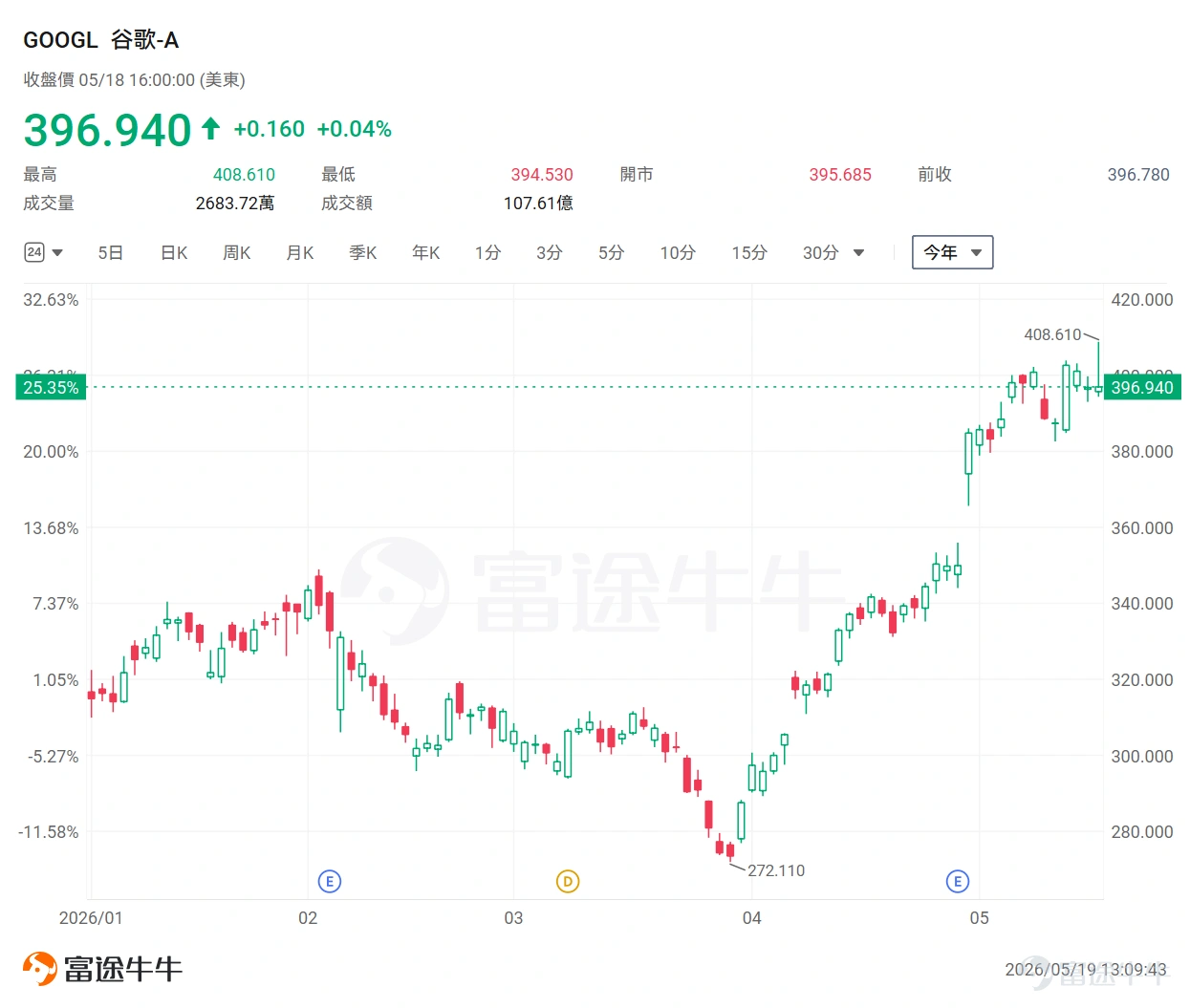
Overnight, $Alphabet-A (GOOGL.US)$ Its stock price has risen against the market trend, hitting an all-time high and pushing its market cap close to the $5 trillion mark.
This rally comes at just the right time—At 1 a.m. Beijing time on May 20, Google I/O 2026, the developer conference, will kick off in California with great fanfare.Immediately following that isGoogle Marketing Live on May 21, which is more directly focused on advertising and monetization.
Past I/O conferences have always served as Google’s platform to showcase its future strategy; now, with its pivotal role in the race for AI supremacy, this upcoming tech extravaganza is drawing unprecedented global attention!
Lo Toney, Founding Managing Partner of Plexo Capital and early investor in Anthropic, commented: "Google may be the company best positioned to commercialize AI at scale, as it controls virtually every layer of the technology stack. We’ve never really seen a company achieve such comprehensive vertical integration—from top to bottom—to support AI development."

So, what are the key highlights of this Google I/O conference that’s about to ignite the tech world? And from an investment perspective, which companies in the AI supply chain show promising potential? This article will break it down for fellow investors.
What are the key highlights of the Google I/O conference?
Key focus areas of this Google I/O conference include the Gemini model, AI agents, AI-powered e-commerce, Google Cloud, and TPUs, as detailed below:
Core Theme 1: Large Models and Ecosystem Evolution — From 'Chatbox' to 'AI Operating System'
The conference's technical depth will center on how Google transforms its model capabilities into genuine productivity tools.
1. The Next Step for Gemini: Anticipation Around Iteration and Hard Data
The market is eagerly awaiting whether 'Gemini 4' will make a stunning debut. Citi expects this could be a routine upgrade to version 3.2 or 3.5; however, Mizuho points out that launching Gemini 4 would truly position Google back at the forefront of technological innovation.
Regardless of the version number, Gemini’s commercial performance is already impressive: enterprise paying users saw a 40% month-over-month increase in active usage in Q1, and token consumption has reached an astonishing 16 billion per minute.
2. Full-Scale Takeover by AI Agents
This is the defining theme of this year’s conference. Rumors suggest the 'Gemini Spark' AI agent platform will be unveiled. Google’s ambition is clear: to evolve Gemini from a simple chatbot into an 'AI operating system layer' spanning all applications, igniting a battle for dominance in next-generation office Copilot solutions.
3. Android 17’s AI Core Transformation
Android 17, expected to launch as early as mid-2026, will undergo a major system-level overhaul. It will deeply integrate on-device AI architecture (Gemini Nano), enabling one-click, cross-application, complex multimodal workflows. Additionally, the new lightweight Aluminum OS may make its debut, helping Google re-enter the PC and XR markets.
Core Theme Two: Foundational Compute Power and Infrastructure — The Most Certain 'Pick-and-Shovel' Play
In the AI arms race, infrastructure offers the clearest monetization path. Google is demonstrating to the market its unparalleled vertical integration capabilities.
1. Cloud business surges, backlog orders explode
Google Cloud has evolved into Alphabet’s most profitable revenue pillar. It posted a Q1 growth rate of 63%, with total backlog orders soaring to $462 billion (a 90% quarter-over-quarter surge). Revenue specifically from generative AI products grew nearly 800% year-over-year. The number of billion-dollar-plus enterprise deals exceeded the combined total of the past three years, signaling that enterprise IT budgets are rapidly shifting toward Google.
2. Key variable: TPU chips offered externally for the first time
This could be the biggest dark horse in the current AI race. Google plans to begin delivering custom AI chips (TPUs) to external customers in the second half of 2026. Even capturing a small slice of the $500 billion AI chip market would represent a massive growth engine. The market will closely watch its pricing strategy, profit margins, and how these chips are accounted for in customer contracts.
3. Partnering with Anthropic: A Perfect 'Capital Hedging' Move
Google is deeply aligned with Anthropic (rumored to include up to $200 billion in cloud commitments). This isn’t the 'excessive concentration risk' some fear—it’s an exceptionally smart hedging strategy: capital flowing into Anthropic ultimately returns to Google through cloud services and TPU compute spending. Whether enterprises prefer Claude or Gemini, Google captures profits from the underlying infrastructure either way.
Core Theme Three: Monetization and End-Market Transformation — Seeking Growth While Managing Risk
AI must ultimately move toward consumer and commercial monetization, which is also the key driver of secondary market valuations.
1. AI-Powered Agent Commerce: Beware of 'dimensionality reduction strikes' on vertical-focused platforms
Google is partnering with tech giants like Meta and Stripe to build an 'agent-driven one-click checkout' experience. Gemini can not only help you plan your itinerary but also place and pay for orders directly on your behalf.
Mizuho specifically warned investors that Google's aggressive push into AI agent products could pose a potential 'dimensionality reduction strike' against vertical aggregation platforms and marketplaces such as Booking Holdings, Expedia, DoorDash, Zillow, and Instacart. The firm even noted that recent stock price weakness in these companies largely reflects the market pricing in expectations of this industry reshaping ahead of time.
2. The Core Business Model Question: Balancing AI Advertising
AI-powered ads already account for more than 30% of search ad spend. While AI excels at converting long-tail and complex queries, it also raises concerns: AI overviews result in up to 93% of searches generating no external clicks. Therefore, the new definition of 'proactive commerce' advertising products unveiled at the conference will be critical to addressing monetization concerns.
3. Android XR: Smart Glasses Make a Strong Comeback
Google, acting as a foundational ecosystem builder, is teaming up with Samsung to re-enter the smart glasses arena. Rumors suggest Samsung’s Galaxy Glasses, codenamed 'Jinju,' may debut soon, featuring Qualcomm’s Snapdragon AR1 chip and a lightweight 50-gram design—marking the official start of the battle for AI-powered wearable hardware as the next user interface gateway.
What investment opportunities exist in Google's supply chain?
Ahead of the conference, Wall Street and 'smart money' have already taken positions. Bank of America analysts reiterated their 'Buy' rating on Google with a $430 price target, noting that further expansion of its valuation multiple may require 'a positive AI-related surprise.'
More notably, Berkshire’s current CEO, Greg Abel, in his first quarter at the helm, dramatically increased the company's stake in Google by over 200%. This substantial endorsement—backed by real capital from a top-tier institution—has undoubtedly injected a strong dose of confidence into the market.
However, underpinning these AI initiatives is an astronomical level of capital investment. Google has raised its full-year 2026 capital expenditure guidance to a range of $180–190 billion, nearly doubling the $91.45 billion spent in 2025, and expects capital spending to increase significantly further in 2027. First-quarter capital expenditures alone reached $35.7 billion, causing free cash flow to plummet 46.63% year-over-year.
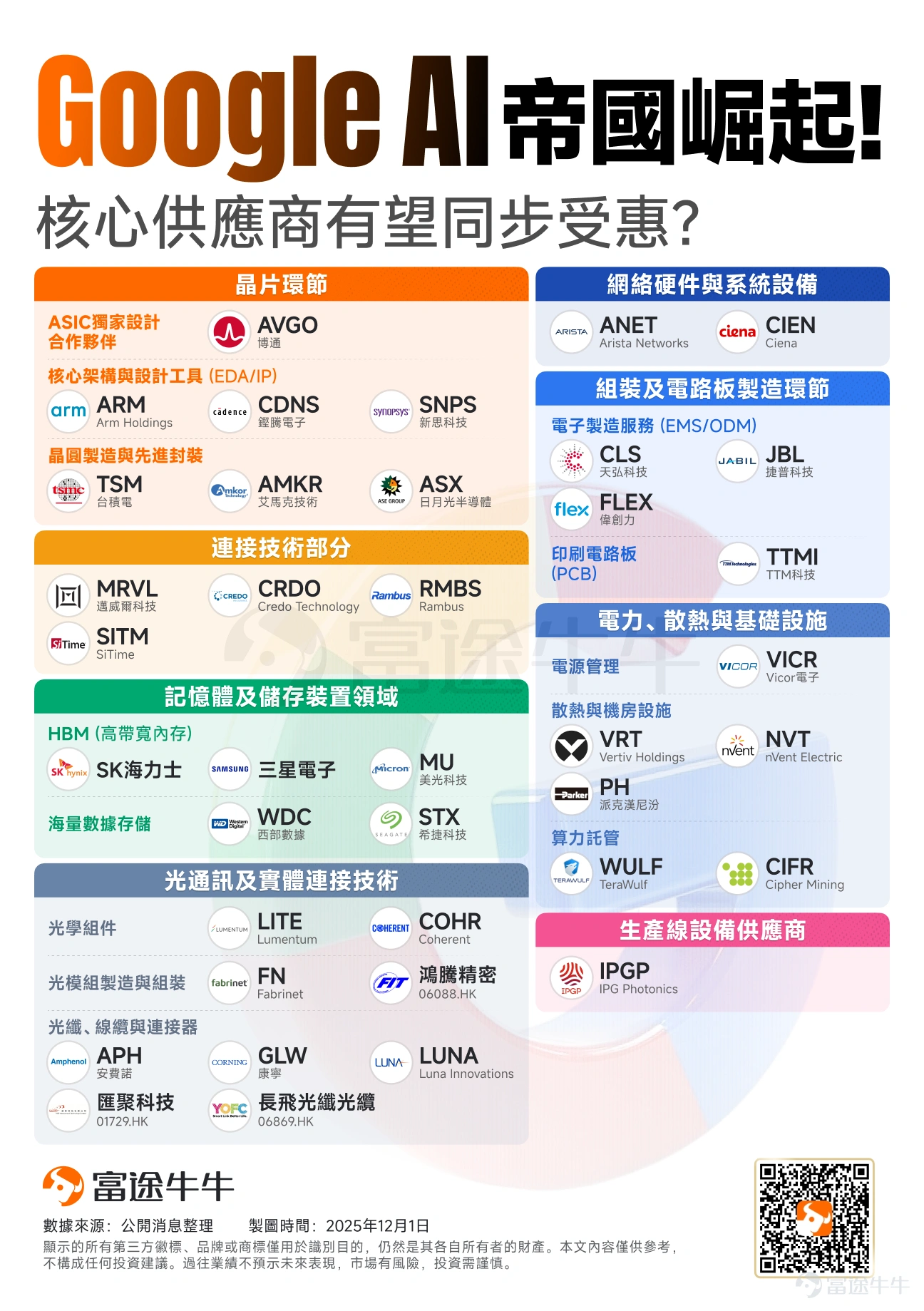
Previously, NiuNiu compiled a list of companies in Google’s supply chain for fellow investors’ reference:
--
--
--
1. Chip Segment - The Core Computing Brain
First,Within Google's technical system, $Broadcom (AVGO.US)$plays an irreplaceable core pillar role.Its three key technologies — high-speed SerDes, switching ASICs, and optical switching chips supporting the Jupiter network — collectively form the physical foundation of the TPU ultra-large-scale cluster, analogous respectively to the cluster’s 'blood vessels,' 'nervous system,' and 'main highways.' Without this set of foundational chips, Google's TPU clusters and optical networks could not achieve their current scale and performance. Therefore, as long as Google continues to develop its dedicated accelerator route, Broadcom will remain an indispensable core supplier.
In terms of packaging, $Taiwan Semiconductor (TSM.US)$、 $Amkor Technology (AMKR.US)$and$ASE Technology (ASX.US)$constitutes an indispensable 'iron triangle.'TPUs’ deep reliance on advanced 3nm/2nm process nodes, HBM stacking, and high-density Chiplet packaging creates a clear division of labor: Taiwan Semiconductor defines the upper limit of computing power, while Amkor and ASE Group become critical enablers of high-bandwidth implementation through cutting-edge packaging technologies. With market expectations that Google’s TPU will dominate the global self-designed ASIC landscape by 2026, the technological synergy among these three companies has already become the indispensable foundation for Google’s iterative advances in computing power.
Additionally, Google requires $Cadence Design Systems (CDNS.US)$ and $Synopsys (SNPS.US)$ software tools; meanwhile, Google’s Axion CPU is developed based on the $Arm Holdings (ARM.US)$ architecture.
2. Connectivity Technology - The Highway of Data Transmission
AI computing bottlenecks often lie in data transmission speeds, making this area the fastest-evolving in terms of technological upgrades. This layer of connectivity technology does not handle computation but instead addresses signal integrity issues when data moves at high speed between chips and servers. Among them,
$Astera Labs (ALAB.US)$: Market leader in PCIe and CXL Retimers, solving high-speed interconnect issues between chips inside AI servers.
$Credo Technology (CRDO.US)$: Specializes in SerDes technology and AEC (Active Cable) chips, addressing short-distance external interconnections for servers.
$Marvell Technology (MRVL.US)$: Giant in optical communication DSPs and switch chips.
$Rambus (RMBS.US)$: Provides high-speed memory interface IP (HBM/DDR interface) and CXL solutions.
$SiTime (SITM.US)$: MEMS timing components to ensure synchronized transmission frequencies.
3. Memory and Storage Segment
With the rise of Google’s TPU, demand in the HBM market could continue to grow.
According to South Korean media outlets such as The Chosun Ilbo, $Samsung Electronics (005930.KR)$ ( $CSOP Samsung Electronics Daily Max (2x) Leveraged Product (07747.HK)$ ) and $SK Hynix (000660.KR)$ ( $CSOP SK Hynix Daily Max (2x) Leveraged Product (07709.HK)$) have become key participants in Google’s TPU supply chain. Among them, SK Hynix is likely to be the preferred supplier of 8-layer HBM3E chips for Google’s seventh-generation TPU and will exclusively provide 12-layer HBM3E chips for the improved version (TPU 7e), enabling higher energy efficiency.
Moreover, the Mizuho analyst team believes that Micron Technology, the U.S. memory giant, will also be one of the biggest beneficiaries of Google’s accelerated expansion of AI computing clusters. After all, whether it is Google’s massive TPU AI computing cluster or its large-scale procurement of NVIDIA AI GPU computing clusters, both rely on fully integrated AI chip-mounted HBM storage systems. Additionally, Google’s accelerated construction or expansion of AI data centers necessitates the large-scale purchase of server-grade high-performance DDR5 memory devices and enterprise-grade high-performance SSDs.And$Micron Technology (MU.US)$It just so happens that Micron Technology is positioned across these three areas: HBM, server DRAM (including DDR5/LPDDR5X), and high-end data center SSDs, making it one of the most direct beneficiaries of the 'AI memory + storage stack.'
In addition,$Western Digital (WDC.US)$and $Seagate Technology (STX.US)$ Provides massive data cold storage.
4. Optical communication and physical connection aspects
Google has previously further reinforced the critical role of OCS optical switching in its network infrastructure.
Optical Circuit Switching (OCS) is a technology that enables direct switching of optical signals between fiber ports without optical-electrical/optical conversion. Google has introduced OCS technology into TPU interconnections to build TPU super nodes consisting of multiple cabinets, supporting a 3D Torus topology architecture.
Founder Securities stated that, according to Cignal AI forecasts, by 2029, the total potential market size for OCS optical switching will exceed $1.6 billion. As Google’s large-scale models progress, the OCS industry chain is expected to benefit from the ongoing advancement of Google’s AI initiatives.
Google's unique OCS architecture in its data center network can significantly reduce power consumption and latency. $Coherent (COHR.US)$ Providing core optoelectronic components; $Lumentum (LITE.US)$ Monopolizes the critical MEMS micromirror component in OCS.
Optical module manufacturing and assembly includes $Fabrinet (FN.US)$、 $FIT HON TENG (06088.HK)$。Fabrinet is the 'king of optical communication module manufacturing,' assembling high-precision modules for Lumentum and Coherent optical manufacturers. Foxconn Interconnect Technology has become a core supplier to Google in the data center hardware sector, providing key components such as optical communication modules, co-packaged optics (CPO) solutions, and high-speed connectors.
Fiber optics, cables, and connectorsIncludes $Amphenol (APH.US)$ 、 $Corning (GLW.US)$ 、 $YOFC (06869.HK)$ 、 $TIME INTERCON (01729.HK)$ 、 $Luna Innovations (LUNA.US)$ 。
5. Network hardware and system equipment
$Arista Networks (ANET.US)$ : The core switch supplier for Google's data centers.
$Ciena (CIEN.US)$ : Long-distance optical transmission systems (DCI), responsible for connecting different data centers.
6. Assembly and PCB stages
Responsible for assembling all parts into server racks.
$Celestica (CLS.US)$ : Specializes in switch and AI server assembly.
$TTM Technologies (TTMI.US)$ : Provides high-layer count PCBs for servers and networking equipment.
7. Power, cooling, and infrastructure
$Vicor (VICR.US)$ :Vertical power module, specifically addressing the high-density power delivery challenges for AI chips (such as TPUs) in the final stage.
$Vertiv Holdings (VRT.US)$ : Thermal management (liquid cooling/air cooling) and power protection systems.
$nVent Electric (NVT.US)$ : Liquid cooling cabinet and connectivity solutions.
$Parker Hannifin (PH.US)$ : Quick connectors and fluid components for liquid cooling systems.
$TeraWulf (WULF.US)$ / $Cipher Digital (CIFR.US)$ : Hosting providers offering power and facility infrastructure.
Summary
This year's Google I/O conference has already transcended the significance of a typical product launch; at its core, it served as an extreme stress test of Google’s 'full-stack AI' strategic positioning. Standing at the pivotal threshold of challenging a $5 trillion market valuation, the capital markets have fundamentally shifted their pricing logic—they are no longer paying for vague 'technological visions,' but are intensely demanding tangible financial performance.
Only by delivering an impeccable performance across the comprehensive stress test of 'computing cost control, commercial model implementation, and defense of ad monetization' can Google truly defend its ironclad throne as the global AI leader amid the brutal competition among tech giants.
Risk Disclaimer: The above content only represents the author's view. It does not represent any position or investment advice of Futu. Futu makes no representation or warranty.Read more


Comments (6)
to post a comment
52
132