
Xiaomi announces a new HK$20 billion share buyback program—will the stock price get a boost?

Xiaomi held above 30 yuan but has not regained strength; the real focus for retail investors is whether it can stabilize at 31 yuan.
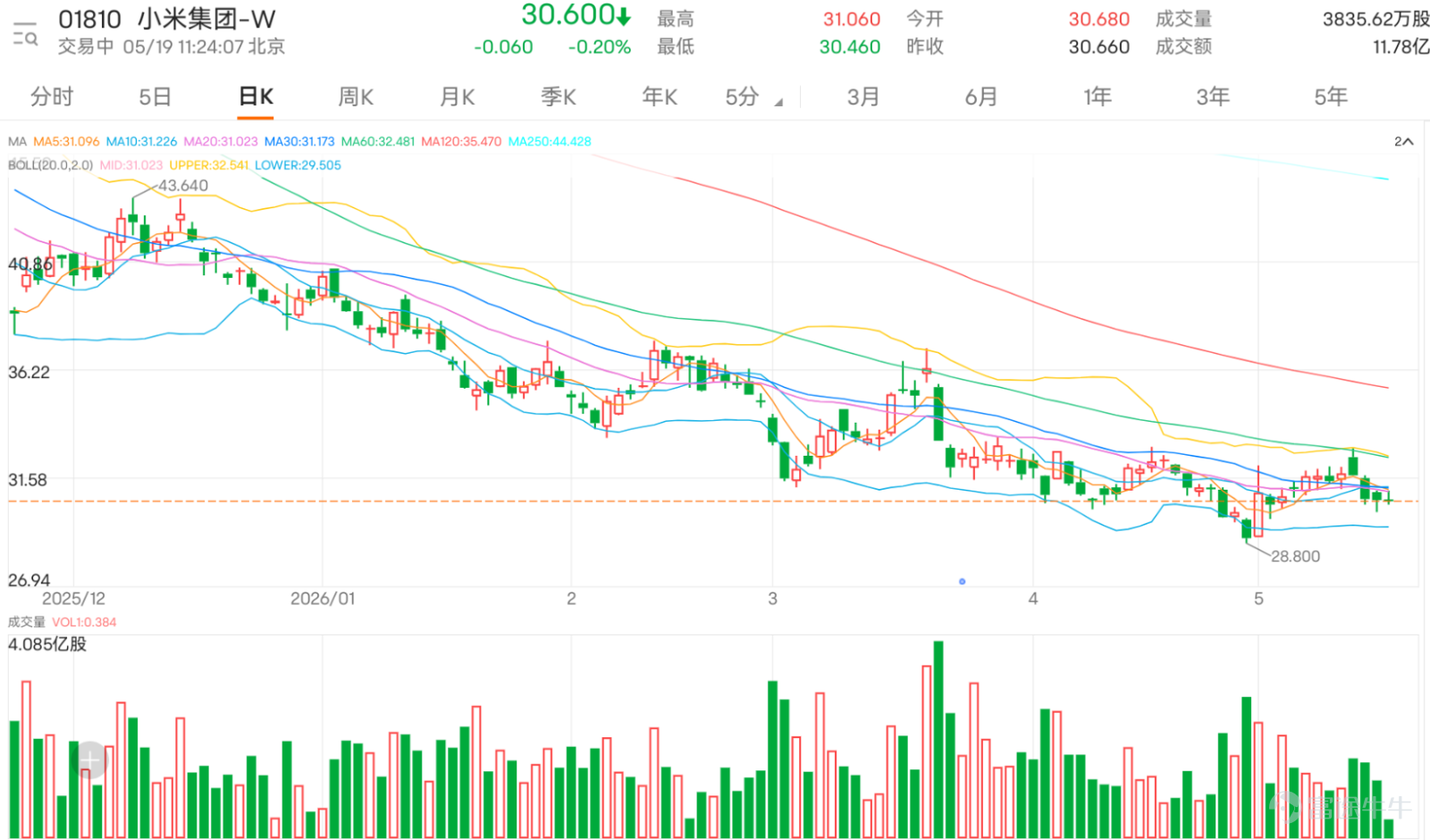
$XIAOMI-W (01810.HK)$ At HK$30.60, the short-term trend remains in a weak sideways consolidation pattern. The stock price is below the 10-day moving average at HK$31.212, the 20-day moving average at HK$31.109, and the 30-day moving average at HK$31.220, indicating that the short-term uptrend has not yet resumed. The Bollinger Band's midline is around HK$31.109, the upper band is near HK$32.714, and the lower band is around HK$29.504. The current price is below the midline but still above the lower band, suggesting that the stock is consolidating within a weaker range. The Relative Strength Index (RSI) is around 38, showing weak momentum but not entering extreme oversold territory, meaning Xiaomi is currently experiencing a lack of rebound strength rather than an abrupt collapse.
Judging from the sentiment in the comments, the biggest market divergence for Xiaomi right now is not whether there's a story, but whether the stock price can truly break out of the bottoming phase near 30 to 31 yuan. The bullish side argues that, given the weakness of the broader market or pressure on auto stocks, Xiaomi's relative decline has been limited, with some even considering Xiaomi the strongest performer today, reflecting that some funds in the market still view Xiaomi as a relatively supported stock. Some investors also mentioned buybacks, the 'magic 3:30 PM' phenomenon, the 'golden needle probing the bottom,' strong buying interest, and significant undervaluation, showing that bulls are still hoping for short-term support to be established around 30 yuan before re-challenging levels above 31 yuan.
However, within the bullish sentiment, there are clear signs of fatigue. Many comments aren’t strongly advocating for chasing gains but instead express hope for turning a profit, breaking even, or returning to 31 yuan, with some even saying they would stop buying Xiaomi shares if they could just break even. Such comments reflect that shareholders’ confidence isn’t solid, with more trapped investors simply waiting for a rebound. While the market still pays attention to Xiaomi’s brand, smartphones, automobiles, and Lei Jun-related concepts, when it comes to the actual stock price, what retail investors care about most is whether it can stabilize above 31 yuan again.
Bearish comments mainly focus on several aspects. First, every time the stock rises near 31 yuan, it retreats again, making investors feel that the rally “doesn’t last long,” lacking sustainability. Second, some suspect that intraday gains are merely due to short-covering or attempts to lure buyers, rather than new money flowing in. Third, the market remains uneasy about short-term news and events, including whether buybacks will actually occur, updates on GF Securities, new car developments, and the 'photo scandal incident,' all of which make it difficult for investors to solely rely on positive news to predict upward movement. Fourth, some remain bearish, believing that the stock may fall back in the afternoon and even suggesting lower targets.
These sentiments reflect that Xiaomi has yet to overcome the most typical issue faced by weak stocks: it’s not that there’s no rebound, but that after each rebound, it fails to stabilize. Currently trading at 30.660 yuan, the stock is very close to the critical level of 31 yuan but remains below the 10-day, 20-day, and 30-day moving averages. This indicates that the 31-yuan level is not only psychological but also an area where multiple short- to medium-term moving averages converge. For Xiaomi to improve its trend, it must break above 31 yuan and stabilize; otherwise, even if it turns positive during the session, it would only represent a technical rebound within a weak trading range.
From a technical analysis perspective, 30.140 yuan is currently the first key support level. The current price remains above this position, indicating that the stock price has not yet broken below the short-term defense line. If 30.140 yuan holds, Xiaomi still has the opportunity to continue consolidating around 30 to 31 yuan, waiting to re-challenge the resistance at 31.060 yuan. However, if 30.140 yuan is breached, the next support will be near 29.527 yuan, close to the lower Bollinger Band at 29.504 yuan. At that point, market focus will shift from 'whether it can reverse' to 'whether 30 yuan holds,' and short-term sentiment will noticeably weaken.
On the upside, the area near 31 yuan is currently the most important watershed. For Xiaomi to improve its short-term trend, it's not enough for the price to just break through 31 yuan temporarily; it needs to stabilize above the 10-day and 20-day moving averages. If the share price can break through 31.060 yuan and stay firmly above 31 yuan, there may be an opportunity to further challenge the resistance at 31.686 yuan. With sufficient trading volume, higher levels could be targeted. Conversely, if every rebound near 31 yuan fails and the price retreats, the weak sideways pattern will persist, and the attractiveness for entering trades will remain low.
Volume analysis also supports this neutral-to-weak assessment. Recent trading volumes have been relatively stable, without any significant breakout. During rebounds, there hasn’t been a sustained increase in volume, reflecting a lack of strong buying interest. Similarly, pullbacks haven’t shown panic selling, indicating that the market isn't dumping aggressively but is instead consolidating at lower levels. This volume structure makes the stock price very sticky—unable to drop significantly but also unable to rise meaningfully. Holders may easily lose patience, and short-term funds are reluctant to take heavy positions.
The观望留言 (observation comments) best reflect retail investors’ core concerns right now. First, whether one should add positions near 30 yuan. Second, why does the price always retreat after reaching near 31 yuan. Third, whether buybacks, mysterious forces, or liquidation pressures are driving the price. Fourth, whether news about new cars or smartphones can reignite the stock price. Fifth, for those stuck at 37 yuan or 60 yuan, whether they should keep waiting. These questions essentially boil down to whether Xiaomi is currently undergoing consolidation at a low level or still stuck in a weak phase. The answers hinge on two key levels: whether 30.140 yuan can hold, and whether 31 yuan can stabilize.
Therefore, Xiaomi’s current risk-reward ratio is moderately low. It’s not entirely without conditions for a rebound since the share price is still holding above 30 yuan, and there’s no sign of panic selling. However, there’s also no clear signal of strengthening as it remains below several moving averages, with rebound volumes failing to show sustained growth. For short-term trading, the most reasonable judgment is that holding above 30.140 yuan suggests continued consolidation at lower levels, while breaking through and stabilizing above 31 yuan would indicate improvement. If 30.140 yuan is breached, caution is needed for a potential retest near 29.527 yuan.
Overall, what Xiaomi needs most at this stage is not just a single day’s recovery to positive territory, but a truly effective stabilization above HK$31. Retail investors can continue to monitor buybacks, new products, smartphones, Lei Jun’s moves, and changes in market capital flows. However, technically speaking in the short term, the key level to watch is HK$31. Until it regains the HK$31 mark, all rallies should be treated as pullbacks within a weak consolidation phase. If the price falls below HK$30.140, short-term support will weaken, and HK$29.527 will become the next focal point. At this stage, chasing highs isn't advisable, nor is being overly pessimistic; the key is to wait for clear direction from support at HK$30 and a breakout above HK$31. Key focus: First, see if support at HK$30.140 holds; if so, a low-level sideways rebound may occur. A decisive move above HK$31 and holding above the 10-day and 20-day moving averages could improve the weak structure. If support at HK$30.140 fails, the price could test near HK$29.527.

Strategy One | Bet on a Low Rebound After Stabilizing Above HK$30.140
$UBXIAMI@EC2712A.C (25395.HK)$ | Strike Price HK$35.90 | Actual Leverage 3.0x | The strike price is not too far from the current price, offering moderate leverage. Suitable for betting on a rebound to near HK$31 after the stock price stabilizes above HK$30.140.
$CIXIAMI@EC2710A.C (28818.HK)$ | Strike Price HK$33.88 | Actual Leverage 3.0x | The strike price is closer to the upper resistance zone, making it suitable for more conservative rebound plays after a period of low consolidation. The key is waiting for the stock price to approach HK$31 first.
$GJXIAMI@EC2710A.C (28881.HK)$ | Strike Price HK$33.30 | Actual Leverage 2.9x | This strike price is relatively close to the current price in the same group, making it suitable for capturing the initial recovery after holding support. However, if the price fails to rise above HK$31, upside potential will remain limited.
Strategy Two | Bet on Short-Term Recovery After Breaking Above HK$31
$UBXIAMI@EC2610C.C (28164.HK)$ | Strike Price HK$39.80 | Actual Leverage 6.7x | Though out-of-the-money, it still meets conditions. Suitable for higher elasticity bets on a recovery once the stock price breaks above HK$31.
$BPXIAMI@EC2611A.C (28619.HK)$ |Strike price 39.10 yuan|Actual leverage 6.0x|Leverage is relatively balanced, suitable for observing whether it can stabilize above the 10-day and 20-day moving averages after breaking through 31 yuan; if the upward trend continues, a more complete rebound phase can be captured.
$HUXIAMI@EC2610A.C (28250.HK)$ |Strike price 38.90 yuan|Actual leverage 7.2x|Higher elasticity, suitable for use when trading volume improves after breaking through 31 yuan; leans toward short-term momentum chasing, not suitable for early deployment while still consolidating near 30 yuan.
Strategy Three|Chasing downside after breaking below 30.140 yuan
$BIXIAMI@EP2609B.P (27565.HK)$ |Strike price 30.64 yuan|Actual leverage 4.4x|Strike price is very close to the current price, suitable for capturing short-term weakness after breaking below 30.140 yuan, with a target of testing around 29.527 yuan.
$CIXIAMI@EP2607A.P (22857.HK)$ |Strike price 29.88 yuan|Actual leverage 6.7x|Strike price is close to the lower support zone, suitable for chasing a more direct bearish leg after breaking below 30.140 yuan; reacts quickly.
$UBXIAMI@EP2608A.P (26121.HK)$ |Strike price 28.16 yuan|Actual leverage 6.5x|Lower strike price, suitable for targeting a deeper retracement after the stock price breaks below 29.527 yuan; better suited for use after confirming a downtrend.
@7349090: If the bearish momentum disappoints, it indicates there is still support near 30 yuan; however, bulls need to break through 31 yuan to gain an advantage.
@Dave Tsang: Insider information cannot be speculated; short-term focus is only on chart levels, with 30.140 yuan and 31 yuan being the most critical.
@231142649: Constantly grinding down sellers reflects disappointment among shareholders. Short term, we still need to wait for a breakout above 31 yuan.
@28530975: A few minutes of strength indicate insufficient sustainability in the rebound; 31 yuan remains the biggest test currently.
@MTC小跳豆The rebound was unimpressive because trading volume did not increase continuously, failing to confirm that funds were flowing back in.
Feel free to share your insights in the comment section. For more market analysis, please continue following ‘Hong Kong Stock Warrants Jenny’ for daily updates!
Reminder: This article does not constitute any investment advice.
This article is for reference only and does not constitute any investment advice. Market data, opinions, and analysis contained herein may change at any time without prior notice. We are not responsible for any loss or damage caused by reliance on the information in this article. Technical analysis only shows whether certain technical conditions are met; asset performance should be comprehensively evaluated using other sources of information, and trading decisions should not be made solely based on this article. Please note that past performance is not indicative of future results.
#Hong Kong Stocks #Real-time Analysis #Warrants Selection #Warrants Strategy #Derivatives Hedging #Hong Kong Stocks Warrants Jenny #Xiaomi #01810 #Blue Chip Stocks #Technical Analysis $Hang Seng Index (800000.HK)$$Hang Seng TECH Index (800700.HK)$
Risk Disclaimer: The above content only represents the author's view. It does not represent any position or investment advice of Futu. Futu makes no representation or warranty.Read more

Comments (2)
to post a comment
6