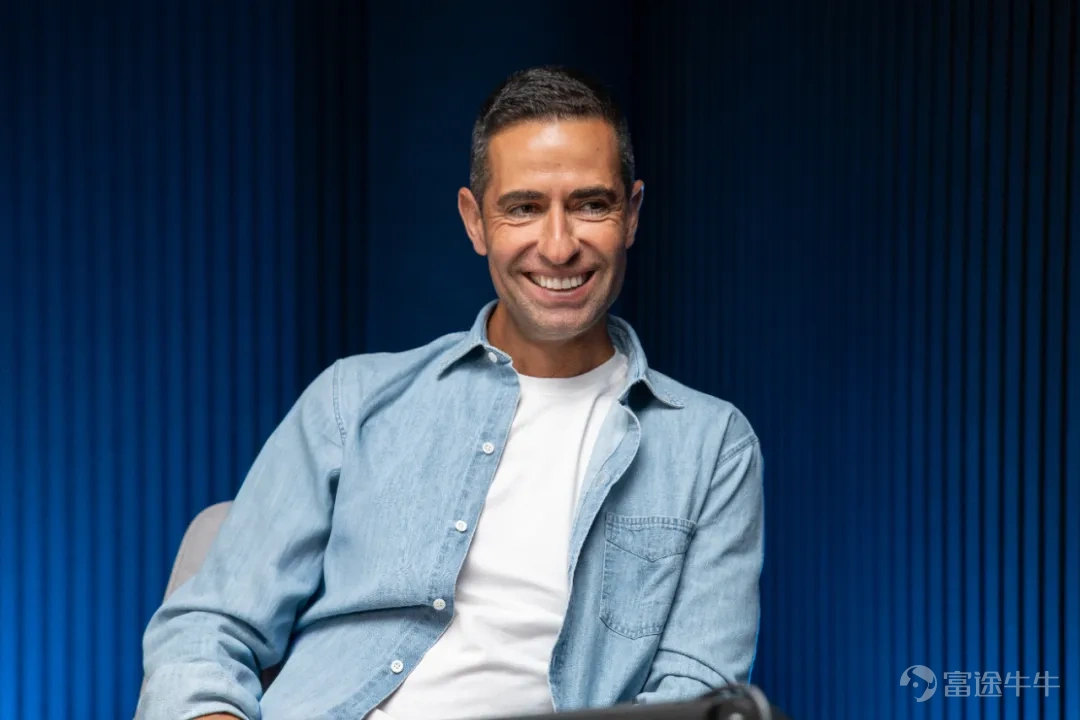

The 'socially awkward' entrepreneur rejected by VCs has built a hundred-billion-dollar 'AI money-printing machine'
Adam Foroughi doesn't like being seen.
During his first interview after graduating from university, he walked in wearing a suit and came out drenched with sweat from nerves.
Fourteen years after founding AppLovin, when the company's market value once exceeded 200 billion US dollars, he still rarely appeared in public. He didn't attend industry summits, didn't manage social media accounts, and didn't engage in routine investor communications. In 2022, when the company's stock price dropped by 92% and its market value evaporated from 40 billion to 3.8 billion US dollars, he simply shut down the investor relations department:
"No one is buying our stock. What's the point of explaining at investor meetings? It’s better to spend time on the business itself and longer-term initiatives."
But in recent weeks, this usually low-key and reserved CEO has unexpectedly appeared on several in-depth podcast interviews, talking about entrepreneurship, technology bets, organizational philosophy, and darkest moments—almost unpacking every key decision made over the past fourteen years.

In Q1 2026, AppLovin continued its impressive performance of 'high growth + high profitability': revenue reached 1.842 billion US dollars, growing 59% year-over-year; net profit increased by 109%; EBITDA margin hit a record high of 84.5%, making it a unique player among US-listed tech stocks.
Since the iteration of its core advertising engine, this marks the 12th consecutive quarter of rapid growth, with no signs of slowing down.
Why did he choose silence when the stock price fell by 92%, but decided to speak up when the company delivered its best-ever results? What did he talk about in these conversations, and what does he want the outside world to understand?


A Business of Certainty
In Foroughi's own words, AppLovin's business can be summarized in one sentence: "We turn advertisers into arbitrageurs."
Advertisers spend money on the platform to buy traffic and can see in real time how many downloads, paying users, and how much revenue each dollar generates. If the ROI is positive, they continue to invest until the budget runs out. There are no vague metrics like brand awareness—advertising effectiveness is obvious.
We don't sell 'belief that ads work'—we sell the fact that 'ads really do work,' and everything is measurable.
In this model, ad placement becomes a self-driven action. When an advertiser discovers that for every dollar spent, they earn more than a dollar in return, they will increase their budget from $100,000 to $500,000, and from $500,000 to $1 million on their own initiative.
According to Foroughi, more than a year ago, the annualized advertising expenditure on the AppLovin platform had already exceeded $11 billion, entirely performance-based, and it has continued to grow significantly since then.
Driving all of this was the April 2023 launch of the Axon 2 ad recommendation model. Its development occurred during what could be described as AppLovin’s darkest hour.
In 2022, AppLovin’s stock price plummeted from $115 per share to $9, with its market value evaporating from $40 billion to less than $4 billion. Recalling that period, Foroughi noted:
People called me, not to ask about the business—but to check if I hadn’t considered taking my own life.
At this critical juncture, where survival was at stake, Foroughi made a decision that was difficult for both insiders and outsiders to comprehend—a drastic move to replace the core technology stack.
He halted all development of the old ad engine, completely overhauled the existing machine learning architecture, and shifted to deep learning. Leading the company’s engineers, he completed an absolute upgrade of the entire system amid an atmosphere where outsiders thought the company was on the verge of collapse.
After Axon 2 went live, the results were immediate.
The advertiser's ROI surged, driving an increase in the scale of investment, and propelling the platform’s revenue into an accelerated growth trajectory—since its launch in April 2023, AppLovin has achieved high-speed revenue growth for 12 consecutive quarters, with profit margins also advancing rapidly.
In parallel with the bold bets on the technology side, there was a 'surgical strike' approach from the capital side, boldly addressing 'historical issues' while the stock price remained low.
At the time of its IPO, AppLovin left behind a structural vulnerability: a large number of private equity shareholders and early investors were eager to exit. This impending selling pressure was one of the factors behind the stock price collapse in 2022.
With the stock price at a low point, Foroughi didn't wait for these sell-offs to further depress the price; instead, he chose to take the initiative by reaching out individually to these shareholders and repurchasing their shares through targeted buybacks. He boldly funneled all the company’s operating cash flow into this effort, even raising a round of debt financing.
After 18 months of 'targeted buyback operations,' AppLovin completed the repurchase of nearly $60 billion worth of shares—this buyback created value equivalent to one-third of the company’s current $150 billion market cap.

An ultra-lean organization creates a money-printing machine in the US stock market.
Looking at AppLovin’s organizational chart might give you an unreal sense of 'did I read that wrong?'
The core executive team consists of just four people: the CEO, CTO, CFO, and General Counsel. There is no Chief Operating Officer, no Chief Marketing Officer, no Chief Human Resources Officer, and not even an independent product department—the decision-making brain of this $100 billion giant could fit into a four-seater car.
Supporting its core advertising business is a team of only about 400 people. Based on the latest quarterly data, the per capita annualized EBITDA contribution exceeds $15 million.
The HR department, which once had seventy to eighty employees at its peak, has been slashed to around fifteen, leaving only those defined by Foroughi as 'Doers.' Above them, there is no management layer. The company doesn’t hold one-on-one meetings, has abolished annual performance reviews, and doesn’t even have formal onboarding training.
"Truly outstanding individuals will find their own path; they don't need a nanny-style mentorship." Foroughi stated bluntly in an interview. So, what should new hires rely on? His answer fits the AI era: "Ask Claude. Have it summarize what the CEO focused on last quarter, who made the best sales calls—this is far more efficient than any lengthy training system."
However, AppLovin's organizational structure wasn't always this 'minimalist' from the start.
Like most companies that have been operating for over a decade, processes expand, hierarchies thicken, and the company gradually becomes bloated. The real turning point came at the end of 2022—when Giovanni Ge (Greg Xiaoquan), who later became the company’s CTO, joined the firm.
When he first arrived, he had a habit of continuously questioning Foroughi: Why does this person exist? Why is this process necessary? The people under this VP are clearly more capable than him—why not promote them instead?
"He is much smarter than me. The 'whys' he asks are things I've grown so accustomed to that I no longer notice them."
The inertia accumulated over more than a decade of operations was pierced one by one by a newcomer 'smart guy.' Over the following year, while AppLovin's business growth nearly doubled, the organization slimmed down by nearly 40%.
Regarding the logic of organizational streamlining, Foroughi’s reasoning is ruthless yet crystal clear:
If a position is destined to be automated by AI, keeping someone in that role is a waste. "Provide sufficient compensation and let them go. I don’t want anyone stuck in a position with no future."
A deeper consideration lies in defending against mediocrity. People stuck in unfulfilling roles drag down the entire system. When management's energy is forced into soothing emotions rather than clearing obstacles for top talent, the organization veers off course. "Top performers won’t stay long in an environment filled with mediocrity. Only when you look around and see everyone else is equally outstanding will you truly enjoy fighting alongside them."
As for how to build a corporate structure in the AI era, Foroughi says his starting point is a hypothesis: If we were to rebuild this company today, knowing what AI can do, what should the team look like? Once thought through, we shouldn’t tinker with the existing structure but should leap directly to that state.
This philosophy of extreme minimalism also extends to product and technology management.
The reason AppLovin lacks an independent product department is simple—every iteration of the Axon engine's model directly impacts advertisers' ROI and platform revenue in real time, allowing engineers to observe KPI changes on their own. What needs optimization and which direction to take are already clearly indicated by the numbers. AppLovin only needs to focus on optimizing the core chain of its business: model accuracy → advertiser ROI → revenue growth. Without conflicting priorities across multiple product lines, there’s no need for another role to arbitrate.
Foroughi stated, 'Either product people become engineers, or engineers become product people; both roles don’t need to exist simultaneously.'
In daily development, the team heavily relies on Claude Code, with 80% to 90% of the code now being AI-generated. However, Foroughi strongly opposes the token consumption metrics favored by many Silicon Valley peers.
'Set up a token usage leaderboard, and people will start generating junk code. Money gets burned, bills for large model companies get paid, but nothing grows in the business.'
He said he only recognizes one standard: whether the money spent on tokens is covered by the income generated from the code.
The logic of spending money works this way, and so does the logic of distributing it.In the tech industry, where stock-based compensation (SBC) is rampant and dilutes shareholder equity excessively, AppLovin caps its annual SBC at around $300 million, strictly allocating it to the top 10%-15% of core contributors while compensating all other employees solely in cash. No inflation, no dilution.
An extremely streamlined structure, AI-native workflows, and restrained equity dilution—all converge in the financial reports, crystallizing into the figure that excites Wall Street: an 84.5% EBITDA margin.
This figure stems not only from the business model itself—the core advertising model can be trained once and deployed infinitely; adding 100 advertisers doesn’t require hiring additional sales or operations staff—but also from how this organizational form maximizes cost compression.
The combination of growing revenue, highly controllable costs, and an extremely streamlined organization has turned this US stock into a 'cash printing machine'.

From gaming to everything
AppLovin's advertising empire started in a modest vertical overlooked by two ad giants, Meta and Google – mobile gaming.
A former Meta ad engineer once explained the brilliance behind this choice: in an industry completely dominated by giants in terms of technology, data, and traffic, AppLovin managed to gain a foothold because it found a niche that was not deeply covered by the giants but had extremely dense data.
Mobile gamers have low loyalty to individual games but are highly engaged with the act of 'playing games' – over a billion people globally open their phones to play games every day, frequently switching between different products, and each switch represents an opportunity for ad exposure. The density of paying behaviors and behavioral signals is high.
For recommendation models like Axon, it’s hard to find a more ideal training environment than this.
After succeeding in the gaming sector, Foroughi wanted to know whether this capability could be applied to larger markets.Now, there’s already a preliminary answer.
This wasn't just a natural extension of gaming business success; the internal technical team earlier saw the potential for Axon’s capabilities to transfer across scenarios.
AppLovin's non-gaming advertising business targeting e-commerce and consumer brands launched just 18 months ago, and its growth has already surpassed that of the gaming segment. In March 2026, advertising revenue from the retail and consumer goods categories increased by about 25% month-on-month from January; in April, the platform set a new monthly record for advertiser spending.
The industry structure is also benefiting from favorable tailwinds. Nowadays, an increasing number of games that previously relied solely on in-app purchases (IAP) for revenue are beginning to integrate ads for monetization, moving toward a hybrid model. Meanwhile, non-gaming advertisers—e-commerce platforms and consumer brands—are flocking to the platform, which has alleviated game developers' concerns about 'advertising competing products within their own games.' With more supply, richer data, and increasingly precise models, the flywheel is spinning faster and faster.
The upcoming change in June may be even more pivotal—AppLovin plans to launch Self-serve, enabling global advertisers to register independently and connect directly to the platform. Over the past fourteen years, new advertisers have primarily been onboarded through word-of-mouth and targeted outreach. Self-serve essentially transforms an invitation-only channel into an open gateway, marking the company’s first move from a closed to an open system since its founding.
Morgan Stanley regards Self-serve as one of the most important growth catalysts, predicting that non-gaming ad revenue will grow from approximately $800 million in 2025 to over $3 billion by 2028.
Foroughi's vision for the ultimate outcome looks even further ahead:
"Our dream is that someone playing a mobile game might discover a nearby laundromat—because the advertising precision reaches that level. If we achieve this, there will be no ceiling."
And the audience base supporting this vision is robust enough. Globally, over a billion people open their phones to play games every day; just in the U.S. market, there are more than 150 million adult gamers. Contrary to popular intuition, the core demographic isn't teenagers or young adults scrolling through short videos but middle-aged individuals with purchasing power and household decision-making authority—people who spend two to three hours daily relaxing with casual games, watching full-screen video ads for an average of over 35 seconds per view, with attention levels comparable to traditional TV ads.
When asked about the path to reaching a trillion-dollar market cap, Foroughi ran some numbers: "We don’t need to become a social network. If we generate $30 to $35 billion in annual cash flow, given the multiples the market assigns, that roughly equals a trillion."
Currently, growth is coming from three directions: deeper user value extraction within games, CTV connected TV (bringing mobile performance advertising capabilities to TV screens so small businesses can run measurable TV ad campaigns), and replicating recommendation systems across e-commerce and other consumer scenarios.
As AI inference costs continue to decline rapidly, platforms like AppLovin, which rely on AI models for real-time ad decisions, benefit significantly. The lower the inference cost, the greater the potential to enhance model accuracy, and thus, the more room for the company to expand its potential.
As a result, investors are now pricing AppLovin using the valuation framework of an AI platform company rather than viewing it as a traditional ad stock. However, the flip side of high expectations is high volatility.Once e-commerce expansion falls short of expectations in a given quarter, or the leading advantage in advertising effectiveness narrows, the valuation correction could be severe – which is why AppLovin repeatedly becomes a target for short-selling institutions.
Precisely because of this, the CEO who dislikes being in the spotlight finally chose to step forward.
Our financial data seems illogical to many. In an illogical world, people may think you're cheating.” The short-sellers’ report attacking the company, in his view, essentially questions the judgment of advertisers spending over $10 billion annually on the platform.
He feels he owes his team and clients an explanation – “The team has built such great technology, and as CEO, it’s my responsibility to help the world understand what this company does.”

There’s never a finish line.
Adam Foroughi was four years old when his family moved from Iran to the United States.
His father once ran one of the most successful real estate development companies in Iran, with thousands of employees under him. But the moment they landed in the U.S., everything reset to zero. Growing up in America, young Foroughi may not have fully comprehended the enormous fall from grace his father experienced, but he could keenly sense that something was permanently “missing” from his father’s life.
This perception eventually internalized into the deepest and most enduring driving force within him.
“He gave up everything to bring us here, and I need to work as hard as possible to prove it wasn’t in vain.” After a pause, he added: “I don’t know what ‘success’ looks like. It’s a moving target, and I’m far from reaching it.”
However, this desire for success hit a wall in Silicon Valley in 2012. That year, offering the modest terms of '1 million dollars for 25% equity,' he knocked on the doors of top Silicon Valley VCs, only to be rejected by all. In the eyes of the VC elite at the time, advertising plus gaming – this was simply not a good business. What hurt even more was that those same investors later poured large sums of money into his competitors.
Foroughi said that one of his goals was to 'take down these companies.'
As he sprinted ahead, the costs kept piling up. Fourteen years of entrepreneurship brought insomnia, hair loss, and eight cups of coffee a day. It wasn't until AppLovin's stock price hit rock bottom in 2022 that this publicly listed company CEO suddenly woke up: to steer this giant ship through cycles, the helmsman’s health couldn’t falter first.
The cost on the family front was more concealed. He described his state with his children as being “physically present, but mentally always elsewhere.” He dreamt of business simulations and upon waking, his first act was to check data, ensuring the company was still running. His wife half-jokingly hinted that he might have some autistic tendencies.
However, time has smoothed some of the edges of his youth. Foroughi joked in an interview that he used to be far more closed off when he was younger.
Later, he set himself a rule: every time he spent time with his children, he would give at least ten minutes of absolute, undivided attention; he started learning to surf — “You must put down your phone and completely disconnect”; he stepped down as chairman of the board, handing it over to Craig Billings, whom he believed was better suited for corporate governance.
However, beneath the delegation of authority and self-reconciliation, Foroughi’s core nature has never changed.
Waking up at the same time every day, following the same morning routine, and reviewing the same set of data. The first thought upon waking is still — are we going bankrupt today? He knows that given the current size of the company, this thought is somewhat absurd, but he still insists on personally monitoring the data, maintaining a sense of crisis akin to walking on thin ice.
Moreover, Foroughi steadfastly refrains from any external investments. “Every available second of my time should be invested in this company. Every second you spend on something else is an unquantifiable loss. This kind of loss accumulates and compounds.”
This extreme focus and hunger permeates downward to become the organizational soul of the company. When hiring, he looks for only one thing: whether the person possesses an unyielding drive to win at all costs.
“A chip on their shoulder — they must have something they feel compelled to prove driving them. If someone has had a smooth life all along, chances are they’re not the kind of person I’d hire into this company.”
His earliest business partner, Raf Vivas, is exactly this kind of person. He started working with Foroughi at the age of 16 and dropped out of high school—a resume that would struggle to get an offer from any major Silicon Valley company. But his raw talent and instincts at the negotiation table leave classically trained elites powerless to counter.
Eighteen years later, Vivas' net worth has exceeded $1 billion—but if you call him at 11 PM on a Sunday night, he'll still pick up immediately.
Even now, he’s still haggling with advertisers over an additional $5,000 in ad spend budget. Some clients joke with him: 'You’re already a billionaire, and you're still arguing over $5,000?'
This is the true essence of the company.
Billionaires are still grinding out budgets deal by deal, and the CEO wakes up every day still wondering if the company might go under. Profit margins, organizational structures, and expansion paths are all changing, but the underlying fuel driving these changes remains that same primal hunger—identical to what it was fourteen years ago when every venture capital firm turned them away.
"I don't ever feel like we've made it. Always got to be pressing," Foroughi said—I never feel like we've succeeded; you have to keep moving forward.
On this racetrack with no finish line, AppLovin's value reassessment may just be beginning. And those writing this new chapter remain the same group of people—unchanged in essence, forever on the journey.
*The above content does not constitute investment advice, does not represent the views of the publishing platform, the market carries risks, invest with caution, and make independent judgments and decisions.
Risk Disclaimer: The above content only represents the author's view. It does not represent any position or investment advice of Futu. Futu makes no representation or warranty.Read more
Comments
to post a comment
1