
New Lotus, one of the largest suppliers of traditional Chinese medicine decoction pieces in China, files for listing on the Hong Kong Stock Exchange reflecting new industry trends
The traditional Chinese medicine decoction pieces industry is reaching a new milestone in the capital market.
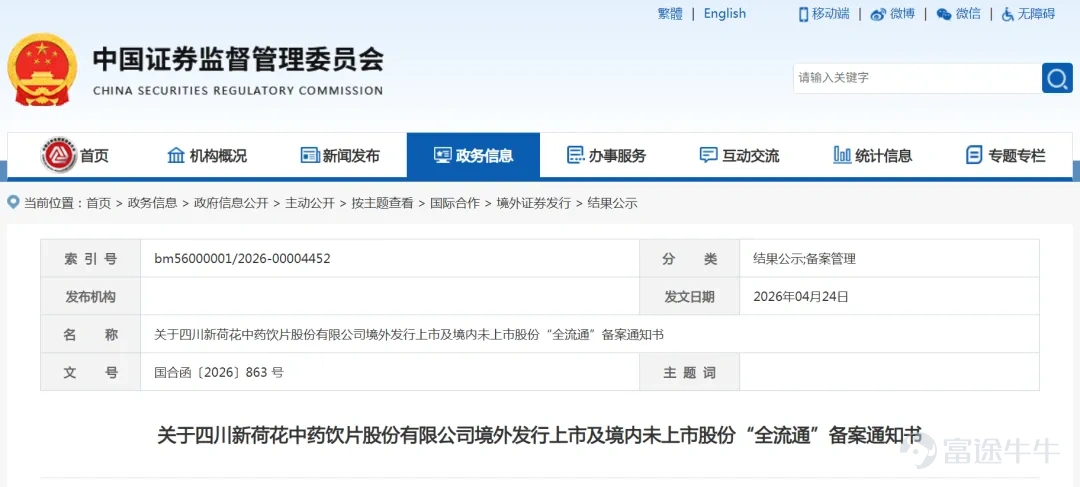
Recently, Sichuan Xinyunhe Traditional Chinese Medicine Pieces Co., Ltd. (hereinafter referred to as 'Xinyunhe')$Sichuan Neautus Traditional Chinese Medicine Co., Ltd. (810721.HK)$ has completed the overseas issuance and listing filing with the China Securities Regulatory Commission and submitted an application for listing on the Main Board of the Hong Kong Stock Exchange. Market insiders believe that in the current context where the traditional Chinese medicine pieces industry still lacks a truly leading listed enterprise, the progress of Xinyunhe might indicate a further acceleration in the industry's capitalization and concentration process.


Public information shows that Xinyunhe mainly engages in the research, production, and sales of traditional Chinese medicine pieces. It is one of the largest suppliers of traditional Chinese medicine pieces in the country and was also among the first enterprises to establish a modernized production system for traditional Chinese medicine pieces according to GMP standards. According to brand rankings published by the China Association of Traditional Chinese Medicine, Xinyunhe has ranked first in the 'China Traditional Chinese Medicine Pieces Brand Enterprises' list for several consecutive years; based on sales volume statistics, the company ranks second nationally, first among private enterprises, and first in the toxic medicine pieces sector.
Xinyunhe has formulated and implemented a relatively stringent standardization system for the production and quality control of traditional Chinese medicine pieces, integrating digital technology into the production and quality control processes. The company’s clients span multiple end-user scenarios, including hospitals and medical institutions, medical trading companies, pharmacies, pharmaceutical companies, and individual consumers.

From the perspective of operating data, Xinyunhe has maintained steady growth in recent years.
According to the prospectus disclosure, from 2023 to 2025, Xinyunhe’s revenue will be approximately RMB 1.146 billion, RMB 1.249 billion, and RMB 1.335 billion, respectively; during the same period, annual profits will be approximately RMB 104 million, RMB 89 million, and RMB 106 million, respectively. Excluding the impact of one-time factors such as listing expenses, the company's adjusted profit for 2025 is about RMB 127 million.
Industry insiders believe that future competition in the traditional Chinese medicine pieces industry will not only be at the single-product level but will also include comprehensive capabilities such as standard systems, quality systems, and supply chain systems.
The traditional Chinese medicine pieces industry naturally features complex raw materials, numerous varieties and specifications, and high difficulty in controlling quality standards. Companies capable of simultaneously meeting requirements for type, category, output, and quality stability are relatively limited. As industry regulation continues to improve and terminal markets increasingly demand product stability, companies' standardization capabilities, quality control capabilities, and stable supply capabilities are gradually becoming one of the core barriers in the industry.
To address long-standing pain points in the regular medicine pieces market, such as insufficient supply stability and uneven quality, Xinyunhe has continuously expanded its business scale and enhanced production capacity, further strengthening its ability to meet market demands for high-quality regular medicine pieces. Market insiders believe that against the backdrop of ongoing industry standardization, companies with scaled and standardized capabilities are expected to further increase their market share.
Public information shows that Xinyunhe has been continuously increasing its investment in standardization and quality control systems in recent years, including being the first to incorporate molecular biology into the quality identification system for traditional Chinese medicine. Its DNA barcoding system for identifying medicinal herbs has been adopted by both the Chinese and British Pharmacopoeias. Through cooperation with institutions like the China Academy of Chinese Medical Sciences, it has continuously improved its capabilities and advanced the process of modernizing traditional Chinese medicine in production and quality control.
In addition, Xin Hehua is also one of the key suppliers in the toxic decoction pieces field. Toxic decoction pieces have a long-standing tradition in the Chinese medicine sector and are one of the most representative types of traditional Chinese medicine, widely used in Chinese medicine prescriptions. The company's main toxic decoction products include Prepared Pinellia, Cleaned Pinellia, Ginger-processed Pinellia, White Aconite Slice, and Black Shun Slice. Due to the strict processing standards, quality control, and high production qualification requirements for toxic decoction pieces, the related products better reflect a company’s comprehensive capabilities in processing techniques, quality systems, and production management.

The market continues to expand, with a gradual trend toward consolidation becoming evident.
It is worth noting that the traditional Chinese medicine decoction pieces industry itself is currently in a phase of structural change.
As one of the most core components of the traditional Chinese medicine industrial chain, Chinese medicine decoction pieces have been extensively used in hospital clinical settings, traditional Chinese medical treatments, primary healthcare institutions, and residents' daily health consumption scenarios. In recent years, driven by continuous support from the medical insurance system for traditional Chinese medicine, increasing demand for TCM treatments, strengthening trends in population aging, and the upgrading of health consumption, the overall Chinese medicine decoction pieces industry has maintained rapid growth.
According to Frost & Sullivan data, the scale of China's Chinese medicine decoction pieces market reached a substantial 306.7 billion yuan in 2024, making it the fastest-growing pharmaceutical sub-sector in 2024, with a compound annual growth rate of approximately 11.2% from 2020 to 2024. It is expected that by 2030, the industry scale will further grow to about 409 billion yuan. At the same time, due to global recognition of the preventive and health-preserving value of traditional Chinese medicine, overseas market demand for Chinese medicine exports has surged.

The market generally believes that, driven by continuous support for traditional Chinese medicine from the medical insurance system, strengthening trends in population aging, and the upgrading of health consumption, Chinese medicine decoction pieces are still considered a sub-sector with a long-term demand foundation.
At the same time, the current level of industry concentration remains relatively low, with the top five enterprises collectively holding about 2.6% of the market share, and the industry as a whole is still in the process of evolving from fragmentation toward scale and standardization.
Some industry experts believe that, against the backdrop of a market size exceeding 300 billion yuan, the current level of industry concentration is still relatively low, indicating that there is room for future consolidation and integration in the Chinese medicine decoction pieces industry. Enterprises with the ability to operate on a large scale, robust quality control systems, and nationwide supply capabilities may more easily gain opportunities to increase their market share.

Under the trends of nationalization and standardization, the logic of industry competition is changing.
Meanwhile, the logic of industry competition is also undergoing changes.
In the past, the variety and specifications of traditional Chinese medicine (TCM) decoction pieces were extensive, with the industry mainly characterized by regionalized operations and price competition. However, as regulatory oversight has tightened and terminals such as hospitals, medical institutions, and chain pharmacies have raised requirements for quality stability and supply capability, competition in the industry is gradually shifting towards supply chain capabilities, standardized production abilities, and brand system strengths.
Industry experts believe that, against the backdrop of the ongoing strengthening trend toward industry standardization, the core competitiveness of the TCM decoction piece industry is gradually transitioning from regional supply capabilities to nationwide supply chains, quality control systems, and standardized production capabilities. Publicly available information shows that Xin Hehua has already established a nationwide sales network, with clients covering multiple terminal scenarios such as hospitals, medical institutions, and chain pharmacies, demonstrating strong nationwide channel coverage capabilities.
From an application perspective, TCM decoction pieces possess a wide range of applications and a solid demand foundation. They are not only an essential part of clinical treatment in traditional Chinese medicine but are also widely used in various consumer scenarios, including chronic disease management, health preservation, and medicinal-food homology. With the aging population, the upgrading of health consumption, and the growing recognition of traditional Chinese medicine, the future market potential for the TCM decoction piece industry remains widely optimistic.

Under the space for industry consolidation, scarcity is gradually becoming apparent.
Currently, listed TCM decoction piece enterprises in the capital markets with nationwide layouts and scaled operational capabilities remain relatively scarce.
Against the backdrop of the ongoing push toward industry standardization and centralization, the related scarcity is increasingly attracting market attention.
Given the still relatively low level of industry concentration and the limited number of representative listed companies, there will be room for future integration and centralization in the TCM decoction piece industry. As industry standardization continues to advance and the importance of nationwide supply capabilities keeps increasing, industry resources may further concentrate toward enterprises with scaled operational capabilities, standardized systems, and supply chain strengths.
*The above content does not constitute investment advice, does not represent the views of the publishing platform, the market carries risks, invest with caution, and make independent judgments and decisions.
Risk Disclaimer: The above content only represents the author's view. It does not represent any position or investment advice of Futu. Futu makes no representation or warranty.Read more
Comments
to post a comment