
The S&P 500 has risen for seven consecutive weeks—should you chase the rally or take profits?
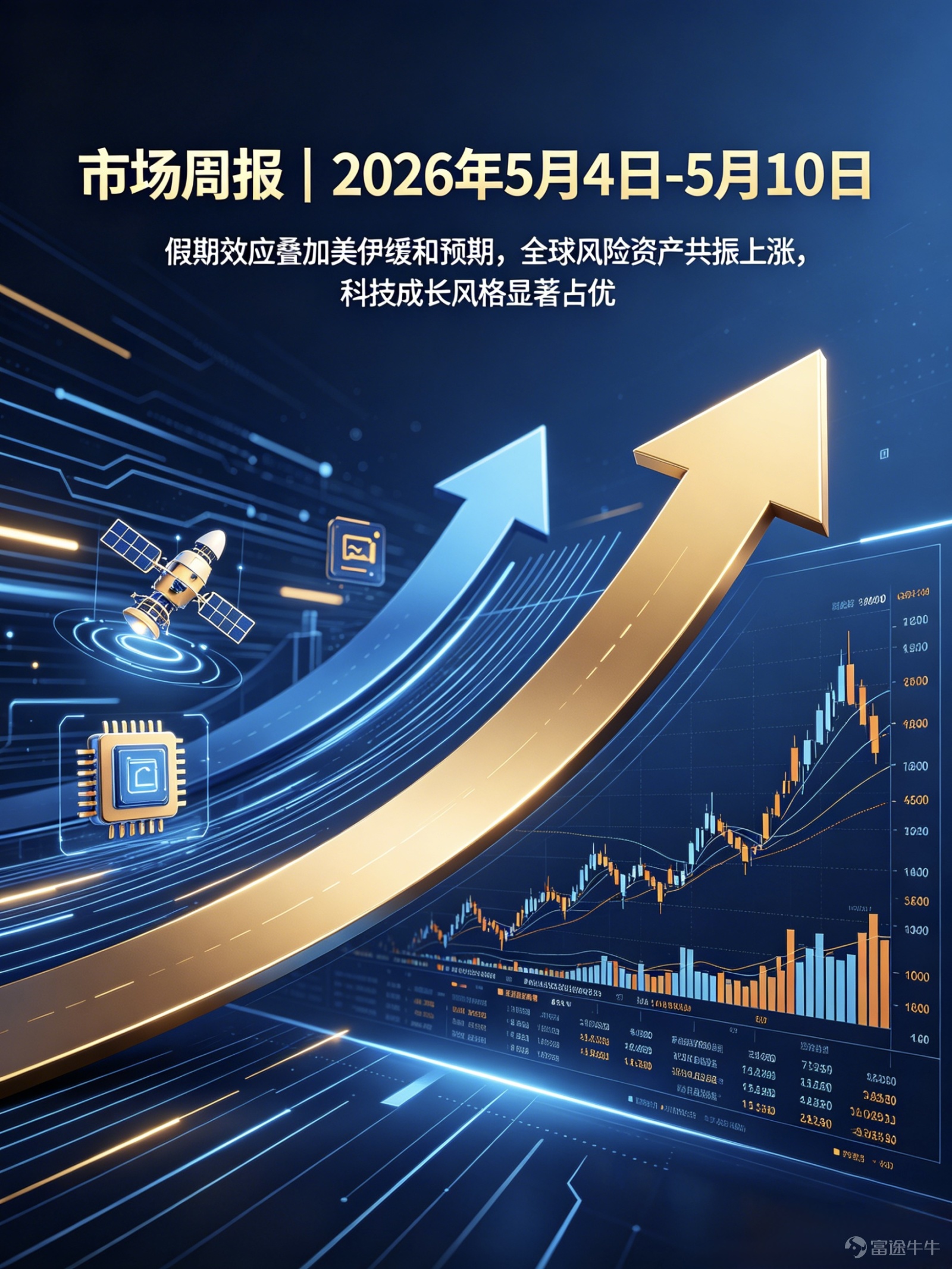
Market Weekly Report | May 4, 2026 - May 10, 2026
The holiday effect combined with expectations of easing US-Iran tensions fueled a global rally in risk assets, with technology and growth stocks significantly outperforming.

I. Global Macroeconomic Overview
This week, global markets were influenced bythe misalignment of Labor Day holidays, leading to a divergence in trading rhythms — mainland China was closed from May 1 to May 5, with only three trading days (May 6-8), Hong Kong resumed trading on May 4 after being closed on May 1 (four trading days), while the US market traded normally throughout the week. Despite the shortened trading days, market activity increased rather than decreased, continuing the recovery in global risk appetite.
At the macro level, there are two main storylines: first,a marginal easing of US-Iran tensions. On May 6, Trump stated that hostilities were "very likely to end," with both sides nearing an agreement. The market has become increasingly desensitized to geopolitical risks,with Brent crude plunging 11.8% in a single week, as risk premiums rapidly unwound; second,The US April nonfarm payroll data was weaker than expected, with 115,000 new jobs added (previous figure 178,000), the unemployment rate remaining at 4.3%, and sluggish wage growth. Market expectations for a 25-basis-point interest rate cut within the year have slightly rebounded, but maintaining the current rate remains the dominant pricing (with a probability of about 80%).
Domestically, the April PPI rose sharply to +2.8% year-on-year, with a month-on-month increase of +1.7%, hitting the highest level since 2023, mainly driven by imported factors such as rising oil prices. After the holiday, A-shares surged in volume, with average daily trading volume exceeding3.16 trillion yuan, an increase of over 530 billion yuan compared to pre-holiday levels. The central bank conducted a 300-billion-yuan, three-month outright reverse repo operation, fostering a favorable liquidity environment.
II. Global Asset Performance
Key feature this week: Global equities rallied in tandem, with tech growth stocks significantly outperforming; crude oil plummeted, precious metals rebounded, and the US dollar weakened.
Equity marketsMost major global indices rose, showing a distinct style of 'growth outperforming value, small caps outpacing large caps.' The Asia-Pacific market showed the greatest elasticity:KOSPI +13.6%led global gains,Nikkei 225 +5.4%,Hang Seng Tech Index +4.8%,Hang Seng Index +2.4%. In the A-share market,Beijing Stock 50 Index +8.0%showing the strongest performance,STAR 50 Index +4.4%、ChiNext Index +3.2%, while the CSI Dividend Index -1.7%, showing a significant divergence between growth and value styles. The US stock market also strengthened,Nasdaq +4.5%,S&P 500 +2.3%。
In terms of commodities, internal divergence continues to intensify.Brent crude oil fell 11.8% for the week, with optimistic expectations for US-Iran talks being the core driver; precious metals and non-ferrous metals rebounded,COMEX silver +7.1%,spot gold +2.2%to 4,714 dollars per ounce.
In terms of bonds, China's 10-year government bond yield slightly increased to1.77%nearby, while US Treasury yields declined, continuing the pattern of the China-US interest rate differential.
In terms of exchange rates, the US Dollar Index weakened,with the USD/CNH pair retreating to around 6.80,and the Chinese yuan remaining strong.
Third, a weekly recap of the Hong Kong market
This week, Hong Kong stocks continued their rebound, primarily driven byeased tensions between the US and Iran boosting risk appetite,andcatalysts in the AI/technology sector,. In terms of style, small and mid-cap growth significantly outperformed large-cap value.
Index Performance
The Hang Seng Index rose 2.39% for the week, closing at 26,393.7 points.;Hang Seng Tech Index +4.75%, closing at 5,102.8 points; style performance showedMid-cap (+3.9%) > Small-cap (+3.4%) > Large-cap (+2.6%). In terms of valuation, the PE ratio of Hang Seng Index is approximately 11.6 times, with the A-H share premium index retreating to 119.06.
Industry sector gains and losses

Capital conditions
– The Hong Kong Stock Exchange's average daily turnover was approximately HKD 299.2 billion, indicating relatively high market activity
– Southbound funds recorded a slight net outflow of HKD 193 million for the week, with a net inflow of HKD 6.67 billion through the Shanghai channel and a net outflow of HKD 6.86 billion via the Shenzhen channel, continuing the divergence between Shanghai and Shenzhen. Year-to-date, southbound funds have cumulatively recorded a net inflow of approximately HKD 246 billion
– On May 8th, southbound funds saw a large net inflow of HKD 13.17 billion in a single day, indicating some short-term recovery in risk appetite.
IV. Outlook for the future market
The market will enter a new phase next week"Trump's visit to China + intensive release of macro data + earnings disclosure"window of multiple catalysts.
Key calendar

Core Assessment
In the short term, the market is still in a favorable period for risk appetite recovery, but attention should be paid to the risk of increased volatility.The marginal easing of US-Iran tensions and Trump's visit to China provide positive catalysts. Technology growth remains the main market theme amid AI industry prosperity validation. However, beware: (1) Although oil prices have retreated, they remain at high absolute levels, with imported inflationary pressures yet to dissipate; (2) If US CPI data exceeds expectations, it may suppress rate cut expectations again; (3) The weakening of southbound capital flows means Hong Kong stocks need additional funds for upward momentum.
In terms of allocation strategy, we suggest focusing on two main lines:
1. AI/technology remains the core main lineThe overseas computing power chain continues to validate its robust performance (Micron and Hynix earnings exceeded expectations). Domestic computing power has been boosted by DeepSeek V4 inference demand, combined with adjustments to the Hang Seng Tech Index components (Zhipu and Minimax are expected to be included), providing dual support from industrial catalysts and capital inflows to the technology sector.
2. Pay attention to trading opportunities brought by potential shifts in US-China relations expectations due to Trump’s visit to ChinaIf the visit sends out positive signals, it is expected to boost foreign investors' risk appetite for Chinese assets, and there is still room for valuation recovery in Hong Kong stocks.
Risk Warning
⚠️ Repeated US-Iran negotiations have led to another surge in oil prices. | US April CPI exceeded expectations. | Trump's visit to China fell short of expectations. | Southbound capital continues to flow out.
Disclaimer: This report is for internal communication purposes only and does not constitute investment advice.
Data source: Alpha Insights database, retrieved on May 13, 2026.

$CMS Hang Seng Tech Index ETF (03423.HK)$ $BABA-W (09988.HK)$ $TENCENT (00700.HK)$ $XIAOMI-W (01810.HK)$ $NTES-S (09999.HK)$ $MEITUAN-W (03690.HK)$ $KUAISHOU-W (01024.HK)$ $SMIC (00981.HK)$ $BYD COMPANY (01211.HK)$ $JD-SW (09618.HK)$ $LI AUTO-W (02015.HK)$ $TRIP.COM-S (09961.HK)$ $XPENG-W (09868.HK)$ $BIDU-SW (09888.HK)$ $LENOVO GROUP (00992.HK)$ $HAIER SMARTHOME (06690.HK)$ $JD HEALTH (06618.HK)$ $KINGDEE INT'L (00268.HK)$ $SUNNY OPTICAL (02382.HK)$ $BILIBILI-W (09626.HK)$ $MIDEA GROUP (00300.HK)$ $SENSETIME-W (00020.HK)$ $KINGSOFT (03888.HK)$ $ALI HEALTH (00241.HK)$ $HUA HONG GRACE (01347.HK)$ $TONGCHENGTRAVEL (00780.HK)$ $BYD ELECTRONIC (00285.HK)$ $ASMPT (00522.HK)$ $NIO-SW (09866.HK)$ $HORIZONROBOT-W (09660.HK)$ $TME-SW (01698.HK)$
Risk Disclaimer: The above content only represents the author's view. It does not represent any position or investment advice of Futu. Futu makes no representation or warranty.Read more

Comments
to post a comment
1